Author: Denis Avetisyan
A new approach integrates domain knowledge into deep learning models to enhance interpretability, accuracy, and robustness in scientific applications.
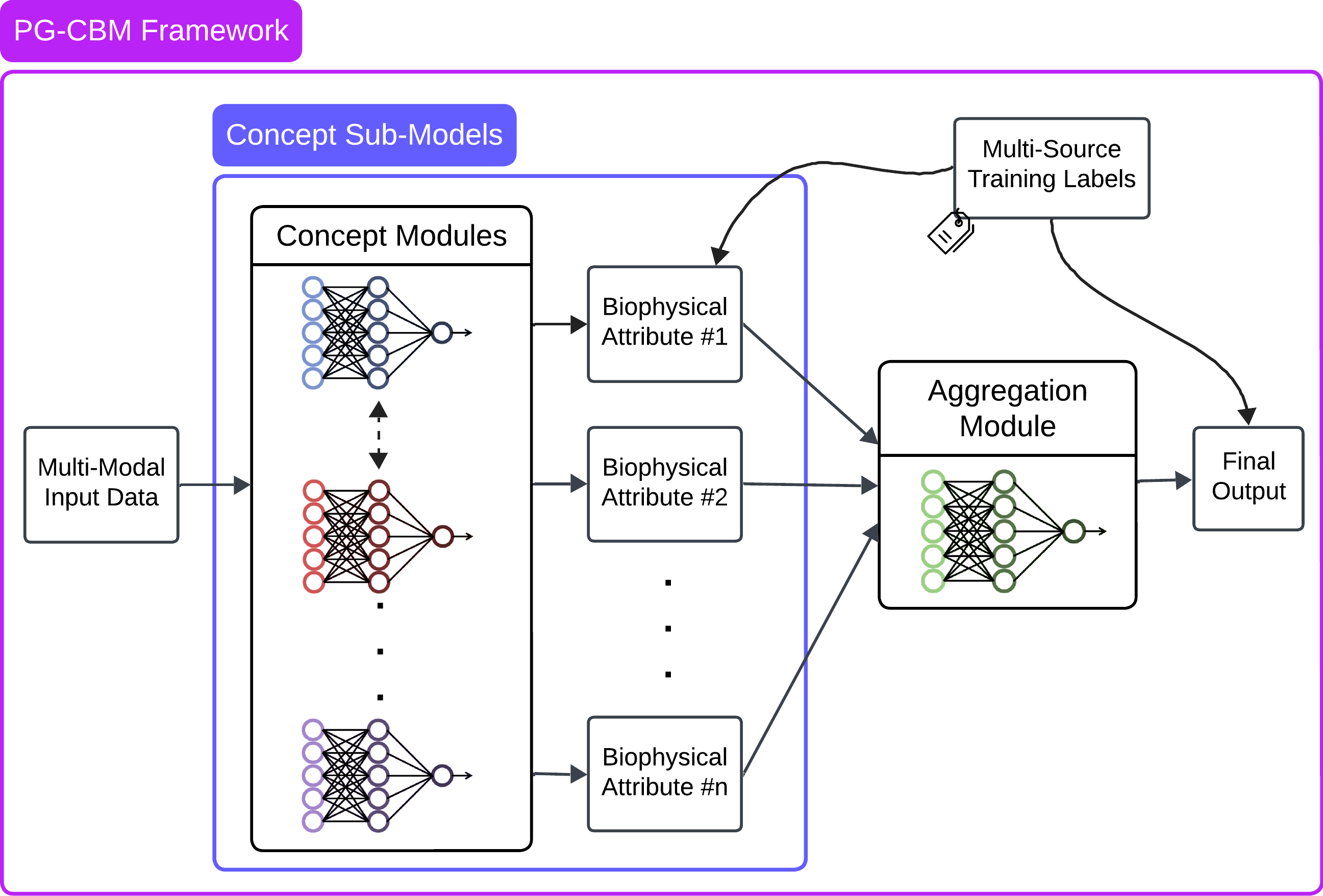
Process-Guided Concept Bottleneck Models improve Above Ground Biomass Density estimation from remote sensing data by explicitly modeling underlying physical processes.
While Deep Learning excels at complex tasks, its “black box” nature hinders trust and scientific insight. To address this, we introduce the Process-Guided Concept Bottleneck Model (PG-CBM), an extension of Concept Bottleneck Models that integrates domain-specific causal mechanisms to improve interpretability and performance. Demonstrating PG-CBM’s efficacy using Earth Observation data for above ground biomass density estimation, we show significant reductions in error and bias alongside the generation of meaningful intermediate outputs. Could this approach unlock more trustworthy and scientifically valuable AI systems across diverse fields requiring both accuracy and transparency?
Mapping the Forest: Why We Bother, and the Pitfalls of Precision
Understanding the planet’s above ground biomass density – the amount of living plant material above the ground – is fundamental to tracking carbon cycling and assessing the overall health of ecosystems. This metric directly informs models predicting atmospheric carbon dioxide levels, as forests and vegetation act as vital carbon sinks, absorbing CO_2 during photosynthesis. Accurate AGBD estimates are also critical for monitoring deforestation rates, evaluating biodiversity, and predicting the impact of climate change on terrestrial environments. Variations in AGBD reflect not only forest density but also species composition, forest age, and disturbance history, providing a comprehensive indicator of ecosystem function and resilience. Consequently, reliable AGBD data are indispensable for informed environmental management and effective climate mitigation strategies.
Historically, determining the amount of plant life – above ground biomass – relied heavily on physically visiting ecosystems and manually measuring trees and vegetation. These field-based approaches, while providing detailed local data, are inherently limited by their cost and the sheer time investment required for comprehensive surveys. Consequently, obtaining a complete picture of biomass across vast landscapes, or even globally, proves exceptionally difficult. The logistical challenges of accessing remote areas, coupled with the need for consistent and repeated measurements over time, make traditional methods impractical for large-scale monitoring of carbon stocks and overall ecological health. This limitation hinders efforts to accurately model carbon cycles, assess biodiversity, and understand the impact of environmental changes on terrestrial ecosystems.
Estimating above ground biomass density from Earth Observation (EO) data, particularly using Synthetic Aperture Radar (SAR), presents a significant hurdle due to the intricate nature of ecological systems. SAR signals, while capable of penetrating cloud cover and providing data regardless of sunlight, respond to the physical structure of vegetation – not biomass itself. Translating these signals into accurate biomass estimates requires accounting for factors like forest canopy height, leaf area, stem density, and the influence of topography, all of which vary considerably across different ecosystems. Simply correlating SAR backscatter with biomass often proves insufficient; complex relationships exist where similar signal returns can indicate vastly different forest compositions or even saturated responses in high-biomass areas. Therefore, robust algorithms and extensive ground-truth data are essential to calibrate and validate models, effectively bridging the gap between remotely sensed data and the underlying ecological realities that govern biomass distribution.
From Black Boxes to Blueprints: Why Interpretability Matters
Deep Learning (DL) techniques excel at identifying patterns and correlations within high-dimensional ecological datasets, offering predictive capabilities for phenomena ranging from species distribution modeling to forecasting population dynamics. However, these models frequently operate as ‘black boxes’; while accurate predictions can be generated, the internal logic driving those predictions remains opaque. This lack of transparency hinders scientific understanding because it prevents researchers from validating whether the model is relying on ecologically meaningful relationships or spurious correlations within the data. Consequently, while DL can predict ecological outcomes, it often fails to provide insights into why those outcomes occur, limiting its utility for informing conservation strategies or testing ecological theory.
Concept Bottleneck Models (CBMs) enhance the interpretability of deep learning models by introducing an intermediate layer requiring the network to explicitly predict human-defined concepts before making a final prediction. This process compels the model to represent its reasoning in terms of these understandable concepts, rather than operating as a purely opaque function. Specifically, a CBM is structured such that input data is first mapped to a set of predefined concepts, and then these concepts are used to generate the final output. By examining the model’s predictions for these intermediate concepts, researchers can gain insight into the features and relationships driving the model’s decisions, facilitating verification and trust in the model’s outputs.
Standard Concept Bottleneck Models (CBMs) utilize pre-defined concepts as an intermediate layer between input features and final predictions; however, ecological processes are frequently characterized by intricate interactions and context-dependent relationships that are inadequately captured by broad, generalized concepts. This limitation stems from the difficulty in anticipating all relevant factors and defining concepts that accurately reflect the underlying mechanisms driving ecological phenomena. Consequently, models may exhibit reduced performance or provide interpretations that lack the granularity necessary for effective ecological understanding and management, necessitating the development of CBM architectures that allow for more specific, data-driven concept definition and refinement.

Building Models with a Forest Mind: Process-Guided Concepts for AGBD
Process-Guided Concept Bottleneck Models (PG-CBMs) integrate established ecological principles directly into the model’s structure by defining intermediate predictive attributes – specifically Canopy Height, Canopy Cover, and Stem Number Density – as conceptual bottlenecks. This architectural approach necessitates the model learn relationships not only between Earth Observation (EO) data and Aboveground Biomass Density (AGBD), but also between the EO data and these defined ecological variables. By forcing the model to explicitly represent these known ecological attributes, PG-CBMs aim to improve both the accuracy and interpretability of AGBD estimations, effectively translating remotely sensed data into ecologically meaningful parameters before predicting final biomass values.
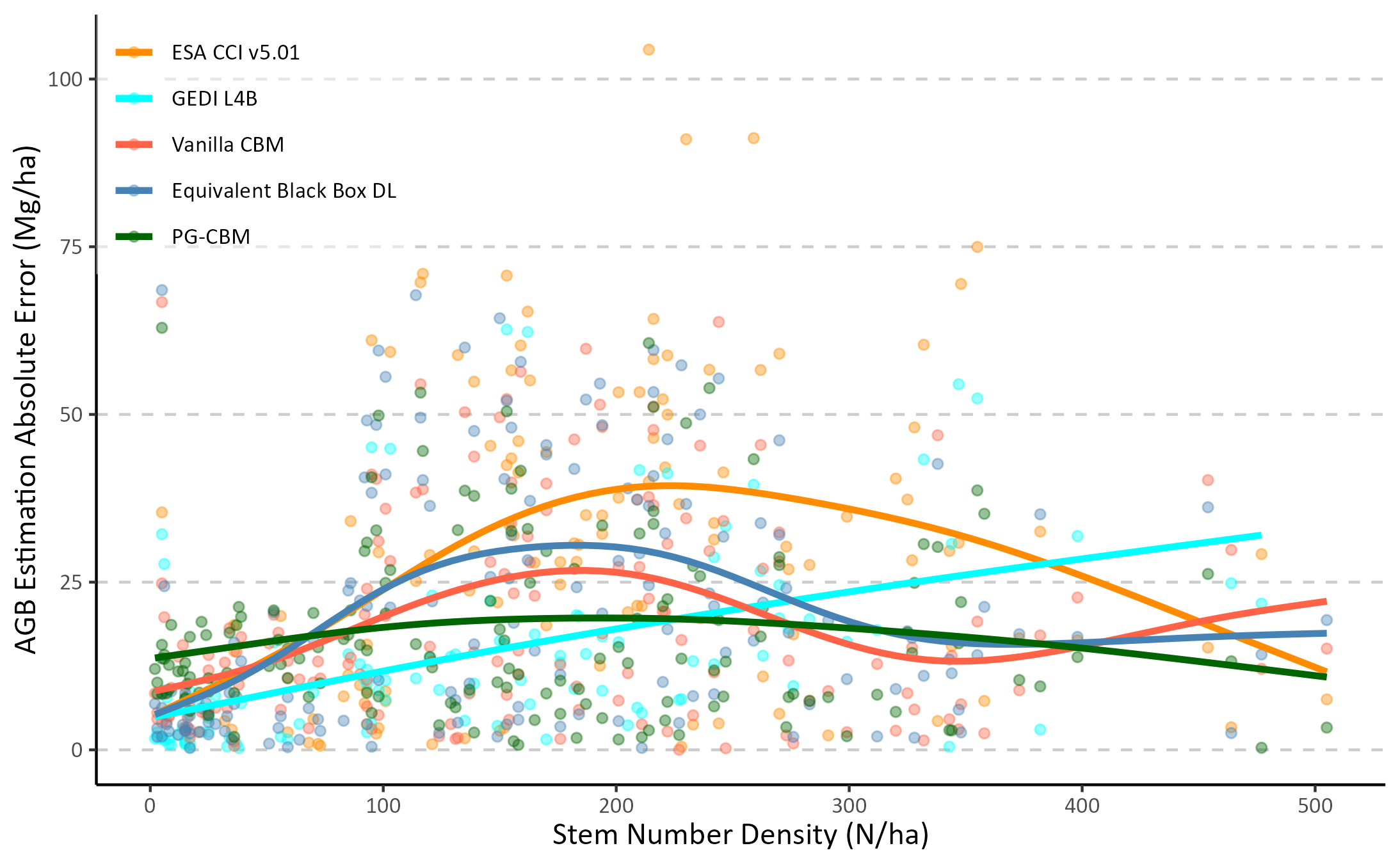
Explicitly modeling ecological variables – specifically Canopy Height, Canopy Cover, and Stem Number Density – within the Process-Guided Concept Bottleneck Model (PG-CBM) facilitates a more direct and constrained learning process between Earth Observation (EO) data and Aboveground Biomass Density (AGBD). This approach contrasts with traditional “black box” models by providing intermediate targets that reflect known ecological relationships. By forcing the model to predict these interpretable concepts before estimating AGBD, the PG-CBM reduces ambiguity and improves robustness to variations in EO data and across diverse forest structures. The resulting relationships are therefore more readily interpretable and less susceptible to overfitting, leading to improved generalization performance and a more reliable AGBD estimation.
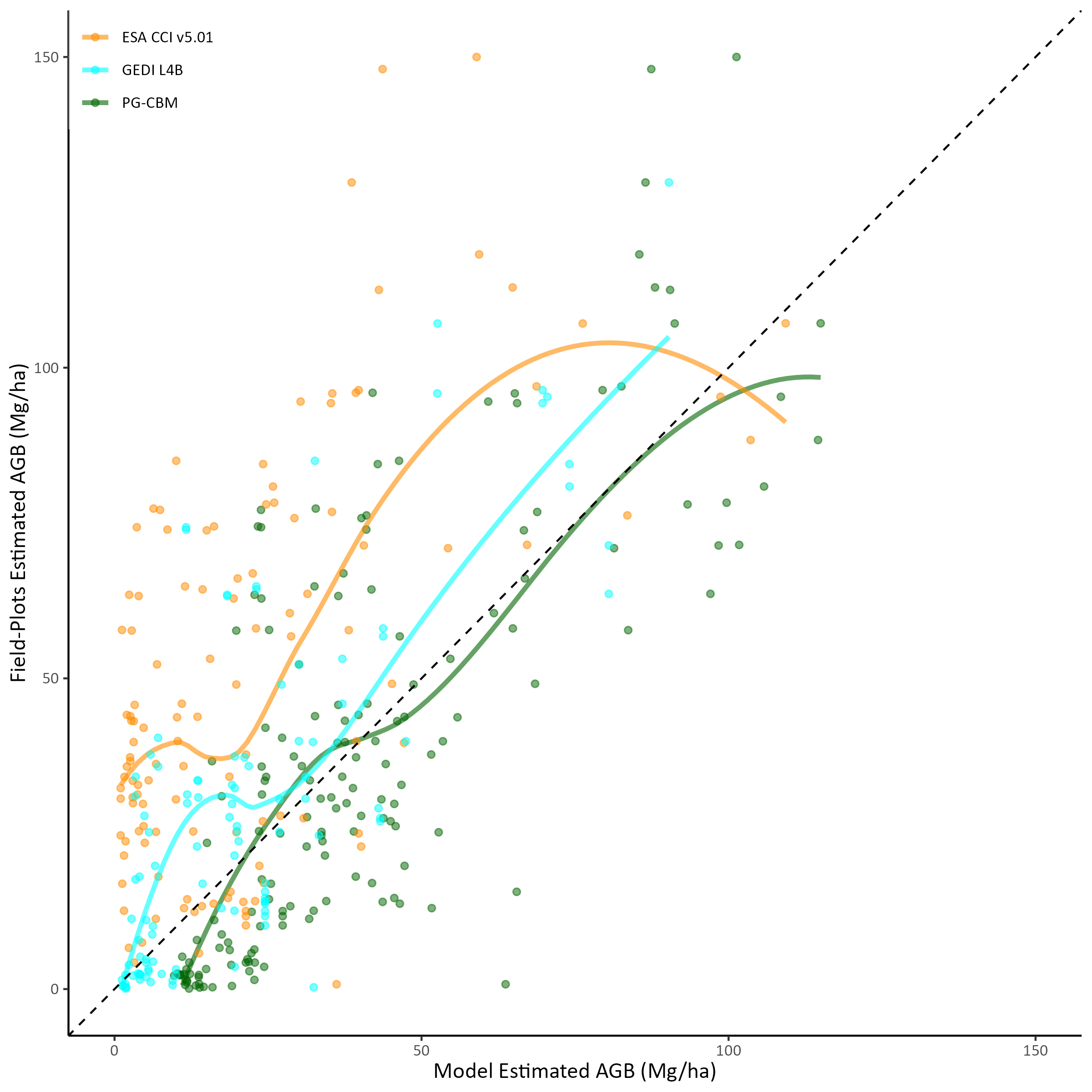
The Process-Guided Concept Bottleneck Model (PG-CBM) was trained and validated using data acquired from the Global Ecosystem Dynamics Investigation (GEDI) instrument. This dataset provided the necessary observations for assessing the model’s performance in estimating Aboveground Biomass Density (AGBD) across a range of ecological conditions. Evaluation of the PG-CBM against GEDI data resulted in a Root Mean Squared Deviation (RMSD) of 21.8 Mg/ha, indicating the model’s accuracy in predicting AGBD. This performance demonstrates the model’s capability to generalize across diverse ecosystems when utilizing GEDI-derived data for both training and validation.
The loss function within the Process-Guided Concept Bottleneck Model (PG-CBM) is critical for establishing accurate correlations between modeled ecological concepts – such as canopy height and stem density – and the ultimate Aboveground Biomass Density (AGBD) prediction. Specifically, the PG-CBM’s loss function minimizes discrepancies between predicted and observed AGBD values, resulting in a demonstrated Mean Bias of 1.5 Mg/ha. This reduced bias, relative to other AGBD estimation models, indicates improved accuracy in predicting AGBD and suggests a more robust representation of the underlying ecological processes driving biomass distribution. The minimization process ensures that the intermediate concept predictions are not only accurate in themselves but also contribute effectively to a precise final AGBD estimate.
Beyond the Training Data: The Promise of Generalizable Ecological Models
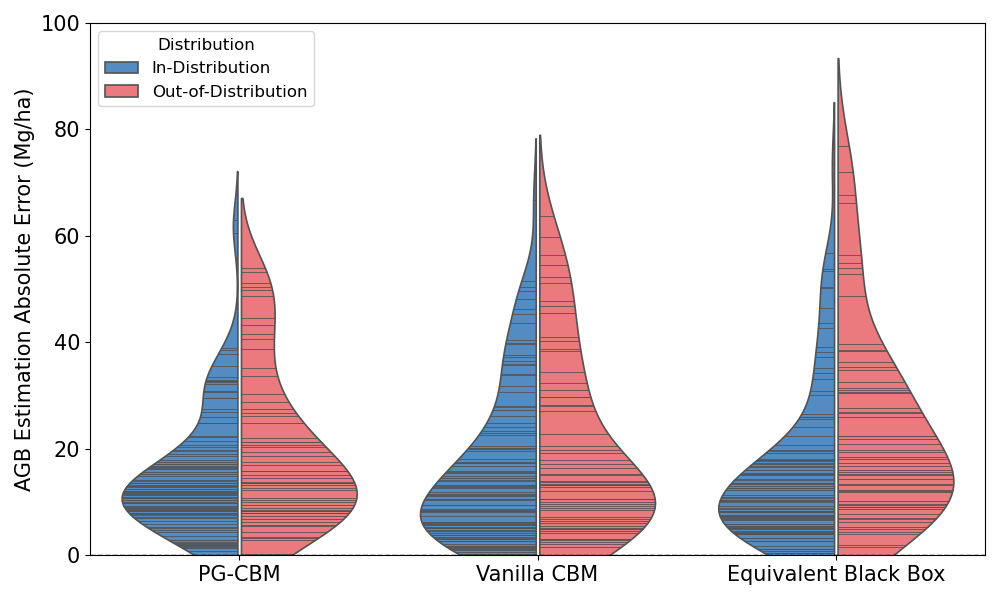
Predictive Generalization Capacity – specifically, the ability to accurately estimate Aboveground Biomass Density (AGBD) in previously unseen environments – represents a significant advancement offered by process-guided Component-Based Models (PG-CBMs). Traditional ecological models often struggle when applied to regions lacking extensive training data, leading to unreliable predictions due to an over-reliance on statistical correlations present in the original dataset. PG-CBMs, however, explicitly incorporate established ecological principles into their framework, effectively reducing dependence on purely data-driven patterns. This approach allows the model to extrapolate beyond the limitations of the training data, providing more robust and reliable AGBD estimates even in areas with sparse or absent ground-truth measurements. The benefit is not merely increased accuracy, but a fundamental improvement in the model’s capacity to function effectively in data-limited scenarios, expanding its utility across diverse and under-sampled landscapes.
Process-guided Carbon-Budget Models (PG-CBMs) exhibit enhanced adaptability due to their foundational reliance on established ecological principles. Unlike purely data-driven approaches, which can inadvertently learn and perpetuate misleading relationships – spurious correlations – within training datasets, PG-CBMs integrate knowledge of plant physiology, biogeochemical cycles, and ecosystem dynamics. This mechanistic grounding allows the model to distinguish genuine drivers of Aboveground Biomass Density (AGBD) from coincidental patterns, bolstering performance in unfamiliar environments or when faced with data that deviates from the initial training conditions. Consequently, the model isn’t simply extrapolating existing trends, but rather applying ecological rules to predict outcomes, yielding more robust and reliable AGBD estimates even in novel settings.
A crucial aspect of building reliable ecological models lies in understanding how well they perform on unseen data – a concept formalized through theoretical bounds on generalization error. Rademacher Complexity, for instance, offers a mathematical framework to quantify a model’s capacity to fit random noise, effectively setting an upper limit on its expected error in predicting outcomes for novel environments. By analyzing these bounds, researchers can proactively identify potential weaknesses in a model’s design and implement strategies to enhance its robustness. This might involve simplifying the model’s structure, increasing the diversity of training data, or incorporating regularization techniques – all aimed at reducing the gap between training performance and real-world predictive power. Ultimately, leveraging these theoretical tools allows for the development of ecological models that are not merely accurate on existing data, but possess a demonstrable capacity to generalize and remain reliable even when faced with the complexities of previously unobserved ecological scenarios.
Evaluations reveal the Process-Guided Carbon-Budget Model (PG-CBM) achieves a significantly reduced Relative Mean Bias of just 3.2% when estimating Aboveground Biomass Density (AGBD). This performance metric indicates a substantial improvement in predictive accuracy compared to alternative modeling approaches. The lower bias suggests the PG-CBM minimizes systematic errors, delivering more reliable AGBD estimations-particularly valuable in data-scarce regions where accurate ecological assessments are critical for carbon accounting and forest management. This enhanced precision stems from the model’s capacity to incorporate established ecological principles, resulting in predictions that are less susceptible to noise and more reflective of true underlying relationships within forest ecosystems.
The pursuit of increasingly complex models, as demonstrated in this paper’s exploration of Process-Guided Concept Bottleneck Models, often feels like building a more elaborate Rube Goldberg machine. It’s a valiant attempt to capture nuance, yet inevitably introduces new points of failure. The authors rightly attempt to inject domain knowledge – a practical concession to reality. As Blaise Pascal observed, “The eloquence of youth is that it knows nothing.” This rings true; the elegance of a purely data-driven approach is quickly eroded when confronted with the messy realities of Above Ground Biomass Density estimation. Better one well-understood, process-guided model than a hundred opaque neural networks chasing statistical correlations. The logs, predictably, will tell the tale.
What’s Next?
The integration of domain knowledge, as attempted by Process-Guided Concept Bottleneck Models, will inevitably reveal the limits of formalization. Any attempt to distill ‘process’ into a manageable set of concepts presupposes a completeness that nature rarely affords. The current success with Above Ground Biomass Density estimation merely postpones the inevitable encounter with genuinely novel ecosystems-those for which the encoded ‘process’ is, at best, a poor approximation. Expect diminishing returns as model complexity increases; anything self-healing just hasn’t broken yet.
Future work will likely focus on automated knowledge extraction-a quest doomed to repeat the history of artificial intelligence. Documentation is, after all, collective self-delusion. The real challenge isn’t building more sophisticated models, but accepting that a bug, if reproducible, signals a stable system – a known failure mode, preferable to unpredictable collapse. The pursuit of ‘interpretability’ itself feels like a category error; understanding why a model fails is infinitely more valuable than understanding how it succeeds.
Ultimately, the field will be forced to confront the unglamorous reality that remote sensing, like all data-driven endeavors, is an exercise in controlled approximation. The goal shouldn’t be perfect prediction, but robust error characterization. Let the next generation wrestle with the consequences of encoding assumptions into deep neural networks; the current success is merely a temporary reprieve from the tyranny of real-world complexity.
Original article: https://arxiv.org/pdf/2601.10562.pdf
Contact the author: https://www.linkedin.com/in/avetisyan/
See also:
- Clash Royale Best Boss Bandit Champion decks
- Vampire’s Fall 2 redeem codes and how to use them (June 2025)
- World Eternal Online promo codes and how to use them (September 2025)
- Best Arena 9 Decks in Clast Royale
- Mobile Legends January 2026 Leaks: Upcoming new skins, heroes, events and more
- Country star who vanished from the spotlight 25 years ago resurfaces with viral Jessie James Decker duet
- How to find the Roaming Oak Tree in Heartopia
- M7 Pass Event Guide: All you need to know
- Solo Leveling Season 3 release date and details: “It may continue or it may not. Personally, I really hope that it does.”
- Kingdoms of Desire turns the Three Kingdoms era into an idle RPG power fantasy, now globally available
2026-01-18 08:13