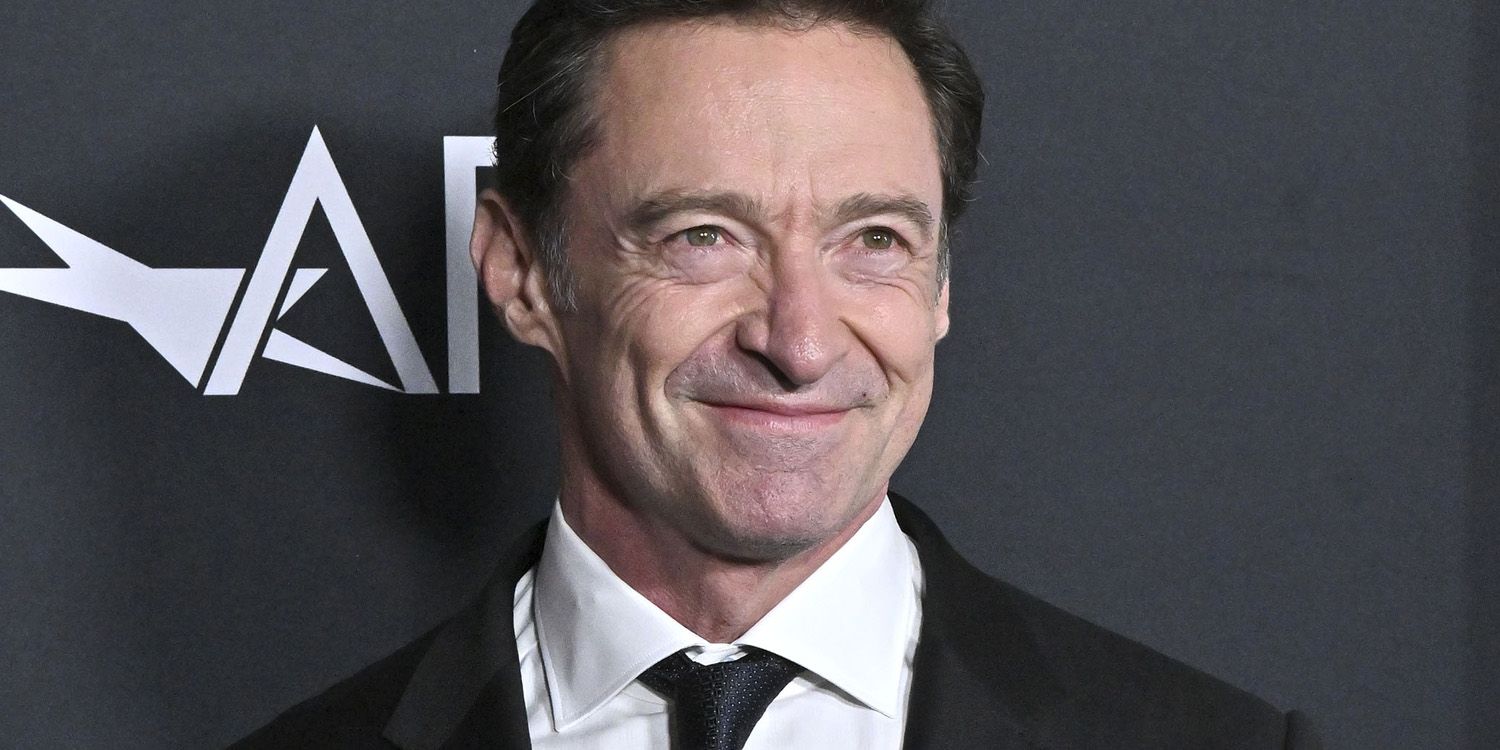
Hugh Jackman is one of Hollywood’s most popular leading men. While he’s famous for playing Wolverine, the iconic superhero, he’s also a remarkably talented singer and dancer. He’s proven his incredible range, seamlessly transitioning between intense roles like the one in Logan and the joyful performances in The Greatest Showman. Though his recent films haven’t been as big hits, he remains incredibly well-liked, and upcoming projects like Song Sung Blue and The Death of Robin Hood could easily bring him back to the top of the box office.
It’s interesting that Hugh Jackman has largely focused on movies, especially in recent years. While many actors are now drawn to high-quality TV series, Jackman has mostly avoided them, appearing only in voice roles for animated comedies like Rick and Morty, Human Resources, and Koala Man. This is a bit surprising considering a key influence on his early career was a classic six-part detective drama from the 1980s. It’s easy to understand why he loved that show, though – it was a compelling mystery, but also included musical performances.
The Singing Detective Is One of the Greatest British Shows Ever Made
In November 1986, the BBC premiered The Singing Detective, a groundbreaking and intricate series that blended music, fiction within fiction, and elements of the author’s own life. Created by Dennis Potter, known for Gorky Park, and directed by Jon Amiel (of Copycat fame), the show centers on Philip E. Marlow, a mystery novelist struggling with both writer’s block and a severe skin and joint condition while in the hospital.
Confined to his hospital bed with painful skin sores and aching joints, he stubbornly refuses pain medication. He’s determined to stay lucid and finish his new novel, a dark and gritty story called The Singing Detective. But a fever takes hold, and he descends into a strange, dreamlike world where he becomes Philip E. Marlow, a detective investigating a case of hidden Nazi war criminals.
The six-part series, The Singing Detective, seamlessly shifts between different realities. It mainly focuses on two versions of the main character, Marlow: one recovering in a hospital, and another as a fictional detective. Throughout the show, we also see flashbacks to his difficult childhood and moments from his past that cause him deep regret. At one particularly low point, Marlow’s health worsens so much that he has to physically tie his pen to his hand—to the skin itself—just to be able to finish writing his story.
As a result, different realities begin to merge, creating a strange new world where people from Marlow’s life meet characters from fiction, and actors find themselves playing several parts. For example, Patrick Malahide (known from Game of Thrones) portrays Finney, a man Marlow suspects is having an affair with his ex-wife, as well as Binney, a central character in the story, and Raymond, a friend of Marlow’s father who had an affair with his mother.
The show was quite unconventional, and things got even stranger when characters suddenly started lip-syncing to songs from the 1930s and 40s. These bizarre moments enhanced the surreal atmosphere, but also cleverly connected to the story’s central themes. Director Dennis Potter first experimented with this technique in his 1978 show, Pennies From Heaven, but he truly mastered it in The Singing Detective. Unlike simply showing off or being odd for its own sake, the musical sequences felt integral to the narrative.
Their success likely stemmed from the grounding provided by Michael Gambon’s remarkable performance as Marlow. He brought such honesty, subtlety, and charisma to the role that he won a BAFTA Award in 1987. Years later, this performance deeply impressed a young actor studying at the Actors’ Center in Sydney, Australia.
Jackman Watched the Show During His First Year of Acting Training
Hugh Jackman developed a passion for acting while growing up in Sydney, even participating in his school’s production of My Fair Lady in 1985. However, he didn’t initially consider it as a potential career path. It wasn’t until his final year at the University of Technology Sydney that he began to take acting seriously, and it happened somewhat unexpectedly.
Imagine a college student nearing graduation with a communications degree, needing a few extra credits. He’d always enjoyed acting as a pastime, so taking a drama class seemed like the obvious choice. It was during a performance of Václav Havel’s play, The Memorandum, where he played the lead role, that he discovered his true passion and a sense of belonging. After graduating at 22, Jackman spent a year at the Actors’ Center taking a course called ‘The Journey,’ and it was there he saw a performance that both inspired and challenged him.
Hugh Jackman recently shared that one of his favorite TV shows is the British series The Singing Detective, starring Michael Gambon. He told Rotten Tomatoes he discovered it during his first year of acting school and was immediately captivated. He described the show as ‘so amazing’ and fondly remembers watching it while he was training to be an actor.
Jackman readily admitted he felt intimidated by Michael Gambon’s talent. He even confessed to feeling depressed, jokingly recalling thinking, “I’ll never be able to act at his level.” He found Gambon’s performance simply incredible.
The Show was Eventually Remade as a Movie By Robert Downey Jr in 2003
Hugh Jackman was incredibly impressed by Michael Gambon’s work in The Singing Detective, considering it a high standard to aim for in his own career. However, Gambon himself found the project challenging at first. As he told the British Film Institute in 2013, the story was so complex and lengthy that the director, Jon, would help him break it down each day.
The director’s guidance clearly helped Michael Gambon navigate the show’s complex layers, from the gritty, noir-style mystery within the main plot to the deeply upsetting scenes. This resulted in a truly memorable performance that remains powerful even today.
The show didn’t feel like typical television; it was more like a carefully crafted work of art. It showcased a level of storytelling skill that was ahead of its time, demonstrating the potential of TV before the current era of high-quality shows. It proved that a creator could be deeply involved in their work and still create something broadly appealing.
Dennis Potter actually had a painful condition called psoriatic arthropathy, which caused both skin breakouts and arthritis. He was frequently hospitalized during flare-ups, and these experiences heavily influenced his TV show, The Singing Detective. The scenes of the main character, Marlow, struggling to write while in intense pain, and being supported by a hopeful nurse, were based directly on Potter’s own life. These moments were deeply moving for viewers, even without knowing the personal connection behind them.
Despite enjoying the television series The Singing Detective, Roy Potter always imagined it as a movie. He actually wrote a screenplay in 1992, two years before his death, but it wasn’t until over a decade later that his vision became a reality on the big screen.
This installment featured a character named Dan Dark, played by Robert Downey Jr. (who later became famous for other roles). In the movie, Dark is severely affected by his illness and unable to write. Rather than battling writer’s block, he reflects on the story of one of his previous novels and imagines elaborate musical sequences set to popular songs from the 1950s, such as “Doggie in the Window.”
I loved the film adaptation of The Singing Detective, and it definitely kept that amazing, reality-bending quality of the original series. However, most critics didn’t think it quite lived up to the show, and honestly, I can see why. It felt like they were trying to pack all the emotional depth and complexity of Amiel’s brilliant creation into a shorter format, and it just didn’t quite have the same impact. Even with a strong lead performance, the movie felt a little fragmented, like it didn’t fully come together.
The movie was okay, lasting about two hours, but it didn’t compare to the original series, which had over six hours to develop its strange and deeply meaningful story. Interestingly, the biggest sign of its reception might have been that Hugh Jackman didn’t even mention it when discussing his favorite films.
Read More
- Clash Royale Best Boss Bandit Champion decks
- Mobile Legends January 2026 Leaks: Upcoming new skins, heroes, events and more
- Clash Royale Furnace Evolution best decks guide
- Vampire’s Fall 2 redeem codes and how to use them (June 2025)
- Best Hero Card Decks in Clash Royale
- Mobile Legends: Bang Bang (MLBB) Sora Guide: Best Build, Emblem and Gameplay Tips
- Best Arena 9 Decks in Clast Royale
- Clash Royale Witch Evolution best decks guide
- Brawl Stars Steampunk Brawl Pass brings Steampunk Stu and Steampunk Gale skins, along with chromas
- Brawl Stars December 2025 Brawl Talk: Two New Brawlers, Buffie, Vault, New Skins, Game Modes, and more
2025-12-10 21:13