In David Lowery’s atmospheric and intense film, Mother Mary (played by Anne Hathaway) isn’t portrayed as a traditional saint. Instead, she’s a pop star accustomed to wearing glittering headpieces. These were originally designed by Sam Anselm (Michaela Coel), her first creative director and someone with whom she once shared a powerful and intimate connection—spiritually, emotionally, and physically. She’s tired of the halo, a symbol of her former image.
However, Mother Mary wants to leave everything behind – her music, her celebrity, and the image people have of her. It’s created a troubling presence, a haunting force she refers to as The Red Woman, which has consumed her. Now, she finds the music terrifying.
She’s part of a growing trend. Lately, many movies have featured famous singers or musicians dealing with supernatural or scary situations. Just this year, in 2024, we saw this with both the thriller Trap and the sequel Smile 2.
The first story features Lady Raven (Saleka Night Shyamalan), a pop star reminiscent of Ariana Grande, confronting a serial killer (Josh Hartnett as Cooper) who wants to watch a performance with his daughter before continuing his crimes. The second story follows Skye Riley (Naomi Scott) as she becomes the newest victim of a demon that uses past trauma to push people towards suicide, appearing to the public as just another celebrity struggling with personal issues.
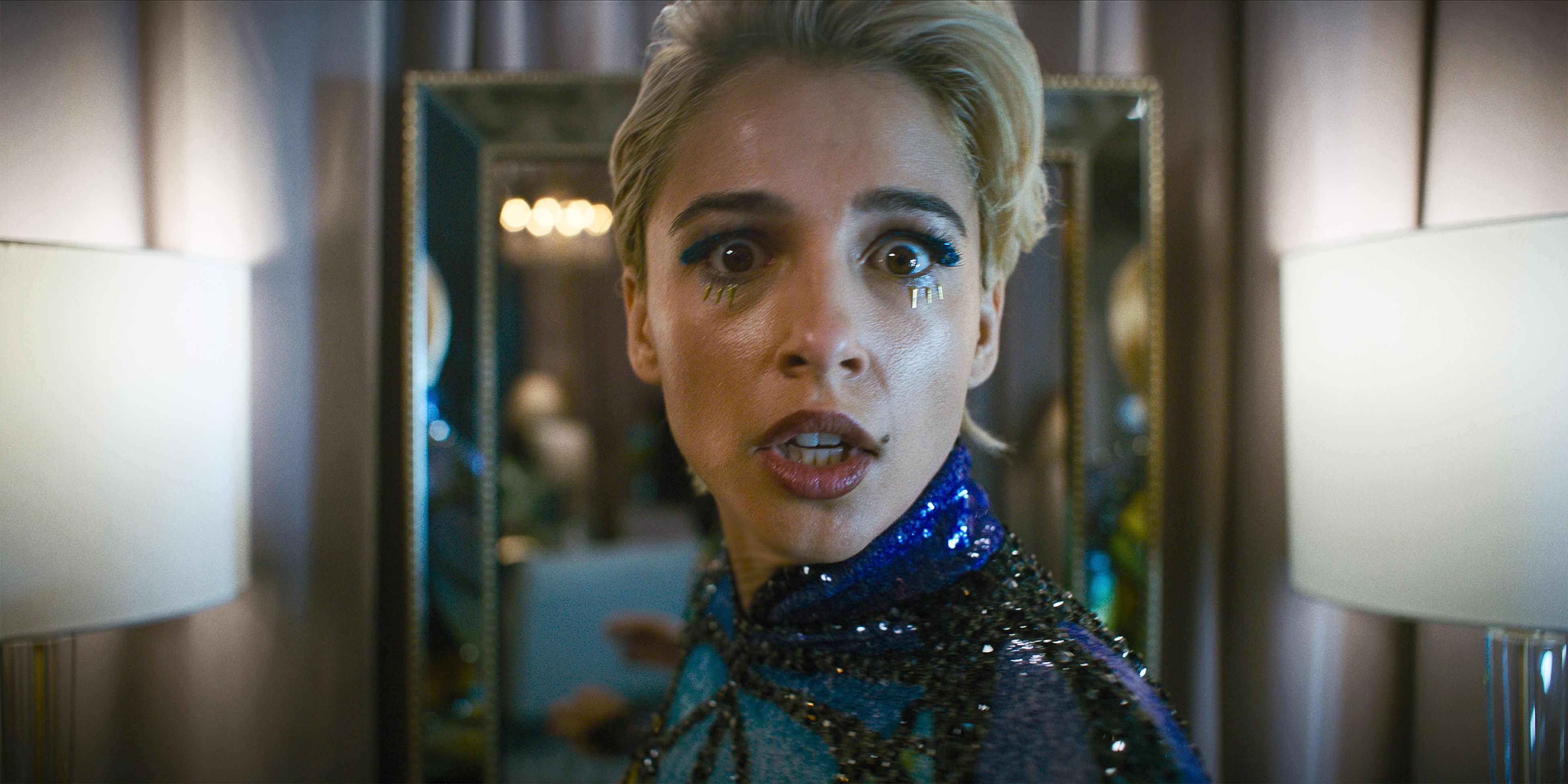
Recently, several movies and TV shows have explored the dangerous side of celebrity fandom. Examples include the films Lurker (starring Archie Madekwe), Borderline (with Samara Weaving), and Hurry Up Tomorrow (featuring The Weeknd and Jenna Ortega), as well as the series Swarm, created by Janine Nabers and Donald Glover. These stories often focus on the intense and sometimes frightening relationships between pop stars and their most devoted fans.
Pop stars are increasingly appearing in roles that explore bigger, more serious themes beyond typical genre constraints. For example, Ariana Grande played a character in Don’t Look Up who provided a welcome escape from an impending disaster, and Miley Cyrus confronted the implications of artificial intelligence in a Black Mirror episode. Brady Corbet’s film Vox Lux powerfully depicts how a country’s collective trauma can impact a pop star – specifically, a school shooting survivor (played by Natalie Portman) who achieves fame but is ultimately consumed by it.
What to Read Next
These films and series all explore how pop music both hides and reveals our inner selves. Even something as lighthearted as Trap demonstrates this: music initially serves as a way for the protagonist to escape capture – people are too focused on the performance to notice him – but ultimately it brings people together, as the killer is found when Lady Raven rallies her fans to help locate him and save the day.
In Mother Mary, Hathaway plays a pop star overwhelmed by the weight of her own fame. She turns to Sam, someone who truly understands her, hoping to rediscover her true self by shedding the persona she’s built up over time.

Lowery came up with the idea for the movie while he was struggling creatively. He was juggling the final touches on his medieval film, The Green Knight, with early work on Disney’s Peter Pan & Wendy, and he felt exhausted. It reminded him of the joy he’d felt when making his short film, Pioneer, where he had complete creative freedom.
The pressure of expectations and other people’s preconceived notions can be overwhelming—it feels suffocating. This is especially true for pop stars, who are often defined by carefully crafted images, distinct periods in their careers, and elaborate costumes. A filmmaker like David Lowery, M. Night Shyamalan, or Gaspar Noé might find this phenomenon particularly fascinating.
Even the biggest stars seem to be exploring what it means to be truly themselves. Taylor Swift’s incredibly popular Eras Tour playfully revisited different phases of her career, while Beyoncé’s documentary, Homecoming, thoughtfully connected her groundbreaking Coachella performance to the rich history of Black music and ideas. Lady Gaga has also shifted gears, moving from elaborate, artistic performances to a more personal and honest style, as seen in her album Joanne and her acting role in A Star is Born.

Fans respond with unwavering devotion, creating a deeply personal connection. This blurring of lines between pop culture and religion is highlighted by the imagery of figures like the Virgin Mary, suggesting that concerts can now provide the same emotional experience and sense of community once found in faith. In a world where fewer people practice religion, celebrities are increasingly seen as figures of hope and inspiration.
Lowery isn’t the first artist to explore religious imagery. Madonna famously used religious themes, particularly with songs like ‘Like a Prayer.’ More recently, Beyoncé referenced divine femininity during her 2017 Grammy performance, and Lady Gaga’s ‘Judas’ presented her as a rebellious, conflicted version of Mary Magdalene.
In the movie Vox Lux, Celeste begins to think she’s special, believing she was spared from a tragedy that took the lives of her classmates. This boosts her self-importance, and she boldly tells reporters, “I’m the new faith.”

Even pop stars who aren’t trying to be controversial often use religious language in their songs. For example, Lady Raven has a song called ‘Save Me’—suggesting salvation from wrongdoing—and Skye Riley sings about ‘parting the sea’ in ‘Blood on White Satin’, even though her character is facing a serious demonic possession.
Is fame a source of pain or joy? What drives people to stalk and become obsessed with celebrities – are they seeking forgiveness or simply unconditional love? It’s no surprise these pop stars often feel trapped in a difficult situation. Even though the film Vox Lux shows us the flawed side of Celeste – her cruelty and selfishness – it also lets us enjoy her performances. Whether her image is genuine or not, the emotions of her fans are real, and they find a temporary sense of calm through her music.
Like many artists, Mother Mary explores the line between reality and perception in her work. But instead of trying to avoid difficult truths, she aims for understanding. Ultimately, she hopes her music evokes a sense of comfort and familiarity – a feeling of returning home.
Mother Mary is out now in cinemas.
The latest issue of Living Legends, a beautifully illustrated 100-page tribute to Sir David Attenborough, is now available! You can purchase it at newsstands or online.
Read More
- Total Football free codes and how to redeem them (March 2026)
- Last Furry: Survival redeem codes and how to use them (April 2026)
- Pixel Brave: Idle RPG redeem codes and how to use them (May 2026)
- Clash of Clans May 2026: List of Weekly Events, Challenges, and Rewards
- Light and Night brings its beloved otome romance experience to SEA region with a closed beta test starting May 20, 2026
- Top 5 Best New Mobile Games to play in May 2026
- Gear Defenders redeem codes and how to use them (April 2026)
- Skip Bayless and Stephen A. Smith to reunite on ESPN’s ‘First Take’ for one day only
- Winnita Casino Guida per vincere in grande nel gioco d’azzardo online
- FC Mobile 26 TOTS (Team of the Season) event Guide and Tips
2026-04-24 19:20