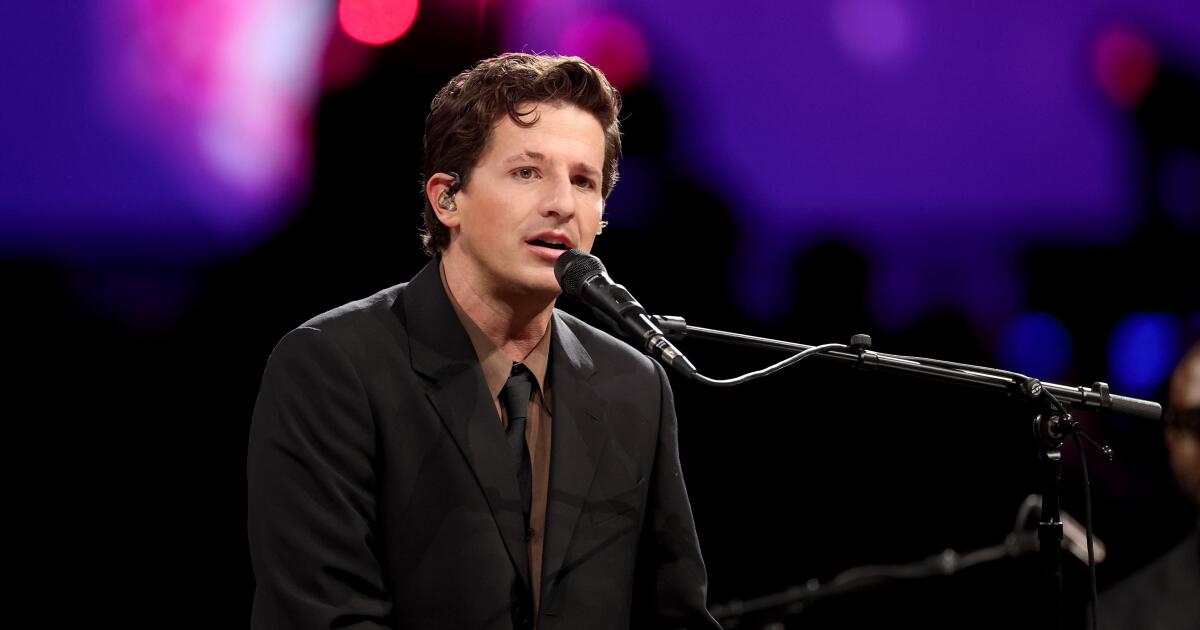
Charlie Puth was at Spotify’s Los Angeles office one Friday morning, thinking about what might happen sooner: the release of his new album or the birth of his first child. He was drinking a can of La Croix while he considered this.
“It’s quite possible it could be the same week,” he said.
Turns out the kid beat the music.
Charlie Puth shared on social media that his wife, Brooke Sansone, welcomed their son, Jude, on March 13th. He had traveled from their home in Santa Barbara earlier in the month to promote his new album, but quickly shifted focus to being a dad.
I’m so excited for Charlie Puth’s new album, “Whatever’s Clever!” It’s his fourth since he first became famous in 2015 with “See You Again” – that huge song he did with Wiz Khalifa for “Fast & Furious.” But he says this one feels different. He’s actually living the themes of the album, and everything just feels right with this project. It’s a really personal record, and I can’t wait to hear it!
 ×
× The album begins with “Changes,” where Puth looks forward to growth and learning. “Home” uses imagery of idyllic suburban life, comparing it to a nostalgic view of the past. Throughout the album, Puth also reflects on his relationships with his father and brother, and remembers what it was like growing up in suburban New Jersey.
When he was starting out, Charlie Puth used to think artists needed to keep their personal and professional lives completely separate. He described it like a computer’s hard drive: one section for your private life, and another for your public persona – the version of yourself you create for your career, maybe even changing your appearance or how you talk. But he’s changed his mind about that now.
He said his wife encouraged him to simply be himself. He also mentioned that Taylor Swift helped shift his perspective when she referenced him by name in the title song of her 2024 album, “The Tortured Poets Department.”
Charlie Puth’s album, “Whatever’s Clever!,” has a bright, polished sound. He co-produced it with BloodPop, who’s worked with artists like Justin Bieber and Lady Gaga, and drew inspiration from classic yacht rock and soulful music. The album features collaborations with legendary artists like Kenny Loggins, Michael McDonald, and Kenny G, who also performed with Puth at the Super Bowl recently.
McDonald describes Puth as incredibly talented and explains he’d been wanting to collaborate with him for some time, after a friend suggested it. He was hesitant to reach out directly, not wanting to bother Puth if he wasn’t interested. That’s why he was so excited when Kenny Loggins offered him an opportunity to work with Puth, and he immediately agreed.

Music
The up-and-coming pop and soul artist has started her first major tour across the United States, following the success of her popular song ‘Die on This Hill.’
The three collaborators created a cheerful song called “Love in Exile,” featuring high-pitched vocals and a sound reminiscent of the Doobie Brothers’ classic hit “What a Fool Believes,” which Michael McDonald and Kenny Loggins wrote together fifty years prior.
Coco Jones, featured on the album and collaborating with Puth on the song “Sideways,” was impressed by his extensive understanding of R&B music.
“There were some references where I was like, ‘What even is that?’” she recalls with a laugh.
Late last year, Sam Puth performed a series of small, personal shows at the Blue Note jazz clubs in New York and Los Angeles. He showcased his own songs in new ways, along with covers of classics like “Ain’t No Mountain High Enough” and New Edition’s “Can You Stand the Rain.” Next month, he’ll kick off a world tour promoting his album, “Whatever’s Clever!”, with a stop at the Kia Forum in Inglewood on April 29th.
During our interview, as the video team got ready to film, Sam Puth told me he’d never been so busy in his life.
I’ve really liked your style throughout this album release – the jeans, sweaters, and penny loafers. It brings back memories of shopping for school clothes at the Bass outlet when I was in Catholic school, where they had endless rows of penny loafers. I wanted the album to feel like discovering old, hidden messages and drawings inside a school textbook – things kids had written years ago.
Could you mention some of the artists who influenced you? You’ve already mentioned Phil Collins and Philip Bailey, and I also hear elements of Fine Young Cannibals in your work. Yes, definitely.
Time-wise, you were thinking, what, 1984 to 1989?
’89 to ’90 — ’92 maybe.
I really appreciate how detailed that is. Thinking about it now, the late 80s and early 90s were a pivotal moment for music technology. Songs like Madonna’s “Vogue” – with its powerful, driving beat created by the 909 drum machine – sounded completely new at the time. Then you had the “Bodyguard” soundtrack with Whitney Houston’s “I’m Every Woman,” and everything had a strong dance feel. Chicago house music was becoming increasingly popular and moving into the mainstream, and that was directly linked to improvements in music technology.

The way the music sounds is really reminiscent of John Mayer’s album, “Sob Rock.” I tend to express myself through my music rather than directly, and I like to balance serious themes with upbeat melodies. It’s a contrast you can often find in John’s work too. Take my song, “Washed Up,” for example. It’s about a difficult situation – helping a friend who’s struggling – but I used bright, cheerful trumpets in the song, almost like the theme song to “Wheel of Fortune,” to create that balance.
“Washed Up” made me think of “Stop” by the Spice Girls.
Same key. C major is a very happy key.
Justin Bieber’s song “Swag” is also really well-done. One track, “All I Can Take,” features drumbeats similar to Lisa Stansfield’s “All Around the World.” I’m not sure if Bieber and Dijon were inspired by that song while creating it, but it’s great to hear that influence in music by a major artist.
I’m curious about the idea of having Kenny G play on the song “Cry.” He’s a well-known artist who brings a lot of different ideas and impressions to mind, and it could be quite humorous to see that combination.
I brought him in to highlight his serious side. He’s incredibly versatile – you see him in funny videos with Andy Samberg or performing with the Jonas Brothers, sometimes leaning into well-known tropes. But I wanted to focus on the Kenny G people first encountered in the late 80s, before he became known for his holiday music.
We wanted to get Justin involved in a unique way, so BloodPop and I found a track on one of his older albums featuring only his saxophone. We used Melodyne to create a melody based on that saxophone part, intending for him to use it as a starting point for a solo. It wasn’t a polished recording – it was more like a rough draft we hoped he’d improve upon, and he absolutely did!
I was curious if you felt you needed to clarify to him that you weren’t making fun of him. I shared the album with him, and I believe he could sense its authenticity simply from the way it sounded – the chords felt genuine and warm.

Music
Inside John Mayer’s takeover of a Hollywood music mecca
John Mayer and filmmaker McG have bought Henson Studios for $44 million and are now calling it Chaplin Studios. They plan to maintain the historic buildings at the La Brea Avenue location.
Honestly, getting the nod from legends like Kenny G, Michael McDonald, and Kenny Loggins meant everything to me. They’re the reason this album even exists! You can’t try to make something like this without acknowledging the artists who pioneered the sound. I really wanted to capture that feeling – the one my parents had when they first heard songs like “What a Fool Believes” – and share it with a new generation who might not know their music yet.
The album definitely has a bit of a push and pull, doesn’t it? You’re celebrating the pioneers while also having a song called “Don’t Meet Your Heroes.” Can you tell us who that song is about?
How do you reconcile that conflicting idea? I’ve been fortunate to work with incredible artists like Michael McDonald and Kenny Loggins, and I discovered they’re really no different from me – they’re simply songwriters. They’re not stuck in the past. I’m certain I could collaborate with them today and create a hit for current artists like Dua Lipa or Zara Larsson. Take Olivia Dean’s song, “Man I Need,” for example. She’s not relying on basic chords; she’s using more complex harmonies, starting with a Db chord that includes an F note.
You’re saying that’s a modern song with those silky yacht rock chords.
I think silk is in.
Someone said our song with Coco Jones is incredibly smooth, and I definitely agree! That beautiful piano sound comes from a preset called ‘Dig EP’ on the Roland JV-1080 – it’s actually the same one Babyface used on the ‘Waiting to Exhale’ soundtrack.
You and Coco are challenging each other with your singing. I don’t try to compete with guest artists. Coco actually had to rush to the airport for a late-night flight to New York right after recording, but she already knew the song perfectly.
Regarding the song “Don’t Meet Your Heroes,” I intentionally didn’t reveal who inspired it. The song explores a common experience: admiring someone greatly, finally meeting them, and being disappointed. It’s that feeling of wishing you could go back in time and not have met them, because it changes how you see their work. They might still be talented, but the experience is ruined, and it’s just not the same anymore.
The album wraps up with a track called “I Used to Be Cringe,” and honestly, it’s a fair point. But it got me thinking: I still adore their earlier song, “Boy,” so does that make me the cringe one? I don’t buy it – “Boy” still holds up. If anything, the track “Marvin Gaye” from their first album might be a better example of something that feels a little…dated now.

It’s interesting when an artist decides they no longer connect with their older songs – what does that feel like for a fan? I’m currently planning my tour setlist, and my music director asked about playing ‘Marvin Gaye.’ I told him I don’t want to perform it in the same style as the original Motown version. My life has changed – I’m about to become a father – and I’m just not in the same headspace as when I wrote that song. I’m not expressing affection to my wife the same way the song suggests. However, I believe we can still perform it in a way that everyone enjoys, simply by changing the musical arrangement – maybe lowering the key or using a different drum beat. I’m even thinking about how to transition from a song called ‘Washed Up’ into ‘Marvin Gaye.’
Your performance at the Blue Note got me thinking about the history of ‘blue-eyed soul’ – white artists performing R&B with incredible Black musicians. I’m curious about your perspective on this complex musical tradition. I don’t claim to have created it, or even the music within my own songs – it feels like I’m connecting with something much older, something that’s always existed. That’s a discussion we could have another time, though.
Someone suggested I talk about this on Joe Rogan’s podcast, and while I don’t think I’ll be going on the show, it made me realize something important: acknowledging where inspiration comes from is crucial. I’m a student of music, and I’m lucky enough to be able to ask legends like Babyface about their creative process. He told me he was inspired by a specific chord in an El DeBarge song, and that got me thinking about their influences. I like to trace those roots so that if anyone ever asks me about my own work, I can accurately explain the history behind it. I really value knowing the facts.
It seems like you’ve become a favorite among music lovers, and that’s why it was so cool to hear Taylor Swift shout you out with the lyric, ‘We declared Charlie Puth should be a bigger artist.’ You’ve never discussed it with her directly—though you plan to—but she’s so good at expressing herself through her songs. You feel like that lyric was her way of saying there’s more to explore in your music, and you should delve a little deeper.
Instead of focusing on the task at hand, what were you constantly talking about? It turned out to be songs about old relationships. I appreciate those songs, actually – they’re the reason I’m even having this conversation. But I realized I’d never written about my relationship with my dad. I wrote the song “Cry” just a week before his mother passed away. Seeing him so openly emotional – something I hadn’t witnessed in my 34 years – I wanted to offer him comfort, and I knew I could do that through music. It just needed to be a song.
Look, if this album actually manages to connect with people who really get music – the serious fans, you know? – well, that would be amazing. Seriously, that’s a huge compliment.
How will this affect Charlie Puth? He hopes to become more recognized – perhaps even a little famous – rather than being overlooked.
Read More
- Invincible Season 4 Episode 4 Release Date, Time, Where to Watch
- Physics Proved by AI: A New Era for Automated Reasoning
- How Martin Clunes has been supported by TV power player wife Philippa Braithwaite and their anti-nepo baby daughter after escaping a ‘rotten marriage’
- Gold Rate Forecast
- American Idol vet Caleb Flynn in solitary confinement after being charged for allegedly murdering wife
- Olivia Colman’s highest-rated drama hailed as “exceptional” is a must-see on TV tonight
- Total Football free codes and how to redeem them (March 2026)
- Nicole Kidman and Jamie Lee Curtis elevate new crime drama Scarpetta, which is streaming now
- “Wild, brilliant, emotional”: 10 best dynasty drama series to watch on BBC, ITV, Netflix and more
- Goddess of Victory: NIKKE 2×2 LOVE Mini Game: How to Play, Rewards, and other details
2026-03-26 13:34