Author: Denis Avetisyan
Researchers have developed a novel system that enables robots to perceive contact and track movement by ‘listening’ to vibrations, offering a surprisingly effective and affordable alternative to traditional tactile sensors.
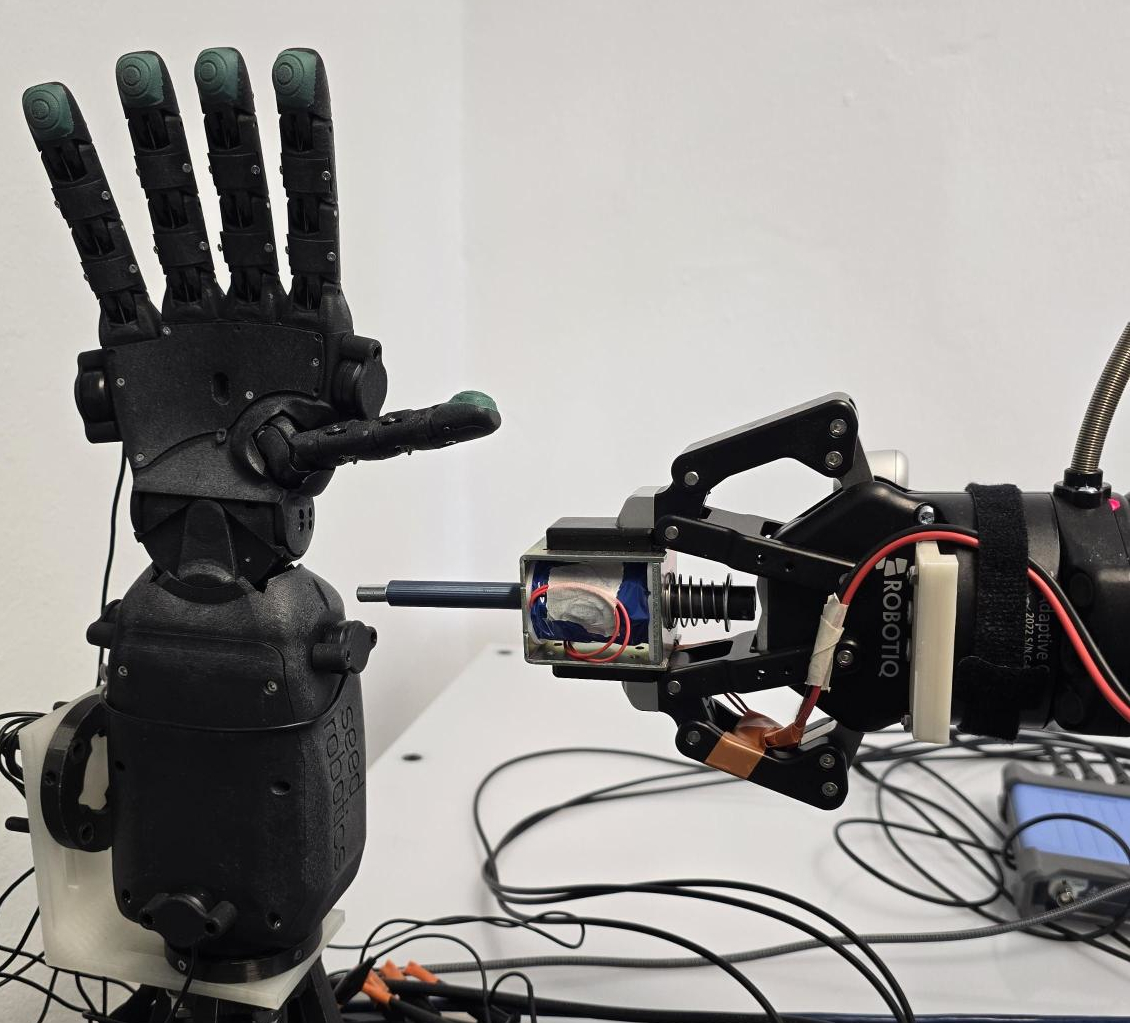
A deep learning approach utilizing vibro-acoustic sensing and audio spectrogram transformers enables robust contact localization and trajectory tracking for robotic hands.
Despite advances in robotic manipulation, achieving rich and affordable tactile perception remains a significant challenge. This is addressed in ‘Vibro-Sense: Robust Vibration-based Impulse Response Localization and Trajectory Tracking for Robotic Hands’, which introduces a novel system for high-accuracy contact localization and trajectory tracking using only vibrational signals. By employing low-cost piezoelectric microphones and an Audio Spectrogram Transformer, the authors demonstrate that complex contact dynamics can be effectively decoded from simple vibrations, achieving sub-5mm localization error and robust tracking even during active manipulation. Could this vibro-acoustic approach pave the way for widespread, affordable contact perception, fundamentally changing how robots interact with the world?
The Limits of Current Robotic Perception
Robotic systems frequently falter when handling delicate or unpredictable interactions, largely due to limitations in perceiving subtle contact events. Existing perception methods often treat contact as a binary state – either something is touching the robot, or it isn’t – overlooking the critical nuances of how things touch. This simplification hinders reliable manipulation because successful grasping and assembly require understanding not just presence of contact, but also its location, force distribution, and dynamic changes-information essential for adapting to variations in object shape, surface texture, and external disturbances. Consequently, robots struggle with tasks that humans perform effortlessly, such as assembling intricate components, handling fragile objects, or responding to unexpected pushes and pulls during collaborative work.
Conventional robotic systems frequently depend on force/torque sensors to understand physical interactions, but these methods present inherent limitations. While capable of measuring overall forces and moments applied to a robot’s end-effector, they often struggle to detect the rapid, localized vibrations that characterize subtle tactile events – akin to the difference between feeling a gentle texture and simply registering weight. This sluggish response time and limited spatial resolution hinder a robot’s ability to reliably manipulate delicate or complex objects, or to adapt to unexpected contact scenarios. The difficulty in discerning fine details, such as slippage or the precise location of contact, can lead to unstable grasps and failed manipulations, particularly in unstructured environments where objects present unpredictable surfaces and geometries. Consequently, a need exists for sensing technologies that can provide a more granular and responsive understanding of tactile information.
Robust robotic manipulation in real-world settings demands more than simply detecting that contact has occurred; it requires precise knowledge of where and how that contact is evolving over time. Accurately localizing contact points and tracking their trajectory allows a robot to adapt its grip, redistribute forces, and maintain stability even as an object’s position or external forces change. Without this ability, manipulation becomes brittle and unreliable, particularly when dealing with deformable objects or navigating cluttered environments. The challenge lies in achieving this localization and tracking with sufficient speed and precision to react to dynamic events, effectively allowing the robot to “feel” the object and respond intelligently to subtle changes in interaction forces and positions – a crucial step toward truly versatile robotic systems.
The current landscape of robotic perception demands innovation beyond conventional force and tactile sensors. Existing systems frequently struggle to capture the high-frequency, localized vibrations inherent in many real-world interactions – the subtle ‘feel’ of a surface, the initial impact of a grasp, or the slip between contacting objects. These fleeting vibrational signals contain crucial information about contact state, material properties, and dynamic forces, yet are often lost due to sensor limitations or slow processing speeds. A new sensing modality, capable of detecting these rapid, localized vibrations with high fidelity, is therefore essential for enabling robots to perform delicate manipulation tasks, adapt to unpredictable environments, and ultimately, achieve a more nuanced understanding of the physical world through touch.

Decoding Touch: The Physics of Vibro-Acoustic Sensing
Vibro-acoustic sensing functions on the premise that any physical contact between a robot and an object introduces mechanical vibrations within both materials. These vibrations propagate as waves, and the characteristics of these waves – including frequency, amplitude, and waveform – are directly influenced by the specifics of the contact event. Factors such as the force applied, the contact location, the surface textures of the materials involved, and the material properties themselves all contribute to a unique vibrational signature for each interaction. Analyzing these signatures allows for the reconstruction of information about the contact, effectively “listening” to the physics of touch rather than relying solely on force or positional data.
Contact localization and trajectory tracking via vibro-acoustic sensing relies on the principle that each contact event generates a unique vibrational profile within the contacted material. High-sensitivity microphones, strategically positioned, capture these transient vibrations. Analysis of the signal’s time-of-arrival differences between multiple sensors allows for triangulation and precise determination of the contact location. Furthermore, continuous tracking of these vibrational signatures, coupled with algorithmic processing, enables real-time reconstruction of the contact trajectory, providing data on the speed, direction, and force applied during interaction. This method achieves millimeter-level precision in both location and trajectory estimation, suitable for robotic manipulation and tactile sensing applications.
Piezoelectric contact microphones are employed as the primary sensing modality for capturing vibro-acoustic signals. These microphones operate on the principle of the piezoelectric effect, converting mechanical stress – resulting from surface contact – directly into an electrical charge. Miniaturized versions of these sensors are integrated directly into the fingertips of the robot hand, allowing for localized vibration detection. The close proximity of the microphones to the contact point maximizes signal amplitude and minimizes noise. Multiple microphones are often utilized per fingertip to enable spatial resolution of the contact and facilitate more accurate determination of contact location and trajectory. The output of these microphones is a high-frequency electrical signal representing the vibrational characteristics of the contact event.
The amplitude and frequency content of vibrational signals used in vibro-acoustic sensing are directly correlated with the material properties of the contacting surfaces. Specifically, a material’s Young’s modulus, density, and internal damping characteristics influence how vibrations propagate and are reflected. Higher density materials generally exhibit lower vibrational frequencies, while stiffer materials (higher Young’s modulus) support faster propagation. Furthermore, damping within either the robot hand or the contacted object attenuates vibrational energy, reducing signal strength. Therefore, accurate interpretation of vibro-acoustic data requires consideration of these material properties to differentiate between genuine contact events and signal distortion caused by material-dependent vibrational behavior.

From Signal to Insight: Deep Learning for Tactile Perception
The conversion of raw vibrational data from tactile sensors to a usable format for deep learning models is achieved through the application of the Short-Time Fourier Transform (STFT). Vibrational signals are initially captured in the time domain, representing amplitude changes over time. The STFT decomposes these signals into their constituent frequencies and tracks how those frequencies evolve over time. This process generates a spectrogram, a visual representation displaying the magnitude of each frequency component as it changes over the duration of the signal. Specifically, the STFT applies a sliding window function to the time-domain signal, performing a Fourier Transform within each windowed segment, and then stacking the results to create the time-frequency representation. This spectrogram serves as the primary input to the subsequent deep learning model, allowing it to analyze the vibrational characteristics in both the frequency and temporal dimensions.
The Audio Spectrogram Transformer (AST) architecture is employed to process the time-frequency representations generated from vibrational signals. This transformer-based model is trained on spectrograms to directly regress the spatial coordinates of contact locations and predict the subsequent trajectory of the contact point. The AST leverages self-attention mechanisms to identify relevant patterns within the spectrogram data, enabling it to effectively map vibrational signatures to specific contact events. The model’s output is a continuous representation of contact location over time, allowing for real-time tracking of tactile interactions.
Data augmentation was implemented to enhance the robustness and generalization capabilities of the tactile perception model. This process involved applying several transformations to the training data’s spectrograms, including time stretching, pitch shifting, and the addition of random noise. These transformations artificially expanded the dataset, exposing the model to a wider range of vibrational signal variations and improving its ability to accurately predict contact location and trajectory even with noisy or imperfect input. Specifically, time stretching varied the duration of the spectrogram by up to 10%, pitch shifting altered the frequency content by ±5%, and additive Gaussian noise with a signal-to-noise ratio ranging from 0 to 20 dB was applied. This approach mitigated overfitting and improved performance on unseen data, contributing to the overall accuracy and reliability of the system.
System performance was quantitatively evaluated using Mean Squared Error (MSE) as the loss function during training and validation. This metric facilitated iterative model refinement and optimization of tactile perception accuracy. Specifically, the system achieves a localization error of less than 6mm when identifying the point of initial contact – referred to as impulse response localization. Furthermore, the system demonstrates trajectory tracking performance with an error of under 13mm, quantifying the precision with which it can follow a moving contact point. These error rates were consistently observed across the validation dataset, indicating robust performance and generalization capability.
![Mean test distances (in mm) decrease with increasing frequency and spectral resolution [latex]n_{fft}[/latex], demonstrating the impact of these parameters on measurement accuracy.](https://arxiv.org/html/2601.20555v1/x3.png)
The Material World: Validating Tactile Sensitivity
The study investigated how the material properties of an impacting object influence the resulting vibrational signals used for tactile localization. By employing both a metal and a wood indenter during controlled impacts, researchers observed the creation of unique vibrational signatures – essentially, distinct ‘fingerprints’ for each material. This difference in vibrational response directly impacted localization accuracy; the system achieved a more precise impulse response localization error of 3.460 mm with the metal indenter, compared to 5.823 mm with the wood indenter. These findings highlight the importance of considering material properties in the design of vibro-acoustic sensing systems and demonstrate the potential for material-based identification alongside contact localization.
A key component of the experimental setup involved a [latex]UR5e[/latex] robotic arm, meticulously programmed to deliver controlled tactile interactions to a robotic hand. This precision was achieved through the integration of a solenoid actuator, which facilitated repeatable and quantifiable stimuli. By utilizing the robotic arm, researchers were able to move the indenter across the sensor surface in a consistent manner, generating a dataset crucial for training and validating the vibro-acoustic sensing system. This automated process minimized human error and allowed for the collection of high-resolution data necessary to refine the accuracy of contact localization and trajectory tracking, ultimately contributing to the development of more adaptable and reliable robotic technologies.
The experimental framework relied heavily on a robotic system – specifically a UR5e Robotic Arm coupled with a solenoid actuator – to ensure data collection was both highly precise and consistently reproducible. This level of control was paramount, as it allowed for the delivery of standardized interactions to the robot hand, minimizing variability and extraneous noise within the collected datasets. Such high-quality data proved essential for effectively training and validating the acoustic sensing model, enabling accurate localization of contact and reliable tracking of movement trajectories – a critical step toward developing more adaptable and robust robotic systems capable of navigating complex and unpredictable environments.
The study’s findings validate the effectiveness of vibro-acoustic sensing, coupled with the AST model, in pinpointing contact location and monitoring movement paths with notable precision. Specifically, trajectory tracking errors were minimized-reaching 2.226 mm with a wood indenter held in a stable position-and remained manageable even under more challenging conditions, such as random movement with a soft plastic material, where errors peaked at 12.946 mm. These results suggest a significant advancement in robotic perception, promising the development of systems capable of interacting with complex environments and responding dynamically to changing stimuli, ultimately leading to more robust and adaptable robotic solutions.

The pursuit of robust robotic perception, as demonstrated in this work on Vibro-Sense, echoes a fundamental principle of systemic design. The system elegantly sidesteps the complexities and costs of traditional tactile sensing by focusing on vibrational signals – a holistic approach that considers the ‘bloodstream’ of contact rather than isolated pressure points. As Paul Erdős once stated, “A mathematician knows a lot of things, but a physicist knows deep down.” This sentiment applies here; the researchers haven’t simply applied deep learning, but have delved into the underlying physics of contact to create a system where the whole – vibration sensing and trajectory tracking – is indeed greater than the sum of its parts. The system’s reliance on inexpensive contact microphones emphasizes that impactful perception doesn’t necessarily require sophisticated hardware, but rather, intelligent interpretation of fundamental signals.
Future Directions
The demonstration of robust perception from vibrational data is, predictably, not a panacea. The current architecture relies heavily on a learned mapping from signal to state – a black box, in essence. Future work must address the inherent limitations of such opaque systems; what happens when the learned patterns encounter truly novel interactions, beyond the scope of the training data? A deeper investigation into the fundamental physics of contact – the interplay of force, frequency, and material properties – may yield more generalizable, and ultimately more reliable, models. The elegance of this approach lies in its simplicity, yet that very simplicity demands a correspondingly rigorous understanding of the underlying principles.
Expanding beyond static localization and trajectory tracking presents another challenge. The system currently perceives what is happening, but lacks an intrinsic understanding of why. Integrating this vibro-acoustic data with other sensory modalities – vision, force sensing – could unlock a richer, more contextualized perception. Furthermore, scaling this technology to more complex hand designs, and to a wider range of materials, requires careful consideration of the signal processing and model architecture. The promise of low-cost tactile sensing is considerable, but realizing that promise demands a commitment to both empirical rigor and theoretical clarity.
Ultimately, the true test of any perceptual system is not its accuracy in controlled environments, but its resilience in the face of real-world complexity. Good architecture is invisible until it breaks, and only then is the true cost of decisions visible.
Original article: https://arxiv.org/pdf/2601.20555.pdf
Contact the author: https://www.linkedin.com/in/avetisyan/
See also:
- ‘Project Hail Mary’s Unexpected Post-Credits Scene Is Worth Sticking Around
- Beyond Accuracy: Gauging Trust in Human-AI Teams
- How Martin Clunes has been supported by TV power player wife Philippa Braithwaite and their anti-nepo baby daughter after escaping a ‘rotten marriage’
- Clash Royale Balance Changes March 2026 — All Buffs, Nerfs & Reworks
- Gold Rate Forecast
- CookieRun: OvenSmash coupon codes and how to use them (March 2026)
- eFootball 2026 is bringing the v5.3.1 update: What to expect and what’s coming
- The most surprising Hannah Montana cameos: From John Cena to Dwayne Johnson and even a Coronation Street soap star as show celebrates its 20th anniversary
- Genshin Impact Version 6.5 Leaks: List of Upcoming banners, Maps, Endgame updates and more
- Total Football free codes and how to redeem them (March 2026)
2026-01-29 08:21