Author: Denis Avetisyan
A new AI framework, PowerGenie, automatically discovers power converter designs that outperform existing solutions by intelligently exploring a vast landscape of circuit configurations.
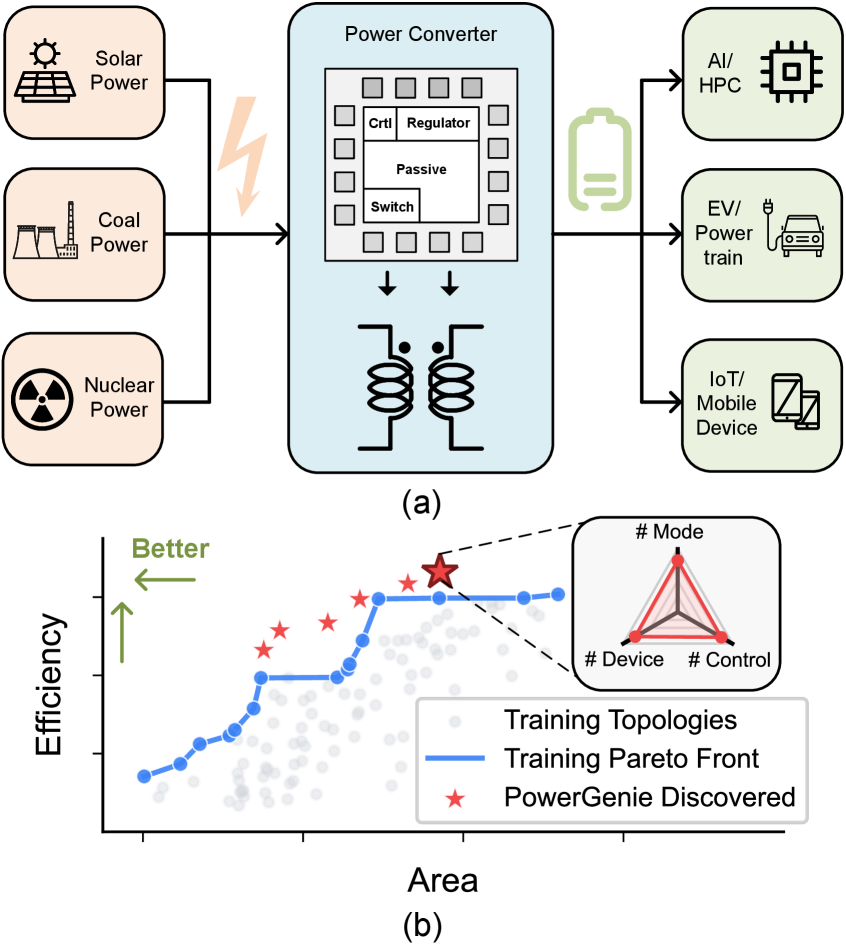
PowerGenie leverages evolutionary algorithms and analytical guidance to achieve superior performance in reconfigurable power converter design.
Navigating the exponentially expanding design space of power electronics remains a significant challenge, traditionally requiring extensive human expertise. This paper introduces PowerGenie: Analytically-Guided Evolutionary Discovery of Superior Reconfigurable Power Converters, a framework leveraging analytical performance bounds and evolutionary algorithms to automate the discovery of high-performance power converter topologies. PowerGenie achieves superior results by co-evolving a generative model with rigorous validation, uncovering a novel 8-mode converter exceeding the figure-of-merit of existing designs by 23%. Will this approach unlock a new era of AI-driven power electronics design, enabling rapid innovation and optimization beyond human capabilities?
The Inevitable Complexity of Power Conversion
The creation of power converters, essential components in nearly all electronic devices, has historically been a demanding and protracted undertaking. Designers traditionally depend on a blend of seasoned intuition, developed through years of experience, and repeated computer simulations to refine their circuits. This iterative process, while yielding functional results, is notably slow and resource-intensive, often requiring extensive testing and modification to meet stringent performance criteria. Each design cycle necessitates adjustments to component values and circuit configurations, demanding significant time investment from highly skilled engineers. Consequently, bringing a new, optimized power converter to market can be a lengthy and costly endeavor, hindering innovation and responsiveness to rapidly evolving technological demands.
The relentless drive towards miniaturization and heightened energy efficiency in modern electronics is fundamentally reshaping power converter design. Contemporary devices – from portable electronics and electric vehicles to data centers and renewable energy systems – demand power supplies that are both incredibly compact and exceptionally efficient. Traditional design methodologies, reliant on experienced engineers and iterative simulations, are increasingly unable to meet these stringent requirements within acceptable timeframes. This escalating demand is, therefore, compelling a paradigm shift towards automated topology discovery – computational methods capable of intelligently exploring the vast landscape of possible circuit configurations to identify optimal solutions that maximize efficiency, minimize size, and reduce development cycles. The ability to automatically generate and evaluate novel power converter topologies represents a critical pathway for innovation in power electronics and a necessary adaptation to the ever-increasing performance demands of modern technology.
The exploration of potential power converter designs is hampered by an inherent vastness in the solution space; a seemingly limitless combination of topologies, component values, and control strategies presents a significant computational challenge. Current automated design methods often rely on heuristics or pre-defined search spaces, which, while reducing complexity, inadvertently restrict the investigation to a fraction of all possible solutions. This limitation frequently results in suboptimal designs – power converters that meet basic requirements but fall short of achieving peak efficiency, minimal size, or optimal cost. The sheer combinatorial explosion makes exhaustive searches impractical, forcing designers to settle for locally optimal solutions rather than globally superior ones, and hindering innovation in power electronics.

The Automated Genesis of Optimized Topologies
Conventional power converter design relies heavily on human expertise and iterative refinement, a process that is both time-consuming and often suboptimal. PowerGenie overcomes these limitations by integrating analytical evaluation with evolutionary finetuning. Analytical evaluation provides a rapid, albeit approximate, assessment of design performance, allowing for the efficient culling of poorly performing topologies. This is then coupled with an evolutionary algorithm that iteratively refines promising designs, guided by the analytical feedback. By combining these two approaches, PowerGenie systematically explores the design space, leveraging the speed of analytical methods with the optimization capabilities of evolutionary algorithms to identify superior converter designs.
PowerGenie utilizes a Large Language Model (LLM) to create a broad range of power converter topologies during the design exploration phase. This LLM is prompted to generate circuit designs represented as textual descriptions, which are then translated into quantifiable circuit parameters. The use of an LLM enables the framework to move beyond pre-defined design templates and explore a significantly larger design space than traditional methods. This generative approach produces a diverse set of potential topologies, facilitating the identification of novel and potentially high-performing converter designs beyond those typically considered by human designers.
PowerGenie employs a co-evolutionary strategy where the generative model, responsible for creating power converter topologies, is simultaneously optimized alongside the distribution of designs it is trained on. This process avoids premature convergence and allows for continuous improvement of the generative model’s ability to produce high-performing designs. Specifically, this methodology yielded a demonstrated Figure of Merit (FoM) of 0.323, representing a quantifiable measure of the optimized designs’ efficiency and performance characteristics. The co-evolutionary approach ensures the model continually refines its design generation process based on the evolving performance landscape, leading to efficient convergence on superior solutions.
![PowerGenie identified an optimized eight-mode power converter that achieves improved steady-state loss ([latex] ilde{M}_{SSL} = 0.732 [/latex]) and reduced capacitor count ([latex] ilde{N}_{cap} = 0.417 [/latex]) compared to existing designs, while exhibiting comparable fast switching loss ([latex] ilde{M}_{FSL} = 0.801 [/latex]), and SPICE simulations demonstrate both higher efficiency at low loads and a 10.45% average efficiency gain at 3mA, highlighting its superior power handling capabilities.](https://arxiv.org/html/2601.21984v1/x4.png)
Graph Theory: A Structural Lens on Performance
PowerGenie employs Graph Theory to represent circuit topologies as mathematical graphs, where nodes represent circuit elements and edges define their connectivity. This allows the system to analyze circuit characteristics – such as current flow, voltage distribution, and switching behavior – through graph-based algorithms, rather than relying on computationally intensive circuit simulation. By mapping the circuit’s structure onto a graph, PowerGenie can predict performance characteristics based on the topological properties of the graph, enabling efficient analysis of complex circuits without requiring detailed time-step simulations. This analytical approach facilitates the identification of potential performance bottlenecks and optimization opportunities within the circuit design.
The PowerGenie system determines circuit performance boundaries using the Slow Switching Limit (SSL) Metric and Fast Switching Limit (FSL) Metric, both calculated analytically without relying on SPICE simulation. The SSL Metric identifies the point at which circuit switching speed becomes unacceptably slow, while the FSL Metric defines the maximum achievable switching speed before instability occurs. These metrics are derived from the circuit’s topology and component values through Graph Theory-based analysis, providing a rapid assessment of performance limits. This analytical approach avoids the computational expense of iterative SPICE simulations, which require solving complex differential equations for each circuit evaluation.
PowerGenie’s analytical evaluation framework achieves significant time savings in circuit topology assessment by eliminating the need for SPICE simulation. Traditional SPICE-based evaluations require an average of 8741 seconds per topology, whereas PowerGenie completes the same evaluation in 0.07 seconds. This represents a reduction in evaluation time of approximately 124,857x, allowing for substantially more rapid iteration and exploration of the design space. The framework’s speed is attributable to its simulation-free methodology, which relies on analytical calculations rather than iterative simulations to determine performance characteristics.

Beyond Optimization: A Holistic View of Design Excellence
Conventional evaluations of power converter designs often prioritize single metrics, such as efficiency, overlooking crucial trade-offs with component count and overall system complexity. PowerGenie addresses this limitation through a comprehensive Figure of Merit (FoM), a holistic assessment that simultaneously considers efficiency, the number of components utilized, and other performance-critical factors. This nuanced approach allows for a more realistic and practical evaluation of converter topologies, moving beyond simple optimization of isolated parameters. By integrating these diverse considerations into a single score, PowerGenie facilitates the discovery of designs that aren’t just efficient, but also compact, reliable, and cost-effective – ultimately leading to superior overall performance and enabling advancements in power electronics design.
Evaluations reveal that PowerGenie consistently outperforms established reinforcement learning and supervised learning techniques for power converter design. Compared to Direct Preference Optimization (DPO), Proximal Policy Optimization (PPO), and Supervised Fine-Tuning (SFT), the framework achieves a notably higher Figure of Merit, indicating superior efficiency and component utilization. This improved performance isn’t merely incremental; PowerGenie attains a Figure of Merit of 0.323, exceeding the training set maximum of 0.263 achieved by baseline methods, and demonstrates this consistency with a standard deviation of 0.033 – significantly lower than the approximately 0.13 observed in comparative tests. These results highlight PowerGenie’s capacity to identify optimized topologies that not only enhance performance metrics but also offer increased reliability and reduced physical size.
The PowerGenie framework demonstrably surpasses conventional design methods by autonomously identifying power converter topologies exhibiting substantial improvements across key performance indicators. Rigorous testing reveals a 22% increase in the composite Figure of Merit (FoM), achieving a value of 0.323 – a significant leap from the 0.263 maximum observed within the initial training dataset. This optimization extends beyond mere efficiency, also resulting in a reduction of component count – the highest performing topology discovered utilized 47 switches compared to the 51 found in the best training example. Notably, the framework exhibits greater design consistency, evidenced by a standard deviation of FoM measuring just 0.033 – substantially lower than the approximately 0.13 observed across all baseline methods, indicating more robust and reliable converter designs.

The pursuit of optimized power converter topologies, as demonstrated by PowerGenie, echoes a fundamental truth about complex systems. It isn’t merely about assembling components, but cultivating an ecosystem where emergent properties arise through iterative refinement. The framework’s evolutionary approach, exceeding human-designed benchmarks, suggests that the limitations aren’t in the algorithms themselves, but in the initial constraints imposed. As Carl Friedrich Gauss observed, “If other sciences or branches of knowledge offer their own advantages, it is because they are more simple; and they are simpler because they are less comprehensive.” PowerGenie, in its capacity for large-scale exploration, doesn’t build superior designs; it allows them to evolve, revealing that the path to optimization often lies in embracing complexity rather than attempting to constrain it.
What Lies Ahead?
The presented work demonstrates automated topology discovery, but each successful configuration feels less like an achievement and more like a temporary reprieve. PowerGenie exposes the sheer vastness of the design space, a space no human, and increasingly no algorithm, can truly know. Future iterations will undoubtedly yield incrementally better converters, yet the fundamental problem persists: optimization within a defined, but ultimately arbitrary, search space. The true limitation isn’t computational power, but the implicit biases baked into the very definition of ‘superior’ performance.
The field now faces a subtle shift. It’s no longer about finding the best answer, but about intelligently defining the question. Generative models will likely move beyond topology, attempting to co-optimize component characteristics and control strategies. However, the accumulation of ‘optimized’ designs will inevitably create brittle, overspecialized systems, exquisitely tuned to conditions that will never perfectly repeat. Documentation, naturally, will become an exercise in archaeological reconstruction, detailing how things used to work.
One can foresee a future where automated design tools aren’t judged on peak efficiency, but on their capacity for graceful degradation. Systems that fail interestingly, revealing their internal logic rather than collapsing into silent failure, may prove more valuable in the long run. The goal shouldn’t be to eliminate failure, but to understand it, to build systems that whisper the reasons for their decline. Every deploy, after all, is a small apocalypse.
Original article: https://arxiv.org/pdf/2601.21984.pdf
Contact the author: https://www.linkedin.com/in/avetisyan/
See also:
- The Division Resurgence Best Weapon Guide: Tier List, Gear Breakdown, and Farming Guide
- Last Furry: Survival redeem codes and how to use them (April 2026)
- Guild of Monster Girls redeem codes and how to use them (April 2026)
- GearPaw Defenders redeem codes and how to use them (April 2026)
- After THAT A Woman of Substance cliffhanger, here’s what will happen in a second season
- Gold Rate Forecast
- Clash of Clans Sound of Clash Event for April 2026: Details, How to Progress, Rewards and more
- eFootball 2026 “Countdown to 1 Billion Downloads” Campaign arrives with new Epics and player packs
- Wuthering Waves Hiyuki Build Guide: Why should you pull, pre-farm, best build, and more
- Genshin Impact Version 6.5 Leaks: List of Upcoming banners, Maps, Endgame updates and more
2026-01-31 16:01