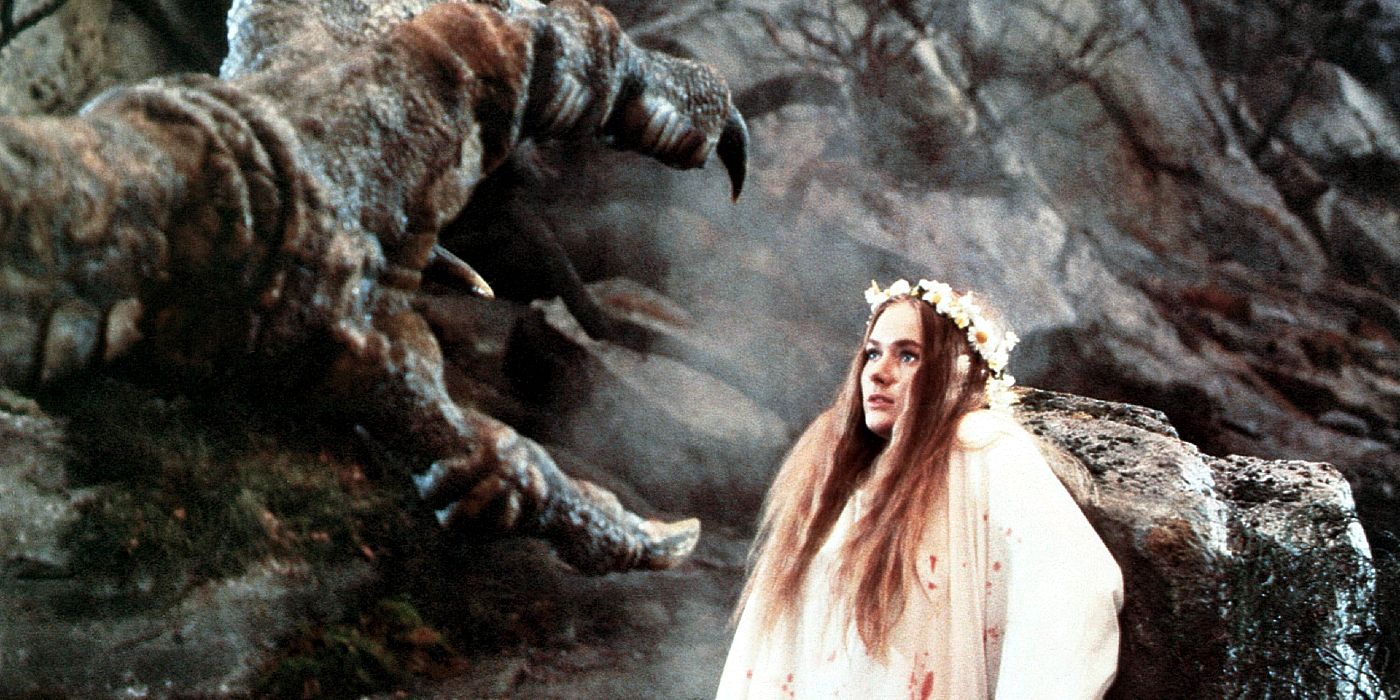
The 1980s produced some truly memorable and visually stunning films. Because animation wasn’t as advanced and more money went into creating detailed worlds, fantastic creatures, and elaborate costumes, fantasy movies could really shine with impressive sets, monsters, and action sequences, rather than relying heavily on big-name actors or computer effects. While films like Willow, The Princess Bride, and Labyrinth are often remembered as the best of ‘80s fantasy, Matthew Robbins’ 1981 film, Dragonslayer, is arguably the most overlooked – and boasts some of the most impressive creature design of the era.
The movie Dragonslayer tells the story of Galen Bradwarden, a wizard’s apprentice chosen by a magical amulet to save a kingdom from a fearsome dragon named Vermithrax Pejorative. This ancient dragon, over 400 years old, is terrorizing the land and demanding human sacrifices. Despite receiving two Academy Award nominations and a high 84% rating on Rotten Tomatoes, Dragonslayer didn’t perform well at the box office, failing to earn back its $18 million production cost. This was an unusual loss for both Disney and Paramount, the studios that teamed up to make the film.
Dragonslayer’sVermithrax Pejorative Is Still the Best-Looking Dragon Ever Put to Screen
These days, it’s rare to see truly realistic dragon effects in movies and TV. While the dragons in the live-action How to Train Your Dragon look impressive, they’re clearly created with computer graphics and lack the believable quality of physical effects. In contrast, Vermithrax Pejorative from Dragonslayer was a massive, 40-foot dragon brought to life with animatronics and a team of 16 puppeteers, allowing it to flap its wings, move convincingly, and even breathe fire.
I was so impressed with what Phil Tippett brought to the table! He’d already done amazing work on The Empire Strikes Back, and would go on to create incredible effects for Jurassic Park. But what really blew me away was his invention of “Go-Motion.” Basically, he figured out how to add a little blur during the filming of stop-motion animation, right when the camera shutter opened and closed. This made the creatures’ movements look so much smoother and more realistic – way less stiff than traditional stop-motion! It was a game-changer.
To create a truly stunning dragon, Tippett led a team of 80 special effects artists at Industrial Light & Magic. They used a combination of techniques: a massive 16-foot robotic head for detailed close-ups and smaller, stop-motion models for distant flying scenes. While David Bunnet originally designed the dragon, Vermithrax Pejorative, Tippett refined the look to make it more believable, including adding large, bat-like wings.
The movie truly showcased ILM’s skill in a stunning fantasy sequence, when the dragon Vermithrax emerges from the water and fire behind Galen, revealing its immense size and wingspan. The subsequent battle was epic and could have been enough to win the film the Oscar for Best Visual Effects. However, it was competing against Raiders of the Lost Ark, widely considered one of the greatest adventure films ever made.
Dragonslayer Was Much More Influential to the Fantasy Genre Than It Seems
Although Phil Tippett didn’t begin his effects career with Dragonslayer, it was one of his first projects and a significant achievement, earning him an Oscar nomination. This early recognition helped launch his career and led to his work on iconic films like Return of the Jedi (including the Rancor creature), Starship Troopers, and the popular 1990s fantasy film, Dragonheart. Without Dragonslayer, these visually stunning films might not have been possible.
Matthew Robbins’ career really began to flourish around this time. He went on to direct another film, Batteries Not Included, and even contributed uncredited writing to Steven Spielberg’s blockbuster E.T. the Extra-Terrestrial. This wasn’t their first collaboration; Robbins had previously written The Sugarland Express with Spielberg, and also secretly helped with the scripts for two of Spielberg’s most famous films, Jaws and Close Encounters of the Third Kind.
In the 1990s, Robbins began working with acclaimed director Guillermo del Toro on the film Mimic, a story about giant cockroaches infesting New York City’s subway tunnels. He continued to write screenplays with del Toro for several of his most popular movies, including Crimson Peak in 2015, and a film that earned a Best Animated Feature nomination in 2022.
While not a widely famous film, Dragonslayer is incredibly influential in the history of cinema. Its special effects were groundbreaking and inspired many of Hollywood’s most respected directors and some of the most beloved movies ever created.
Read More
- Clash Royale Best Boss Bandit Champion decks
- Vampire’s Fall 2 redeem codes and how to use them (June 2025)
- World Eternal Online promo codes and how to use them (September 2025)
- Best Arena 9 Decks in Clast Royale
- Mobile Legends January 2026 Leaks: Upcoming new skins, heroes, events and more
- Country star who vanished from the spotlight 25 years ago resurfaces with viral Jessie James Decker duet
- How to find the Roaming Oak Tree in Heartopia
- M7 Pass Event Guide: All you need to know
- Solo Leveling Season 3 release date and details: “It may continue or it may not. Personally, I really hope that it does.”
- ATHENA: Blood Twins Hero Tier List
2025-12-08 07:10