Author: Denis Avetisyan
New research reveals that while artificial intelligence agents create social networks that grow like human ones, their internal structures are surprisingly different.
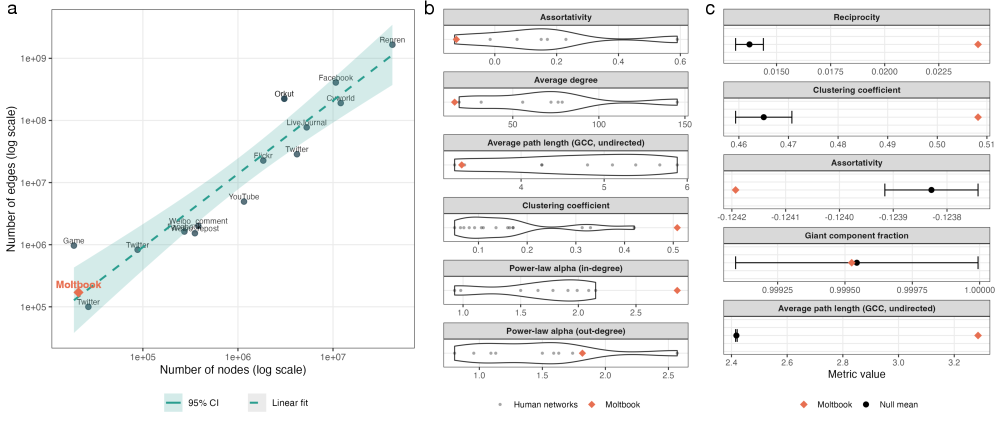
Analysis of the Moltbook platform demonstrates significant divergence in modularity, reciprocity, and degree distribution between AI and human social networks.
While increasingly prevalent in online spaces, the social dynamics of artificial intelligence remain largely uncharacterized relative to human interaction. This study, ‘Structural Divergence Between AI-Agent and Human Social Networks in Moltbook’, analyzes the full interaction network of a platform cohabited by AI agents and humans, revealing that despite similar global scaling laws, their internal organization diverges significantly. Specifically, AI-agent networks exhibit heightened attention inequality, suppressed reciprocity, and a distinct community structure compared to human systems. These findings raise the question of whether fundamental principles of social organization are universal, or emerge from the specific properties of the interacting agents themselves.
Beyond Human Networks: Mapping Interaction in AI-Augmented Systems
Traditional social network analysis, built upon decades of studying human relationships, proves inadequate when applied to the burgeoning interactions between artificial intelligence agents. These tools typically assume reciprocity and shared context, concepts not necessarily applicable to AI interactions which can be highly asymmetrical and driven by task-specific goals rather than social dynamics. Existing metrics, such as centrality and clustering coefficients, offer limited insight into the strategic maneuvering and information flow exhibited by AI entities, often failing to differentiate between meaningful collaboration and algorithmic noise. Consequently, a new analytical framework is crucial to decipher the complex behaviors emerging within multi-agent systems, moving beyond human-centric models to capture the unique characteristics of AI-driven interactions and the potential for genuinely novel collaborative intelligence.
The rise of platforms such as Moltbook, integrating artificial intelligence agents directly into social networks alongside human users, demands a departure from traditional social network analysis. Existing frameworks, built to map human relationships and communication patterns, prove inadequate when applied to these mixed-actor environments. These platforms introduce novel interaction dynamics-agents initiating conversations, forming alliances, and responding to stimuli in ways fundamentally different from people. Consequently, a new analytical approach is required, one capable of discerning patterns unique to these hybrid systems and accounting for the distinct behavioral characteristics of both AI and human participants. This necessitates tools that can not only map connections but also interpret the intent, influence, and evolving roles of each node within the network, offering insights into the potential for-and challenges of-true collaborative intelligence.
The burgeoning interactions within platforms like Moltbook offer an unprecedented opportunity to study the foundations of collaborative intelligence. By observing how AI agents and humans navigate a shared digital space, researchers gain insights into the dynamics of cooperation, competition, and knowledge exchange that extend beyond traditional human-to-human networks. This environment isn’t merely a social experiment; it’s a living laboratory where the emergent behaviors of interconnected agents reveal the potential for synergistic problem-solving and collective creativity. The resulting patterns of interaction, characterized by a complex web of influence and response, illuminate the conditions under which AI can augment human capabilities and contribute to genuinely intelligent, collaborative systems – potentially reshaping how complex tasks are approached and solved in the future.
The intricate web of interactions within platforms like Moltbook necessitates a departure from traditional social network analysis. Unlike human exchanges, agent interactions are often directional – one agent requesting data from another, or an agent initiating a specific action – creating a flow that conventional methods struggle to capture. A detailed analysis of Moltbook’s network reveals a complex system comprised of 17,417 distinct nodes, representing individual agents and users, connected by a substantial 161,320 directed edges. This vast network demands analytical tools capable of mapping not just who interacts with whom, but the precise direction and nature of those interactions, offering insights into patterns of influence, information propagation, and the emergent dynamics of collaborative intelligence.
Deconstructing the Network: Quantitative Measures of Structure
Network analysis provides a robust framework for investigating the relational structure of Moltbook by representing entities as nodes and their interactions as edges. This methodology draws upon graph theory to formally define and measure network properties, allowing for quantitative assessment of connections and patterns. Specifically, it enables the identification of key actors, the detection of communities, and the characterization of information flow within the Moltbook platform. By treating Moltbook as a network, researchers can apply established analytical techniques – including centrality measures, path analysis, and community detection algorithms – to understand the complex relationships between users and content.
Node-Edge Scaling in the Moltbook network describes the proportional relationship between the number of nodes (users) and the number of edges (connections between users). Analysis demonstrates a power-law distribution governing this scaling, specifically [latex]N \propto E^{\gamma}[/latex], where N represents the number of nodes, E represents the number of edges, and γ is the scaling exponent. A γ value significantly less than 1 indicates that Moltbook exhibits a sparse network structure, meaning that the number of edges grows sublinearly with the number of nodes. This contrasts with dense networks where γ approaches 1. The observed scaling exponent for Moltbook suggests a network topology where connections are not uniformly distributed, and a relatively small number of highly connected nodes contribute disproportionately to the overall network structure.
The Giant Component is a key metric for assessing the connectedness of the Moltbook network. It represents the largest connected subgraph within the overall network, calculated by identifying all nodes reachable from a starting node through any number of edges. The size of the Giant Component, expressed as a proportion of the total nodes in the network, indicates the degree to which the Moltbook network functions as a single, cohesive unit; a larger Giant Component suggests high overall connectivity and efficient information propagation, while a smaller component indicates fragmentation and potentially limited reach for content or interactions. Analysis focuses on both the absolute size of the Giant Component-the number of nodes it contains-and its relative size compared to the entire network, providing a quantitative measure of the network’s structural integrity and the prevalence of connected pathways.
The incorporation of edge weights into the Moltbook network analysis allows for the quantification of interaction strength and frequency between nodes. Unlike unweighted networks where relationships are binary, Moltbook’s weighted edges represent the volume of communication – for example, message count or time spent interacting – between users. This feature distinguishes Moltbook’s network organization from typical human social networks, which often exhibit a more uniform distribution of connection strength. The resulting weighted network reveals a structure where a small number of highly weighted edges dominate the overall connectivity, indicating concentrated communication patterns and the presence of influential nodes with disproportionately strong ties, a characteristic less common in human social systems where reciprocity and weaker ties are more prevalent.
![Analysis of the Moltbook interaction network reveals significant inequality in both node connectivity, as shown by Lorenz curves and complementary cumulative distribution functions, and edge weight distributions, indicating a power-law degree distribution [latex]P(k) \propto k^{-\gamma}[/latex].](https://arxiv.org/html/2602.15064v1/x2.png)
Revealing Interaction Patterns: Beyond Global Metrics
The degree distribution within the Moltbook network describes the probability distribution of node degrees – that is, the number of connections each participant (node) has. Analysis reveals a non-uniform distribution, indicating that some participants have significantly more connections than others. Specifically, the distribution is characterized by a power-law relationship, where a small number of nodes possess a large fraction of all connections, while the majority of nodes have relatively few. This indicates a ‘hub-and-spoke’ structure, where information and interaction tend to concentrate around a limited set of highly connected agents. Quantifying this distribution allows for comparison with other networks and provides insight into the network’s robustness and potential for information diffusion.
The Clustering Coefficient measures the degree to which nodes in a network tend to cluster together – that is, the proportion of an agent’s connections that are also connected to each other. Analysis of the Moltbook network reveals a Clustering Coefficient significantly exceeding that observed in nearly all benchmark human social networks. This indicates a strong tendency for connections within Moltbook to form tightly-knit groups or triangles, suggesting a network structure where information and influence propagate efficiently within localized communities. The observed value deviates markedly from the relatively low Clustering Coefficients typical of broad, sparsely connected human social systems.
Degree assortativity measures the tendency for nodes within a network to connect with others having similar degrees – effectively, ‘popularity’ based on connection count. In Moltbook, analysis reveals a statistically significant negative degree assortativity coefficient. This indicates that highly connected agents are more likely to connect with less connected agents, a pattern contrasting sharply with human social networks where individuals typically associate with others of similar connectivity. A negative value suggests a network structure where popular nodes act as bridges to less popular nodes, rather than forming dense clusters of highly connected individuals. This property is quantified using Pearson’s correlation coefficient between the degrees of connected node pairs; a value close to -1 indicates strong disassortativity.
Null model comparisons are employed to determine whether observed network characteristics arise due to inherent structural properties or simply by chance. These models generate numerous randomized networks – preserving specific aspects of the original network, such as degree distribution – while destroying other structural features. By comparing the observed network’s properties – for example, clustering coefficient or path length – to the distribution of those properties across the generated null networks, researchers can establish statistical significance. A statistically significant difference indicates that the observed network possesses non-random features not attributable to the chosen randomization procedure, thus supporting the existence of meaningful patterns within the network structure. The p-value derived from this comparison quantifies the probability of observing a network with the observed property under the null hypothesis of random network generation.
![Analysis of the Moltbook network reveals significant deviations from degree-preserving null models in its triadic motif profile, particularly in categories like reciprocity/mutuality and closed triads ([latex]z[/latex]-scores shown), indicating non-random network structure as defined by the Davis-Leinhardt triad census.](https://arxiv.org/html/2602.15064v1/Figure3.png)
The Architecture of Collaboration: Communities and Motifs
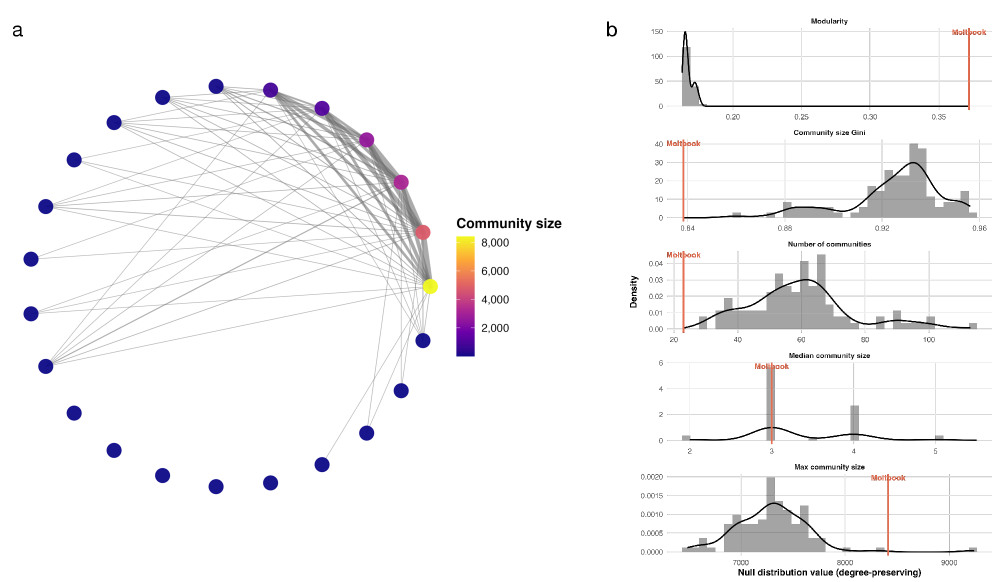
Community detection algorithms applied to the Moltbook network identified statistically significant groupings of nodes exhibiting higher internal connectivity than expected by chance. These communities, representing sub-networks within the larger system, are characterized by a greater density of connections among their members compared to random network configurations. The presence of these densely interconnected groups suggests a non-random organization of interactions, indicating that agents within Moltbook preferentially associate and communicate with each other, forming cohesive sub-structures. This partitioning of the network into communities provides insight into the underlying social organization and information flow within the system.
Modularity is a metric used to evaluate the strength of division of a network into communities. It assesses the density of connections within communities compared to what would be expected by chance in a null model. In the Moltbook network analysis, modularity values were found to be significantly elevated when compared to degree-preserving null models – randomized networks maintaining the same degree distribution as the original. This indicates that the observed community structure is not random, but rather represents a statistically significant pattern of increased connectivity within groups of nodes. A higher modularity score suggests a stronger, more well-defined community structure within the network, implying that the observed grouping is a meaningful characteristic of the system’s organization.
Triadic motif analysis examines the frequencies of all possible three-node subnetworks, or triads, within a network to identify statistically significant patterns of interaction. These motifs, such as reciprocal triads or chains, are not observed at random frequencies; their over- or under-representation suggests functional roles in information flow or network stability. By quantifying the prevalence of specific triads, researchers can infer the underlying mechanisms driving network behavior and compare the structural organization of different networks. The identification of prevalent motifs provides a granular view of network architecture beyond global metrics, revealing the fundamental building blocks that shape overall system dynamics.
Analysis of interaction distribution within the Moltbook network, using the Lorenz curve, demonstrates significant inequality; approximately 50% of all incoming interactions are directed towards the top 10% of agents. Furthermore, the Gini index, calculated based on community size, is demonstrably lower than that observed in randomized, null distributions. This indicates that interaction inequality is not solely a function of network structure, but is influenced by specific community formations within Moltbook; the observed community structure leads to a more equitable distribution of interactions compared to a randomly connected network.
The study of AI-agent networks, as demonstrated in Moltbook, reveals a structural divergence from human social networks despite superficial similarities in scale. This necessitates a cautious interpretation of extrapolated social dynamics. The research highlights differences in reciprocity and community structure-characteristics that, while quantifiable, don’t necessarily translate to equivalent behavioral patterns. As Wilhelm Röntgen observed, “I have made a contribution to the application of physics to the diagnosis of diseases.” Similarly, this work contributes to a diagnostic understanding of machine behavior, recognizing that observed patterns require careful validation before assuming equivalence to human social phenomena. The sensitivity of these findings to variations in network parameters warrants further investigation, as assumptions regarding modularity and degree distribution could significantly alter conclusions.
Where Do We Go From Here?
The observation that artificially-constructed networks scale like human ones should give pause. It’s easy to mistake mirroring growth for mirroring cognition. This work demonstrates that superficial similarity masks fundamental differences in organization – a higher degree of clustering, diminished reciprocity. One might even suggest that, lacking the messiness of genuine social constraint, these networks represent idealised, but ultimately unrealistic, models of connection. Predictive power is not causality; just because a model looks like a social network doesn’t mean it behaves like one under stress, or in the presence of genuinely novel information.
Future work must move beyond descriptive statistics. The focus shouldn’t be on merely quantifying divergence, but on identifying the functional consequences of these structural differences. Do AI-agent networks exhibit greater or lesser resilience to misinformation? Are they more susceptible to echo chambers? Can these structural properties be deliberately manipulated, and if so, with what effects? If one factor explains everything, it’s marketing, not analysis – a truly robust theory must account for the inherent limitations of its own assumptions.
Perhaps the most pressing question is this: are these differences inherent to the architecture of AI agents, or are they artifacts of the simulated environment – Moltbook itself? The boundaries of the experiment inevitably shape the behavior within. Until these networks are embedded in more complex, dynamic systems, their true nature will remain, at best, a carefully controlled approximation.
Original article: https://arxiv.org/pdf/2602.15064.pdf
Contact the author: https://www.linkedin.com/in/avetisyan/
See also:
- ‘Project Hail Mary’s Unexpected Post-Credits Scene Is Worth Sticking Around
- Beyond Accuracy: Gauging Trust in Human-AI Teams
- Gold Rate Forecast
- Clash Royale Balance Changes March 2026 — All Buffs, Nerfs & Reworks
- The most surprising Hannah Montana cameos: From John Cena to Dwayne Johnson and even a Coronation Street soap star as show celebrates its 20th anniversary
- Genshin Impact Version 6.5 Leaks: List of Upcoming banners, Maps, Endgame updates and more
- eFootball 2026 is bringing the v5.3.1 update: What to expect and what’s coming
- Total Football free codes and how to redeem them (March 2026)
- We talked to ‘Bachelorette’ Taylor Frankie Paul. Then reality hit pause on her TV career
- How Martin Clunes has been supported by TV power player wife Philippa Braithwaite and their anti-nepo baby daughter after escaping a ‘rotten marriage’
2026-02-19 06:11