Author: Denis Avetisyan
A new machine learning technique accurately identifies the size and charge of polycyclic aromatic hydrocarbons in space by analyzing their infrared light signatures.
![The ratio of emission intensities at 11.2 and 3.3 micrometers-a proxy for molecular complexity-correlates with the number of carbon atoms in polycyclic aromatic hydrocarbons (PAHs), as demonstrated by analysis of a dataset of 15,022 neutral PAHs-including a subset of 81 identified by Maragkoudakis et al. (2020)-and refined using a 6 eV cascade model, yielding a robust fit-indicated by [latex]R^{2}[/latex] values-that suggests a predictable relationship between molecular size and infrared spectral features.](https://arxiv.org/html/2602.12531v1/x1.png)
This study demonstrates full-spectrum inference using random forest algorithms to improve spectroscopic analysis of interstellar polycyclic aromatic hydrocarbons.
Traditional analyses of interstellar polycyclic aromatic hydrocarbons (PAHs) have relied on limited band ratios, introducing biases and information loss in characterizing these ubiquitous molecules. This limitation is addressed in ‘Full-Spectrum Machine Learning Diagnostics for Interstellar PAHs’, which introduces a novel framework leveraging machine learning to interpret the complete infrared emission spectrum as a unique fingerprint. By training a Random Forest classifier on a large dataset, the authors achieve highly accurate classification of PAH size and charge states, revealing a complex interplay between spectral features and ionization. Can this full-spectrum approach unlock a more detailed understanding of the physical conditions within the interstellar medium and the role of PAHs in galactic evolution?
The Interstellar Mirror: Unveiling PAHs
Polycyclic aromatic hydrocarbons, or PAHs, represent a significant, though incompletely understood, fraction of the interstellar medium’s carbon budget. These molecules, formed in the outflows of dying stars and in the aftermath of supernova explosions, are thought to play a vital role in the heating and cooling of interstellar gas, and serve as the building blocks for more complex organic molecules. Despite their prevalence – detected throughout galaxies and even in distant quasars – characterizing PAH properties remains a substantial challenge. Existing observational limitations and the inherent complexity of interstellar environments hinder precise determination of PAH size distributions, ionization states, and chemical compositions. This lack of detailed knowledge impedes a complete understanding of their influence on astrophysical processes, from star formation to the evolution of galaxies, necessitating continued research and innovative analytical techniques.
Astronomical studies of polycyclic aromatic hydrocarbons (PAHs) frequently employ band ratio analysis – notably the [latex]I_{11.2}/I_{3.3}[/latex] ratio – as a proxy for PAH size. However, this technique fundamentally assumes a single, dominant PAH population and struggles to accurately characterize the complex mixtures prevalent in interstellar space. The intensity of these specific bands is sensitive not only to size, but also to ionization state, the presence of aliphatic side groups, and subtle variations in the molecular structure of the PAH itself. Consequently, relying solely on band ratios can lead to misinterpretations, potentially oversimplifying the true diversity of PAH populations and obscuring crucial information about their formation pathways and evolution within the interstellar medium. A more holistic approach, capturing the full spectral morphology, is necessary to disentangle these complexities and gain a more nuanced understanding of PAH properties.
Precisely defining the size and charge state of polycyclic aromatic hydrocarbons (PAHs) is paramount to unraveling their influence on astrophysical phenomena. These molecules, prevalent throughout interstellar space, interact with radiation in ways heavily dependent on their physical characteristics; smaller PAHs tend to emit at higher energies, while those with larger structures produce emissions at lower energies. Crucially, the number of electrons associated with a PAH – its charge state – significantly alters its spectral fingerprint. A negatively charged PAH, for example, will exhibit different emission patterns than a neutral or positively charged one. Determining these properties isn’t merely an exercise in molecular identification; it allows scientists to accurately model how PAHs contribute to infrared emission observed from galaxies, influence the heating and cooling of interstellar gas, and even participate in the formation of planets. Accurate characterization, therefore, is fundamental to interpreting vast amounts of astronomical data and building a complete picture of the interstellar medium.
The rich tapestry of light emitted by polycyclic aromatic hydrocarbons (PAHs) in space holds a wealth of information, yet conventional analysis often focuses on a few prominent emission features, effectively overlooking the subtleties encoded within the complete spectrum. This ‘full-spectrum morphology’ – the detailed shape and structure of the entire PAH emission – reveals nuances in molecular structure, size distribution, and ionization states that are obscured when relying solely on band ratios. While techniques like examining the I11.2/I3.3 ratio provide a first-order approximation of PAH characteristics, they fail to capture the full complexity of interstellar PAH mixtures, potentially leading to misinterpretations of their abundance, evolution, and influence on crucial astrophysical processes like star formation and the heating of the interstellar medium. A more holistic approach, embracing the full spectral fingerprint, is therefore essential for unlocking the complete story of these ubiquitous molecules.
A Machine’s Gaze: A New Analytical Pathway
Traditional methods of determining polycyclic aromatic hydrocarbon (PAH) properties rely on fitting observed spectra to theoretical models, a process which can be computationally expensive and prone to degeneracy. Machine learning techniques offer a direct approach by inferring PAH characteristics from full emission spectra without requiring explicit modeling. This alternative leverages the relationships inherent within spectral data to predict properties such as PAH size and charge state, effectively bypassing the need for iterative fitting procedures. The ability to directly analyze emission spectra significantly reduces computational demands and allows for the rapid characterization of PAHs in complex astronomical environments.
A Random Forest Classifier was implemented to determine both the size and charge state of Polycyclic Aromatic Hydrocarbons (PAHs) directly from their observed emission spectra. This supervised learning approach utilizes an ensemble of decision trees, each trained on a subset of the spectral features, to predict the PAH characteristics. The classifier leverages variations in peak positions and intensities within the spectra – features sensitive to both molecular size and ionization state – to differentiate between PAH populations. The algorithm outputs a predicted size category (small, medium, or large) and charge state, providing a quantitative assessment based on the input spectral data.
The AmesPAHdb database provided the spectral data necessary for both training and validating the Random Forest Classifier. This database contains a substantial collection of PAH spectra, specifically comprising 13,626 emission spectra representing small PAHs, 4638 for medium PAHs, and 663 for large PAHs. This dataset distribution allowed for a robust training process, ensuring the model was exposed to a wide range of PAH sizes and their corresponding spectral features. Independent subsets of this database were utilized for training and validation to assess the model’s generalization capability and prevent overfitting.
The generation of the training dataset necessitated the conversion of available absorption spectra to emission spectra via the Thermal Cascade Approximation (TCA). The TCA models the internal conversion of energy within a PAH molecule following initial excitation, predicting the relative intensities of emitted photons at different wavelengths. This process is crucial because astronomical observations primarily capture emission spectra, while the AmesPAHdb database initially contained absorption spectra. The TCA effectively simulates the radiative cascade, allowing for the creation of synthetic emission spectra that accurately represent the expected observational signatures of PAHs, and thereby enabling the supervised training of the Random Forest Classifier.
Unveiling the Signals: Feature Importance and Robustness
The AmesPAHdb dataset exhibits class imbalance, a common challenge in spectral analysis where some PAH compounds are significantly less represented than others. To mitigate this, the Synthetic Minority Oversampling Technique (SMOTE) was implemented. SMOTE generates synthetic examples for minority classes by interpolating between existing minority class instances, effectively increasing their representation in the training set. This process does not create copies of existing data, but rather novel, similar instances. Application of SMOTE to the AmesPAHdb resulted in an improved model accuracy, as the classifier was no longer biased towards the more prevalent PAH classes during training and evaluation.
Gini Importance, a metric calculated within the Random Forest Classifier, quantifies each feature’s contribution to the reduction in the node impurity (typically Gini impurity or entropy) across all trees in the forest. Features with higher Gini Importance values are thus more predictive. In this analysis, the metric was used to determine which spectral features most strongly influenced the model’s PAH classification performance. The resulting feature rankings provide insights into the spectral characteristics most relevant for distinguishing between different PAH compounds and, subsequently, for understanding the underlying chemical processes contributing to the observed spectral signatures.
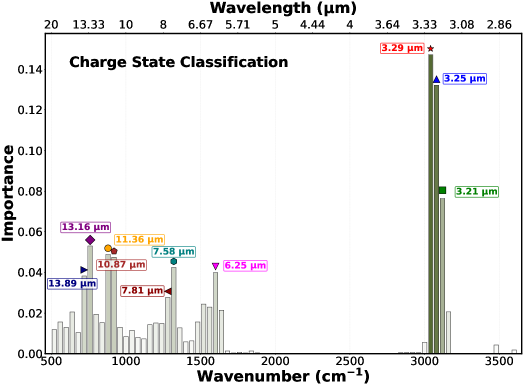
Gini Importance analysis within the Random Forest Classifier model indicated that the spectral feature at 3.3 μm, corresponding to C-H stretching vibrations, is a highly influential predictor. Further analysis revealed that C-H Out-of-Plane Bending Modes also contribute significantly to the model’s predictive power. These features likely serve as strong indicators of the presence and concentration of polycyclic aromatic hydrocarbons (PAHs) due to the prevalence of C-H bonds within their molecular structures. The consistent identification of these features underscores their importance in spectral-based PAH detection and characterization.
Analysis of the AmesPAHdb dataset indicated that spectral features associated with C-C stretching modes are significant predictors of polycyclic aromatic hydrocarbon (PAH) charge state. These features, observable in the mid-infrared region, relate to the vibrational frequencies of carbon-carbon bonds within the PAH molecule. Variations in these frequencies are sensitive to the electronic structure of the PAH, which is directly influenced by its charge. Consequently, the intensity and position of C-C stretching peaks provide information necessary to differentiate between neutral, positively charged, and negatively charged PAH species, contributing to improved PAH identification and quantification.
![Feature importance analysis reveals that the top five influential features ([latex]\pmb{highlighted}[/latex]) vary across different charge states-neutral, cation ([latex]+1+1[/latex]), dication ([latex]+2+2[/latex]), and anion ([latex]-1-1[/latex])-influencing size classification.](https://arxiv.org/html/2602.12531v1/x3.png)
Echoes in the Void: Implications for Astrochemistry and Beyond
The analysis of interstellar spectra, notoriously complex due to the superposition of numerous molecular signals, has been significantly advanced by a novel machine learning technique. This approach moves beyond traditional methods by effectively disentangling the intricate patterns within spectral data, allowing for a more precise characterization of polycyclic aromatic hydrocarbons (PAHs) – molecules crucial to understanding the interstellar medium. By accurately identifying and quantifying PAH populations, researchers gain deeper insights into the composition and evolution of star-forming regions and protoplanetary disks. The system’s ability to process and interpret these complex datasets offers a powerful new tool for astrochemists, facilitating more detailed studies of these ubiquitous molecules and ultimately refining models of interstellar processes.
Precisely characterizing the size and charge state of polycyclic aromatic hydrocarbons (PAHs) unlocks crucial insights into their astrophysical lifecycle. These molecules, abundant in interstellar space, are not static entities; their formation pathways – whether through bottom-up processes involving smaller carbon fragments or top-down fragmentation of larger structures – directly influence their size distribution. Simultaneously, the charge state, determined by the balance of electron gains and losses in the harsh radiation environment, dictates a PAH’s susceptibility to various destruction mechanisms, including photodissociation and collisions. By accurately resolving these properties, researchers can refine existing models of PAH evolution, trace their origins to specific stellar environments, and better understand their role in the chemical processing of interstellar gas and dust, ultimately illuminating the broader cycle of carbon in the cosmos.
The nuanced spectral fingerprints of polycyclic aromatic hydrocarbons (PAHs), as revealed by this machine learning approach, extend beyond mere compositional analysis and function as sensitive probes of astrophysical environments. Variations in the intensity and shape of specific PAH emission features – particularly those related to charge state and size – directly correlate with the density, temperature, and radiation field present within star-forming regions and protoplanetary disks. Consequently, astronomers can utilize these identified spectral characteristics to map the physical conditions of these complex nebulae, discern the evolutionary stage of nascent planetary systems, and even investigate the processes governing the birth of stars. This ability to remotely diagnose environmental parameters, with a precision exceeding traditional methods, promises a more detailed understanding of the chemical and physical processes shaping the interstellar medium and the building blocks of future worlds.
The newly developed methodology exhibits exceptional performance in characterizing polycyclic aromatic hydrocarbons (PAHs), achieving a macro-averaged F1-score of 0.96 – a significant improvement over conventional band-ratio diagnostics. This high score indicates a strong balance between precision and recall in identifying PAH characteristics. Critically, the system maintains consistent classification accuracies ranging from 0.95 to 0.96 even when analyzing data simulated with varying excitation energies-3eV, 6eV, and 9eV-demonstrating its robustness and reliability across a range of astrophysical conditions. This level of accuracy and consistency suggests the technique is not only highly effective but also capable of providing dependable results for diverse interstellar environments, promising a new standard for PAH analysis.
The pursuit of characterizing interstellar polycyclic aromatic hydrocarbons, as detailed in this work, echoes a fundamental challenge in theoretical physics. Any attempt to fully define a complex system – be it a PAH’s size and charge from its spectral emissions, or the nature of a singularity – inevitably runs into limitations. As Lev Landau once observed, “A beautiful theory is ruined when it predicts something that isn’t true.” This paper’s advancement beyond traditional band-ratio methods, employing full-spectrum inference with machine learning, doesn’t claim to solve the problem of PAH characterization, but rather offers a more nuanced and comprehensive approach – a refinement of the model, acknowledging the inherent difficulties in grasping complete information from limited observations. It’s a testament to the idea that progress lies not in finding absolute truths, but in building increasingly accurate approximations.
Where Do the Shadows Fall?
The refinement of spectroscopic diagnostics for interstellar polycyclic aromatic hydrocarbons, as presented, feels less like a victory and more like a precise mapping of the shoreline before an inevitable flood. The ability to infer size and charge state from full infrared spectra is valuable, certainly, but it merely sharpens the image of what remains fundamentally unknown. These molecules, so ubiquitous in the cosmos, continue to hint at complexities beyond current modeling. The current approach, while an improvement on band-ratio methods, still operates within the confines of established assumptions about molecular behavior – a pocket black hole of predictability constructed to contain the infinite possibilities of the interstellar medium.
The true challenge lies not in better defining the known, but in acknowledging the limits of definition. Sometimes matter behaves as if laughing at the laws proposed to govern it. Future work should not focus solely on expanding the training sets for these machine learning algorithms, but on incorporating methodologies that can detect, and crucially, account for deviations from expected spectra. The abyss beckons: complex simulations that attempt to model PAH formation and evolution in realistic environments are necessary, even if those simulations reveal the inherent untrustworthiness of any single model.
Ultimately, the persistent mystery of these molecules is a reminder that the universe does not owe humanity a tidy explanation. The refinement of diagnostics is a worthy endeavor, but it is merely a tool for peering into the darkness, not for banishing it. The shadows will always fall somewhere, and it is in acknowledging those shadows that true understanding begins.
Original article: https://arxiv.org/pdf/2602.12531.pdf
Contact the author: https://www.linkedin.com/in/avetisyan/
See also:
- Invincible Season 4 Episode 4 Release Date, Time, Where to Watch
- How Martin Clunes has been supported by TV power player wife Philippa Braithwaite and their anti-nepo baby daughter after escaping a ‘rotten marriage’
- Beyond Accuracy: Gauging Trust in Human-AI Teams
- Gold Rate Forecast
- Clash Royale Balance Changes March 2026 — All Buffs, Nerfs & Reworks
- ‘Project Hail Mary’s Unexpected Post-Credits Scene Is Worth Sticking Around
- CookieRun: OvenSmash coupon codes and how to use them (March 2026)
- We talked to ‘Bachelorette’ Taylor Frankie Paul. Then reality hit pause on her TV career
- Roco Kingdom: World China beta turns chaotic for unexpected semi-nudity as players run around undressed
- eFootball 2026 is bringing the v5.3.1 update: What to expect and what’s coming
2026-02-17 00:19