Author: Denis Avetisyan
New research demonstrates how AI and quantum computing are poised to dramatically improve the analysis of cardiorespiratory signals, opening doors to earlier and more accurate diagnoses.
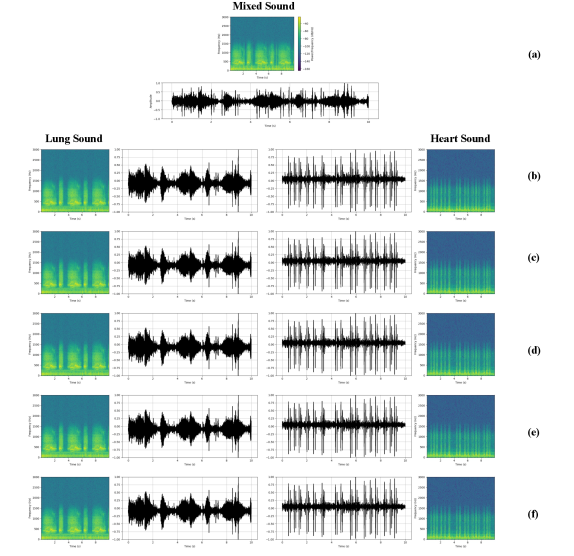
This review examines the application of machine learning, including non-negative matrix factorization and variational autoencoders, to enhance cardiorespiratory signal processing and biosensor data acquisition.
Accurate interpretation of physiological signals is often hampered by noise and the complexity of underlying biological processes. This challenge is addressed in ‘AI-Driven Cardiorespiratory Signal Processing: Separation, Clustering, and Anomaly Detection’, which explores novel applications of artificial intelligence and quantum computing to enhance cardiorespiratory signal analysis. The research demonstrates the potential of techniques-including variational autoencoders, non-negative matrix factorization, and quantum convolutional neural networks-coupled with advances in biosensing technologies like photonic integrated circuits, to effectively separate, cluster, and identify anomalous patterns within complex datasets. Could these integrated AI-driven systems pave the way for a new generation of intelligent diagnostic tools and proactive healthcare solutions?
Whispers from the Chest: Decoding Cardiorespiratory Complexity
The inherent subtlety and frequent overlap of heart and lung sounds present a significant hurdle for traditional signal processing techniques. These methods often falter when attempting to isolate individual physiological events within the complex acoustic landscape of the chest, as variations in patient anatomy, breathing patterns, and even ambient noise introduce considerable signal distortion. Consequently, diagnostic accuracy suffers; subtle anomalies indicative of cardiac or pulmonary disease can be obscured by this complexity, leading to misdiagnosis or delayed intervention. The variability isn’t merely random – the cyclical nature of respiration and the precise timing of heart valves create temporal dependencies that are difficult for algorithms not specifically designed to account for these patterns. This limitation underscores the need for more sophisticated analytical tools capable of discerning meaningful physiological signals from the noise and inherent biological fluctuations.
Cardiorespiratory sounds, while rich in diagnostic information, present a significant analytical challenge due to the frequent overlap of heart and lung signals. The human respiratory system doesn’t operate in discrete events; breathing and heartbeat are continuous, creating complex waveforms where individual sounds are often masked. Accurate analysis, therefore, necessitates sophisticated techniques capable of deconstructing these layered signals and isolating relevant features. Crucially, these methods must also recognize the inherent temporal dependencies within each respiratory cycle – the predictable patterns and relationships between inhalation, exhalation, and cardiac events. Failing to account for this temporal context can lead to misinterpretation, as a sound occurring at a specific point in the breathing cycle may carry different significance than the same sound at another time. Successful disentanglement and temporal modeling unlock the potential to identify subtle anomalies indicative of various cardiopulmonary conditions.
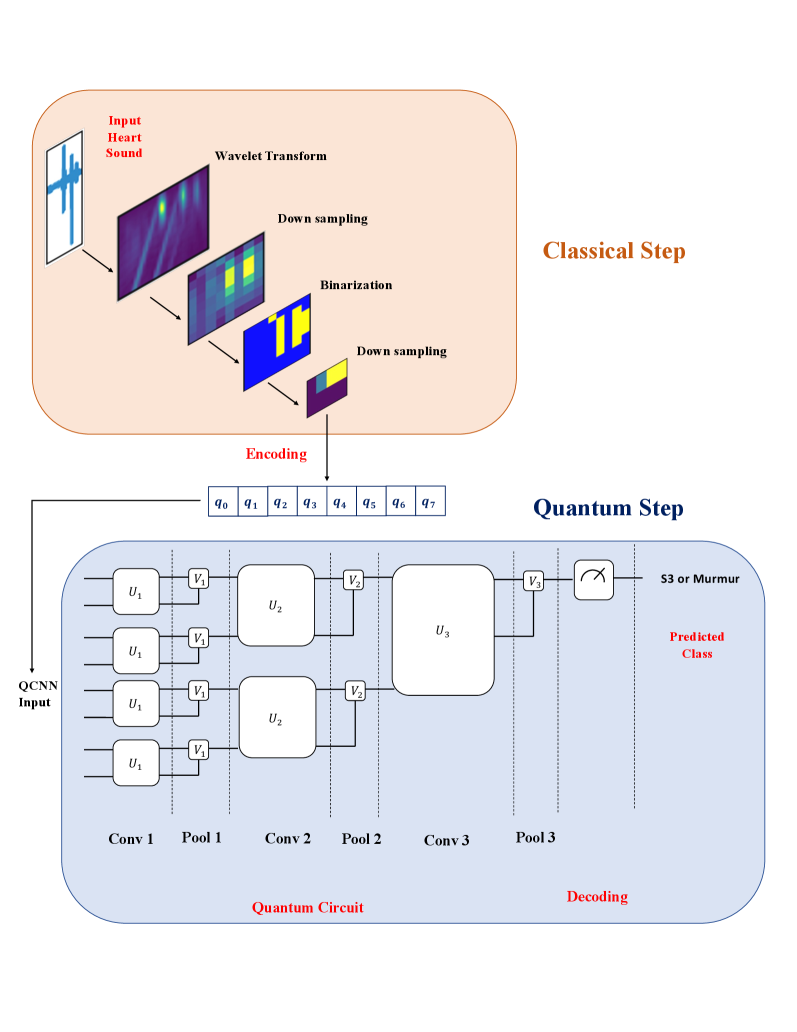
AI-Driven Cardiorespiratory Signal Processing represents a significant advancement in diagnostic capabilities, moving beyond traditional methods hindered by the intricacies of heart and lung sounds. This field leverages data-driven techniques-particularly quantum machine learning-to effectively disentangle overlapping biological signals and account for the inherent temporal dependencies within respiratory cycles. Recent studies demonstrate the potential of this approach, with a Quantum Convolutional Neural Network (QCNN) achieving a noteworthy 93.33% test accuracy in binary heart-sound classification. This level of precision suggests a future where automated, AI-powered analysis offers a more reliable and efficient means of identifying cardiac anomalies and improving patient outcomes.
Deconstructing the Signal: Wavelets and Temporal Harmony
The XVAE-WMT method utilizes the Wavelet Transform to decompose cardiorespiratory signals into constituent frequency components, facilitating improved feature extraction. This decomposition allows for the isolation of specific signal characteristics that might be obscured within the raw waveform. By representing the signal in different frequency bands, the method can more effectively identify and quantify subtle variations indicative of physiological states or anomalies. The Wavelet Transform’s ability to provide both time and frequency information is crucial for analyzing non-stationary signals like those encountered in cardiorespiratory monitoring, ultimately enabling a more granular and informative feature set for subsequent analysis.
Temporal Consistency Loss functions by minimizing the difference between reconstructed signals at consecutive time steps, thereby enforcing smoothness and preventing abrupt changes that would indicate inconsistencies. This is achieved through a loss function that penalizes deviations from expected temporal correlations within the cardiorespiratory waveform. Maintaining temporal coherence is particularly important for anomaly detection because subtle variations indicative of pathology can be obscured by reconstruction artifacts or noise if the temporal structure is not preserved. The loss specifically targets discontinuities in the reconstructed signal’s phase and amplitude, ensuring that the time series remains plausible and facilitates accurate identification of irregular patterns.
The XVAE-WMT method establishes a robust framework for dissecting cardiorespiratory waveforms into their constituent sound components. Quantitative evaluation demonstrates performance metrics of 26.8 dB for the Signal-to-Distortion Ratio (SDR) and 32.8 dB for the Signal-to-Interference Ratio (SIR). These values indicate a substantial capacity to isolate desired signals from both additive distortion and interfering sounds present within the complex waveform, allowing for more precise analysis of individual respiratory and cardiac events.
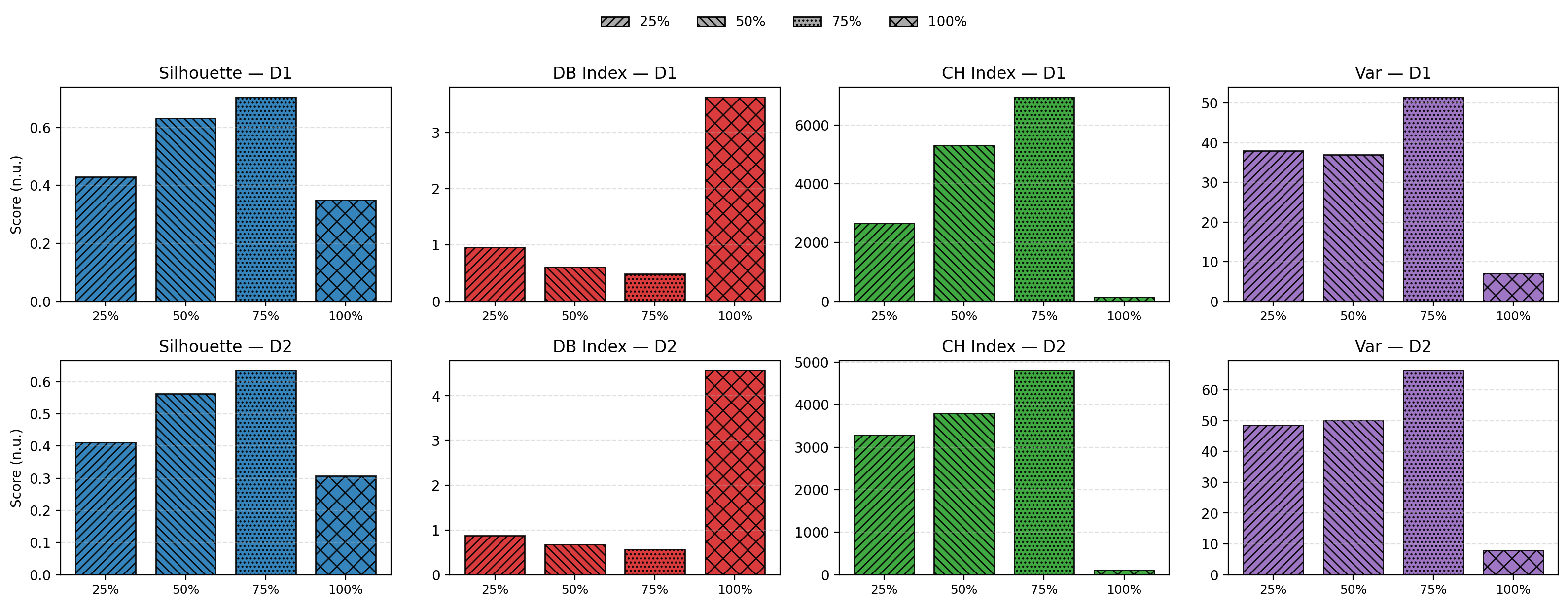
Evaluation of the XVAE-WMT method utilizing the Silhouette Score consistently yields a value of 0.345, indicating strong separation and clustering performance. The Silhouette Score measures the similarity of each sample to its own cluster compared to other clusters, with higher values denoting better-defined clusters. A score of 0.345 suggests that the method effectively distinguishes between different components within the cardiorespiratory signals, facilitating accurate analysis and anomaly detection. This metric provides a quantitative assessment of the method’s ability to group similar signal characteristics, contributing to its overall robustness and reliability.
A Transparent Gaze: Unveiling the Logic of XVAE-WMT
The XVAE-WMT method integrates three core techniques for enhanced signal analysis. Wavelet-based signal decomposition is employed to break down heart sounds into different frequency components, allowing for focused analysis of relevant features. Temporal consistency enforcement then ensures that the model’s interpretations remain stable over time, reducing spurious detections. Finally, Explainable AI (XAI) techniques are incorporated to provide transparency into the model’s decision-making process, revealing which signal features contribute most to the classification result and facilitating interpretability for clinical users.
The XVAE-WMT method integrates Explainable AI (XAI) techniques to provide clinicians with detailed rationales behind diagnostic suggestions. This is achieved by exposing the features and patterns within the heart sound data that most strongly influenced the model’s classification. Specifically, the system highlights the relevant portions of the wavelet-decomposed signal – representing different frequency components and temporal features – that contributed to the final diagnosis. This level of transparency allows clinicians to assess the validity of the model’s reasoning, identify potential biases, and ultimately make more informed decisions regarding patient care, moving beyond a simple prediction to an understandable justification.
The XVAE-WMT method demonstrates a 93.33% test accuracy when utilizing a Quantum Convolutional Neural Network (QCNN) for binary heart-sound classification. This level of performance is coupled with an emphasis on model transparency, achieved through Explainable AI (XAI) techniques. The resulting insights into the model’s decision-making process are intended to enhance clinician understanding and confidence in the diagnoses suggested, thereby supporting more informed clinical decision-making and potentially improving patient outcomes.
![t-SNE visualization of latent embeddings reveals that different VAE variants-including [latex]XVAE-WMT[/latex], [latex]XVAE-WT[/latex], and others-exhibit varying abilities to separate and organize data from two distinct sources within the latent space, as indicated by the clustering of two shades of blue.](https://arxiv.org/html/2602.09210v1/x6.png)
The pursuit, as outlined in this study of cardiorespiratory signal processing, isn’t about understanding the body’s whispers – it’s about coaxing patterns from the noise. It demands a ritualistic refinement of algorithms, a constant negotiation with inherent chaos. Marie Curie once observed, “Nothing in life is to be feared, it is only to be understood. Now is the time to understand more, so that we may fear less.” This sentiment echoes the core of the research; not to conquer biological complexity, but to persuade it to reveal its secrets through the carefully constructed spells of non-negative matrix factorization and variational autoencoders. The aim isn’t mastery, but a temporary truce with the unpredictable nature of biosensors and cardiorespiratory signals.
Where Do We Go From Here?
The pursuit of clearer cardiorespiratory signals, augmented by artificial intelligence, feels less like signal processing and more like divination. This work, while elegant in its application of non-negative matrix factorization and variational autoencoders, merely polishes the lens-it doesn’t fundamentally alter the fact that these signals are echoes of a profoundly messy biological reality. The true limitation isn’t algorithmic; it’s the assumption that ‘normal’ exists as a stable point in a chaotic system.
The invocation of quantum computing feels… ambitious. A tantalizing suggestion, certainly, but presently akin to building a cathedral to house a firefly. The real gains will likely come from accepting the inherent noise-recognizing that ‘noise’ is simply truth lacking sufficient sensors or funding-and building models robust enough to function within that uncertainty. The separation of signals isn’t the goal; it’s learning to read the palimpsest.
Future work should focus less on achieving pristine separation and more on quantifying the cost of that separation. What information is discarded when striving for clarity? Perhaps the anomalies aren’t errors to be corrected, but whispers of previously unknown physiology. The highest diagnostic resolution isn’t about seeing more, but knowing what to ignore.
Original article: https://arxiv.org/pdf/2602.09210.pdf
Contact the author: https://www.linkedin.com/in/avetisyan/
See also:
- Invincible Season 4 Episode 4 Release Date, Time, Where to Watch
- Physics Proved by AI: A New Era for Automated Reasoning
- American Idol vet Caleb Flynn in solitary confinement after being charged for allegedly murdering wife
- Magicmon: World redeem codes and how to use them (March 2026)
- Gold Rate Forecast
- “Wild, brilliant, emotional”: 10 best dynasty drama series to watch on BBC, ITV, Netflix and more
- Total Football free codes and how to redeem them (March 2026)
- Goddess of Victory: NIKKE 2×2 LOVE Mini Game: How to Play, Rewards, and other details
- Seeing in the Dark: Event Cameras Guide Robots Through Low-Light Spaces
- Olivia Colman’s highest-rated drama hailed as “exceptional” is a must-see on TV tonight
2026-02-11 19:49