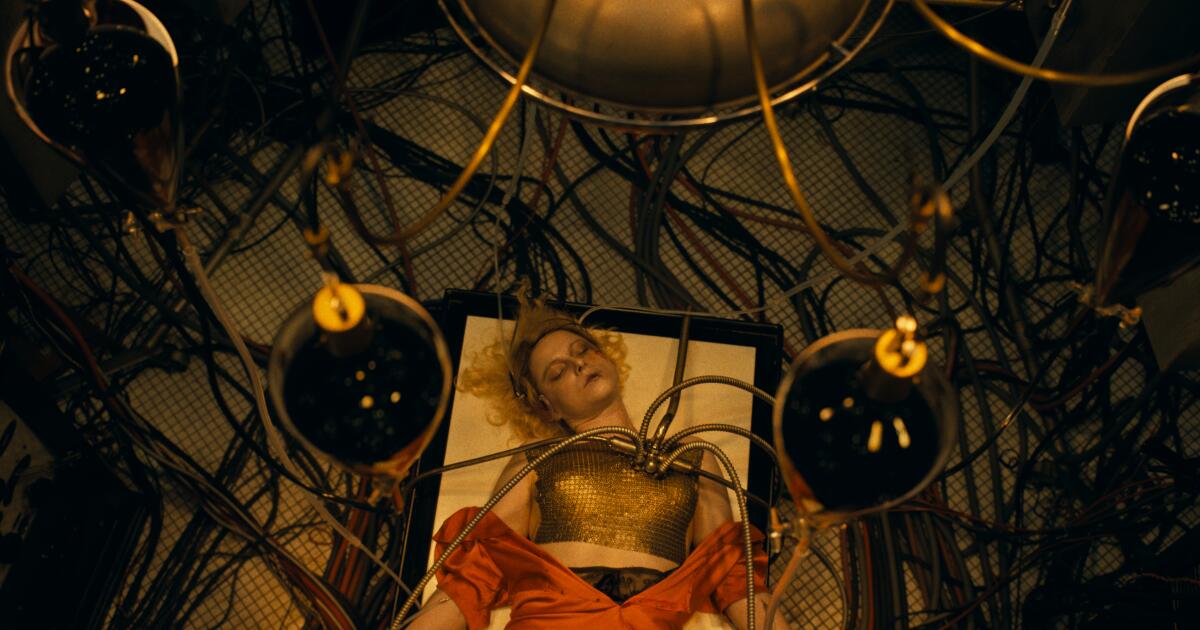
“The Bride!” is a wildly energetic mix of classic musicals, film noir, 19th-century novels, and modern ideas. Throughout the film, you can feel how easily it could have fallen apart. Like a spiritual successor to “Frankenstein,” it’s a romantic story about intense obsession, control, and fantasy—qualities that also describe its director, Maggie Gyllenhaal, who poured tremendous effort into bringing it to life. She manages to pull it off, but just barely.
The monster’s mate is a character long anticipated, much like the elusive Godot. In Mary Shelley’s original novel, Dr. Frankenstein considers creating a companion for his creature but ultimately rejects the idea, fearing she would be even more dangerous. This debate played out in the 1935 film, “Bride of Frankenstein,” which finally introduced Elsa Lanchester as the Bride with only minutes left in the movie. She made an immediate, iconic impact before both she and the monster were destroyed. Boris Karloff, as the monster, sadly notes, “She hate me.” Notably, the Bride never speaks and likely doesn’t understand what’s happening to her.
Jake Gyllenhaal’s take on empowerment feels raw and unrestrained. Jessie Buckley, who previously worked with Gyllenhaal on “The Lost Daughter,” brilliantly plays two roles: the Bride and Shelley, echoing Elsa Lanchester’s performance in the original film. The story begins at Shelley’s grave, where she’s been harboring resentment for centuries over a sequel she never wrote. It then jumps to an American nightclub where Shelley’s spirit violently takes over Ida, a drunken woman. The possession isn’t seamless; it’s jarring and erratic, causing Ida’s speech to switch between an American accent and a sharp British tone as she publicly accuses a mob boss of murder. And, unfortunately, she’s right – and now she’s a target herself.
The story takes place in a heightened, fictionalized Chicago in 1936. Meanwhile, the original creature—played by Christian Bale and known simply as Frank—has stumbled into town after traveling from Austria, still searching for a friend. He approaches the morally ambiguous Dr. Euphronius (Annette Bening) hoping she can help him achieve what he politely refers to as “a garden of pleasure.” Dr. Euphronius, however, cuts to the chase and bluntly asks if he has a specific preference. (Her maid, played by Jeannie Berlin, provides a lot of comic relief.)

Movies
Maggie Gyllenhaal’s new film, ‘The Bride!’, starring Jessie Buckley and Christian Bale, offers a fresh and ambitious take on the classic story ‘Bride of Frankenstein’.
This woman is brought back to life in a harsh and unwanted way. Now, she’s trying to understand what to do next, possibly with or without the help of someone named Frank, but she’s missing crucial memories. Frank has led her to believe she has amnesia, and she’s unaware she’s actually deceased.
The film centers on a woman’s right to make her own choices. What makes Gyllenhaal’s direction unique is how she presents Ida with a wider range of responses than simple acceptance or refusal. Ida’s options are complex – ranging from hesitant agreement to conditional acceptance, and even a refusal to engage with the question at all. The director frequently uses the phrase “I would prefer not to,” from Bartleby the Scrivener, which becomes repetitive. While neither the character nor the audience fully get what they desire, this reflects the nuanced choices at the heart of the story.
The script has an interesting twist: Frank, despite being manipulative and emotionally abusive, is ultimately a likable character. Their relationship is complicated and exciting, highlighted by a truly charming romantic montage. There’s a particularly memorable scene where Frank vulnerably reveals his feelings, only to be turned down – and he actually laughs about it, because he genuinely appreciates the Bride’s strong will.
The bride looks stunning in her coral dress and black lace bra. When she’s zapped, her hair turns completely white, like the classic look of Jean Harlow, and she’s left with a strangely attractive black mark on her cheek. It’s a fantastic, yet unsettling, look – both glamorous and a little bit silly – as she races across the country, evading gangsters and the police, swapping cars but sticking with the same outfit.
The movie doesn’t even try to hide how artificial it is. One minute the Bride is a nationally known criminal, and the next, a police officer doesn’t recognize her. There are several unbelievable moments, like when Frank seemingly controls people with his mind to dance the jitterbug – he almost seems to have invented the dance! – and honestly, the best thing to do is just relax and enjoy it.
Gyllenhaal’s performance is captivating because she fully commits to her choices, creating a sense of both freedom and daring. The film is also elevated by strong performances from Buckley and Bale, as well as the entire cast. Visually and sonically, the movie is stunning, thanks to the excellent work of cinematographer Lawrence Sher, production designer Karen Murphy, and composer Hildur Guðnadóttir, who together create a gritty, atmospheric, and lavish experience.
Jake Gyllenhaal’s enthusiasm for this type of story is clear, and the film playfully references classics like Mel Brooks’ “Young Frankenstein” and the lesser-known “Frankenhooker.” But “The Bride!” isn’t simply built on those films—it feels like it’s made from every movie, overflowing with a lively and sometimes overwhelming number of references.
The characters in the film feel like they’re built from director Paul Thomas Anderson’s favorite classic movies. For example, Penelope Cruz’s detective is a blend of several iconic performances – she’s named after Myrna Loy from ‘The Thin Man,’ acts with the energy of Rosalind Russell in ‘His Girl Friday,’ and has a style reminiscent of Barbara Stanwyck in ‘Double Indemnity.’ I have a feeling director Paul Thomas Anderson and I share a love for the movie ‘Pennies From Heaven,’ a wonderfully nostalgic musical from the 1980s set in the 1930s. If you watch it, let me know what you think – even if you disagree with me, you’ll have experienced a truly great film.
There’s a memorable scene where Frank encounters a version of his hero, Fred Astaire (played by Jake Gyllenhaal’s brother, who’s convincingly playful and sings well), and overwhelms him with enthusiastic praise until the actor is visibly uncomfortable. This captures how intense devotion can feel. The story also suggests our society is ready for genuinely new ideas. Just as Mary Shelley essentially created science fiction, many current artists seem to be building on existing work rather than originating entirely new concepts.
Okay, so I really wanted to love this film, and parts of it are genuinely brilliant. But honestly, the director, Gyllenhaal, pushes her message so hard it almost ruins everything. It’s like she doesn’t trust us to get it without hammering the feminist themes home repeatedly. The most obvious example? The main character keeps shouting the ‘#MeToo’ hashtag – it felt incredibly heavy-handed. If we could just trim about ten minutes of that, though, it would be a truly amazing, energetic film. Because underneath all that, there’s a monster of a movie fighting to get out – it’s absolutely vibrant and alive!
Read More
- Invincible Season 4 Episode 4 Release Date, Time, Where to Watch
- Physics Proved by AI: A New Era for Automated Reasoning
- Gold Rate Forecast
- American Idol vet Caleb Flynn in solitary confinement after being charged for allegedly murdering wife
- Magicmon: World redeem codes and how to use them (March 2026)
- “Wild, brilliant, emotional”: 10 best dynasty drama series to watch on BBC, ITV, Netflix and more
- Total Football free codes and how to redeem them (March 2026)
- Goddess of Victory: NIKKE 2×2 LOVE Mini Game: How to Play, Rewards, and other details
- Seeing in the Dark: Event Cameras Guide Robots Through Low-Light Spaces
- Simulating Humans to Build Better Robots
2026-03-04 23:31