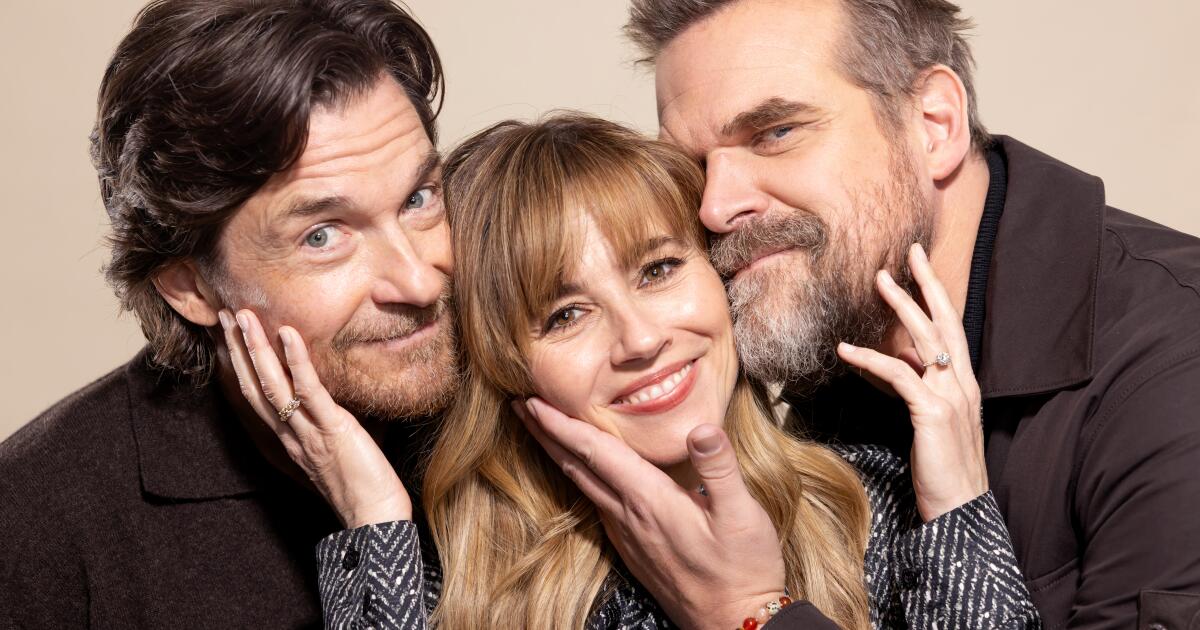
HBO’s new dark comedy, “DTF St. Louis,” follows a dangerous love triangle involving adults in the suburbs. They’re all looking to add excitement to their relationships, whether through a hook-up app (explaining the show’s title) or by having an affair with their spouse’s close friend.
The story takes inspiration from a real-life scandal detailed in a 2017 New Yorker article about a dentist’s murder trial involving infidelity and deception. However, beyond that initial basis in a true crime event, the plot diverges significantly from typical true crime narratives.
This seven-episode show is full of surprises. From its unusual characters to its complex plot and the excellent acting, it consistently defies what you’d expect, thanks to the work of creator Steven Conrad.
David Harbour, known for his role in “Stranger Things,” plays Floyd, a dedicated ASL interpreter. Floyd is a former athlete who has gained weight and now lives with Peyronie’s disease, causing a curvature of his penis, after an unexplained incident. He’s passionate about his work and incorporates hip-hop dance moves – learned from his son’s dance classes – into his interpreting to better connect with deaf and hard-of-hearing audiences. Harbour’s energetic and expressive interpreting, especially during a pop concert, is truly captivating.
Jason Bateman, known for “Ozark,” plays Clark Forrest, a local weatherman who unexpectedly becomes friends with Floyd. Clark appears to have a perfectly organized life – he bikes to work, drinks healthy juices, and enjoys family game nights. However, there’s more to him than meets the eye.
Linda Cardellini, known for “Dead to Me,” plays Carol, Floyd’s practical wife. She wants a better life – to pay off their house and afford private school for her son, Richard (Arlan Ruf). However, her job as an accountant at Purina doesn’t pay enough, and neither does Floyd’s income. When Carol meets Clark at a backyard party, she hopes he might be the answer to her financial problems.
The series began development in 2022 with Harbour as executive producer and Pedro Pascal attached to star and also executive produce. However, two years later, Pascal left the project and the show’s creative focus shifted away from the original New Yorker article it was based on. The cast includes Peter Sarsgaard as an unexpected romantic interest, Richard Jenkins as an experienced detective, and Joy Sunday as a young officer he finds hard to dismiss.
Harbour, Bateman, and Cardellini discussed how the show takes typical true crime elements – like sex, love, and murder – and transforms them into a clever, humorous, and compassionate mystery. This interview has been shortened and clarified for readability.

“DTF” is an inappropriate acronym I can’t repeat. Imagine the embarrassment of accidentally sending important work emails with that in the subject line – how would that feel?
Cardellini: So much fun.
The show’s title is a bit edgy, but Floyd is so genuine that he later explains it can be interpreted differently. He jokes that ‘DTF’ doesn’t have to be what everyone thinks – it could mean ‘Feel good together.’
The title makes you expect a scandalous or exciting story, something about people being reckless and having secret encounters. But the show is the opposite of that. The intimate scenes aren’t glamorous; they’re actually a bit awkward and uncomfortable to watch. However, that’s part of its appeal – it’s charming and even funny. It feels very real and honest, capturing the messy, human side of relationships.
Floyd is a really interesting character. He seems like a lovable underdog at first, but there’s a lot more depth to him than that. I’m curious, what was it like developing such a complex character when he could have easily been just a comedic sidekick in another show?
Honestly, this role has been the best of my career so far. I’ve played some incredible characters, but there’s something about this one that really got to me – he’s incredibly vulnerable. He’s got this amazing mix of humor and tragedy, and there are so many moments throughout the series that truly define who he is. I fell in love with him right away, actually, when I first read the scene in the pilot with me and my stepson at therapy. It just instantly clicked.

Clark and Carol’s relationship involved some unusual and explicit acts during a hotel encounter. For instance, Clark expressed a desire to role-play as a sex robot and even a pool boy. The question now is whether having an intimacy coordinator on set was beneficial in managing these scenes.
I really appreciated the experience. Jason and I have rarely done scenes with a lot of intimacy throughout our careers, so doing that at age 50 felt significant. But once we filmed the first intimate scene, it was liberating. It was a moment of self-acceptance – embracing my body and being comfortable with it. After decades in this industry, that was a really enjoyable feeling. It mirrored the show’s theme of exploring sexual freedom later in life, and wondering what might happen if you try things you never considered before.
As a film buff, I’ve always been fascinated by how intimacy is handled on set. You often hear stories about directors just rolling cameras and telling actors to ‘make out’ – it sounds incredibly awkward! But working on this project was different. Our director, Steven, was incredibly specific about exactly what he needed for each shot – the angles, the movements, everything. He’d even have my character verbally direct the action, like, ‘I need you to do this…’ It felt very clinical and precise, which actually took away the usual nervousness. There wasn’t any pressure to improvise or ‘feel’ it – the camera was just there to capture what was planned. Honestly, when the director starts commenting on specific moments and asking for repeats, it gets a little strange, but it’s a far cry from the chaotic, ‘let’s just see what happens’ approach.
Let me tell you, working on this project was a blast. There was always something unexpectedly hilarious happening on set, which immediately put everyone at ease. I mean, a robot yelling ‘powerhouse!’? It just broke the tension and made everything feel more natural. It was a really fun atmosphere.
Let’s talk about Floyd’s incredible dancing! He signed up for hip-hop lessons hoping his son would join, but when his son wasn’t interested, Floyd took the classes himself. And he’s surprisingly good, even while wearing a prosthetic belly!
Throughout my career, directors have often seen me as a very physical actor, but I’ve always considered myself an intellectual – I went to a good college and used to be an avid reader before the internet became popular. For this series, I really leaned into the physical aspects of the role. Floyd wanted to create something unique with his ASL performance, and the way he uses his hands is incredibly intimate and expressive. On top of that, the character constantly eats as a way to avoid dealing with his emotions, creating a fascinating connection and disconnection with his own body. It was liberating to fully embrace the physicality, including wearing a prosthetic belly, and just have fun with the role and its movements.


David Harbour, who plays Floyd, enjoyed getting to dance in the series. He said it was a blast to let go and have fun, even with a fake belly! (Tina Rowden / HBO)
“DTF St. Louis” is a captivating mystery because it slowly and skillfully reveals its secrets, keeping you hooked until the very end.
David’s character doesn’t last long, immediately setting up the show as a whodunit. While there’s crime and potential danger, it doesn’t feel genuinely tragic for the characters – people don’t really show strong emotion, and it’s not particularly upsetting. The show consistently avoids typical genre tropes. Just when you expect something to be steamy, funny, or threatening, it takes an unexpected turn. That unpredictability is what makes it so engaging, both as an actor and as a viewer.
Cardellini describes the show as full of intriguing puzzles, from the central mystery surrounding Floyd and his condition, to smaller, ongoing questions. She feels these mysteries are woven together skillfully, creating a rich and satisfying experience for the viewer, especially when everything comes together in the end.
It’s fascinating to watch characters confidently take on challenges they aren’t prepared for. We often see this in true crime documentaries – people overestimate their abilities and end up in trouble. There’s a certain enjoyment in watching someone make a mistake you, as the viewer, would never make – a feeling of ‘I’m smarter than that.’

These characters aren’t supposed to be closely connected. Does it make it more challenging for actors to build believable chemistry when their characters have hidden feelings and distant relationships?
I find it much easier to create believable connections with other actors when a character has complexity and hidden depths. I actually started out doing soap operas – I was on “As the World Turns” as a kid, in a recurring role. Sometimes, scenes would end with just my character, requiring a close-up where you’re supposed to be lost in thought. But really, you’re often just wondering about everyday things, like if you turned off the stove! It’s difficult to maintain a convincing performance when a character is simple and has only one goal. But when a character has layers, I can always find new things to play and react to in the moment. It’s a joy to work with well-written material that allows you to fully immerse yourself and just be in the scene.
You’ve all been in comedies, and some darker dramas. How did that prepare you for this series?
According to Bateman, comedy allows actors to feel comfortable portraying characters with imperfections. He explains that perfect characters aren’t funny, which is useful in this case because the people he plays are far from perfect.
A perfect illustration of this is when Clark first tries to flirt with Carol. He’s completely unprepared, so he makes up this outlandish story about being the owner of an underwater demolition company – and even gives himself the nickname “The Bang Master.”
I’ve often played characters who come across as arrogant and funny, but it’s usually just a facade. I thought it would be hilarious to play someone who completely fails, someone who’s trying to improvise and comes up with something ridiculous like ‘underwater demolition.’ It shows how bad he is at lying. As actors, we’re trained to convincingly pretend, to make people believe we know what we’re doing. This character, Clark, would be terrible at acting because he just can’t pull off that deception. I loved that about him.
David, does any part of you relate with Floyd?
Harbour shared that exploring themes of meaning, particularly through his connection with Clark in the film, helped him discover a previously hidden side of himself. He found it enjoyable to realize these things about himself while filming, like a growing need for strong male friendships, which can become harder to find as you get older. He also expressed a desire to continue pursuing his career in hip-hop, similar to his character, Floyd.
Read More
- Invincible Season 4 Episode 4 Release Date, Time, Where to Watch
- Beyond Accuracy: Gauging Trust in Human-AI Teams
- How Martin Clunes has been supported by TV power player wife Philippa Braithwaite and their anti-nepo baby daughter after escaping a ‘rotten marriage’
- ‘Project Hail Mary’s Unexpected Post-Credits Scene Is Worth Sticking Around
- Gold Rate Forecast
- Clash Royale Balance Changes March 2026 — All Buffs, Nerfs & Reworks
- CookieRun: OvenSmash coupon codes and how to use them (March 2026)
- We talked to ‘Bachelorette’ Taylor Frankie Paul. Then reality hit pause on her TV career
- eFootball 2026 is bringing the v5.3.1 update: What to expect and what’s coming
- Total Football free codes and how to redeem them (March 2026)
2026-03-10 13:32