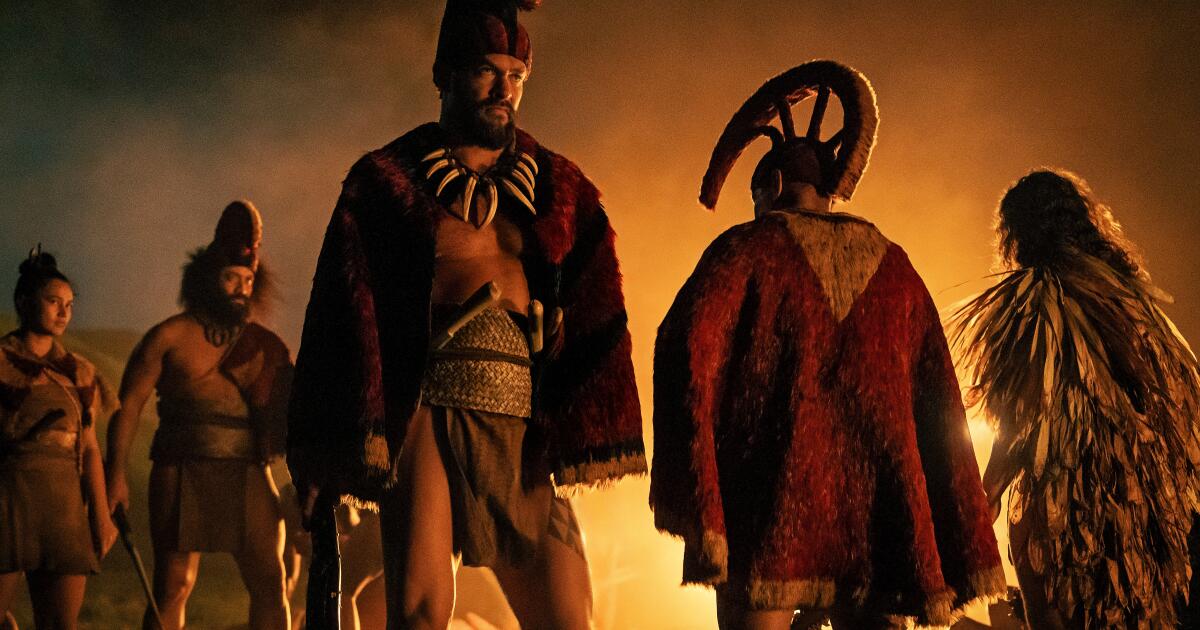
A leisurely, fact-driven historical drama titled “Chief of War,” airing on Apple TV+ this Friday, portrays the late 18th century warrior Ka’iana, played by co-creator and lead actor Jason Momoa. This series is set amidst the clash of island kingdoms and the advent of European colonization in precolonial Hawai’i. The show is evidently a labor of love, though at times it might become too elaborate or heavy-handed – not to say overly serious – yet the sincerity shines through, and it offers an intriguing perspective – definitely something you don’t witness every day.
Hawaii has always been more than just a tropical paradise; it’s a cultural phenomenon that captivated mainland Americans well before its statehood. Ukuleles and steel guitars echo with its melody, as seen in Elvis Presley’s “Blue Hawaii” and “Paradise, Hawaiian Style,” not forgetting his iconic “Aloha from Hawaii via Satellite.” The Brady Bunch and Dennis the Menace from my old comic book have made their visits too. Television shows like “Magnum P.I.”, “Hawaii Five-0”, and “The White Lotus,” especially Season 1, have also immortalized its charm. Hawaiian Punch, created in 1934, with flavors of orange, pineapple, passion fruit, guava, and papaya, remains a staple in stores today. Tiki bars and suburban luaus are common sights, while Walt Disney’s Enchanted Tiki Room brings the birds singing and flowers crooning, courtesy of Dole. This is only a glimpse into its enduring appeal.
As a movie critic hailing from the same islands as Jason Momoa, born in Honolulu, raised in Iowa, and educated on our cherished shores, I’ve followed his journey from “Baywatch Hawaii” and “North Shore” to “Stargate Atlantis,” Conan the Barbarian, Aquaman, and “Saturday Night Live.” It was intriguing to see him venture beyond genre roles and delve into a project that honors our cultural heritage.
“Chief of War” is a testament to meticulous research, although it may require viewers to take notes to navigate the complex web of islands, alliances, and internal conflicts. Characters could reside on or be affiliated with different islands, and within an island, various districts might be engaged in their own conflicts. (I took notes, but I must admit that some details remain a bit blurry.)
Despite the title-induced expectations, the setting wasn’t always clear, adding to the intrigue of this captivating series.
It’s hard to avoid drawing comparisons to “Shogun” due to the subtitled dialogues primarily in Hawaiian, the interactions with foreigners, power-hungry rulers, and conflicting factions. Similarly, it shares similarities with “Game of Thrones,” where Jason Momoa played Khal Drogo for two seasons. The opening sequence might remind you of “The Lord of the Rings” as a female voice narrates an epic tale (a prophesied king will end a cycle of endless war), introducing the island kingdoms of Kaua’i, Hawai’i, Maui and O’ahu, which are divided by cunning chiefs and powerful deities.
Introducing Ka’iana, a former Maui war chief who opted for tranquility on Kaua’i alongside his brothers Nahi’ and Namake, as well as their significant others Kupuohi and Heke. This seemingly idyllic life offers an appealing existence, filled with vegetation-based structures and fashion, playful island kids, and a serene ambiance that I yearn to experience even for a brief moment. However, much like a veteran gunslinger in a western movie, Ka’iana finds it challenging to escape the tumult of his past. (Rest assured, he will indeed wield a gun again before the story concludes.)

In a cave, while on the run, Ka’iana encounters Kaʻahumanu (Luciane Buchanan), a young woman from Maui hiding from her father who is a councilor, intending to marry her off to Kamehameha (Kaina Makua). Kamehameha is associated with the “god of war,” yet he seems more inclined towards peace. However, threats like King Kahekili (Temuera Morrison) and Keoua (Cliff Curtis), as well as unruly white sailors seeking conquest, could complicate matters, postponing any peaceful intentions for now. And to Kaʻahumanu, she labels Ka’iana as a contradiction, being a war chief who flees from conflict.
The modern narrative portrays Ka’iana as standing tall at around 6 feet 5 inches, boasting a physique reminiscent of Hercules. This physicality is similar to Momoa’s characterization. In many aspects, the role of “Chief of War” can be seen as another superhero persona for him, albeit one with more complex emotions. He excels in combat, has the ability to catch a spear with his head, ride a drugged shark, and exhibit a laser-like stare intended to instill fear in his adversaries. However, he is not just a powerful warrior; he also deals with family matters, romantic entanglements, and the challenge of convincing others to follow his wise counsel.
Under certain events, Ka’iana will find himself in the ocean and board a British sailing vessel. This ship will take him to Alaska and the Spanish East Indies. During this journey, he will become familiar with guns, viewing them as a potentially advantageous innovation. He will also learn English, a skill that John Young (Benjamin Hoetjes), a stranded sailor who has been adopted by the Hawaiian community, is teaching back home. Over time, many characters in the story start speaking English, even when it serves no practical purpose. In this tale where white colonizers interact with and take advantage of Indigenous peoples, racism against people of color, including blacks, inevitably receives its share of criticism. As expressed by Tony (James Udom), a black man who forms a friendship with Ka’iana during their unexpected journey, “They do not recognize you as human beings.” This sentiment is reinforced through both verbal and physical expressions of racism.
By infusing a forward-thinking feminist perspective, Momoa and his partner Thomas Paʻa Sibbett have ensured that women play significant roles in their testosterone-dominated universe, such as Sisa Grey, portrayed as a street-savvy Hawaiian immigrant. Moreover, they provide these characters with compelling tasks – Kupuohi was formerly a war chiefess, and Heke desires Nahi’ to teach her combat skills. Additionally, the women are given insightful dialogue, for instance, “Men spend their entire lives becoming warriors, yet they fear being incorrect more than death.” (Such a profound truth.) The representation of LGBTQ+ characters is also seamless and unremarkable.
In this production, the actors are convincingly portrayed as attractive when their characters demand it, and equally convincing in their unattractive roles. All of them, including non-professional Makua, deliver exceptional performances. The storytelling can be slow-paced, even leisurely if you prefer, with moments between major action sequences that might seem prolonged. These quieter scenes can contain intense violence, at times startlingly so when it’s used merely to emphasize a point.
The film was shot in Hawaii and New Zealand and boasts stunning visuals, despite some noticeable CGI issues during the volcano scene. Yes, there is indeed a volcano involved. There’s one scene of a red-lit orgy (signifying villainy) that could be considered excessive – to clarify, it only occurs once.
The score, composed by Hans Zimmer and James Everingham, is typical of Hollywood productions, and the series as a whole has its cheesy moments. However, these instances can also be seen as endearing, perhaps even symbolizing affection.
Read More
- Clash Royale Best Boss Bandit Champion decks
- Vampire’s Fall 2 redeem codes and how to use them (June 2025)
- World Eternal Online promo codes and how to use them (September 2025)
- Mobile Legends January 2026 Leaks: Upcoming new skins, heroes, events and more
- How to find the Roaming Oak Tree in Heartopia
- Best Arena 9 Decks in Clast Royale
- ATHENA: Blood Twins Hero Tier List
- Clash Royale Furnace Evolution best decks guide
- Brawl Stars December 2025 Brawl Talk: Two New Brawlers, Buffie, Vault, New Skins, Game Modes, and more
- Clash Royale Season 79 “Fire and Ice” January 2026 Update and Balance Changes
2025-08-01 16:36