Author: Denis Avetisyan
A critical analysis reveals the surprisingly shaky foundations of the ‘Dull, Dirty, Dangerous’ rationale for automation and proposes a new framework for understanding its impact on work.
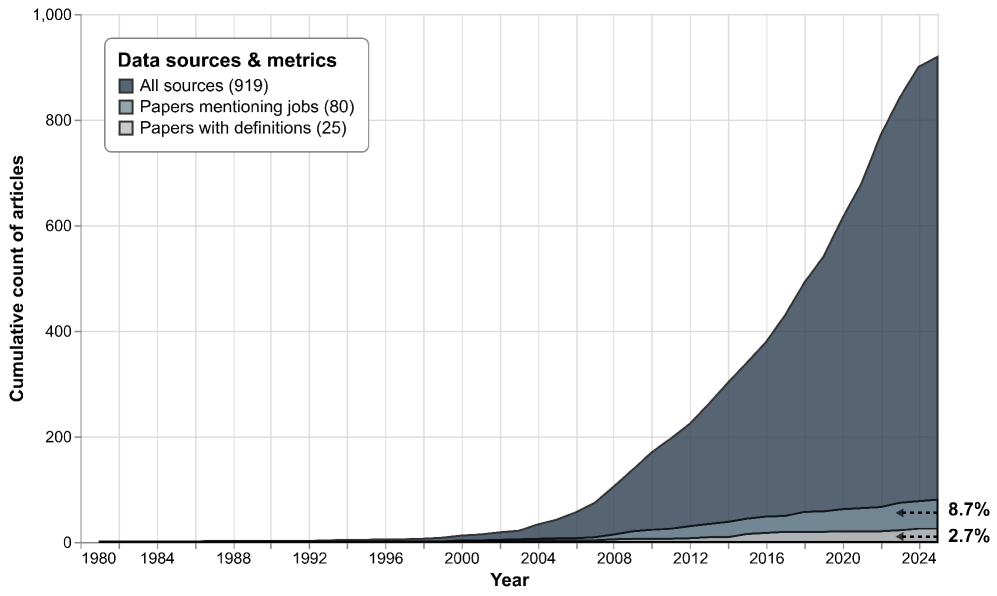
This review assesses the historical use of the ‘Dull, Dirty, Dangerous’ framework in robotics, critiques its lack of empirical support, and presents a sociotechnical approach to evaluating automation’s effects on human labor.
Despite robotics’ longstanding justification through automating “dull, dirty, and dangerous” work, a rigorous understanding of this rationale remains surprisingly absent. This paper, ‘Dull, Dirty, Dangerous: Understanding the Past, Present, and Future of a Key Motivation for Robotics’, empirically analyzes robotics publications from 1980-2024, revealing that the vast majority fail to define or concretely exemplify what constitutes DDD work. By grounding the concept in relevant social science literature, we identify a critical gap between the stated motivation for robotics and its actual impact on labor, and propose a framework to better assess the sociotechnical context of automation. How can a more nuanced understanding of DDD inform the responsible development and deployment of robotics technologies?
The Illusion of Measurement: Beyond Quantifiable Work
Historically, the evaluation of work has been heavily skewed toward easily measured outputs – production rates, efficiency gains, and economic indicators. This emphasis on quantifiable metrics, however, often obscures the lived experience of labor itself. Critical qualitative dimensions, such as the psychological demands of a job, the degree of autonomy afforded to a worker, and the social context of work, are frequently disregarded in favor of purely numerical assessments. Consequently, traditional analyses can present an incomplete and potentially misleading picture of the true costs and benefits associated with various forms of employment, failing to account for factors that significantly impact worker well-being and overall job satisfaction. A more holistic understanding necessitates integrating these nuanced, often subjective, elements into the evaluation of work, acknowledging that labor extends far beyond simple input and output calculations.
The conventional evaluation of work frequently centers on easily measured physical exertion, yet a complete picture necessitates acknowledging the intrinsic qualities of jobs themselves. Many roles, while not necessarily strenuous, are characterized by being fundamentally dull – repetitive and lacking in cognitive stimulation; dirty – exposing workers to unpleasant or hazardous conditions; or dangerous – posing genuine risks to physical safety. This tripartite categorization moves beyond simple energy expenditure to highlight the inherent burdens certain professions place on worker well-being, affecting not just physical health but also mental engagement and overall quality of life. Recognizing these qualitative dimensions is crucial for developing targeted interventions, improving working conditions, and ensuring equitable labor practices across all sectors.
Considering work not just as a source of income, but also through the lens of its inherent qualities-dullness, dirtiness, and danger-offers a vital framework for understanding the potential consequences of increasing automation. As machines take over routine and physically demanding tasks, the focus shifts toward jobs requiring cognitive and emotional skills; however, this transition isn’t universally beneficial. The framework highlights that automation may disproportionately displace workers in roles characterized by these negative attributes, potentially concentrating them in lower-paying service sector jobs lacking opportunities for advancement. Furthermore, it underscores the importance of proactively addressing the qualitative aspects of future work, ensuring that technological progress doesn’t simply replace dangerous labor with forms of work that are equally debilitating in other ways, ultimately impacting worker well-being and societal equity.
Deconstructing Labor: The DDD Framework as a Diagnostic Tool
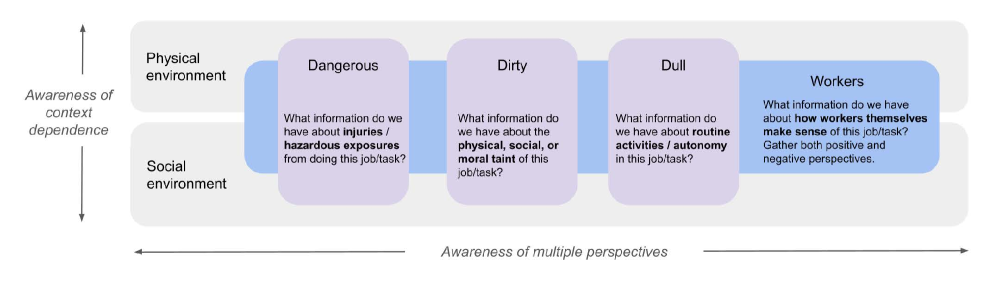
The Dull, Dirty, and Dangerous (DDD) framework systematically categorizes job roles based on three core attributes: the degree of repetitive mental effort (“Dull”), the presence of unpleasant physical conditions (“Dirty”), and the level of inherent risk of injury or health hazard (“Dangerous”). Each characteristic is assessed based on observable job functions and working conditions. Jobs are not assigned to discrete categories, but rather evaluated along a spectrum for each attribute, allowing for nuanced differentiation. This multi-dimensional assessment provides a quantifiable basis for comparing roles and predicting their susceptibility to automation or redesign, independent of economic factors or technological feasibility.
The DDD framework’s predictive capability stems from the correlation between task characteristics and automation feasibility. Roles categorized as ‘Dirty’ and ‘Dangerous’ – those involving repetitive physical labor in hazardous conditions – present the highest likelihood of being replaced by robotic systems or significantly restructured through process optimization. Conversely, tasks requiring complex problem-solving, nuanced judgment, or high degrees of human interaction, even if ‘Dull’, are less susceptible to immediate automation. This allows for proactive workforce planning, enabling organizations to anticipate skill gaps and invest in retraining programs for roles facing potential displacement, while also identifying areas where human expertise remains critical.
The DDD framework distinguishes itself by centering analysis on the lived experiences of workers performing the tasks under evaluation. This ‘Worker Perspective’ is not supplemental; it is foundational to the categorization process, asserting that objective qualities of a job are best understood through the subjective reports of those who directly perform the labor. Data is gathered via worker interviews and observational studies, focusing on aspects like task repetitiveness, physical demands, cognitive load, and the degree of autonomy. This qualitative data is then integrated with quantitative metrics to create a more nuanced and accurate assessment of a job’s characteristics, ultimately improving the predictive validity of the framework regarding automation and restructuring potential.
Echoes in the Machine: Empirical Validation Through Robotics Research
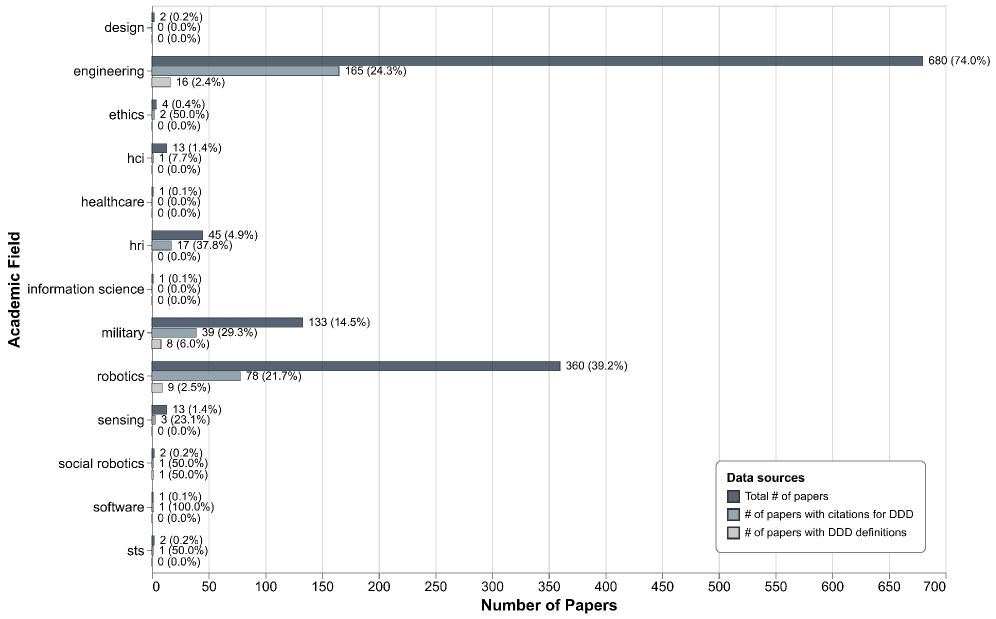
A comprehensive literature review of 919 robotics research papers published between 1980 and 2024 indicates a pronounced focus on automating Dull, Dirty, and Dangerous (DDD) jobs. Analysis of publication content consistently demonstrates that research efforts are disproportionately allocated to tasks categorized as DDD, suggesting a prevailing prioritization of automating these specific job types within the field. This trend was identified through systematic examination of paper abstracts, keywords, and reported application areas, revealing a consistent emphasis on automating tasks involving repetitive, unpleasant, or hazardous conditions. The review encompassed publications from leading robotics journals and conference proceedings to ensure a representative sample of research activity.
Empirical analysis of 919 robotics research papers (1980-2024) indicates a frequent invocation of the “Dirty, Dull, Dangerous” (DDD) concept as a justification for automation research. However, concrete examples of DDD tasks or jobs being addressed by the research were only present in 8.7% of the analyzed publications. This suggests a disparity between the rhetorical use of the DDD framework and its actual implementation within the studied robotics literature, implying that research is often motivated by the concept without demonstrably targeting tasks fitting the defined criteria.
Analysis of 919 robotics research papers (1980-2024) revealed that only 2.7% explicitly defined or cited sources supporting the concept of Dull, Dirty, and Dangerous (DDD) work. This indicates a significant lack of theoretical grounding in the application of DDD as a primary motivator for robotic automation research, despite its frequent invocation within the field. The findings are based on a systematic review process, utilizing rigorous data collection methods and documented through a Prisma flowchart to ensure the inclusion of relevant and high-quality studies.
The Shifting Landscape: Implications for a Future of Work
The increasing adoption of automation technologies in jobs characterized by Dull, Dirty, and Dangerous (DDD) conditions presents a significant risk of workforce displacement, particularly within sectors like waste management. This industry, inherently reliant on manual labor in often hazardous environments, is proving especially susceptible to automated solutions – from robotic sorting systems to autonomous collection vehicles. While automation promises increased efficiency and improved worker safety by removing humans from physically demanding and potentially harmful tasks, it simultaneously threatens the livelihoods of those currently employed in these roles. The trend necessitates proactive consideration of the socio-economic consequences and demands careful planning to mitigate potential job losses and support affected workers through retraining initiatives and the creation of new, sustainable employment opportunities.
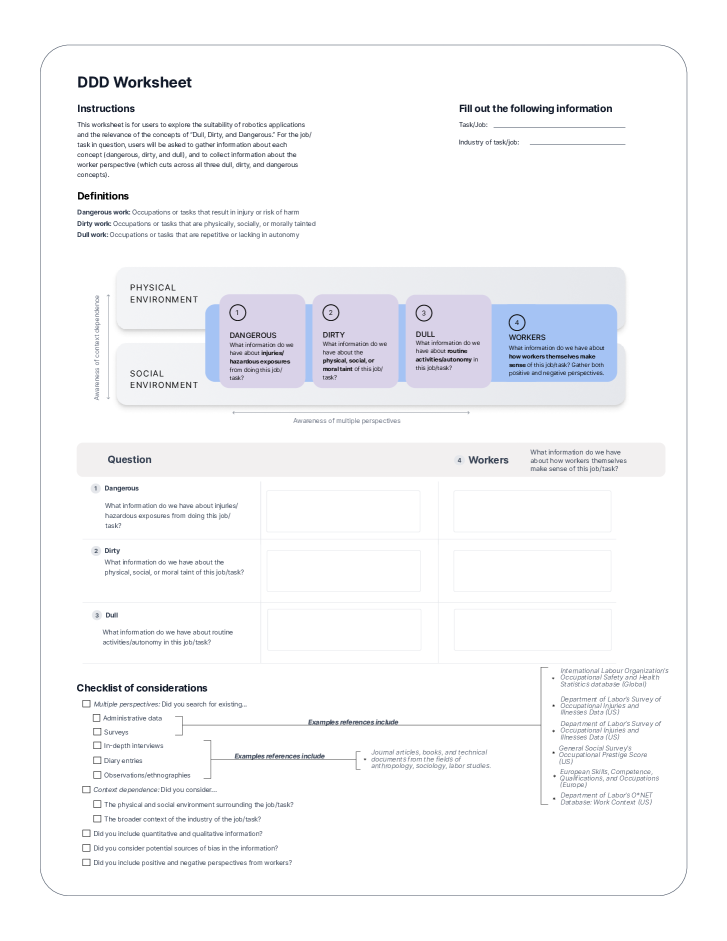
The Degradation, Disruption, and Displacement (DDD) framework offers a systematic approach for anticipating and mitigating the societal impacts of increasing automation. Rooted in established social science literature – particularly studies of technological unemployment and labor market transitions – it moves beyond simple predictions of job loss to analyze how work fundamentally changes. This allows policymakers and businesses to proactively identify vulnerable roles, assess the broader social consequences of automation – such as increased inequality or skill gaps – and develop targeted interventions. By considering not just the disappearance of jobs, but also the degradation of working conditions and the disruption of established skills, the DDD framework facilitates the creation of more equitable and sustainable strategies for navigating the evolving landscape of work, fostering resilience and prioritizing human well-being alongside technological advancement.
Addressing the increasing prevalence of automation demands a forward-looking approach centered on workforce adaptation, rather than solely focusing on technological advancement. Future investigations should prioritize the development of robust reskilling initiatives designed to equip workers with competencies that complement, rather than compete with, automated systems. Crucially, these programs must move beyond technical training to cultivate distinctly human skills – critical thinking, complex problem-solving, creativity, and emotional intelligence – which are less susceptible to automation and vital for emerging roles. The creation of new opportunities that prioritize worker well-being and leverage these uniquely human capabilities is paramount; simply replacing displaced jobs with more automated positions overlooks the potential for a future where technology augments human potential, fostering both economic growth and a more fulfilling work experience.
The pursuit of automation, often framed by the ‘Dull, Dirty, Dangerous’ rationale, reveals a fundamental human tendency: the desire to redefine limitations. This paper rightly challenges the simplistic application of this framework, demanding a more nuanced understanding of how automation reshapes work. It echoes Ada Lovelace’s sentiment: “The Analytical Engine has no pretensions whatever to originate anything.” The article doesn’t dispute the possibility of relieving humans from undesirable tasks-it critiques the lack of rigorous analysis surrounding how that relief impacts the broader sociotechnical system. Just as Lovelace recognized the Engine’s dependence on human instruction, this work highlights that automation isn’t a self-directing force, but a tool whose effects require careful consideration and proactive design to avoid unintended consequences.
Beyond “Dull, Dirty, Dangerous”
The persistent invocation of “Dull, Dirty, Dangerous” as justification for robotics has, predictably, proven resistant to scrutiny. This resistance isn’t a failing of the argument itself, but a symptom of a broader problem: a tendency to post hoc rationalize automation with convenient narratives, rather than proactively assessing its impacts. The proposed framework, grounded in sociotechnical systems theory, is not a solution, but a lever – a means to force a more granular, less ideologically-driven analysis. It reveals that simply identifying a task as DDD offers little predictive power regarding actual labor transformations; the devil, naturally, resides in the implementation, the shifting power dynamics, and the unforeseen consequences.
Future work must abandon the search for universally ‘dangerous’ tasks and instead focus on the processes through which danger – and dullness, and dirtiness – are assigned, negotiated, and ultimately, automated. The interesting questions aren’t about what robots can do, but about who decides what should be automated, and by what criteria. Rigorous studies of failed automation projects – those that increased worker burden or created new safety hazards – will likely yield more actionable insights than celebrations of successful deployments.
Ultimately, the field requires a degree of intellectual discomfort. Assuming automation always improves conditions is a comfortable fiction. A truly robust understanding demands acknowledging that robots, like any tool, amplify existing power structures and can readily exacerbate inequalities. The challenge lies not in perfecting the definition of ‘dangerous’, but in dismantling the assumptions that underpin the entire discourse.
Original article: https://arxiv.org/pdf/2602.04746.pdf
Contact the author: https://www.linkedin.com/in/avetisyan/
See also:
- The Division Resurgence Best Weapon Guide: Tier List, Gear Breakdown, and Farming Guide
- Last Furry: Survival redeem codes and how to use them (April 2026)
- GearPaw Defenders redeem codes and how to use them (April 2026)
- Clash of Clans Sound of Clash Event for April 2026: Details, How to Progress, Rewards and more
- Guild of Monster Girls redeem codes and how to use them (April 2026)
- eFootball 2026 “Countdown to 1 Billion Downloads” Campaign arrives with new Epics and player packs
- After THAT A Woman of Substance cliffhanger, here’s what will happen in a second season
- Gold Rate Forecast
- Wuthering Waves Hiyuki Build Guide: Why should you pull, pre-farm, best build, and more
- Genshin Impact Version 6.5 Leaks: List of Upcoming banners, Maps, Endgame updates and more
2026-02-05 13:53