Author: Denis Avetisyan
New research reveals that while interdisciplinary approaches can open doors for physicists in policy debates, impactful influence ultimately hinges on providing domain-specific evidence.
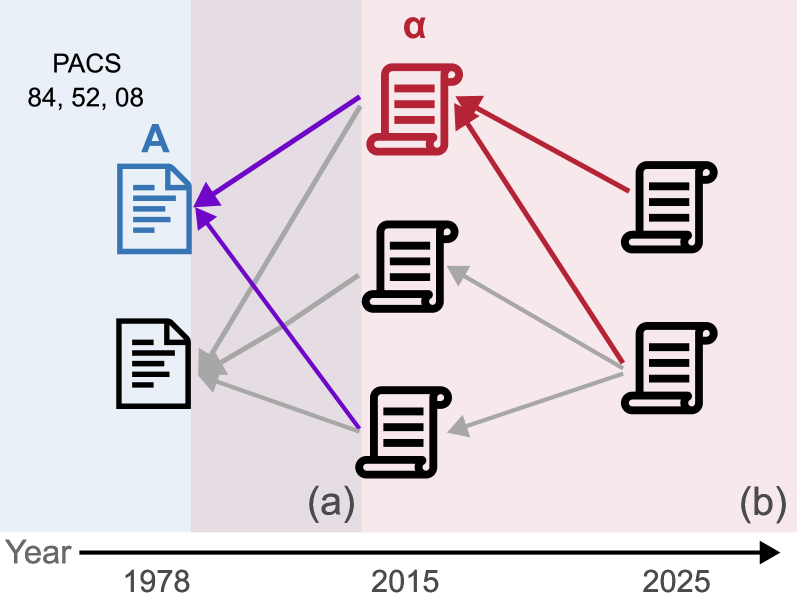
This study uses citation and network analysis to demonstrate a structural mismatch between the supply of interdisciplinary physics research and the demand for targeted evidence in policymaking.
Despite growing calls for evidence-based policymaking, a systematic understanding of which scientific knowledge gains traction-and why-remains elusive. This research, presented in ‘The selective use of physics knowledge in policy: how interdisciplinary physics bridges subfields and shapes policy influence’, investigates how physics knowledge enters policy discourse, revealing a structural mismatch between scientific production and policy demand. Our analysis demonstrates that while interdisciplinary areas of physics facilitate initial entry into policy discussions, domain-specific knowledge-particularly geophysics related to climate change-is more strongly associated with actual policy influence. Does this suggest a need to re-evaluate knowledge mobilization strategies, prioritizing impactful evidence over broad interdisciplinarity in science policy?
The Circuitous Route: Why Science Doesn’t Automatically Shape Policy
The influence of scientific research on policy decisions, while undeniably vital for addressing societal challenges, rarely follows a direct line. Complex pathways often connect discovery to implementation, involving multiple interpretations, adaptations, and mediating factors. Evidence-based policy ideally relies on rigorous findings, but these are frequently filtered through the perspectives of stakeholders, political considerations, and the prevailing socio-economic climate. Consequently, pinpointing the precise contribution of a specific study to a given policy outcome proves remarkably difficult, as the original research may be combined with other data, altered by practical constraints, or simply integrated into a broader narrative. This inherent complexity underscores the need for innovative methods to effectively trace and understand how science genuinely informs public policy, and to better communicate the value of research investment.
Quantifying the translation of scientific research into policy remains a significant challenge due to the intricate and often indirect pathways of influence. Conventional approaches, such as citation analysis or expert surveys, frequently fall short of capturing the nuanced ways evidence informs decision-making. These methods often struggle to differentiate between research that is merely considered during policy formulation and research that demonstrably shaped the final outcome. The sheer complexity of the policy process – involving multiple stakeholders, political considerations, and competing priorities – further complicates efforts to establish a clear causal link between specific findings and concrete actions. This ambiguity not only hinders accurate assessment of research impact but also limits the ability to optimize science communication strategies for greater policy relevance, creating a persistent gap between knowledge generation and practical application.
The ambiguity surrounding the translation of scientific findings into policy creates significant obstacles for both researchers and lawmakers. When the precise route from evidence to action remains unclear, communicating the value of scientific inquiry becomes markedly more difficult, potentially diminishing public support and funding. Simultaneously, policymakers face challenges in effectively leveraging research to address complex societal issues; without a transparent understanding of how studies inform decisions, the potential for evidence-based governance is compromised. This informational gap can lead to policies that are either disconnected from the best available science, or, conversely, to the misapplication of research due to a flawed interpretation of its implications, ultimately hindering progress and eroding trust in the scientific process.
Establishing a definitive link between scientific research and policy outcomes demands more than simply identifying citations or acknowledging funding sources. Robust methodologies now employ techniques like citation network analysis, combined with qualitative case studies and expert interviews, to chart the complex pathways of evidence flow. These approaches attempt to discern not just that a study influenced policy, but how – whether through direct application of findings, reframing of existing debates, or the prompting of further research. Crucially, tracing this influence requires accounting for mediating factors, such as political contexts, stakeholder engagement, and the role of knowledge brokers who translate research for diverse audiences. The development of standardized metrics and transparent reporting practices remains essential for building a comprehensive understanding of scientific impact and fostering a more evidence-informed policymaking landscape.
Mapping the Web: Tracing Influence Through Citation Networks
Citation networks, in this context, are constructed by representing scientific publications and policy documents as nodes, with edges denoting citations from a policy document to a specific research publication. This network approach allows for the visualization of influence and knowledge transfer between the scientific community and policymakers. Each connection signifies a direct reference, establishing a quantifiable link between research findings and their consideration in policy formulation. The resulting network structure enables the identification of key publications frequently cited in policy, as well as the policy areas drawing upon specific scientific disciplines. Analyzing the network’s topology – including node degree, centrality measures, and path lengths – provides insights into the flow of information and the relative policy impact of different research areas.
The Overton Database serves as the primary source for identifying connections between scientific research and policy documents. This database systematically catalogs policy materials – including legislation, parliamentary questions, and official reports – and records instances where these documents cite academic publications. The database’s scope includes materials from a range of governmental and intergovernmental organizations, enabling the construction of a network where nodes represent publications and policy documents, and edges signify a documented citation. Data extracted from the Overton Database forms the foundational layer for analyzing the uptake of scientific findings within the policy-making process and quantifying the extent to which research informs policy decisions.
The Physics Abstracts Classification System (PACS) is a hierarchical taxonomy used to categorize publications within the American Physical Society (APS) journal collection. This system employs a multi-level coding structure, allowing researchers to classify papers based on subject area, methodology, and specific phenomena investigated. Utilizing PACS codes enables a targeted analysis of research trends within defined physics sub-disciplines; for example, researchers can isolate publications pertaining to condensed matter physics or high-energy physics by filtering based on associated PACS codes. This granular categorization is crucial for identifying the scope and concentration of research efforts, and facilitates the construction of citation networks focused on specific areas of physics.
Policy Visibility, as determined through citation network analysis, quantifies the extent to which research within a specific scientific discipline is referenced in policy documents. This assessment relies on tracking citations from policy documents – identified via resources like the Overton Database – to publications categorized by systems such as PACS for the American Physical Society (APS). Higher citation rates from policy documents indicate greater visibility and, potentially, influence of that scientific discipline on policy formation. Analysis focuses on the frequency and nature of these citations to differentiate between disciplines with broad policy impact versus those with limited direct engagement, providing a measurable metric for the translation of research into actionable policy.
![A data pipeline links policy documents from the Overton database to relevant scientific articles using Digital Object Identifiers (DOIs), enabling analysis of policy demand based on the scientific content-categorized using the Physics and Astronomy Classification Scheme [latex]PACS 0-9[/latex]-of the cited papers, with particular emphasis on interdisciplinary areas like General Physics and Interdisciplinary Physics.](https://arxiv.org/html/2602.10427v1/x1.png)
Where Physics Meets Policy: Identifying Key Areas of Influence
Analysis of policy document citations indicates a substantial connection to research within Interdisciplinary Physics and Condensed Matter Physics. These areas, categorized as 0 and 8 respectively, collectively represent 45.8% of all citations originating from physics research. Specifically, Interdisciplinary Physics accounts for 26.0% of policy citations, while Condensed Matter Physics contributes 19.8%. This demonstrates that research within these fields is frequently referenced when formulating policy, extending the impact of the broader physics citation network into governmental and regulatory spheres.
Research areas within Climate Change Research and Geophysics consistently appear in policy documentation, indicating a demonstrable connection between scientific findings and governmental considerations. This linkage is evidenced by the frequent citation of studies addressing climate modeling, atmospheric science, and Earth system processes, as well as geophysical investigations related to natural hazards, resource management, and environmental monitoring. The direct applicability of these research outputs to issues such as disaster preparedness, climate mitigation strategies, and sustainable development contributes to their prominent role in informing policy decisions and shaping regulatory frameworks.
Research within the fundamental physics domains of Elementary Particle Physics and Nuclear Physics contributes to the broader scientific knowledge base, but its connection to specific policy documents is not as direct as that of more applied fields. While these areas generate substantial scientific literature, the translation of findings into actionable policy considerations requires additional steps, often involving interdisciplinary research or application to technological development. This indirect pathway results in a less immediately apparent policy impact compared to disciplines directly addressing societal challenges such as climate change or resource management. The contribution of fundamental physics is primarily through the advancement of scientific understanding and the development of technologies with potential, rather than direct engagement with existing policy needs.
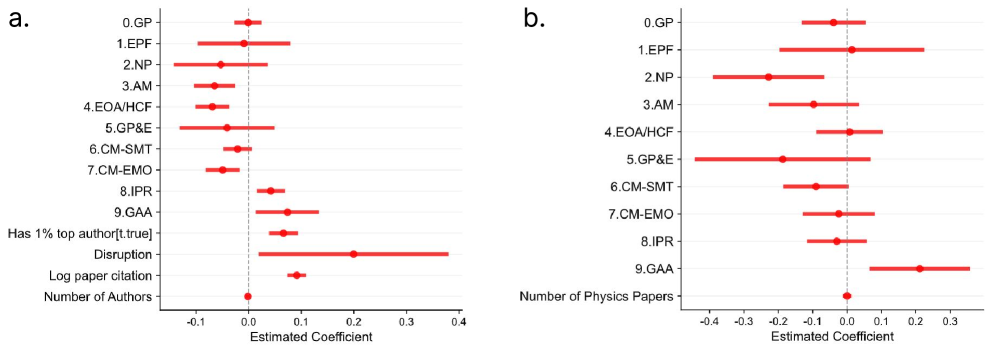
Statistical analysis reveals a disparity between citation rates and policy influence across physics subfields. While interdisciplinary physics exhibits high citation counts within the research network, it demonstrates a negative, though statistically insignificant (p=0.50), regression coefficient of -0.03 regarding its connection to policy documents. Conversely, geophysics, astronomy, and astrophysics collectively show a significant positive association with policy influence, indicated by a regression coefficient of β=0.212 (p=0.004). This suggests that, despite being frequently cited, research within interdisciplinary physics does not readily translate into direct policy consideration, while research in geophysics and related fields demonstrates a stronger and statistically significant link to policy outcomes.
Decoding Policy Priorities: How Science Can Align and Impact
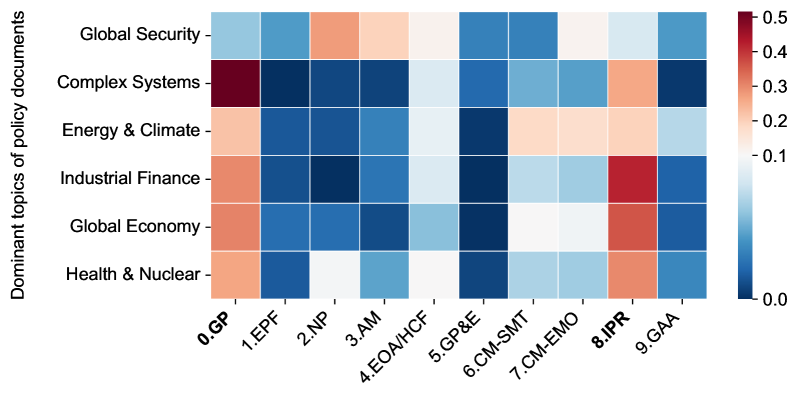
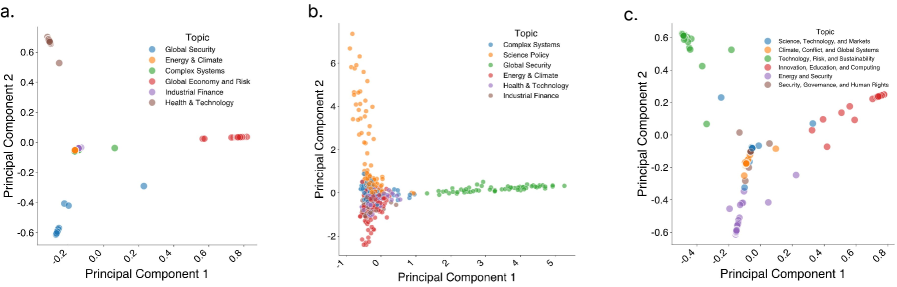
Latent Dirichlet Allocation, or LDA, was employed as a computational technique to dissect large volumes of policy documentation, uncovering the prominent thematic concerns embedded within them. This analytical approach moved beyond simple keyword searches, instead identifying underlying patterns of word usage to reveal nuanced and often implicit priorities. The analysis successfully distilled complex policy landscapes into a manageable set of core themes, such as public health infrastructure, economic stability, and environmental sustainability. These identified themes represent areas where policymakers are demonstrably focused, providing a critical foundation for understanding the context in which scientific research can have the greatest impact and effectively address pressing societal needs.
Scientific research actively responds to and, crucially, shapes the conversations surrounding critical policy issues. Through rigorous investigation and data analysis, researchers don’t simply offer answers to pre-defined questions; they frequently redefine the parameters of those questions, bringing novel perspectives and previously unconsidered factors to light. This process directly informs decision-making by providing evidence-based insights that challenge existing assumptions and offer potential solutions. The resulting discourse, fueled by scientific findings, then permeates policy debates, influencing the framing of problems and the evaluation of proposed interventions – ultimately demonstrating that scientific inquiry is not merely a contributor to policy, but an active force in its evolution and refinement.
Effective science communication hinges on a clear connection between research outcomes and existing policy frameworks. When scientific findings directly address identified policy priorities, the potential for impact is significantly amplified; information is no longer presented as abstract knowledge, but as a relevant contribution to ongoing societal challenges. This alignment fosters greater receptivity among policymakers and the public, increasing the likelihood that evidence-based insights will be integrated into decision-making processes. Consequently, strategic communication that highlights these connections not only disseminates knowledge, but also translates research into tangible action, ultimately strengthening the science-policy interface and maximizing the return on investment in scientific endeavors.
Researchers can strategically amplify the relevance of their findings by directly addressing identified policy concerns. This analytical approach, leveraging thematic modeling of policy documents, offers actionable intelligence, enabling scientists to frame research questions and disseminate results in ways that resonate with decision-makers. By proactively aligning work with existing priorities, researchers increase the likelihood of uptake and impact, moving beyond simply publishing findings to actively contributing to informed policy development. This targeted communication fosters a more responsive relationship between science and governance, ultimately maximizing the return on investment in research endeavors and ensuring scientific knowledge effectively serves societal needs.
The study reveals a predictable human tendency: a preference for readily digestible, domain-specific evidence over the nuanced complexity of interdisciplinary research. This aligns with the observation that people don’t make decisions; they tell themselves stories about decisions. While interdisciplinary physics creates pathways for scientific input into policy, the research demonstrates it doesn’t inherently translate to influence. As Ernest Rutherford famously said, “If you can’t explain it simply, you don’t understand it well enough.” This simplicity, or lack thereof, appears crucial. Policy-makers, much like individuals, gravitate towards narratives that confirm existing beliefs and offer clear solutions, even if those solutions are narrowly focused, bypassing the potential benefits of broader, more integrated knowledge. The structural mismatch isn’t merely a scientific problem; it’s a reflection of deeply ingrained cognitive biases.
What’s Next?
The study reveals a predictable asymmetry. Physics, like any discipline, doesn’t offer ‘knowledge’ so much as narratives that soothe anxieties. The finding that domain-specific evidence carries greater weight in policy isn’t surprising; policymakers aren’t seeking truth, they’re seeking justification – a shield against criticism. Interdisciplinary work, while broadening the conversation, seems to dilute the potency of that shield. It offers options, and options invite responsibility – a burden rarely welcomed.
Future research should abandon the naive pursuit of ‘knowledge mobilization’ and instead focus on the emotional work that evidence performs. Citation analysis and network mapping are useful, but they reveal only the scaffolding. The core question isn’t how knowledge flows, but why certain narratives gain traction while others are ignored. The biases aren’t bugs; they’re features of the human operating system.
The field would benefit from integrating insights from behavioral economics and cognitive psychology. Models of ‘rational choice’ are quaint fictions. Humans don’t decide; they avoid shame. Understanding those avoidance mechanisms – the cognitive shortcuts and emotional heuristics that shape policy preferences – is the true frontier. The challenge isn’t to make science more accessible, but to understand why policymakers consistently prefer comforting stories to inconvenient truths.
Original article: https://arxiv.org/pdf/2602.10427.pdf
Contact the author: https://www.linkedin.com/in/avetisyan/
See also:
- Invincible Season 4 Episode 4 Release Date, Time, Where to Watch
- Physics Proved by AI: A New Era for Automated Reasoning
- How Martin Clunes has been supported by TV power player wife Philippa Braithwaite and their anti-nepo baby daughter after escaping a ‘rotten marriage’
- Gold Rate Forecast
- American Idol vet Caleb Flynn in solitary confinement after being charged for allegedly murdering wife
- Total Football free codes and how to redeem them (March 2026)
- Olivia Colman’s highest-rated drama hailed as “exceptional” is a must-see on TV tonight
- Nicole Kidman and Jamie Lee Curtis elevate new crime drama Scarpetta, which is streaming now
- “Wild, brilliant, emotional”: 10 best dynasty drama series to watch on BBC, ITV, Netflix and more
- Goddess of Victory: NIKKE 2×2 LOVE Mini Game: How to Play, Rewards, and other details
2026-02-13 05:23