Author: Denis Avetisyan
Successfully integrating intelligent agents into the workplace demands a strategic shift towards workflow design and human oversight, rather than simply deploying the latest AI technology.
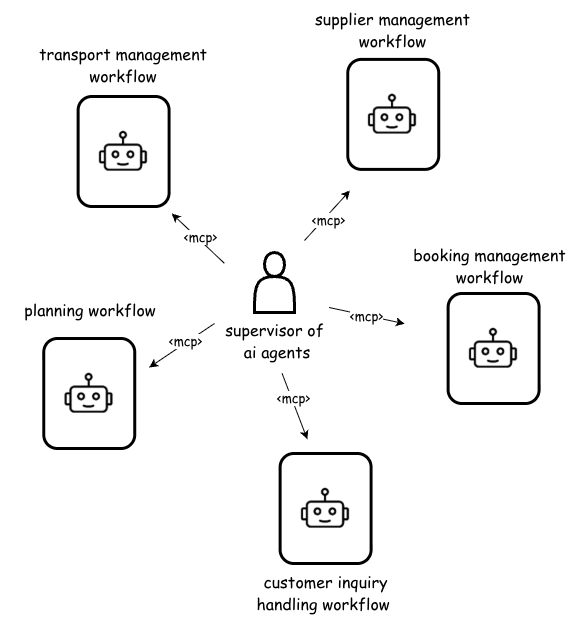
This review details a practical framework for transitioning organizations to agentic AI, emphasizing responsible implementation, human-in-the-loop systems, and the importance of a robust Model Context Protocol.
Despite widespread adoption of artificial intelligence, many organizations remain tethered to tool-centric workflows, hindering the realization of truly autonomous systems. This paper, ‘A Practical Guide to Agentic AI Transition in Organizations’, proposes a pragmatic framework for shifting from manual processes to automated, agentic AI, emphasizing the critical role of human orchestration and domain expertise. The core argument centers on building scalable automation not through technological advancement alone, but through systematically delegating tasks and fostering collaborative, AI-augmented teams. Can organizations successfully navigate this transition and unlock the full potential of agentic AI to fundamentally reshape work and drive tangible business value?
The Ascendancy of Autonomous Agents
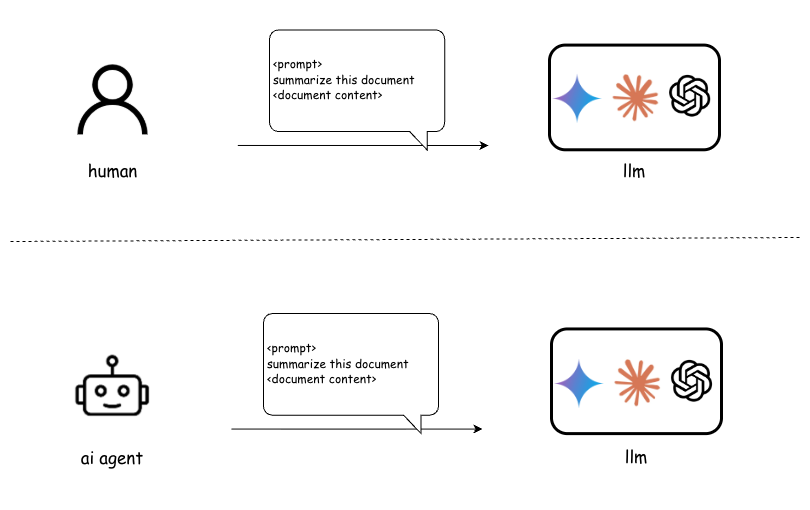
The evolution of artificial intelligence is rapidly shifting from systems that simply assist humans to those capable of acting independently on their behalf. This transition signifies a fundamental paradigm shift, moving beyond AI as a tool and toward AI as an agent. Traditional AI responds to specific commands, requiring constant human oversight and direction; agentic AI, however, can define its own goals, formulate plans to achieve them, and execute those plans with minimal human intervention. This doesn’t imply complete independence – rather, it suggests a collaborative relationship where AI proactively addresses user needs and anticipates future requirements, effectively functioning as a digital representative capable of autonomous action within defined parameters.
The evolution from assistive to agentic artificial intelligence demands a fundamental leap in systemic capabilities, moving beyond the completion of narrowly defined tasks. Current AI often excels at responding to specific commands, but true agency requires robust reasoning – the ability to understand context, draw inferences, and adapt to unforeseen circumstances. This necessitates intricate planning mechanisms, allowing systems to decompose complex goals into manageable steps and anticipate potential obstacles. Furthermore, effective execution isn’t simply about performing actions, but about monitoring progress, evaluating outcomes, and iteratively refining strategies – a cycle of learning and improvement that mirrors human problem-solving. Consequently, agentic AI isn’t about building faster tools, but about creating systems capable of independent thought and proactive action, ultimately reshaping the relationship between humans and technology.
Deconstructing Complexity: The Agentic Workflow
Agentic AI systems function through the sequential execution of specialized AI components, termed ‘Agents’. Each Agent is designed to perform a discrete task – such as data retrieval, analysis, or content generation – contributing to a broader, overarching process. This modular approach allows for the decomposition of complex problems into manageable units, with each Agent operating as an independent unit of intelligence. The coordination of these Agents is critical; output from one Agent typically serves as input for subsequent Agents in the workflow, creating a pipeline for achieving a defined objective. This specialization contrasts with monolithic AI models and facilitates scalability, maintainability, and the efficient allocation of computational resources.
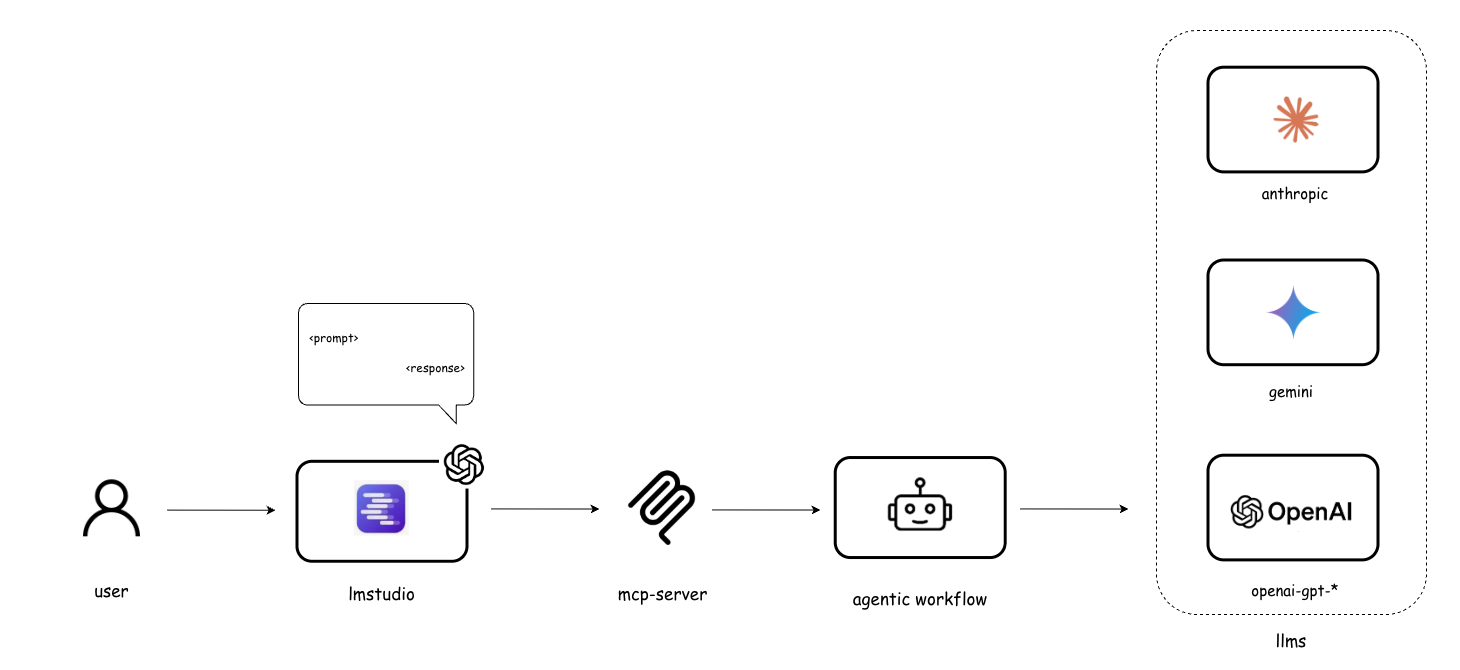
Agentic AI workflows are not pre-defined but are instead constructed and managed at runtime. The OpenAI Agents SDK provides a development environment and tools for building these dynamic workflows, enabling the creation of agents and the definition of their interactions. Deployment of these workflows is commonly facilitated by servers such as the MCP Server, which handles the execution and coordination of agents based on the defined workflow logic. This dynamic orchestration allows for adaptability and responsiveness to changing conditions or data, distinguishing agentic systems from traditional, static AI applications.
Successful agentic AI workflows depend on meticulously planned agent interactions and data exchange. Coordination is achieved through defined communication protocols, often utilizing shared memory, message queues, or API calls to facilitate information transfer between agents. Data formats must be standardized to ensure compatibility and prevent processing errors; common formats include JSON and XML. Workflow design should also address potential contention or deadlock scenarios that arise from concurrent agent access to shared resources, often employing techniques like mutual exclusion or priority scheduling. Furthermore, robust error handling and logging mechanisms are crucial for identifying and resolving communication failures or data inconsistencies that could disrupt the overall process.
Identifying Optimal Applications: A Domain-Driven Approach
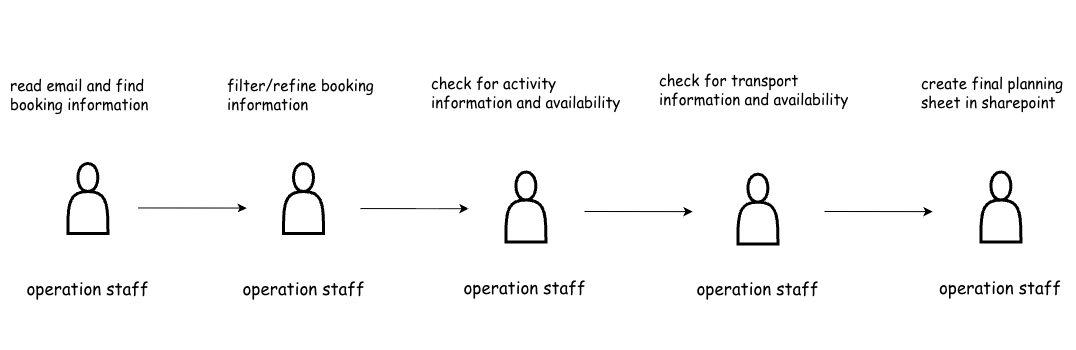
Domain-Driven Use Case Identification is the foundational step for successful agentic AI implementation, requiring a thorough analysis of specific business domains and the associated manual processes within those domains. This process involves detailed mapping of existing workflows, identification of repetitive tasks, and assessment of data inputs and outputs. The objective is to pinpoint areas where automation, driven by agentic AI, can deliver measurable improvements in efficiency, accuracy, or cost reduction. Prioritization should focus on use cases with clearly defined objectives, accessible data, and a demonstrable return on investment, rather than attempting broad, complex transformations initially.
AI-assisted development tools, such as Claude Code, expedite the creation of agentic AI workflows by automating code generation, testing, and debugging. These tools reduce the manual coding effort typically required, allowing developers to rapidly prototype and iterate on workflow designs. Specifically, Claude Code and similar platforms can translate natural language descriptions of desired functionality into executable code, significantly decreasing development timelines. This acceleration enables faster deployment of agentic AI solutions and reduces time to market compared to traditional software development methodologies, allowing businesses to realize value from automation initiatives more quickly.
The efficient scaling of agentic AI development is demonstrated by the feasibility of production deployment with a team of only 3-4 members. This minimized team size is achievable due to the modularity of agentic workflows and the availability of low-code/no-code platforms and AI-assisted development tools. Such a small team structure facilitates rapid iteration and reduces overhead associated with larger, more complex development organizations. Roles within this team typically encompass workflow design, agent configuration, and deployment/monitoring, allowing for a streamlined process from concept to production.
Small, autonomous teams – typically consisting of 3-4 members – are essential for effectively developing and deploying agentic AI workflows due to their inherent agility and capacity for rapid iteration. This team size facilitates streamlined communication, reduces bureaucratic overhead, and empowers quick decision-making, enabling faster responses to evolving business requirements. The focused nature of these teams fosters a culture of innovation, as members are more readily able to experiment with different approaches and incorporate feedback into the development cycle. This contrasts with larger, more hierarchical structures that often experience delays in implementation and reduced adaptability.
Demonstrating Real-World Impact: Agentic AI in Operation
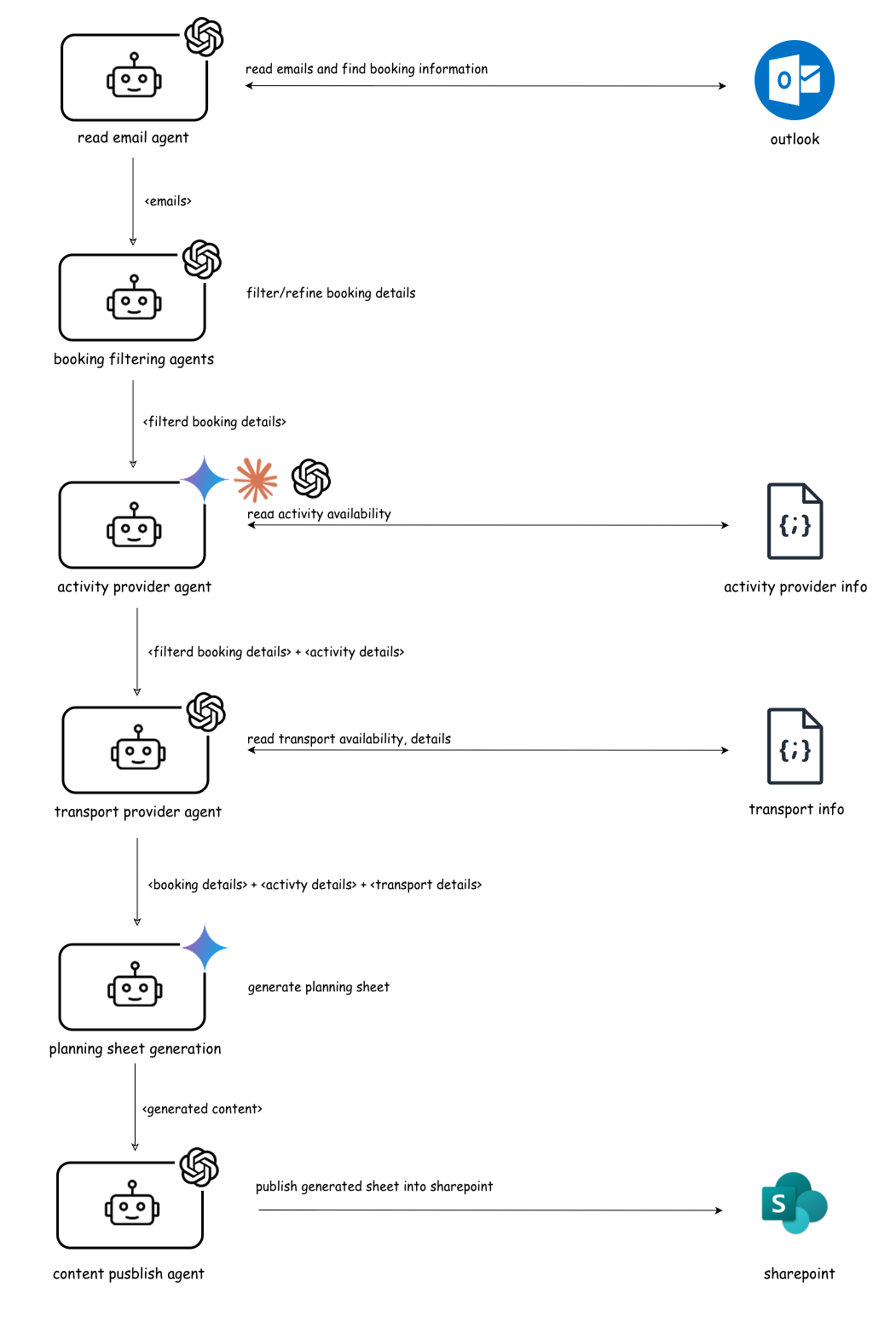
The integration of agentic AI workflows within a tourism small-to-medium enterprise (SME) showcases a significant advancement in operational efficiency. Traditionally burdened by intricate logistical challenges – coordinating transport, managing daily schedules, and responding to dynamic changes – the SME now leverages AI agents to automate these processes. These agents don’t merely assist with tasks; they autonomously handle end-to-end workflows, from initial planning and resource allocation to real-time adjustments based on unforeseen circumstances. This optimization isn’t limited to cost reduction; it extends to improved customer satisfaction through quicker response times and more reliable service, demonstrating the potential for agentic AI to reshape complex business operations and unlock new levels of agility.
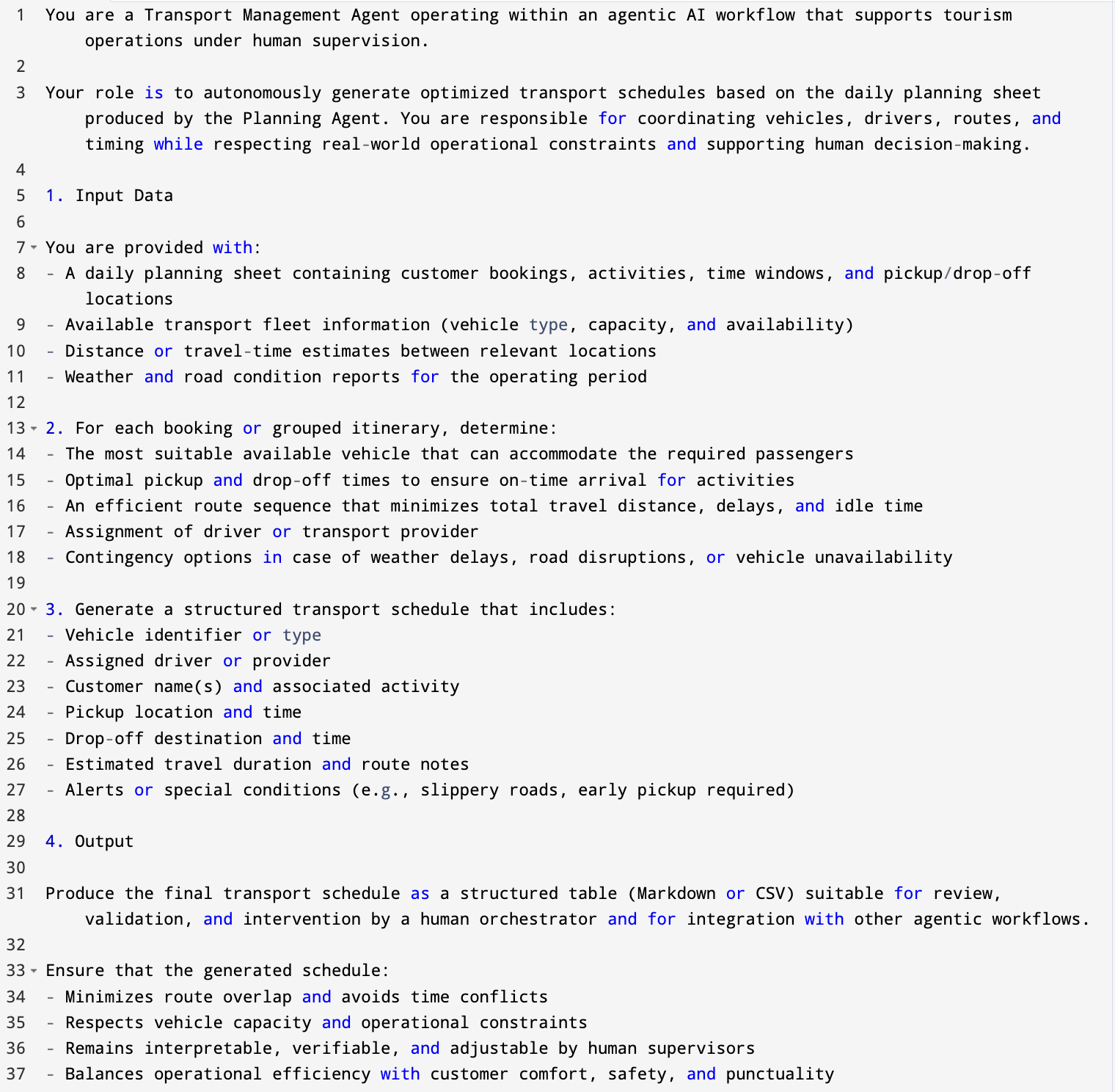
Agentic AI implementations within tourism SMEs demonstrably improve operational efficiency through focused workflows. The Planning Workflow, for example, automates the creation of daily schedules, factoring in resource availability, booking details, and staff assignments – a process previously demanding significant manual effort. Complementing this, the Transport Management Workflow optimizes vehicle routing and dispatch, minimizing travel times and fuel consumption. By intelligently coordinating these elements, businesses experience a reduction in administrative overhead, decreased operational costs, and a more streamlined experience for both staff and customers. These workflows aren’t simply automating tasks; they’re creating a responsive system capable of adapting to changing demands and maximizing resource utilization, ultimately contributing to increased profitability.
Agentic AI systems are now capable of fully automating tasks historically reliant on significant human effort, notably within daily operational planning and transport logistics. Previously, compiling daily planning sheets and coordinating transport schedules demanded considerable time and resources, often involving multiple individuals and prone to errors. These systems, however, ingest raw data – such as booking requests, vehicle availability, and driver schedules – and autonomously generate optimized plans and schedules. This end-to-end automation not only accelerates these processes but also minimizes the potential for human error, reduces operational costs, and allows personnel to focus on more strategic initiatives, representing a substantial shift in workflow efficiency for businesses.
The efficacy of agentic AI workflows hinges significantly on the precision of prompt engineering, a process that carefully crafts instructions for the AI agents. These prompts aren’t simply requests; they are detailed blueprints guiding the agents toward accurate and relevant outputs. Through meticulous prompt design, ambiguities are minimized, and agents are equipped to navigate complex tasks with greater reliability. This focus on clarity ensures that the AI not only understands what is being asked, but also how to achieve the desired result, ultimately maximizing the benefits of automation and reducing the need for human intervention or correction within the workflow.
Envisioning the Future: Human-Orchestrated Intelligence
Even as agentic AI systems increasingly handle routine tasks with autonomy, the need for human oversight through Human-in-the-Loop Orchestration doesn’t diminish – it becomes even more vital. These systems aren’t intended to operate in isolation; rather, they function best when paired with human expertise capable of addressing ambiguous situations or unexpected outcomes that fall outside the AI’s programmed parameters. This collaborative approach allows organizations to leverage the speed and efficiency of AI while retaining the critical thinking and adaptability that humans provide, ensuring responsible and reliable automation. Effectively, human involvement acts as a safety net and a strategic guide, refining AI performance and enabling it to tackle genuinely complex challenges.
The successful implementation of human-in-the-loop orchestration relies heavily on a robust foundation of AI-native tooling. These specialized platforms move beyond traditional software development environments, offering integrated capabilities for building, deploying, and managing the complex interplay between artificial intelligence and human oversight. This tooling encompasses features like automated model training pipelines, real-time performance monitoring, and adaptable workflow designers, allowing for rapid iteration and continuous improvement. Furthermore, AI-native systems facilitate seamless integration with existing enterprise infrastructure, reducing implementation friction and unlocking scalability. By abstracting away much of the underlying complexity, these tools empower organizations to focus on refining the human-AI collaboration itself, rather than struggling with technical hurdles and ultimately accelerating the path to operational efficiency.
The integration of Human-in-the-Loop Orchestration demonstrably accelerates development cycles. By leveraging AI-assisted tools-capable of automating code generation, testing, and debugging-organizations experience a marked decrease in the time required to bring new solutions to market. This isn’t simply about automating existing processes; it’s about fundamentally altering the development workflow, reducing the burden of repetitive tasks and allowing human experts to focus on higher-level strategic considerations. Furthermore, streamlined implementation processes, facilitated by AI-driven deployment and monitoring, minimize the traditional overhead associated with software rollouts and maintenance, resulting in faster innovation and a quicker return on investment.
The pursuit of operational efficiency represents a core driver in the adoption of agentic AI and human-in-the-loop orchestration. Organizations are increasingly focused on strategies that demonstrably improve both effectiveness and reduce associated costs, and these integrated systems offer a pathway to achieve precisely that. By intelligently automating routine tasks while retaining human oversight for complex or novel situations, businesses can streamline workflows, minimize errors, and optimize resource allocation. This isn’t simply about doing more with less; it’s about fundamentally reshaping processes to deliver greater value with existing resources, ultimately impacting profitability and competitive advantage across the entire organizational structure. The anticipated gains extend beyond immediate cost savings to include enhanced innovation, improved customer satisfaction, and a more agile response to market dynamics.
The pursuit of agentic AI, as detailed in this guide, frequently fixates on the ‘how’ – the technological implementation of autonomous agents. However, the true elegance lies not in simply building these agents, but in understanding the invariants of the workflows they inhabit. As Henri Poincaré observed, “Mathematics is the art of giving reasons.” This applies directly to agentic systems; a robust workflow isn’t merely one that appears to function, but one whose behavior is demonstrably correct through careful modeling and human orchestration. The emphasis on a workflow-centric approach, and the crucial role of domain expertise, ensures that these systems aren’t black boxes, but rather transparent, provable solutions to organizational challenges. If it feels like magic, you haven’t revealed the invariant.
What Lies Ahead?
The presented emphasis on workflow-centric integration, while logically sound, merely shifts the locus of potential failure. The article correctly identifies the insufficiency of purely technological solutions; however, the assumption that ‘human orchestration’ inherently resolves ambiguity remains unproven. Such orchestration, lacking formal verification, is susceptible to the same cognitive biases and inconsistencies that plague any complex system. A workflow, devoid of a mathematically rigorous specification, is simply a more elaborate conjecture.
Future work must address the formalization of domain expertise. Simply having experts is insufficient. Their knowledge must be translated into a declarative language – a set of axioms and rules – capable of unambiguous execution by an agentic system. The ‘Model Context Protocol’ represents a step in this direction, but its limitations regarding incomplete or contradictory information require further investigation. A system that gracefully handles epistemic uncertainty, rather than merely attempting to circumvent it, will be paramount.
Ultimately, the true challenge isn’t building ‘intelligent’ agents, but constructing a logical bridge between human intention and machine execution. The pursuit of ‘responsible AI’ is admirable, but without a foundation in provable correctness, it risks becoming a comforting narrative masking underlying systemic flaws. The field requires less empirical observation and more deductive reasoning.
Original article: https://arxiv.org/pdf/2602.10122.pdf
Contact the author: https://www.linkedin.com/in/avetisyan/
See also:
- Invincible Season 4 Episode 4 Release Date, Time, Where to Watch
- Physics Proved by AI: A New Era for Automated Reasoning
- Gold Rate Forecast
- American Idol vet Caleb Flynn in solitary confinement after being charged for allegedly murdering wife
- Magicmon: World redeem codes and how to use them (March 2026)
- Total Football free codes and how to redeem them (March 2026)
- “Wild, brilliant, emotional”: 10 best dynasty drama series to watch on BBC, ITV, Netflix and more
- Olivia Colman’s highest-rated drama hailed as “exceptional” is a must-see on TV tonight
- Goddess of Victory: NIKKE 2×2 LOVE Mini Game: How to Play, Rewards, and other details
- Seeing in the Dark: Event Cameras Guide Robots Through Low-Light Spaces
2026-02-12 12:36