Author: Denis Avetisyan
A new approach to information access is emerging, shifting the focus from simply finding documents to actively solving problems with the data they contain.
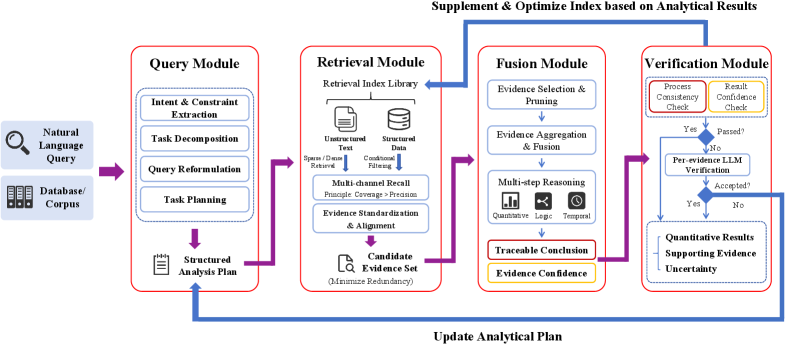
Analytical Search reframes information retrieval as sequential decision-making, leveraging large language models for reasoning, evidence fusion, and dynamic index organization.
While information retrieval excels at finding documents, it often falls short when applied to complex analytical tasks demanding reasoning and evidence fusion. This paper introduces ‘Analytical Search’, a paradigm shift reframing search as an evidence-governed workflow explicitly modeling analytical intent and enabling verifiable conclusions. At its core, this approach moves beyond simple relevance to support end-to-end problem solving through sequential decision-making and reasoning-aware evidence integration. Will this new framework unlock the next generation of search engines capable of truly supporting analytical information needs across diverse domains?
The Evolving Landscape of Information Needs
For decades, Information Retrieval (IR) systems have operated on a principle of lexical matching – efficiently locating documents containing specified keywords. While remarkably successful at this task, this approach fundamentally falters when confronted with analytical queries. These aren’t simple requests for documents about a topic, but demands for synthesized insights derived from multiple sources. Consider a question like “What is the relationship between rising sea levels and coastal property values?” A keyword search might return documents mentioning both terms, but it cannot independently assess the validity of claims, reconcile conflicting data, or construct a cohesive answer. The limitations stem from IR’s focus on document retrieval, not knowledge synthesis; it excels at finding information, but struggles to reason with it, highlighting the need for systems capable of more than just matching terms.
The demands placed on information retrieval systems are evolving beyond simple keyword matching, as users increasingly require solutions to complex analytical questions. These Analytical Information Needs represent tasks where the desired outcome isn’t merely a list of relevant documents, but rather a synthesized, evidence-based answer. Consider scenarios requiring comparative analysis, causal inference, or the identification of trends – these necessitate systems capable of extracting, interpreting, and integrating information from multiple sources. This shift reflects a growing need for tools that actively support problem-solving, going beyond document retrieval to deliver actionable insights grounded in verifiable evidence, and fundamentally changing how people interact with and utilize information.
The limitations of conventional information retrieval, designed to match keywords within documents, are giving way to a new approach termed Analytical Search. This paradigm prioritizes problem-solving, moving beyond simply locating relevant texts to actively synthesizing evidence and constructing solutions. Unlike traditional systems that deliver lists of documents, Analytical Search aims to directly address complex analytical information needs-queries requiring reasoning, inference, and the integration of information from multiple sources. This represents a fundamental shift in how individuals interact with information, demanding systems capable of not just finding data, but of analyzing it and delivering actionable insights, as detailed in this work.
Deconstructing Complexity: A Systematic Approach
Analytical Search employs query decomposition as a fundamental technique for managing analytical complexity. This process involves breaking down a single, high-level analytical request into multiple, discrete sub-tasks that can be processed individually. These sub-tasks are typically formulated as focused queries, each designed to retrieve specific data or perform a limited calculation. The decomposition is not arbitrary; it is guided by the structure of the analytical request and the relationships between the required data elements. By addressing these smaller tasks sequentially or in parallel, the system reduces the computational burden and enhances the efficiency of complex analytical operations, ultimately enabling the solution of problems that would be intractable with a single, monolithic query.
Following query decomposition, the system utilizes a synthesis engine to integrate the results from each processed sub-task. This process involves data aggregation, conflict resolution, and the application of predefined analytical rules to combine evidence from disparate sources. The synthesis engine prioritizes data based on source reliability and relevance to the original query, ultimately constructing a unified response that addresses the initial complex request. This structured approach ensures that the final solution is not simply a collection of individual findings, but a coherent and well-supported answer derived from the systematic analysis of decomposed query components.
Query decomposition facilitates a broad spectrum of analytical tasks by breaking down complex requests into manageable components. Specifically, the system addresses Descriptive Analytical Needs through historical trend analysis, leveraging decomposed queries to identify and synthesize past data points. Predictive Analytical Needs are met by utilizing decomposed queries to feed forecasting models and assess probabilities of future events. Finally, Prescriptive Analytical Needs are supported by evaluating potential actions through decomposed queries, allowing the system to recommend optimal strategies based on synthesized evidence; this capability represents a core achievement detailed within this paper and demonstrates the system’s capacity to move beyond observation and prediction towards actionable intelligence.
Bridging the Data Divide: A Unified Retrieval Strategy
Analytical Search employs a tiered approach to data retrieval, recognizing the distinct characteristics of different data formats. Structured data, typically residing in relational databases, is most efficiently accessed via Text-to-SQL interfaces. These systems translate natural language queries into SQL commands, enabling users to directly query and retrieve specific data points without requiring manual SQL expertise. This contrasts with the methods needed for unstructured data, such as free-form text documents, where techniques like keyword-based sparse retrieval or semantic-based dense retrieval are applied. The selection of the appropriate retrieval method is contingent on the data’s organization and the specific analytical goals.
Unstructured data retrieval employs two primary methodologies: sparse retrieval and dense retrieval. Sparse retrieval techniques, such as those utilizing inverted indexes and keyword matching, prioritize precision by directly matching query terms to document terms, making them effective for targeted information needs. Conversely, dense retrieval leverages vector embeddings – numerical representations of text – to capture semantic meaning, enabling generalization to documents that don’t explicitly contain query keywords but are conceptually related. These methods utilize models like Transformers to create these embeddings, allowing for similarity searches based on meaning rather than literal text matches. The optimal approach often involves a hybrid strategy, combining the precision of sparse retrieval with the generalization capabilities of dense retrieval to maximize recall and relevance in unstructured data analysis.
Combining structured data, typically residing in relational databases, with unstructured data from sources like text documents, emails, and logs, enables more comprehensive analytical solutions than either data type can provide in isolation. This integration allows for the correlation of factual, quantifiable data with qualitative insights and contextual information. The innovation lies in the ability to move beyond analyzing data within a single system and instead perform cross-data-type analysis, offering a holistic view crucial for tasks such as root cause analysis, trend identification, and predictive modeling. This approach facilitates a more nuanced understanding of complex phenomena by leveraging the strengths of both data formats – the precision of structured data and the breadth of unstructured data.
The pursuit of Analytical Search, as detailed in this work, mirrors a fundamental principle of intelligent systems: the decomposition of complex problems into manageable steps. This resonates with Marvin Minsky’s assertion: “The more we understand about intelligence, the more we realize how much of it is simply good thinking.” The paper’s emphasis on sequential decision-making and evidence fusion isn’t merely about retrieving information; it’s about reasoning with that information – building a chain of thought to arrive at a solution. This shift from relevance to reasoning is paramount; a system that simply finds documents is limited, while one that actively synthesizes evidence and adapts its search strategy embodies a higher form of intelligence. Good architecture is invisible until it breaks, and only then is the true cost of decisions visible.
The Road Ahead
The introduction of Analytical Search signals a necessary, if belated, recognition that information retrieval has long mistaken the map for the territory. For decades, the field optimized for locating documents; now, it begins to grapple with the harder problem of using information. This is not merely a technical shift, but a conceptual one. One does not repair a fractured femur by finding more bones; the structure itself demands understanding of the whole musculoskeletal system. The current work offers a promising architecture, but the devil, predictably, resides in the details of scaling and generalization.
A critical limitation remains the inherent brittleness of any system reliant on pre-defined reasoning chains. Real-world problems rarely conform to neat logical progressions. Future efforts must focus on enabling dynamic reasoning-systems that can not only follow a path but forge a new one when the terrain shifts. The challenge is not simply to fuse evidence, but to assess its reliability and relevance within a constantly evolving context.
Ultimately, the success of Analytical Search, or its successors, will depend not on achieving ever-higher scores on benchmark datasets, but on demonstrating genuine problem-solving capability. One cannot replace the heart without understanding the bloodstream. The true measure of progress will be whether these systems can move beyond clever imitation and exhibit something resembling genuine intelligence.
Original article: https://arxiv.org/pdf/2602.11581.pdf
Contact the author: https://www.linkedin.com/in/avetisyan/
See also:
- Invincible Season 4 Episode 4 Release Date, Time, Where to Watch
- Physics Proved by AI: A New Era for Automated Reasoning
- How Martin Clunes has been supported by TV power player wife Philippa Braithwaite and their anti-nepo baby daughter after escaping a ‘rotten marriage’
- Gold Rate Forecast
- American Idol vet Caleb Flynn in solitary confinement after being charged for allegedly murdering wife
- CookieRun: OvenSmash coupon codes and how to use them (March 2026)
- Total Football free codes and how to redeem them (March 2026)
- Only One Straw Hat Hasn’t Been Introduced In Netflix’s Live-Action One Piece
- Olivia Colman’s highest-rated drama hailed as “exceptional” is a must-see on TV tonight
- Goddess of Victory: NIKKE 2×2 LOVE Mini Game: How to Play, Rewards, and other details
2026-02-13 10:13