Author: Denis Avetisyan
New research reveals how analyzing reciprocal interactions-not just who follows whom-unlocks a deeper understanding of user behavior and content engagement on social media.
![User behavior exhibits a continuous spectrum across varying degrees of reciprocity, demonstrated by a heatmap revealing smooth transitions in user properties-represented as median values across a [latex]10 \times 10[/latex] grid defined by inbound and outbound reciprocity ratios-and indicating a lack of discrete behavioral boundaries.](https://arxiv.org/html/2601.15623v1/x31.png)
A reciprocity-based framework identifies a continuous behavioral space and an intermediate ‘engagement zone’ within social networks.
Despite the prevalence of social media, characterizing the diversity of user behaviors remains a fragmented challenge. This is addressed in ‘Mapping Social Media User Behaviors in Reciprocity Space’, which introduces a novel framework defining user positions within a continuous behavioral space based on bidirectional connection ratios. Analyzing nearly 150 million Twitter connections, the study demonstrates that previously categorized user types-such as influencers and lurkers-emerge as natural regions within this space, revealing smooth behavioral gradients and an intermediate reciprocity zone linked to maximized content engagement. Could this reciprocity-based approach offer a more nuanced understanding of online influence and inform the design of more effective social platforms?
Beyond Simple Connections: Mapping the Reciprocal Web
Conventional social network analysis often reduces complex relationships to simple metrics like follower counts, providing a superficial understanding of online interactions. This approach treats connections as uniform, failing to differentiate between various types of engagement – a user might passively follow an account without genuine interaction, or actively participate in discussions with a select group. Consequently, valuable insights into user behavior, information diffusion, and community structure remain obscured. The limitations of this methodology become particularly apparent when attempting to model real-world social dynamics, where reciprocity, shared interests, and the strength of ties play critical roles in shaping network behavior, and are not adequately reflected by mere connection counts.
The architecture of online social networks isn’t simply about who is connected, but rather the nature of those connections-specifically, reciprocity. Analyses revealing mutual exchange, where connections are returned, demonstrate a far more accurate picture of information dissemination than simple follower counts ever could. Studies indicate that information doesn’t flow equally through these networks; it tends to concentrate along reciprocal links, creating pathways of higher trust and engagement. This mutual reinforcement amplifies certain voices and ideas while simultaneously suppressing others, meaning that a network’s true structure-and its susceptibility to influence-is best understood by mapping these reciprocal relationships. Ignoring reciprocity risks mistaking passive audiences for active participants and misinterpreting the dynamics that genuinely shape online conversation and community formation.
Current methods for analyzing social networks often treat all connections as equal, failing to differentiate between users who actively reciprocate connections, passively accept them, or strategically offer them. This limitation hinders a comprehensive understanding of online communities because the way individuals connect reveals crucial information about their roles and influence. Without a framework to categorize users based on their connection behaviors – such as ‘reciprocators’, ‘broadcasters’, or ‘isolates’ – researchers struggle to identify key influencers, understand information diffusion patterns, and accurately model the dynamics of online social structures. Developing such a categorization system promises to move beyond simple connectivity metrics and provide deeper insights into the complex relationships that shape online communities and the information they share.
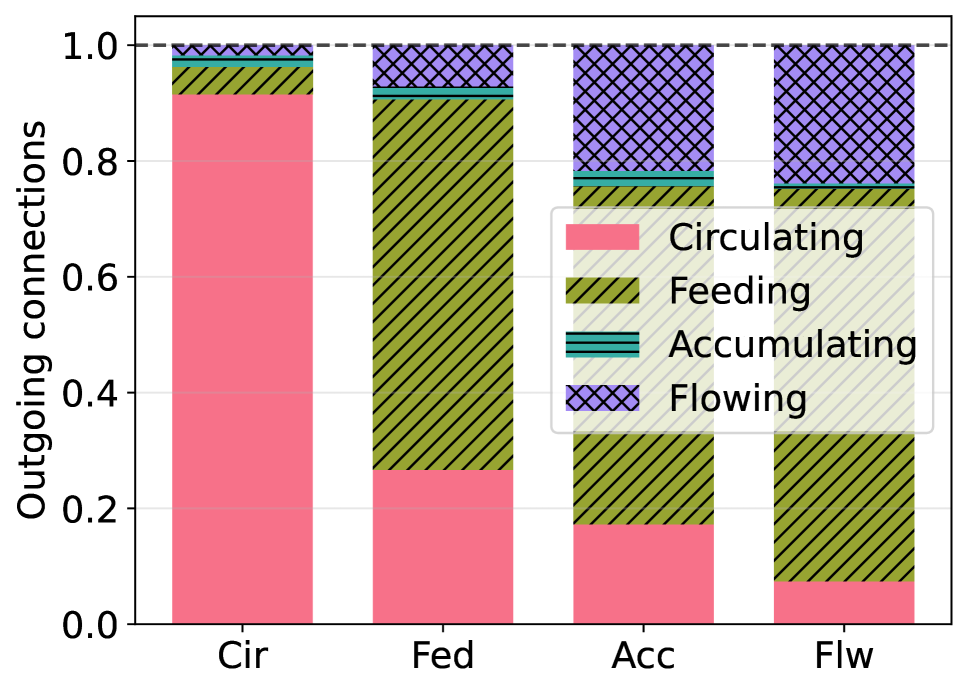
Defining User Roles: A Framework Based on Reciprocity
The reciprocity framework quantifies interaction patterns by calculating ratios derived from network edge directionality. Specifically, it assesses reciprocity by comparing the number of bidirectional edges – connections where both users link to each other – to both in-degree and out-degree. In-degree represents the total number of incoming connections to a user, while out-degree represents the total number of outgoing connections. The ratio of bidirectional edges to in-degree indicates the proportion of received connections that are reciprocated, while the ratio to out-degree indicates the proportion of initiated connections that are reciprocated. These ratios, calculated at the user level, provide a normalized measure of reciprocal behavior, independent of overall network activity, and form the basis for archetype assignment.
User categorization within this framework is achieved by analyzing the ratio of bidirectional (reciprocal) connections to a user’s in-degree and out-degree. Users exhibiting a high proportion of reciprocal connections relative to their total connections are identified as potential Influencers, indicating strong, mutually acknowledged relationships. Conversely, users with a low reciprocity ratio and a high in-degree are categorized as Lurkers, suggesting they primarily receive connections without actively reciprocating. A high out-degree combined with low reciprocity defines Brokers, users who connect disparate groups but do not necessarily maintain strong reciprocal ties with all connections. Remaining users are categorized based on variations in these core connection patterns, allowing for the identification of further archetypes and a nuanced understanding of user behavior within the network.
Analysis of a dataset comprising 48,830 users and 149,368,679 connections demonstrates a non-uniform distribution of user archetypes. The application of the reciprocity-based framework identified statistically significant populations within each archetype – Influencers, Lurkers, Brokers, and others – indicating that connection patterns are not random. This distribution suggests an inherent structure within the social web, characterized by varying degrees of reciprocity and differing roles played by individual users. Quantitative analysis revealed that while no single archetype dominates, the collective behavior of these archetypes contributes to the overall network topology and information flow.
![Analysis of user interactions in reciprocity space-defined by [latex]rin[/latex] and [latex]rout[/latex]-reveals four distinct archetypes-Feeding, Accumulating, Flowing, and Circulating-based on user density and interaction patterns.](https://arxiv.org/html/2601.15623v1/x1.png)
Revealing Engagement Patterns: The Dynamics of Archetypes
The ‘Feeding Archetype’ is characterized by a low ratio of inbound reciprocity ([latex]rinr\_in[/latex]) and a high ratio of outbound reciprocity ([latex]routr\_out[/latex]), indicating a broadcasting communication pattern. Quantitative analysis reveals these users possess a median follower count exceeding 2,000, a statistically significant difference compared to all other identified archetypes. This suggests ‘Feeding Archetype’ accounts primarily disseminate information to a large audience with limited reciprocal engagement, functioning as one-to-many communication hubs rather than participating in dense conversational networks. The high follower count, combined with the reciprocity ratios, defines this archetype’s prevalence as content originators in the observed social network.
Users identified as the ‘Flowing Archetype’ exhibit low levels of both incoming (rinr_in) and outgoing (routr_out) reciprocity, indicating a network position characterized by bridging rather than dense clustering. This pattern suggests these users primarily function as brokers, connecting otherwise disconnected communities by relaying information between them without necessarily fostering reciprocal engagement within those communities. Analysis demonstrates that ‘Flowing Archetype’ users are not central to tightly-knit information loops but instead facilitate communication between loops, indicating a role in structural cohesion at a broader network level. Their low reciprocity scores suggest they receive and transmit information with minimal expectation of direct return engagement, further supporting their function as informational bridges.
Analysis of reciprocity metrics – specifically, the ratio of inbound to outbound replies ([latex]rin[/latex]) and outbound to inbound replies ([latex]rout[/latex]) – reveals a ‘High Engagement Zone’ where content experiences peak virality. This zone is defined by [latex]rin[/latex] values ranging from approximately 0.5 to 0.7 and [latex]rout[/latex] values between 0.6 and 0.9. Content propagation within this zone is primarily driven by users categorized as the ‘Circulating Archetype’, characterized by consistently high values for both [latex]rinr\_in[/latex] and [latex]routr\_out[/latex], indicating a high degree of reciprocal engagement and content re-sharing.
![Analysis of user behavior across five archetypes-Flowing, Accumulating, Feeding, Circulating, and Other-reveals statistically significant distinctions ([latex]p<4\times 10^{-{124}}[/latex]) in tweet composition, activity levels, network structure, and content engagement metrics.](https://arxiv.org/html/2601.15623v1/x15.png)
From Theory to Practice: Validating the Framework with Real-World Data
A comprehensive analysis of a representative 1% stream of Twitter data demonstrates the robust applicability of the proposed framework in identifying a remarkably diverse range of user archetypes within a real-world social network. This examination revealed not a monolithic user base, but a complex distribution of behavioral patterns, indicating that individuals gravitate towards distinct roles in information dissemination and social interaction. The observed variety suggests that understanding these archetypes is crucial for deciphering the dynamics of online communities, and predicting how information propagates through networks. Furthermore, this data-driven validation strengthens the framework’s potential as a tool for modeling and interpreting complex social behaviors across various digital platforms.
The study reveals that content engagement within social networks isn’t simply a matter of popularity, but emerges from the dynamic interactions between distinct user archetypes. These archetypes – identified through analysis of a large Twitter sample – consistently exhibit predictable patterns of content creation, sharing, and response, yet their combined activity generates complex network behaviors. Specifically, the framework demonstrates how certain archetype pairings amplify message reach, while others foster focused discussion or, conversely, contribute to echo chambers. This interplay isn’t random; the analysis consistently showed that content originating from, or directed towards, specific archetype combinations consistently garnered significantly higher engagement rates, suggesting that understanding these relationships is crucial for predicting and influencing network dynamics and information dissemination.
The architecture of social networks is fundamentally sculpted by the prevalence of reciprocal relationships, as demonstrated by an analysis revealing that 16.8% of all connections are mutual. This finding underscores that social bonds aren’t solely one-directional broadcasts, but often involve a back-and-forth exchange of attention and information. Such mutuality fosters stronger ties, encourages sustained interaction, and contributes to the formation of cohesive subgroups within the broader network. The relatively high proportion of mutual connections suggests that individuals actively cultivate relationships with those who also acknowledge them, highlighting the significance of reciprocity in maintaining social structure and influencing the flow of influence across the network.
The study meticulously charts the contours of user interaction, revealing not rigid classifications but a fluid behavioral space. This aligns with Kernighan’s observation that “Debugging is twice as hard as writing the code in the first place. Therefore, if you write the code as cleverly as possible, you are, by definition, not smart enough to debug it.” The researchers, much like a diligent debugger, stripped away preconceived notions of distinct user ‘types’ to expose the underlying structure of reciprocity. By focusing on the continuous spectrum of behavior – particularly the intermediate reciprocity zone maximizing engagement – the analysis achieves a clarity born from subtraction, mirroring the elegance of simplified design and revealing essential truths about network dynamics.
What Remains
The framing of user behavior as a continuous space, rather than discrete types, proves a useful reduction. It sidesteps the inherent, and ultimately arbitrary, act of categorization. However, this behavioral space remains, at present, a mapping of activity, not a predictor of it. The identification of an intermediate reciprocity zone, maximizing engagement, feels less a discovery of a fundamental principle, and more an observation of current platform dynamics. These dynamics, naturally, are not static.
Future work must address the temporal element. This analysis offers a snapshot, yet the contours of this behavioral space will shift as platforms evolve, algorithms change, and user attention fragments further. A crucial, and stubbornly difficult, task will be discerning whether this ‘intermediate zone’ represents an optimal strategy for content creators, or simply a current equilibrium – a temporary sweet spot before saturation or algorithmic correction.
The elegance of this framework lies in its parsimony. Yet, true understanding demands more than elegant maps. It requires a reckoning with the messy, irrational, and often self-defeating impulses that drive human interaction. The challenge, then, isn’t to add more variables, but to rigorously prune those that obscure, rather than illuminate, the core mechanisms at play.
Original article: https://arxiv.org/pdf/2601.15623.pdf
Contact the author: https://www.linkedin.com/in/avetisyan/
See also:
- Invincible Season 4 Episode 4 Release Date, Time, Where to Watch
- Physics Proved by AI: A New Era for Automated Reasoning
- How Martin Clunes has been supported by TV power player wife Philippa Braithwaite and their anti-nepo baby daughter after escaping a ‘rotten marriage’
- CookieRun: OvenSmash coupon codes and how to use them (March 2026)
- Total Football free codes and how to redeem them (March 2026)
- Goddess of Victory: NIKKE 2×2 LOVE Mini Game: How to Play, Rewards, and other details
- Gold Rate Forecast
- American Idol vet Caleb Flynn in solitary confinement after being charged for allegedly murdering wife
- Olivia Colman’s highest-rated drama hailed as “exceptional” is a must-see on TV tonight
- Only One Straw Hat Hasn’t Been Introduced In Netflix’s Live-Action One Piece
2026-01-24 03:47