Author: Denis Avetisyan
A new perspective argues that successful human-AI interaction isn’t about achieving perfect teamwork, but about rigorously justifying the outcomes of these partnerships.
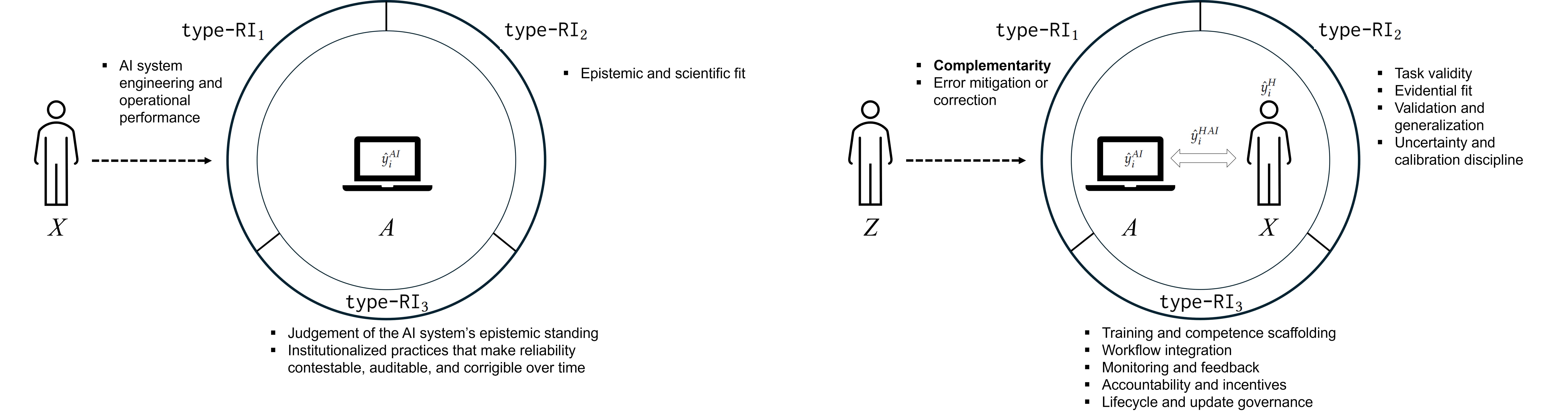
This review frames complementarity as a reliability indicator within computational reliabilism, shifting the focus to epistemic justification in human-AI decision-making.
While human-AI complementarity-the idea that combined performance exceeds that of humans or AI alone-has gained traction as an alternative to ‘trust in AI,’ it lacks robust theoretical grounding and remains largely a post-hoc observation. In ‘Epistemology gives a Future to Complementarity in Human-AI Interactions’, we address these limitations by reframing complementarity within the discourse of justificatory AI and computational reliabilism. We argue that instances of complementarity function as evidence of a reliable epistemic process, contributing to the overall reliability of human-AI teams and supporting reasoned decision-making. Rather than a goal in itself, can complementarity thus serve as a crucial reliability indicator for increasingly AI-supported processes shaping everyday life?
Beyond Prediction: Embracing Human-AI Synergy
Numerous predictive challenges extend beyond the capabilities of contemporary artificial intelligence, frequently demanding the application of human expertise. While AI excels at identifying patterns within structured data, it often falters when confronted with ambiguity, incomplete information, or scenarios requiring common sense reasoning – cognitive abilities readily possessed by humans. Complex forecasting, such as anticipating geopolitical shifts or evaluating the potential success of novel technologies, involves nuanced judgment and contextual understanding that current algorithms struggle to replicate. Consequently, tasks demanding intricate analysis, creative problem-solving, and the integration of disparate knowledge domains often necessitate the involvement of human analysts to refine AI-generated insights and ensure reliable predictions.
Conventional artificial intelligence systems, while proficient at identifying patterns in structured datasets, often falter when confronted with the ambiguities inherent in real-world data. These systems frequently rely on rigid algorithms and predefined parameters, proving inadequate in scenarios characterized by incomplete information, unforeseen events, or subtle contextual cues. Consequently, predictions generated by traditional AI can be unreliable, exhibiting a lack of robustness when faced with novelty or unpredictability. The limitations stem from an inability to effectively generalize beyond the training data and a difficulty in discerning the significance of nuanced details – factors easily managed by human cognition but challenging for purely algorithmic approaches.
The pursuit of consistently accurate predictions increasingly relies on a shift toward collaborative intelligence, where the strengths of both humans and artificial intelligence are combined. Current AI systems, while adept at processing vast datasets, often falter when confronted with ambiguity, novel situations, or the need for contextual understanding – areas where human cognition excels. Conversely, humans are limited by cognitive biases and the sheer volume of data that AI can efficiently analyze. This synergistic approach allows AI to handle repetitive tasks and large-scale data processing, while humans contribute critical thinking, nuanced judgment, and the ability to interpret complex scenarios. The resulting predictions are therefore not merely the output of an algorithm, but a refined assessment informed by both computational power and human expertise, ultimately leading to more robust and reliable outcomes across diverse fields.
The Emergence of Complementarity
Complementarity, in the context of human-AI collaboration, refers to the observed performance gains achieved when a human and an artificial intelligence system work together, exceeding the capabilities of either entity functioning independently. This synergistic effect isn’t simply an average of individual performances; instead, it represents a demonstrable improvement in overall task completion or accuracy. The magnitude of this improvement is dependent on the specific task and the nature of the interaction between the human and the AI, but the core principle is that the combined system possesses capabilities beyond those of its individual components. This phenomenon is observed across various domains, suggesting a fundamental advantage to integrated human-AI workflows.
Effective synergy between humans and AI is not inherent; it necessitates specific patterns of interaction, most notably instances of Reliance. This interaction type involves the sharing or delegation of decision-making authority between the human and the AI agent. Simply pairing a human with an AI does not guarantee improved performance; rather, the human must actively utilize the AI’s capabilities and, conversely, the AI must be designed to support human oversight or task completion. Reliance, therefore, represents a crucial component in achieving complementarity, as it establishes a collaborative dynamic where each agent contributes its strengths to optimize overall outcomes.
Complementarity, as a measurable phenomenon, is quantified by the metric Δτ(D) = min{LH(D), LAI(D)} – LHAIT(D). Here, LH(D) represents the performance of a human on dataset D, LAI(D) denotes the performance of the AI on the same dataset, and LHAIT(D) signifies the performance of the combined human-AI team. The ‘min’ function ensures the baseline for comparison is the superior standalone performance. Therefore, Δτ(D) calculates the absolute difference between that better standalone performance and the performance achieved through human-AI collaboration. A positive value for Δτ(D) indicates complementarity – a demonstrable performance gain resulting from the synergistic interaction – and directly reflects improved predictive accuracy compared to either the human or AI operating independently.
Assessing Reliability: Beyond Simple Accuracy
Traditional metrics for evaluating system reliability, such as accuracy and precision, are insufficient when assessing human-AI teams because they fail to capture the complexities introduced by human interaction and potential sources of error beyond algorithmic performance. A comprehensive evaluation necessitates moving beyond these technical measures to include factors such as the quality of information presented to the human, the human’s understanding of the AI’s limitations, the clarity of roles and responsibilities within the team, and the mechanisms for error detection and correction. Ignoring these elements risks an overestimation of overall system reliability and a failure to identify critical vulnerabilities arising from the human-AI interface and collaborative process.
The TypeRIReliabilityIndicators framework categorizes system reliability into three distinct but interrelated areas. Type1ReliabilityIndicators assess traditional technical performance, such as accuracy, precision, and recall, focusing on the system’s ability to produce correct outputs. Type2ReliabilityIndicators evaluate epistemic validity by examining the system’s understanding of its own uncertainty and the quality of its reasoning processes; this includes calibration and the ability to identify out-of-distribution inputs. Finally, Type3ReliabilityIndicators address socio-technical stabilization, quantifying factors related to human oversight, process standardization, and the robustness of the system within its operational environment, including monitoring and feedback loops.
Quantifying trust in human-AI teams requires assessment beyond simple accuracy metrics. The framework utilizes indicators to evaluate the rationale behind predictions, focusing on both the correctness of the output and the validity of the system’s reasoning process. This involves analyzing the data used for training, the algorithmic logic employed, and the consistency of the system’s performance across varied inputs. Furthermore, evaluation extends to the socio-technical context, including human oversight mechanisms, error detection protocols, and the clarity of communication between the AI and human team members, enabling a comprehensive understanding of the system’s reliability and the basis for justifiable confidence in its outputs.
The Net Benefit of Collaboration
Determining the genuine benefits of human-AI collaboration necessitates a dual assessment of performance gains and associated costs. Simply measuring improved outcomes-the \Delta\tau or Gross Complementarity Gain-provides an incomplete picture; a comprehensive evaluation must also account for the resources expended in achieving that improvement. This includes factors like the time required for human-AI interaction, the cost of maintaining the AI system, and any additional training needed for team members. By subtracting these collaborative costs, represented as c(D), from the raw performance increase, researchers can calculate the Net Complementarity Gain, providing a more accurate and actionable metric for assessing the true value of these partnerships. This nuanced approach moves beyond simply demonstrating that collaboration works, and instead clarifies whether the gains justify the investment.
The true benefit of human-AI collaboration isn’t simply performance improvement, but rather the gain after accounting for the resources expended to achieve it. This is precisely measured by the equation \Delta\tau_{net}(D) = \Delta\tau(D) - \lambda c(D), where \Delta\tau(D) represents the raw performance improvement achieved through complementarity. The term c(D) quantifies the costs associated with achieving this collaborative state – including time, effort, or computational resources. Crucially, λ functions as a conversion parameter, allowing for a defined trade-off between gains and costs; it establishes the acceptable ratio of performance increase needed to justify the resources invested. By subtracting the cost of collaboration, weighted by λ, from the gross performance gain, researchers can determine a net, quantifiable benefit – a value that truly reflects the efficiency and viability of human-AI teams.
Demonstrating the practical value of human-AI collaboration requires more than simply showing improved performance; a quantifiable benefit emerges only when the gains outweigh the costs. This is encapsulated by the concept of Net Complementarity Gain, which reveals a true advantage when positive. Further, assessing efficiency involves comparing the performance improvement, denoted as \Delta\tau(D), against the cost of achieving that improvement, c(D). When the ratio of these – \Delta\tau(D)/c(D) – exceeds a predefined threshold λ, representing acceptable trade-offs, the collaborative approach is not merely beneficial, but demonstrably efficient, justifying its continued investment and broader implementation. This metric provides a clear benchmark for determining whether the resources expended on fostering human-AI synergy are yielding worthwhile returns.
Towards Justified Beliefs: A Computational Foundation
Computational Reliabilism posits that justified belief isn’t merely about what is believed, but how that belief was formed. This philosophical framework moves beyond traditional epistemology by focusing on the underlying processes – the ‘computations’ – that generate beliefs. A belief is considered justified not through introspection or correspondence to reality alone, but by demonstrating the reliability of the mechanism producing it. Essentially, if a computational process consistently yields accurate outputs given appropriate inputs, the beliefs generated by that process gain justification. This is analogous to trusting a well-calibrated instrument; the reading isn’t true because of faith, but because the instrument’s construction and function are demonstrably reliable. This principle extends beyond biological brains, offering a basis for evaluating the trustworthiness of any system – including artificial intelligence – that generates beliefs or makes predictions based on computational processes.
The principles of Computational Reliabilism are increasingly applicable to the realm of human-AI collaboration, offering a pathway to evaluate the trustworthiness of jointly-produced predictions. Rather than treating such systems as ‘black boxes’, this framework emphasizes analyzing the computational processes within both the human and the artificial components. By dissecting how each contributes to a final prediction – identifying strengths, weaknesses, and potential biases – it becomes possible to gauge the overall reliability of the collaborative output. This isn’t merely about achieving high accuracy; it’s about understanding why a prediction is likely to be correct, and quantifying the confidence that can be placed in it. Ultimately, a robust assessment of reliability fosters appropriate reliance on, and effective utilization of, these increasingly prevalent human-AI partnerships.
The development of trustworthy artificial intelligence hinges not solely on predictive accuracy, but on a demonstrable understanding of how those predictions are achieved. Current research emphasizes building AI systems capable of quantifying their own reliability – identifying factors influencing prediction confidence and communicating these to users. This moves beyond simple output provision, enabling a focus on ‘complementarity gains’ – measurable improvements in decision-making resulting from the combined strengths of human and artificial intelligence. By rigorously assessing reliability indicators – such as data provenance, algorithmic transparency, and calibration metrics – and by quantifying how AI enhances, rather than replaces, human judgment, it becomes possible to foster genuine confidence in AI-driven insights, ultimately facilitating more informed and effective decision-making processes.
The study centers on computational reliabilism, moving beyond simply achieving complementarity in human-AI systems to rigorously justifying their outputs. This pursuit of justification echoes Robert Tarjan’s sentiment: “Complexity is vanity. Clarity is mercy.” The article dismantles unnecessary layers of expectation surrounding complementarity, framing it as a measurable reliability indicator – a precise metric, rather than an abstract ideal. By prioritizing justification, the work aligns with Tarjan’s principle; it seeks to distill the core function of human-AI interaction, stripping away complexity to reveal a clear, demonstrable standard for trustworthy decision-making. The emphasis is not on how humans and AI work together, but on whether the resulting output is reliably justified.
What’s Next?
The pursuit of ‘complementarity’ in human-AI systems has, until now, resembled a search for a solution to a problem nobody fully defined. This work suggests the true metric isn’t how humans and AI work together, but whether the resulting output can be justified. A system requiring explicit instruction to achieve ‘complementarity’ has already failed to meet a basic standard of intelligibility. The field must now concern itself with establishing robust indicators of reliability-not crafting elaborate protocols for collaboration.
Remaining, however, is the persistent difficulty of translating epistemic justification into operational terms. The identification of ‘reliability indicators’ is not merely a technical challenge; it demands a clear philosophical account of what constitutes acceptable evidence in a human-AI context. The focus should shift from designing AI to assist decision-making, to designing systems that allow for the rigorous evaluation of those decisions.
Ultimately, the most fruitful lines of inquiry will likely lie not in further complicating the interaction between humans and machines, but in simplifying the criteria by which their outputs are judged. A truly intelligent system requires no explanation; it simply delivers a justified result. The elegance of a solution, it should be remembered, resides in what it omits.
Original article: https://arxiv.org/pdf/2601.09871.pdf
Contact the author: https://www.linkedin.com/in/avetisyan/
See also:
- Clash Royale Best Boss Bandit Champion decks
- Vampire’s Fall 2 redeem codes and how to use them (June 2025)
- World Eternal Online promo codes and how to use them (September 2025)
- Best Arena 9 Decks in Clast Royale
- How to find the Roaming Oak Tree in Heartopia
- Mobile Legends January 2026 Leaks: Upcoming new skins, heroes, events and more
- ATHENA: Blood Twins Hero Tier List
- Solo Leveling Season 3 release date and details: “It may continue or it may not. Personally, I really hope that it does.”
- How To Watch Tell Me Lies Season 3 Online And Stream The Hit Hulu Drama From Anywhere
- Sunday City: Life RolePlay redeem codes and how to use them (November 2025)
2026-01-16 19:15