Author: Denis Avetisyan
A new computational framework moves beyond simple interaction counts to analyze the nuanced significance of characters within novels.
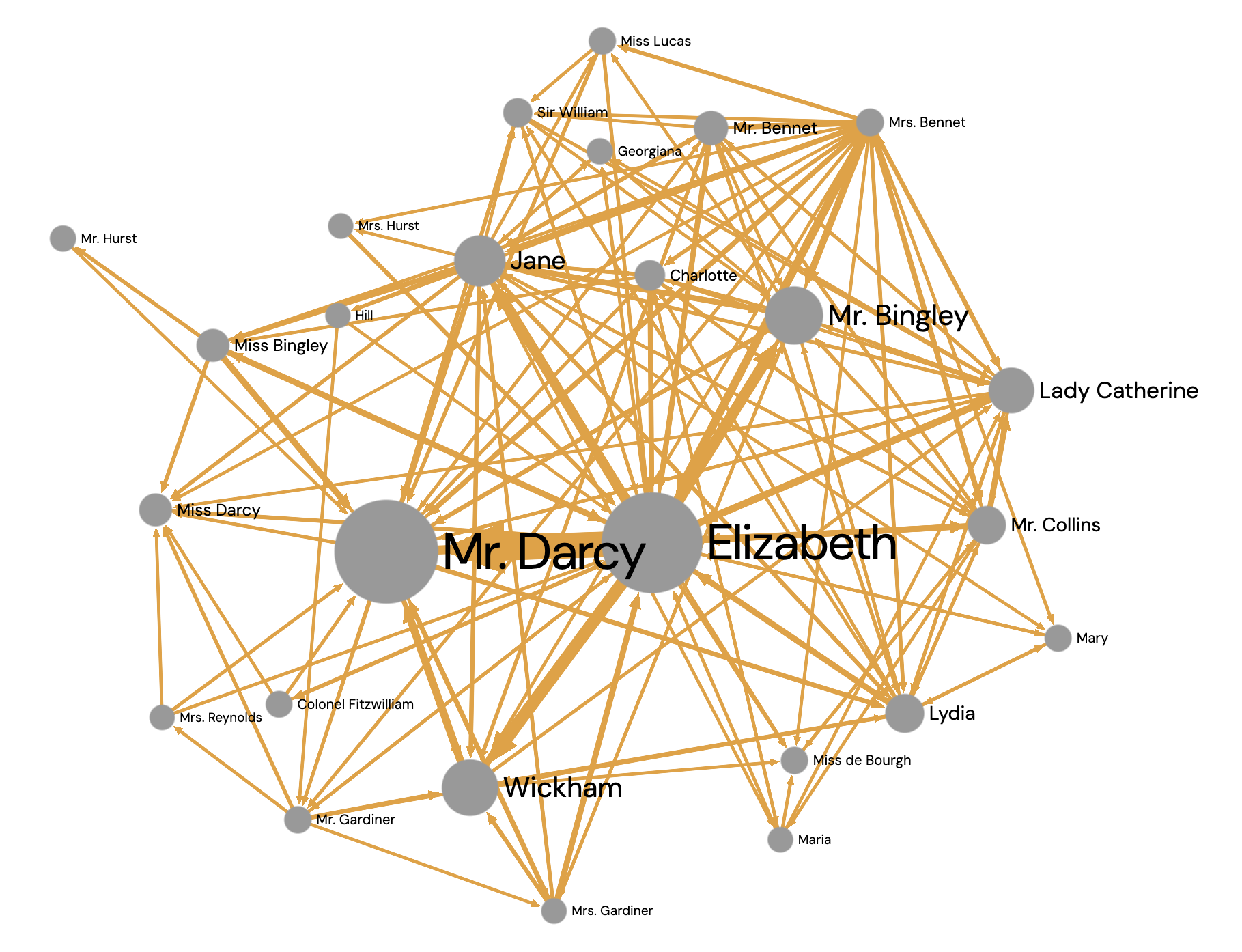
This review details a literary theory-driven approach combining network analysis and natural language processing to model character centrality and narrative role.
Existing computational approaches to character analysis in novels often prioritize main characters based on scene presence, overlooking nuanced relational dynamics. This paper, ‘Computational Representations of Character Significance in Novels’, introduces a novel framework that integrates a six-component literary model with natural language processing to capture a more holistic understanding of character importance. By operationalizing this model-including a previously neglected component of discussion by other characters-and utilizing network analysis, we generate component-level and graph representations enabling large-scale literary inquiry. Can these representations offer new insights into established theories of character centrality and the social dynamics reflected in 19th-century British realist novels?
The Illusion of Character: Beyond Simple Counts
For generations, understanding a character’s prominence within a story has been largely dependent on critical interpretation, a process inherently shaped by individual perspectives and potentially limitless debate. While insightful, this traditional approach offers little in the way of objective measurement, making comparative analyses across different works – or even differing interpretations of the same work – challenging to substantiate. The nuances of character motivation, symbolic weight, and narrative function are often assessed through qualitative arguments, leaving a gap for a more rigorous, data-driven methodology. This reliance on subjectivity, while not invalidating established literary criticism, highlights the need for complementary analytical tools capable of quantifying a character’s true impact on the narrative structure and thematic resonance.
Character significance extends far beyond mere lexical frequency within a text. While a simple word count might identify characters mentioned often, it fails to capture the nuances of their narrative function. A character’s true importance resides in their relationships with other characters, their impact on the plot’s trajectory, and their contribution to the thematic core of the story. Analyzing a character’s centrality requires examining how they influence events, not just how often their name appears. A seemingly minor character, connected to pivotal plot points or embodying a key theme, can wield a disproportionate influence, exceeding that of a more frequently mentioned, yet superficially involved, figure. Consequently, a robust assessment of character importance necessitates a shift from quantitative metrics to qualitative analysis of their role within the intricate web of the narrative fabric.
A Six-Fold Mirror: Deconstructing Character Significance
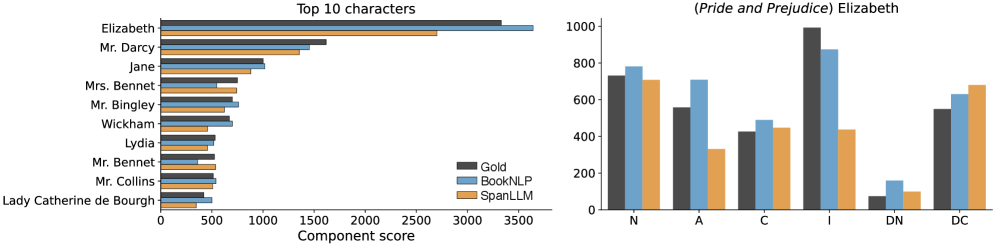
The Six-Component Model evaluates character significance by quantifying six distinct textual features: Name (frequency of mention by name), Communication (dialogue and direct speech), Interiority (access to a character’s thoughts and feelings), Action (physical deeds and events initiated by the character), Discussion (mentions of the character by other characters), and Description (physical and contextual details provided about the character). Each component is measured through automated textual analysis, providing a numerical value representing the character’s prominence in each category; the aggregate score across all six components then serves as an indicator of overall character importance within the narrative. This systematic approach allows for comparative analysis and ranking of characters based on quantifiable textual evidence.
The Six-Component Model differentiates character analysis by isolating six specific indicators of narrative significance. Name refers to the frequency and context of a character’s mention. Communication quantifies dialogue and direct speech attributed to the character. Interiority measures access to a character’s thoughts, feelings, and internal monologue. Action tracks the character’s participation in events and plot progression. Discussion assesses how often other characters talk about the character, regardless of their direct presence. Finally, Description captures the extent of physical and contextual details provided about the character. Each component, therefore, offers a unique lens through which to evaluate a character’s role and influence within the text.
The Six-Component Model enables a quantifiable assessment of character importance through the systematic tagging of narrative components – Name, Communication, Interiority, Action, Discussion, and Description. Validation using BookNLP demonstrates a Mean Absolute Error (MAE) of 1.7 when applying these tags, indicating a relatively low degree of error in identifying and weighting these components to determine character significance. This MAE score suggests the model provides a consistent and reliable framework for comparing and ranking characters within a text based on their presence across these defined textual features.
The Automated Gaze: LLMs and the BookNLP Pipeline
The automated quantification of character significance relies on integrating Large Language Models (LLMs) with the BookNLP pipeline. BookNLP performs a sequence of natural language processing tasks – entity recognition to identify characters, coreference resolution to track character mentions across the text, and part-of-speech tagging – to prepare the text for LLM analysis. This allows for the systematic calculation of metrics related to character importance, such as mentions, centrality, and emotional impact, without manual annotation. The pipeline efficiently processes textual data, enabling the scalable analysis of character networks and literary patterns.
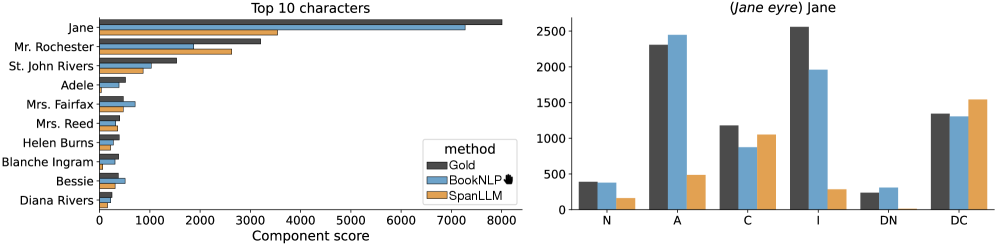
The BookNLP pipeline utilizes a sequence of natural language processing techniques – entity recognition, coreference resolution, and part-of-speech tagging – to facilitate automated character analysis. Entity recognition identifies character mentions, while coreference resolution links those mentions to a single character entity, even across pronoun usage. Tagging assigns grammatical categories to words, aiding in the accurate identification of actions and relationships relevant to character significance. Validation of the pipeline’s accuracy demonstrates a Pearson correlation coefficient of 0.75 between automatically generated counts from BookNLP tagging and manually verified (“gold”) counts, indicating a strong level of agreement and reliability in the automated quantification of character components.
Automated analysis, facilitated by tools like the BookNLP pipeline, enables the processing of substantial volumes of text, moving beyond the limitations of manual literary criticism. This capability supports quantitative studies of character interactions and relationships across a wide range of literary works, allowing researchers to identify recurring patterns and network structures at a scale previously unattainable. The resulting data can be used to explore the evolution of character archetypes, compare character centrality across genres, and assess the influence of narrative structure on character development, all with increased statistical power due to the expanded dataset size.
![Span-level methods demonstrate greater variability in component scores when analyzing the bottom 20 characters of [latex]Pride\, and\, Prejudice[/latex] and [latex]Jane\, Eyre[/latex] due to their lower overall character counts, with the BookNLP approach for [latex]Jane\, Eyre[/latex] benefitting from manual co-reference correction.](https://arxiv.org/html/2601.15508v1/x2.png)
Mapping the Echo Chamber: Networks of Co-occurrence and Dialogue
Character networks are constructed through a quantitative analysis of three primary interaction types: co-occurrence, direct dialogue, and third-party discussion. Co-occurrence is determined by instances where characters appear within the same scenes or passages. Dialogue exchanges are quantified by the number of conversational turns between characters. Finally, the frequency with which a character is mentioned or discussed by other characters – even without direct interaction – is recorded as a measure of their indirect influence and perceived importance within the narrative. These three data points are then used to establish nodes and edges representing characters and their relationships, forming the basis of the network visualization and subsequent analysis.
Character networks constructed from co-occurrence, dialogue, and third-party discussion data demonstrate discernible patterns of interaction and influence within a narrative. Analysis of these networks identifies central characters exhibiting a disproportionately high number of connections, indicating significant roles in driving plot or mediating relationships. Key relationships are revealed not only through direct interactions, but also through instances where characters are discussed by others, effectively mapping both overt and indirect influence. The resulting network visualizations and quantitative metrics allow researchers to identify characters who function as hubs, bridges between groups, or isolates, thereby providing insight into the social dynamics and power structures within the narrative.
Character network centrality is quantified using metrics like degree – the number of direct connections a character has – and betweenness, which measures how often a character acts as a bridge between others. Analysis consistently demonstrates a Gini Coefficient ranging from 0.66 to 0.80 when evaluating component scores derived from these centrality measures. This high Gini Coefficient indicates significant inequality in the distribution of narrative attention; a small number of characters consistently receive a disproportionately large share of interactions and are frequently positioned as intermediaries, while the majority receive comparatively less focus within the established network.
![Network analysis of [latex]Jane Eyre[/latex] reveals that consolidating the first-person narration cluster enhances the protagonist’s centrality and reinforces her connections to key characters.](https://arxiv.org/html/2601.15508v1/jane-cooc.png)
The Visible Structure: Poincaré Disks and the Gendered Gaze
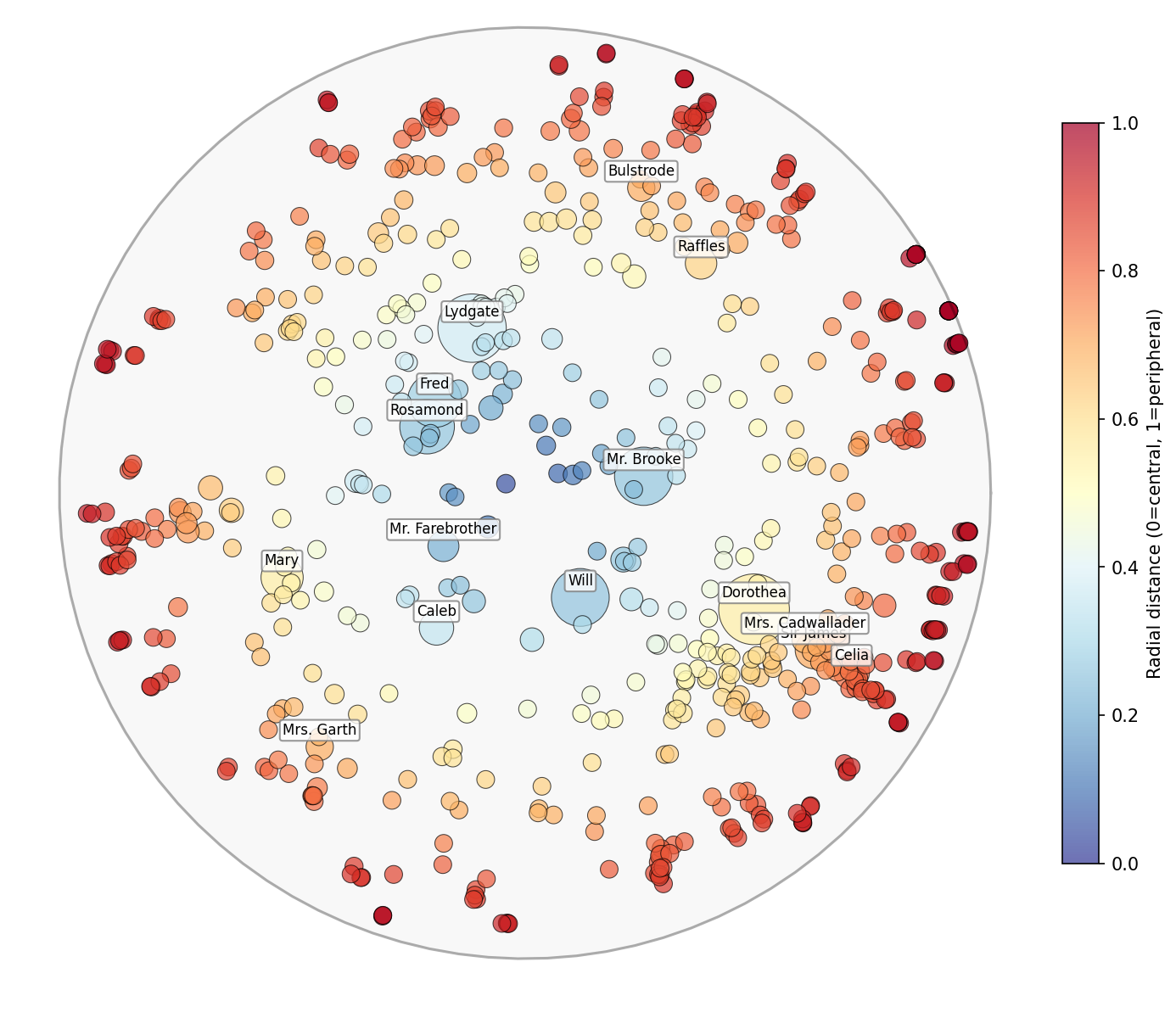
Character networks, often complex webs of interaction, become strikingly clear through the application of Poincaré Disk Embeddings. This visualization technique maps relationships onto a circular space, where proximity signifies connection and position reveals hierarchy. Central figures, those with numerous and strong connections, gravitate towards the center of the disk, while peripheral characters reside closer to the edge. The resulting visual representation isn’t merely aesthetic; it allows researchers to quantitatively assess character importance and influence within a narrative. By observing the spatial arrangement, patterns of power, alliances, and social distance become readily apparent, offering a novel perspective on how stories are structured and how characters function within those structures. The technique transforms abstract relationships into a tangible, interpretable landscape of social dynamics.
Character interaction networks, when examined through a gendered lens, can expose subtle biases in narrative construction. Recent analysis of literary discussion networks reveals an Asymmetric Cross-Gender Attention Ratio of 1.26 – expressed as [latex]F→M/M→F = 1.26[/latex] – demonstrating that references from female characters to male characters occur more frequently than the reverse. This pattern suggests a potential imbalance in how attention and agency are distributed within the story, hinting that female characters may be disproportionately positioned as reactors or initiators of communication towards male characters, while male characters receive or direct attention more often. Such findings illuminate how even seemingly neutral narrative choices can contribute to skewed representations of social dynamics and reinforce existing power imbalances, prompting a closer look at the underlying assumptions embedded within literary works.
Literary analysis is undergoing a transformation through the application of network visualization and quantitative methods, revealing previously obscured patterns in narrative structure and social dynamics. By mapping character interactions and analyzing attention flows, researchers are moving beyond traditional interpretive approaches to identify hierarchical relationships and biases within texts. This computational lens illuminates how characters are positioned relative to one another, and importantly, how those relationships are shaped by gender. The resulting data, such as the observed Asymmetric Cross-Gender Attention Ratio, suggests systemic differences in how male and female characters engage with one another, offering a new perspective on the portrayal of social power and influence within literature. Ultimately, these visualizations and analyses aren’t simply about charting connections; they’re about uncovering the underlying mechanics of storytelling and the subtle ways narratives reflect – and potentially reinforce – societal norms.
The pursuit of quantifying character significance, as detailed in this work, mirrors a fundamental challenge in complex systems: reducing multifaceted phenomena to measurable components. This research, by mapping narrative components into a network of interactions, attempts to discern centrality – not simply as a measure of how much a character interacts, but how those interactions shape the narrative’s evolution. It recalls Carl Friedrich Gauss’s observation: “If other sciences were as well defined as mathematics, the number of their theories would be as small.” The ambition here isn’t to create a perfect model of literary meaning-such a thing is illusory-but to provide a rigorously defined framework, acknowledging that any system built to understand narrative will inevitably evolve in unexpected ways, revealing as much about the method as the story itself. Long stability in the results, rather than an indication of truth, might well signal a hidden limitation within the chosen components.
What Lies Ahead?
The attempt to quantify significance, even within the constrained ecosystem of a novel, reveals the inherent limitations of any such undertaking. This work, while offering a more nuanced approach than simple interaction counts, still operates under the assumption that importance can be extracted from the text. It is more likely, however, that significance emerges from the reader’s engagement, a shifting pattern of resonance and projection. The six-component model, a neat attempt at formalization, will inevitably prove incomplete; a compromise frozen in time, reflecting current theoretical biases more than any inherent textual property.
Future iterations will undoubtedly refine the natural language processing techniques, chasing ever-elusive markers of character centrality. But the core challenge remains: how to model the subjective experience of reading, the subtle interplay between expectation, empathy, and the unpredictable spark of interpretation? The field might benefit from shifting focus, from detecting significance to modeling the conditions under which readers construct it.
Technologies change, dependencies remain. The specific algorithms employed here will be superseded, yet the fundamental problem-translating qualitative experience into quantitative data-will persist. The true measure of progress may not lie in achieving greater accuracy, but in acknowledging the inherent ambiguity, and building systems that embrace, rather than attempt to resolve, the essential mystery of narrative.
Original article: https://arxiv.org/pdf/2601.15508.pdf
Contact the author: https://www.linkedin.com/in/avetisyan/
See also:
- Invincible Season 4 Episode 4 Release Date, Time, Where to Watch
- How Martin Clunes has been supported by TV power player wife Philippa Braithwaite and their anti-nepo baby daughter after escaping a ‘rotten marriage’
- Physics Proved by AI: A New Era for Automated Reasoning
- Total Football free codes and how to redeem them (March 2026)
- CookieRun: OvenSmash coupon codes and how to use them (March 2026)
- American Idol vet Caleb Flynn in solitary confinement after being charged for allegedly murdering wife
- Goddess of Victory: NIKKE 2×2 LOVE Mini Game: How to Play, Rewards, and other details
- Invincible Creator on Why More Spin-offs Haven’t Happened Yet
- eFootball 2026 is bringing the v5.3.1 update: What to expect and what’s coming
- Nicole Kidman and Jamie Lee Curtis elevate new crime drama Scarpetta, which is streaming now
2026-01-24 12:17