Author: Denis Avetisyan
New research explores how social robots can be thoughtfully integrated into classrooms to foster students’ understanding and appreciation of different cultures.
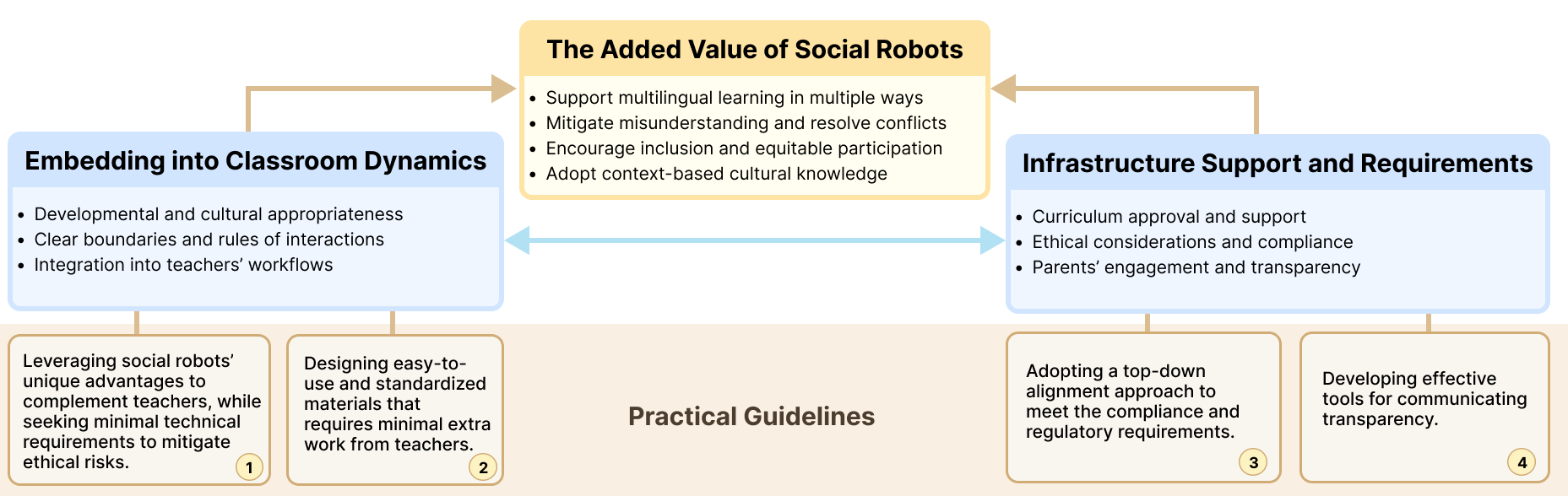
This review outlines practical guidelines for designing and implementing robot-assisted learning experiences focused on developing intercultural competence, based on qualitative findings from co-design workshops with educators.
Despite growing interest in leveraging technology for global citizenship education, realizing the full potential of social robots in fostering intercultural competence remains a challenge. This research-‘Adding More Value Than Work: Practical Guidelines for Integrating Robots into Intercultural Competence Learning’-investigates how to effectively implement these robots within K-12 classrooms, identifying crucial design considerations through co-design workshops with educators. Findings reveal appropriate classroom scenarios, complementary roles for robots alongside teachers, and essential ethical considerations for successful integration. How can the HRI community translate these practical guidelines into scalable solutions that truly enhance intercultural learning experiences for students?
The Imperative of Intercultural Proficiency
The accelerating pace of globalization necessitates a heightened capacity for intercultural competence, yet conventional educational and training methodologies frequently prove inadequate in achieving true understanding. While many programs focus on imparting factual knowledge about different cultures – customs, etiquette, and history – they often fail to cultivate the deeper cognitive and emotional skills required for navigating complex intercultural interactions. This discrepancy arises because traditional approaches prioritize information transfer over experiential learning and the development of empathy, leaving individuals ill-equipped to interpret nuanced communication, manage ambiguity, and build meaningful relationships across cultural boundaries. Consequently, despite increased exposure to diverse perspectives, genuine intercultural understanding remains elusive, hindering effective collaboration and fostering potential for miscommunication in increasingly interconnected global landscapes.
Many current strategies for building intercultural communication skills prioritize recognizing superficial cultural differences – such as greetings or dining etiquette – without adequately addressing the underlying values, beliefs, and communication styles that truly shape interactions. This often results in individuals who can identify cultural markers but struggle to navigate complex situations requiring genuine empathy and adaptability. Effective intercultural communication demands more than simply avoiding offense; it necessitates understanding the subtle cues, unspoken assumptions, and diverse perspectives that inform how individuals from different backgrounds perceive and interpret the world. Without this deeper level of awareness, interactions remain transactional and prone to misinterpretation, hindering the development of meaningful relationships and collaborative efforts across cultures.
A significant deficiency exists in contemporary educational resources designed to cultivate genuine intercultural skills. While many programs address cultural differences superficially, few effectively equip individuals with the sensitivity and nuanced understanding required for meaningful cross-cultural interaction. This gap extends beyond simply imparting knowledge about other cultures; it encompasses a lack of tools that foster empathy, encourage perspective-taking, and develop the ability to navigate complex social cues. Consequently, individuals often remain ill-prepared to address the subtle yet critical aspects of communication, potentially leading to misunderstandings and hindering effective collaboration in an increasingly globalized world. The need for innovative pedagogical approaches and resources that prioritize experiential learning and authentic engagement is therefore paramount.
Co-Design as a Methodological Imperative
A participatory co-design approach was utilized, centering the educational technology development process around teachers as primary stakeholders. This methodology prioritized direct engagement with teachers throughout all phases – from initial concept generation to iterative prototyping and evaluation – to ensure the resulting technologies aligned with their pedagogical needs and classroom workflows. Recognizing teachers’ expertise in learning environments, the process actively solicited their input, feedback, and collaborative refinement of design concepts, rather than imposing externally developed solutions. This collaborative framework aimed to maximize the relevance, usability, and ultimately, the effective integration of robotic tools within existing educational practices.
The Haru robot was utilized as a physical instantiation of a potential educational tool to stimulate focused discussion with teachers. Rather than presenting a fully functional prototype, Haru’s deliberately open-ended design allowed participants to project their needs and expectations onto the platform. This approach facilitated brainstorming sessions centered on specific learning scenarios and how a social robot could integrate into existing pedagogical practices. The robot’s physical presence prompted concrete conversations regarding interaction modalities, appropriate levels of autonomy, and logistical considerations such as classroom placement and charging, yielding detailed qualitative data regarding teacher perspectives.
The research methodology centered on a continuous iterative process of observation and adaptation to existing teacher workflows. Initial classroom observations documented standard teaching practices, including lesson delivery, classroom management, and individual student support. Robotic assistance was not proposed as a replacement for these activities, but rather as a potential augmentation. Subsequent design iterations of the ‘Haru Robot’ were directly informed by teacher feedback regarding feasibility of integration – specifically addressing concerns about disrupting established routines, increasing workload, or requiring specialized training. The goal was to identify specific points within existing workflows where robotic support could be seamlessly incorporated to enhance, not hinder, pedagogical practices.
Empirical Evidence: Teacher Perspectives on Robotic Integration
Analysis of teacher workshop transcripts indicated a strong consensus regarding the utility of social robots in providing individualized language assistance to multilingual learners. Teachers specifically cited the potential for robots to deliver tailored vocabulary instruction, pronunciation practice, and grammatical support at a pace adjusted to each student’s proficiency level. Furthermore, participants highlighted the benefit of robots offering consistent, non-judgmental language exposure, creating a safe environment for students to experiment with and improve their communication skills. The transcripts detailed expectations that robots could supplement traditional language instruction and provide extended learning opportunities beyond the classroom setting.
Workshop participants consistently highlighted the value of social robots in delivering culturally relevant educational content. Teachers expressed that robots, when programmed with diverse cultural narratives, historical contexts, and perspectives, could significantly enhance learning experiences for students. This included access to stories, traditions, and knowledge systems that might not be readily available through standard curricula, fostering a more inclusive and globally-aware learning environment. Participants specifically noted the potential of robots to present information from multiple cultural viewpoints, encouraging critical thinking and challenging ethnocentric biases. The ability of robots to adapt content based on students’ cultural backgrounds was also identified as a key benefit.
Analysis of teacher workshop transcripts indicated a consistent desire for social robots to actively mediate student conflicts and foster positive communication skills. Participants detailed scenarios where robots could guide students through structured dialogues, encouraging them to articulate their perspectives and understand opposing viewpoints. The envisioned functionality included prompting students to identify the root causes of disagreements, suggest compromise solutions, and practice empathetic responses. Teachers specifically highlighted the potential for robots to provide a neutral, non-judgmental space for conflict resolution, particularly beneficial for students who may struggle with self-regulation or verbal communication during emotionally charged interactions.
Ethical Imperatives and Practical Considerations
The effective introduction of social robots into learning environments hinges on a foundational principle of transparency. These robots, designed to interact and assist, must operate as ‘glass boxes’ rather than ‘black boxes’; their functionalities, data collection methods, and operational limitations should be openly communicated to students, educators, and administrators. This isn’t simply a matter of informing users what a robot does, but how it arrives at conclusions or recommendations, fostering trust and allowing for informed pedagogical integration. Without such openness, there’s a risk of anthropomorphization, where users attribute human-like understanding or agency to the robot, or conversely, a lack of trust stemming from perceived inscrutability. Clear communication about the robot’s capabilities and data practices-what information is gathered, how it’s used, and with whom it’s shared-is therefore not just an ethical imperative, but a crucial element in building acceptance and maximizing the potential benefits of these technologies.
The integration of social robots into classrooms demands rigorous attention to ethical safeguards, particularly concerning student privacy and safety. Data collection by these robots, even for seemingly benign purposes like gauging engagement, necessitates transparent policies and robust security measures to prevent unauthorized access or misuse of sensitive information. Beyond data, physical safety is also crucial; robots must be designed and programmed to operate predictably within a dynamic classroom environment, avoiding potential collisions or unintended harm. Careful consideration must be given to the potential for emotional attachment, ensuring students understand the robot’s limitations and preventing undue reliance. Ultimately, responsible implementation hinges on proactive ethical frameworks that prioritize student well-being and establish clear guidelines for data handling, robot behavior, and appropriate interaction.
Effective implementation of social robots in educational settings hinges not simply on technological advancement, but on the creation of robust, scalable frameworks. Researchers emphasize that widespread adoption requires more than isolated pilot programs; standardized materials – encompassing lesson plans, robot scripts, and evaluation metrics – are vital for ensuring consistency and comparability across different classrooms and institutions. Crucially, this standardization must be coupled with top-down alignment with existing institutional policies regarding data privacy, safety protocols, and curriculum integration. Without such alignment, even the most promising robotic interventions risk being fragmented, inconsistently applied, and ultimately failing to achieve their potential impact on student learning and development. This systemic approach promises a sustainable and equitable rollout, maximizing the benefits of this emerging technology for all learners.
Toward a Future of Dynamically Inclusive Learning
The introduction of social robots into educational settings promises a significant evolution in classroom dynamics, moving beyond traditional teacher-centric models to cultivate more inclusive and engaging learning experiences. These robots aren’t intended to replace educators, but rather to augment their capabilities by providing personalized support and facilitating novel interactions for all students, particularly those who may benefit from alternative learning approaches. Through responsive dialogue, adaptive activities, and non-verbal cues, social robots can cater to diverse learning styles and needs, fostering a more equitable and stimulating environment. This expanded dynamic allows for increased student participation, reduced anxiety in asking questions, and the development of crucial social-emotional skills, ultimately creating a classroom where every learner feels valued and empowered to thrive.
Social robots are emerging as powerful tools to augment traditional teaching methods and facilitate genuinely personalized learning experiences. These aren’t intended to replace educators, but rather to function as supportive assistants, seamlessly integrating into existing curriculum goals and teacher workflows. By automating tasks like providing individualized practice exercises, offering immediate feedback, and delivering differentiated content, robots free up teachers to focus on higher-level interactions – fostering critical thinking, creativity, and social-emotional development. This adaptive approach caters to diverse learning styles and paces, ensuring each student receives the targeted support they need to thrive, ultimately moving beyond a one-size-fits-all educational model towards a more responsive and effective system.
A recent study delved into the practical considerations of introducing social robots into educational settings, specifically to cultivate intercultural competence amongst students. Researchers prioritized gathering qualitative data directly from teachers, aiming to understand their perceptions, concerns, and expectations regarding robotic integration. This approach yielded a nuanced understanding of the challenges and opportunities presented by this technology, moving beyond theoretical potential to address real-world implementation hurdles. The findings culminated in a set of actionable guidelines focused on maximizing robot adoption rates, ensuring long-term maintainability of the technology within school systems, and upholding relevant compliance standards – effectively providing a roadmap for schools interested in leveraging social robots to foster more globally-minded learning environments.
The study meticulously details a path toward integrating social robots into educational settings, prioritizing participatory design to ensure relevance and efficacy. This approach aligns with a fundamental tenet of robust system construction – a solution’s validity isn’t determined by superficial functionality, but by provable design. As Vinton Cerf observed, “The Internet treats everyone the same.” This seemingly disparate statement underscores the need for universally applicable design principles – robots, like internet protocols, must operate consistently across diverse contexts, specifically within intercultural competence learning as highlighted by the research. The focus on co-design workshops isn’t merely about gathering preferences; it’s about establishing a foundational consistency that guarantees predictable, and therefore, reliable interaction.
Future Directions
The integration of social robots into educational settings, particularly for the nuanced development of intercultural competence, presents challenges exceeding mere engineering. This work correctly identifies participatory design as crucial, yet stops short of formalizing a provable methodology for translating qualitative insights into robotic behavioral parameters. A robust, mathematically grounded model-perhaps leveraging formal methods from control theory or even game theory-is required to move beyond ‘works in a classroom’ to ‘guaranteed to elicit measurable improvement in intercultural understanding.’
Current evaluation relies heavily on observation and teacher feedback – valuable, but insufficient. The field requires metrics that transcend subjective assessment. Developing an algorithmic definition of ‘intercultural competence’ – however fraught with philosophical difficulty – would allow for automated evaluation, and crucially, iterative refinement of robotic interaction strategies. Until such a definition exists, the efficacy of these systems remains, at best, empirically supported, not demonstrably true.
Further research should address the inherent limitations of anthropomorphism. While robots mimicking human interaction may initially engage students, a reliance on superficial resemblance risks obscuring the underlying principles of cultural understanding. A truly elegant solution might involve robots deliberately avoiding human-like behavior, functioning instead as neutral facilitators that prompt critical reflection and expose cognitive biases. The goal is not to simulate culture, but to illuminate the structure of cultural difference.
Original article: https://arxiv.org/pdf/2602.08123.pdf
Contact the author: https://www.linkedin.com/in/avetisyan/
See also:
- Invincible Season 4 Episode 4 Release Date, Time, Where to Watch
- Physics Proved by AI: A New Era for Automated Reasoning
- American Idol vet Caleb Flynn in solitary confinement after being charged for allegedly murdering wife
- Gold Rate Forecast
- “Wild, brilliant, emotional”: 10 best dynasty drama series to watch on BBC, ITV, Netflix and more
- Seeing in the Dark: Event Cameras Guide Robots Through Low-Light Spaces
- Magicmon: World redeem codes and how to use them (March 2026)
- Total Football free codes and how to redeem them (March 2026)
- Simulating Humans to Build Better Robots
- eFootball 2026 is bringing the v5.3.1 update: What to expect and what’s coming
2026-02-10 15:08