Author: Denis Avetisyan
Researchers have developed a novel flocking algorithm that enhances group coordination by predicting the future movements of individuals within the swarm.
![The study demonstrates that while idealized multi-agent flocking-measured by alignment [latex]\gamma\gamma[/latex] and inter-agent distances-maintains coherence, the introduction of even modest delays and noise predictably degrades performance, manifesting as deviations in centroid path length [latex]SS[/latex] and reduced overall flock stability.](https://arxiv.org/html/2602.04012v1/x9.png)
This review details FDA Flocking, a bio-inspired method leveraging velocity prediction to improve robustness and alignment in multi-agent systems.
While bio-inspired flocking algorithms have advanced multi-agent systems, most rely on reactive behaviors, overlooking the potential of anticipatory cues for enhanced coordination. This work introduces ‘FDA Flocking: Future Direction-Aware Flocking via Velocity Prediction’, a novel approach that integrates short-term velocity predictions of neighbors to augment reactive alignment. By blending reactive and anticipatory control via a tunable parameter, FDA achieves faster alignment, improved flock displacement, and increased robustness to communication delays and noise. Could adaptive prediction schemes further unlock the potential of anticipatory flocking for complex, real-world swarm robotics applications?
The Illusion of Control: Modeling the Flock
The study of collective animal motion – from bird flocks and fish schools to insect swarms – necessitates a modeling approach that prioritizes the individual. Rather than attempting to dictate overall group behavior, researchers focus on defining how each animal responds to its immediate surroundings and neighbors. This perspective acknowledges that complex, coordinated patterns emerge not from central control, but from a multitude of local interactions. By simulating these individual responses – such as maintaining a certain distance, aligning direction, or moving towards the group center – computational models can surprisingly recreate the fluid, dynamic, and seemingly intelligent movements observed in nature. This bottom-up approach allows scientists to investigate how simple rules at the individual level give rise to complex collective behavior, providing insights into the principles governing self-organization and emergent phenomena.
Early explorations into the simulation of flocking behavior revealed a striking truth: complex, coordinated movement doesn’t necessarily require complex programming. Researchers developed computational models, notably the Boids model and the Vicsek model, which generated remarkably realistic flocking patterns using only three basic, reactive rules. Each simulated ‘agent’ followed simple directives – maintaining cohesion with its neighbors, avoiding collisions through separation, and aligning its movement with the local group. The Boids model, for example, utilized these principles to create visually convincing flocks of simulated birds, while the Vicsek model, employing a similar approach with particle alignment, demonstrated that even abstract agents could exhibit emergent, collective behavior. These early successes highlighted the power of decentralized, reactive systems in producing complex phenomena, laying the groundwork for understanding how animals achieve synchronized movement without centralized control.
The emergence of realistic flocking behavior in computational simulations solidified the understanding that collective animal movement isn’t guided by a central leader, but rather by remarkably simple, localized interactions. Researchers discovered that three core principles consistently drive this coordination: cohesion, whereby individuals strive to remain near their neighbors; separation, which prevents collisions and maintains personal space; and alignment, the tendency to match velocity with those nearby. These reactive rules, when applied to numerous agents within a simulation, spontaneously produce highly organized, dynamic flocks – mirroring the complex yet graceful movements observed in bird flocks, fish schools, and even insect swarms. The power of these principles lies in their decentralization; each individual reacts solely to its immediate surroundings, yet the collective outcome is a cohesive, adaptive group behavior, demonstrating that complex systems can arise from surprisingly simple foundations.
The Limits of Pure Reaction: A System Vulnerable to Noise
Current flocking algorithms such as the Cucker-Smale model and Couzin’s Zonal Scheme operate on the principle of reacting to the immediately perceived states of neighboring agents. This means each agent adjusts its behavior based only on the current position and velocity of its neighbors, without considering past states or attempting to predict future movements. Consequently, these purely reactive systems are inherently vulnerable to disruptions caused by communication delays, where information about neighbor states is not instantaneous, and to noise, which introduces inaccuracies in perceived neighbor states. The reliance on instantaneous data limits the system’s ability to maintain stable alignment and coordinated movement when faced with imperfect or delayed information.
Communication delay and Gaussian noise introduce perturbations that negatively impact flock coherence. Delays in receiving neighbor state information cause agents to react to outdated data, leading to misaligned movements and reduced cohesion. Gaussian noise, representing sensor inaccuracies or transmission errors, adds random deviations to perceived neighbor positions and velocities. The combined effect of these factors is a reduction in the magnitude of alignment forces, potentially leading to a loss of flock stability and the eventual dispersal of the group. Specifically, increased delay and noise levels correlate with a decrease in the flock’s ability to maintain a consistent heading and avoid collisions, as agents struggle to accurately estimate and respond to the movements of their neighbors.
The inherent limitations of purely reactive flocking models necessitate the incorporation of predictive elements to improve system performance. Current models, dependent on immediate neighbor states, struggle with real-world conditions like communication delays and noise which introduce inaccuracies in alignment and can induce instability. Predictive models aim to mitigate these issues by estimating future states of neighbors, allowing agents to proactively adjust their behavior and maintain cohesion even with imperfect or delayed information. This anticipatory approach enables more robust coordination and a greater tolerance for environmental disturbances, ultimately leading to more realistic and stable flocking behavior.
![Trajectories of the agent over [latex]t \in [0, 25] \text{s}[/latex] reveal that the FDA approach consistently outperforms reactive control under both nominal conditions and with added delay and noise.](https://arxiv.org/html/2602.04012v1/x3.png)
FDA Flocking: Injecting a Dose of Foresight
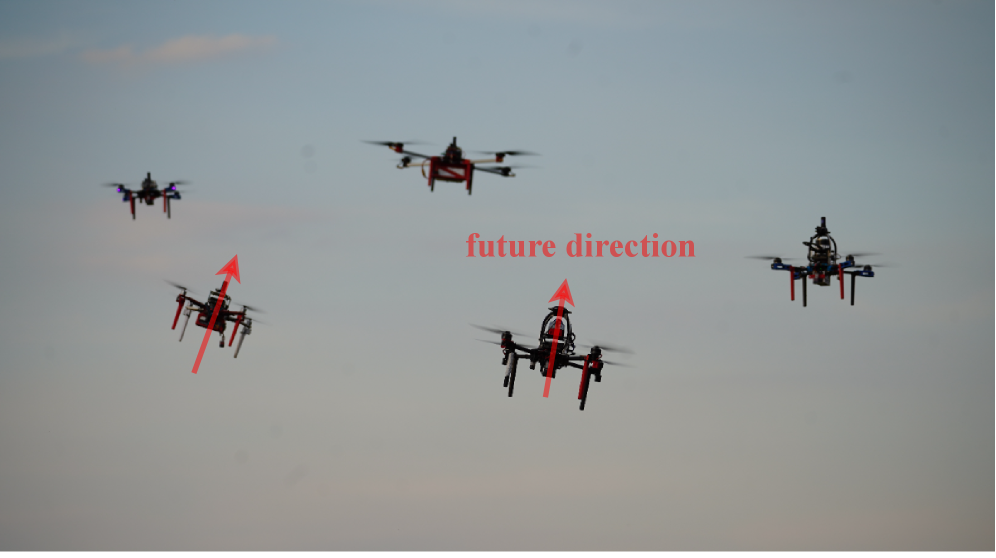
FDA Flocking differentiates itself from traditional flocking algorithms by incorporating predictive behavior alongside standard reactive collision avoidance. Rather than solely responding to the current positions and velocities of nearby agents, the FDA model estimates the future velocities of these neighbors. This estimation is then used to preemptively adjust the agent’s steering behavior, allowing it to anticipate and mitigate potential collisions before they occur. By integrating velocity-based prediction with established reactive rules – such as separation, alignment, and cohesion – the FDA approach aims to enhance the overall stability and responsiveness of the flocking simulation, especially in dense environments or with rapidly changing conditions.
Velocity prediction within the FDA Flocking model operates by estimating the future positions of neighboring agents based on their current velocities. This predictive capability enables proactive behavioral adjustments; instead of solely reacting to immediate neighbor positions, the model incorporates anticipated future interactions into its steering decisions. Specifically, the model calculates a predicted displacement for each neighbor over a short time interval and considers this predicted position when applying separation, alignment, and cohesion forces. By anticipating future proximity and direction, the system mitigates potentially disruptive collisions and facilitates smoother, more stable group movements, reducing erratic course corrections and improving overall coordination among agents.
The Blending Parameter within the FDA Flocking model functions as a weighting factor to control the relative contribution of reactive and predictive behaviors. This parameter, typically denoted as a value between 0 and 1, determines the emphasis given to immediate, rule-based responses versus anticipatory movements derived from neighbor velocity estimations. A value of 0 prioritizes purely reactive flocking, while a value of 1 results in behavior solely driven by predicted trajectories. Optimal performance is achieved by tuning this parameter; excessively high reactive influence can lead to instability and collisions, whereas over-reliance on prediction without reactive correction may cause delayed responses and deviations from cohesive flocking. The Blending Parameter therefore provides a mechanism to dynamically balance responsiveness and proactive coordination, improving the overall stability and realism of the flocking simulation.
Beyond the Simulation: Implications for Real-World Swarms
Research indicates that the implementation of FDA Flocking significantly enhances the cohesion and stability of simulated flocks, achieving improved alignment convergence. Quantitative analysis reveals a compelling 40% increase in Centroid Path Length (SS) under standard conditions, directly correlating to a more streamlined and persistent collective movement. This metric, [latex]SS[/latex], effectively measures how consistently the center of the flock maintains a direct path, and the substantial improvement highlights FDA Flocking’s capacity to minimize dispersal and maintain group integrity over time. The findings suggest that this approach facilitates more reliable and predictable flock behavior, a crucial characteristic for applications requiring coordinated multi-agent movement.
The foundational principles established by FDA Flocking, initially explored through simulations of biological collective motion, possess significant translational potential for the development of advanced control algorithms in multi-agent robotic swarms. By prioritizing a decentralized, feedback-driven approach to alignment and cohesion – mirroring natural flocking behaviors – these principles offer a pathway toward creating robotic systems exhibiting enhanced robustness and adaptability in complex environments. Unlike traditional centralized control methods, FDA Flocking facilitates resilient swarm behavior even in the presence of individual agent failures or communication disruptions, as each robot reacts locally to its immediate neighbors. This distributed intelligence allows for scalable and efficient coordination, promising improvements in applications ranging from search and rescue operations to environmental monitoring and collaborative construction, where a cohesive and adaptable swarm can outperform single, complex robots.
Research indicates that Flocking with Feedback Alignment (FDA) consistently maintains a heightened degree of alignment – represented by the parameter γ – when compared to traditional, reactive flocking algorithms. This superior alignment isn’t merely a statistical advantage; it signifies a fundamental robustness in the system’s collective behavior. Unlike reactive approaches that rely on immediate responses to neighbors, FDA proactively adjusts individual trajectories based on global flocking direction, effectively mitigating deviations and preserving cohesive motion even amidst disturbances. The result is a demonstrably more efficient collective, requiring less corrective maneuvering and exhibiting greater stability over extended periods, suggesting a potential for significantly improved performance in complex, dynamic environments.
The pursuit of elegant collective motion, as demonstrated by this FDA flocking algorithm, feels predictably optimistic. It aims for anticipatory control, predicting neighbor movements to achieve faster alignment and robustness. They’ll call it AI and raise funding, naturally. But the system, however cleverly designed, will inevitably encounter edge cases – a rogue agent with a faulty velocity prediction, a communication delay the algorithm didn’t account for. It’s a beautiful theory, this idea of future direction-awareness, but one suspects it will, like all things, eventually devolve into a complex mess of conditional statements and desperate bug fixes. It used to be a simple bash script, honestly. The documentation lied again, probably.
The Road Ahead
This ‘FDA Flocking’ presents, as do all such algorithms, a lovely demonstration within a controlled environment. The core innovation – anticipating neighbor movements – feels less like a breakthrough and more like acknowledging the inevitable latency of reality. Any system calling itself ‘robust’ hasn’t yet encountered a determined system administrator, or, more likely, a sustained DDoS. The question isn’t whether prediction improves alignment, but rather how much computational overhead is acceptable before the flock simply freezes, overthinking its next move.
The pursuit of bio-inspiration is a comforting narrative, but nature rarely optimizes for elegance. It optimizes for ‘good enough,’ and then layers on redundancy until the whole thing becomes unmanageable. The next phase will inevitably involve attempts at scaling this to larger flocks, and one suspects the benefits of prediction will diminish rapidly as communication costs explode. Better one tightly coupled flock than a hundred loosely associated, lying micro-flocks, each confidently wrong.
Ultimately, the true test will be deployment in a genuinely unpredictable environment – a warehouse full of robots, a swarm of drones navigating a storm, or, heaven forbid, actual birds. Until then, it remains a beautifully crafted simulation, a testament to the enduring human need to impose order on chaos, and a reminder that anything called ‘scalable’ simply hasn’t been stressed enough.
Original article: https://arxiv.org/pdf/2602.04012.pdf
Contact the author: https://www.linkedin.com/in/avetisyan/
See also:
- Limbus Company 2026 Roadmap Revealed
- After THAT A Woman of Substance cliffhanger, here’s what will happen in a second season
- Gold Rate Forecast
- Wuthering Waves Hiyuki Build Guide: Why should you pull, pre-farm, best build, and more
- XO, Kitty season 3 soundtrack: The songs you may recognise from the Netflix show
- Guild of Monster Girls redeem codes and how to use them (April 2026)
- Total Football free codes and how to redeem them (March 2026)
- The Division Resurgence Specializations Guide: Best Specialization for Beginners
- Genshin Impact Version 6.5 Leaks: List of Upcoming banners, Maps, Endgame updates and more
- All Mobile Games (Android and iOS) releasing in April 2026
2026-02-05 20:32