
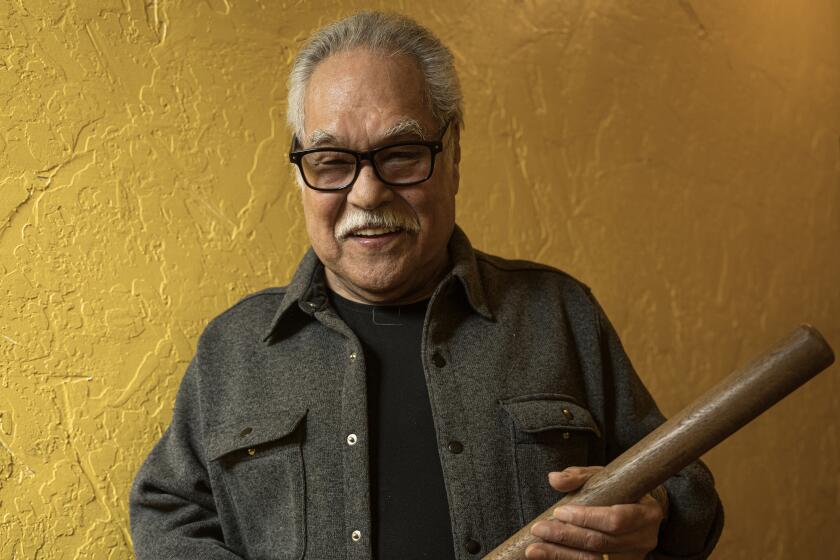
Luis Valdez is known by many names – magician, instigator, and the founder of Chicano Theater – throughout his impressive career. The 85-year-old filmmaker and playwright created the iconic films “La Bamba” and “Zoot Suit,” which resonated with a generation of Latinos and are now considered classics, earning them a place in the U.S. Library of Congress’s National Film Registry.
Entertainment & Arts
‘Zoot Suit’ remains the most important play written by a Chicano playwright, and it’s the only one to ever appear on Broadway. It fundamentally reshaped how Los Angeles remembers its past and left a lasting impact on American theater.
Luis Valdez sparked a cultural shift, bringing the experiences of Chicano farmworkers – the world he knew growing up – to audiences everywhere through theater and film. He changed the way stories were told in America, putting Chicano lives and perspectives center stage and allowing people to see their own hopes, fears, and challenges reflected on screen. Now, a new documentary, “American Pachuco: The Legend of Luis Valdez,” tells his own story.
The film follows Luis Valdez’s life, starting with his childhood as the son of farmworkers in Delano, California. It shows how he began his career in theater, leading El Teatro Campesino – a traveling group that worked with Cesar Chavez to support farmworkers. They used performances – skits and plays – to raise awareness about strikes and unions. Their work, which blended humor, satire, and Mexican history, eventually expanded to address issues like the Vietnam War, racism, inequality, and broader Chicano culture.
The documentary, narrated by Edward James Olmos – known for his breakout role as the stylish and persuasive pachuco in the 1981 film “Zoot Suit” – received the Library of Congress Lavine/Ken Burns Prize for Film last year.
Entertainment & Arts
It was 1946.
De Los chatted with Olmos and Alvarado before the movie debuted at the 2026 Sundance Film Festival on Thursday.
This interview has been lightly edited for clarity.
David, what was your introduction to Luis’ work? And how did it influence you as a filmmaker?
I first encountered the impact of Luis Valdez’s work as a child watching movies like “La Bamba” with my dad, though I didn’t know his name at the time. Later, while studying at the University of North Texas in 2006, I received a scholarship and heard him speak at the award ceremony. As an aspiring filmmaker, I was incredibly inspired to see someone I admired share his journey. I never forgot that experience. Years later, in 2021, I was looking for a more meaningful project after focusing on science and technology stories. I remembered Luis Valdez and realized his story hadn’t been told, so I contacted him, and that’s how this project began.
Mr. Olmos, you first gained widespread recognition for your role as El Pachuco, both on stage and in the movie “Zoot Suit.” What were your initial thoughts when you first encountered the story?
I had been acting in theater for years when I was leaving an audition at the Mark Taper Forum. Someone called out and asked if I’d be willing to try out for another play. I was surprised, but I agreed. I didn’t know who she was or what the play was, but the next day I found myself with around 300 other actors, all receiving the same short excerpt – the opening monologue for “Zoot Suit.” As soon as I read it, I knew this was an important role, so I immediately started focusing on becoming the character.
I’ll never forget getting the call – it was a Friday night, around 8 pm. They were starting rehearsals Monday, and I hadn’t heard from them, so I figured I didn’t get the part. Then the phone rang, and they offered me the role of El Pachuco. I immediately said yes, it would be a dream come true. I was so overwhelmed with joy that I sank to the floor and cried. It was a completely emotional moment.
Eddie was the standout performer – it’s clear he truly captivated the audience. He delivered exactly what Luis envisioned for the production, and it resonated deeply with Chicano audiences at the time, contributing significantly to the success of “Zoot Suit.” Luis had a remarkable talent for finding artists, like Eddie and the Teatro Campesino, and later with “La Bamba,” who authentically embodied the Chicano experience.

The Teatro Campesino has a wealth of amazing historical footage. What did you think when you first saw some of their early performances?
That video is incredibly valuable, and it’s a big part of why this film is so important. Luis has truly given a voice to our culture – he certainly gave me mine. When we try to understand a culture, we usually read books and research what’s been written, but nothing compares to experiencing their art. I’m currently collaborating with Luis on a play called “Valley of the Heart,” which he’s been writing for twelve years. It’s a unique love story about a Mexican American and a Japanese American who fall in love while incarcerated in an internment camp during World War II. It’s been a challenging project, but I believe audiences will appreciate it because its universal themes of humanity will resonate with everyone, no matter their background. I think David’s documentary will have the same effect – it’s truly inspiring.
I believe audiences are eager to hear an honest account of America’s past. Documentaries like “Valley of the Heart” capture genuine American experiences that are often missing from mainstream narratives. There’s a real desire for that kind of authenticity and a re-examination of what truly defines the American story.
A central idea explored in the documentary is how Chicanos perceive the American Dream. It asks whether it’s possible to achieve success while staying true to one’s identity, or if assimilation is necessary. This struggle is shown through the lives of Luis and his brother, Frank, who choose different paths, and is later echoed in the story of “La Bamba.”
A central theme of the film is the American Dream and how its meaning is often unclear. Many, including Chicanos, Latinos, and other immigrants, have attempted to achieve it by abandoning their own culture and identity, sacrificing who they are in the process. Often, this attempt to conform doesn’t succeed. For Luis, the answer was that if America truly values multiculturalism and democracy, there should be a place for Chicano culture within it. He believed in maintaining his heritage while also being American.
Frank and his brother attempted to collaborate, but their differing methods created significant hardship for Frank, ultimately preventing his success. Luis, however, achieved what Frank couldn’t. Because Luis’s work deeply reflected his personal experiences, I knew it was essential to include it in the final cut – it was too important to leave out.
The documentary shows how groundbreaking it was for “Zoot Suit” to be the first play by Chicano artists on Broadway, but also how disappointing it was when critics didn’t understand it. Mr. Olmos, you’ve said that this wasn’t a failure for your team, but a loss for the country. Can you explain what you meant by that?
The show wasn’t going to reach a wide audience and connect with people, and I believe theater has the power to be truly magical when it’s done right. Unfortunately, some negative reviews hindered our potential for growth. One critic, Richard Eder from the New York Times, particularly dismissed it as being like street performance in the wrong location.
Despite negative reviews, audiences who saw the play in New York consistently gave us enthusiastic standing ovations – they absolutely loved it! It was a huge success there, and even in Los Angeles. The criticism really affected Luis and the whole team. Looking back, I think if we’d toured through cities like Arizona, Texas, Chicago, and Miami first, building momentum before reaching New York, the play would have become a long-running hit. It’s a story that truly deserves to be told again and again.
“Zoot Suit” takes place in the 1940s, a period marked by significant prejudice against Mexican Americans. Considering this history, how did the play connect with audiences in the 1980s, and what message does it still offer us today?
The play drew audiences from around the globe, but it especially resonated with the Latino community, who returned week after week. Many were first-time theatergoers, and they brought their loved ones to share the experience. It was incredibly rewarding – like offering a vital refreshment to someone in need. They truly appreciated the opportunity we provided. In fact, our work feels even more important now than it did then, as the current climate is particularly challenging.
Honestly, watching that film was just… tough. It’s raw and doesn’t pull any punches, and it left me feeling really down about how little progress we seem to be making with racism in this country. It makes you wonder when things will actually change. But, I also held onto a little hope while watching – a hope that the film shows how communities can unite and maybe, just maybe, find a path forward through all of this.
This documentary beautifully highlights the impact of art, particularly through the performances of Teatro de Campesinos. These performances empowered farmworkers by giving them a powerful sense of identity and community, which was crucial to their success as a collective. The film asks: what lessons can today’s Latino generation take away from this story?
For me, the core message was about understanding yourself and finding a way to succeed in America. When Luis spoke, what really resonated with me was his encouragement to stop doubting yourself and pursue your goals. It made me think, “Maybe I can actually become a filmmaker and make a living telling stories.” I hope that feeling of self-belief and the possibility of finding your place in America comes across in the film.
Remember that creating things should be joyful, and ultimately, life is about finding happiness and sharing it with others. Even though we’ve discussed some difficult themes, this film is truly about joyful discovery. Luis faces challenges, and those moments can be painful, but his capacity for love shines through – and that’s what art is all about. I hope the film inspires viewers to believe they can create something beautiful too.
EJO: David nailed it. That’s it exactly.
Read More
- Invincible Season 4 Episode 4 Release Date, Time, Where to Watch
- Physics Proved by AI: A New Era for Automated Reasoning
- American Idol vet Caleb Flynn in solitary confinement after being charged for allegedly murdering wife
- Gold Rate Forecast
- Magicmon: World redeem codes and how to use them (March 2026)
- “Wild, brilliant, emotional”: 10 best dynasty drama series to watch on BBC, ITV, Netflix and more
- Total Football free codes and how to redeem them (March 2026)
- Goddess of Victory: NIKKE 2×2 LOVE Mini Game: How to Play, Rewards, and other details
- Seeing in the Dark: Event Cameras Guide Robots Through Low-Light Spaces
- Brawl Stars Brawl Cup Pro Pass arrives with the Dragon Crow skin and Chroma, unique cosmetics, and more rewards
2026-01-22 04:32