Author: Denis Avetisyan
Researchers are moving beyond rigid, pre-programmed workflows by enabling artificial intelligence agents to collaborate through natural language, unlocking new levels of flexibility and performance.
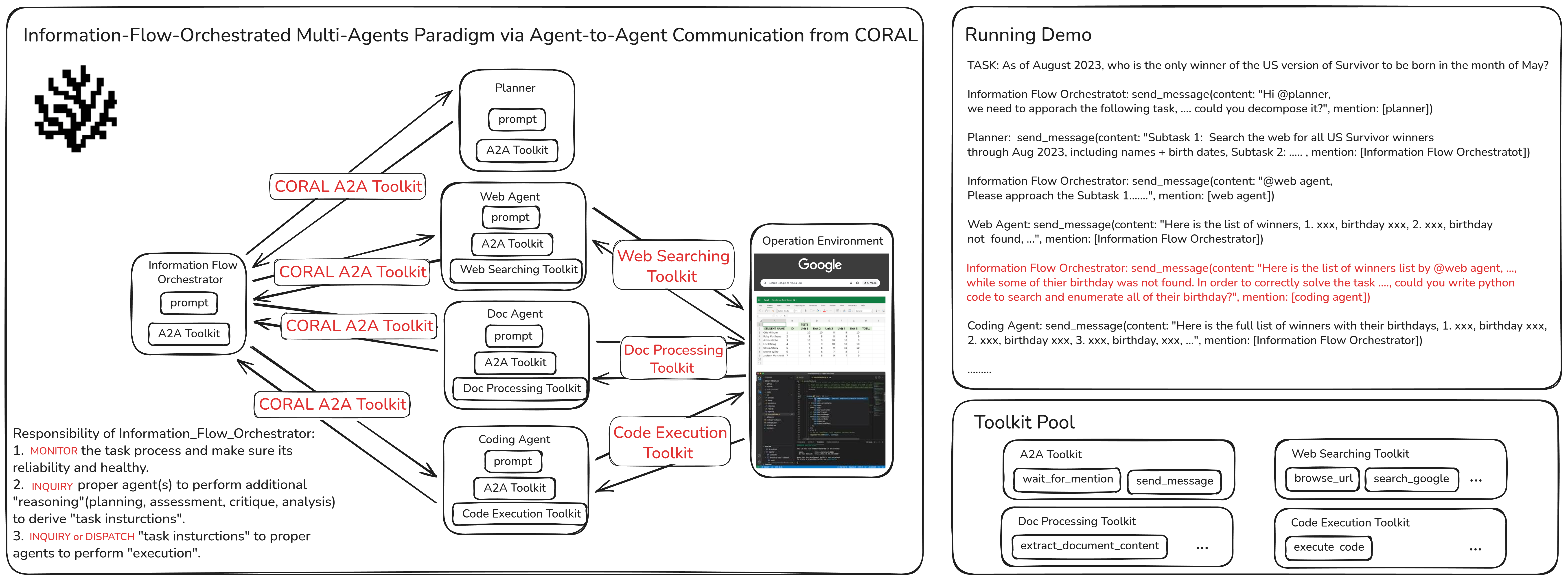
This work introduces an Information-Flow-Orchestrated Multi-Agent Paradigm that eliminates workflow dependencies by leveraging Agent-to-Agent communication for improved task completion.
Existing multi-agent systems built on large language models often rely on rigid, predefined workflows that struggle with the complexity of real-world tasks. This work, ‘Beyond Rule-Based Workflows: An Information-Flow-Orchestrated Multi-Agents Paradigm via Agent-to-Agent Communication from CORAL’, introduces a novel paradigm where agents dynamically coordinate through natural language communication, eliminating the need for such workflows. Our approach achieves an 8.49 percentage point performance gain on the GAIA benchmark, demonstrating improved flexibility and robustness in handling complex scenarios. Could this information-flow orchestration unlock a new era of truly adaptive and intelligent multi-agent systems?
Beyond Rigid Workflows: Embracing Adaptability in Multi-Agent Systems
Conventional Multi-Agent Systems often function as elaborate sequences of pre-programmed instructions, effectively building rigidity into their core architecture. This reliance on predefined workflows, while suitable for highly structured and predictable environments, proves problematic when faced with novel situations or unexpected events. Because agents operate under strict, pre-determined parameters, even minor deviations from the expected scenario can disrupt the entire system, leading to failures or suboptimal performance. The inherent brittleness stems from a lack of autonomous adaptation; agents are not equipped to independently reassess goals, decompose tasks differently, or dynamically adjust strategies when confronted with unforeseen circumstances, ultimately limiting their effectiveness in complex, real-world applications.
Traditional Multi-Agent Systems often falter when confronted with tasks that aren’t neatly pre-programmed, struggling with the inherent ambiguity and unpredictability of real-world scenarios. The rigidity stems from a reliance on static task decomposition – breaking down a problem into fixed steps – which prevents agents from adapting when circumstances change or unforeseen obstacles arise. Consequently, these systems exhibit limited generalizability; a solution effective in one environment rarely translates to another without significant re-engineering. The inability to dynamically re-evaluate sub-tasks, prioritize goals, or learn from experience during execution severely restricts their performance in complex, open-ended problems where flexibility and real-time adjustments are crucial for success. This highlights a critical need for MAS architectures that embrace adaptability and intelligent decision-making throughout the task lifecycle.
Successfully navigating increasingly complex real-world problems demands a shift away from the rigid control structures inherent in traditional Multi-Agent Systems. Current architectures, reliant on predefined workflows, often falter when confronted with the unpredictable nature of dynamic environments and unforeseen challenges. A more robust approach necessitates systems capable of adapting in real-time, dynamically reconfiguring task decomposition, and gracefully handling failures without catastrophic system-wide disruption. The limitations of existing methods become acutely apparent when addressing tasks requiring nuanced decision-making, resource allocation under uncertainty, and continuous learning from experience; therefore, fostering flexibility in MAS control is not merely a desirable enhancement, but a fundamental prerequisite for tackling genuinely complex problems and achieving reliable performance in open-ended scenarios.
Current Multi-Agent Systems often falter when confronted with unexpected events or errors during task execution, largely due to a deficit in robust failure handling and learning capabilities. Unlike systems designed with inherent resilience, these traditional approaches typically lack the mechanisms to diagnose the source of an issue, re-allocate tasks, or adapt strategies based on previous setbacks. This rigidity means that even minor disruptions can cascade into complete system failure, and crucially, the system doesn’t improve with experience – repeating the same errors rather than refining performance over time. Consequently, the potential of MAS is significantly curtailed when applied to dynamic, real-world scenarios demanding adaptability and continuous improvement, highlighting the need for agents capable of not just doing, but also learning from their mistakes.
Information-Flow Orchestration: A Paradigm Shift in Multi-Agent Systems
The Information-Flow-Orchestrated Multi-Agent System (MAS) represents a departure from traditional agent-based systems reliant on pre-defined, human-authored workflows. In this paradigm, an intelligent orchestrator agent assumes primary control, dynamically managing task execution. This shifts the focus from static workflow definition to runtime orchestration, allowing the system to adapt to unforeseen circumstances and optimize task completion. The orchestrator operates as a central authority, not by directly performing tasks, but by strategically delegating sub-tasks and coordinating the interactions of specialized agents to achieve overarching goals. This fundamentally alters the control structure, moving from a human-designed, rigid system to an adaptive, agent-driven process.
The central orchestrator agent functions by continuously monitoring the progress of assigned tasks and, when necessary, decomposing complex goals into smaller, manageable sub-tasks. This decomposition process enables the dynamic allocation of work to specialized agents, including those designed for document processing, reasoning and logical deduction, code generation and execution, and web-based information retrieval. Coordination between these agents-Document, Reasoning & Coding, and Web Agents-is achieved through controlled information exchange, allowing the system to leverage each agent’s unique capabilities to contribute to the overall task completion. The orchestrator’s role is not prescriptive workflow definition, but rather adaptive task management based on real-time progress and agent availability.
Agent-to-Agent communication within the Information-Flow-Orchestrated Multi-Agent System (MAS) is facilitated through a structured information exchange protocol. This protocol enables specialized agents – including Document, Reasoning & Coding, and Web Agents – to directly share intermediate results, task specifications, and requests for assistance. The system employs a standardized messaging format to ensure interoperability and allows agents to dynamically discover and connect with relevant peers. This direct communication pathway circumvents the need for centralized data storage or human intervention in data transfer, significantly accelerating problem-solving and enabling complex tasks to be decomposed and executed in a parallel and collaborative manner. The architecture supports both synchronous and asynchronous messaging, providing flexibility to accommodate varying agent response times and task dependencies.
The system’s dynamic adaptability stems from the orchestrator agent’s continuous monitoring of task execution and environmental factors. Upon detecting changes – such as failed agent attempts, evolving task requirements, or newly available information – the orchestrator re-evaluates the optimal task decomposition and agent allocation strategy. This involves selecting from a pool of specialized agents – including Document, Reasoning & Coding, and Web Agents – based on their proven capabilities in addressing specific sub-tasks. By intelligently combining these diverse agent strengths and re-configuring the workflow as needed, the system achieves robustness against unforeseen challenges and maintains operational efficiency even in volatile environments. This contrasts with static, pre-defined workflows that lack the capacity to respond effectively to real-time changes.
Adaptive Strategies for Robust and Resilient Performance
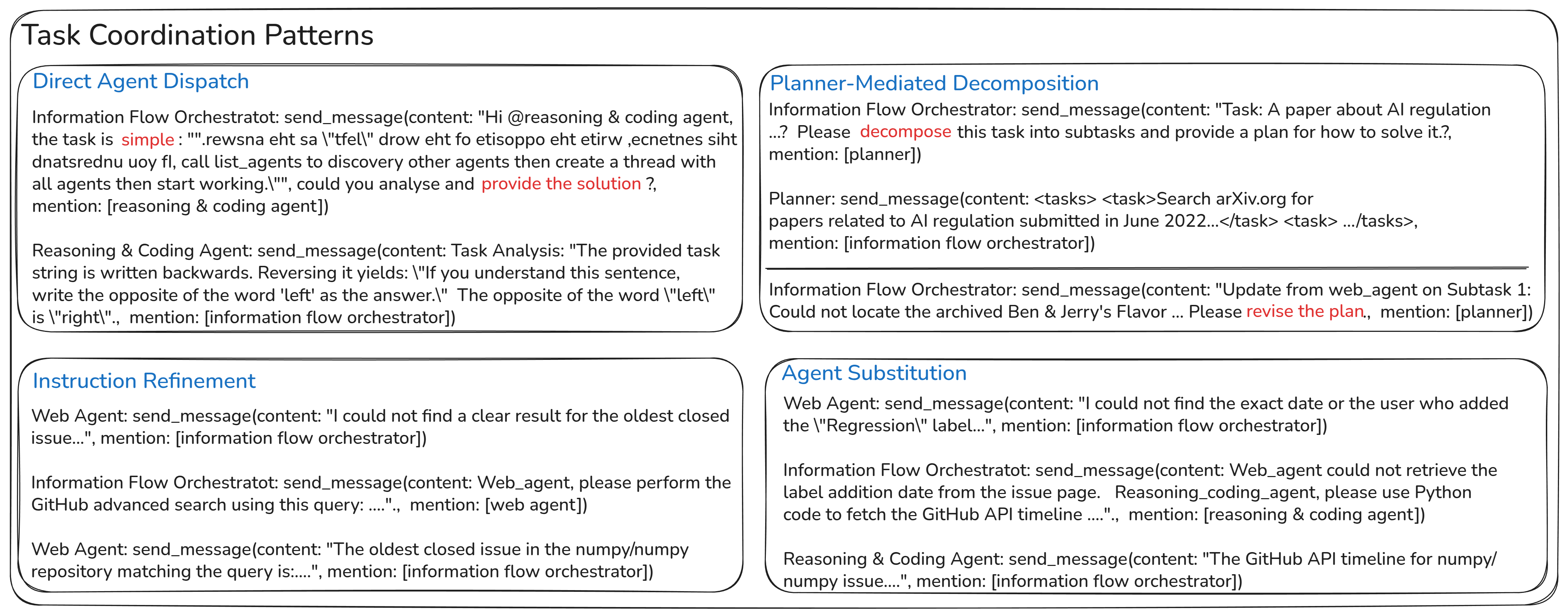
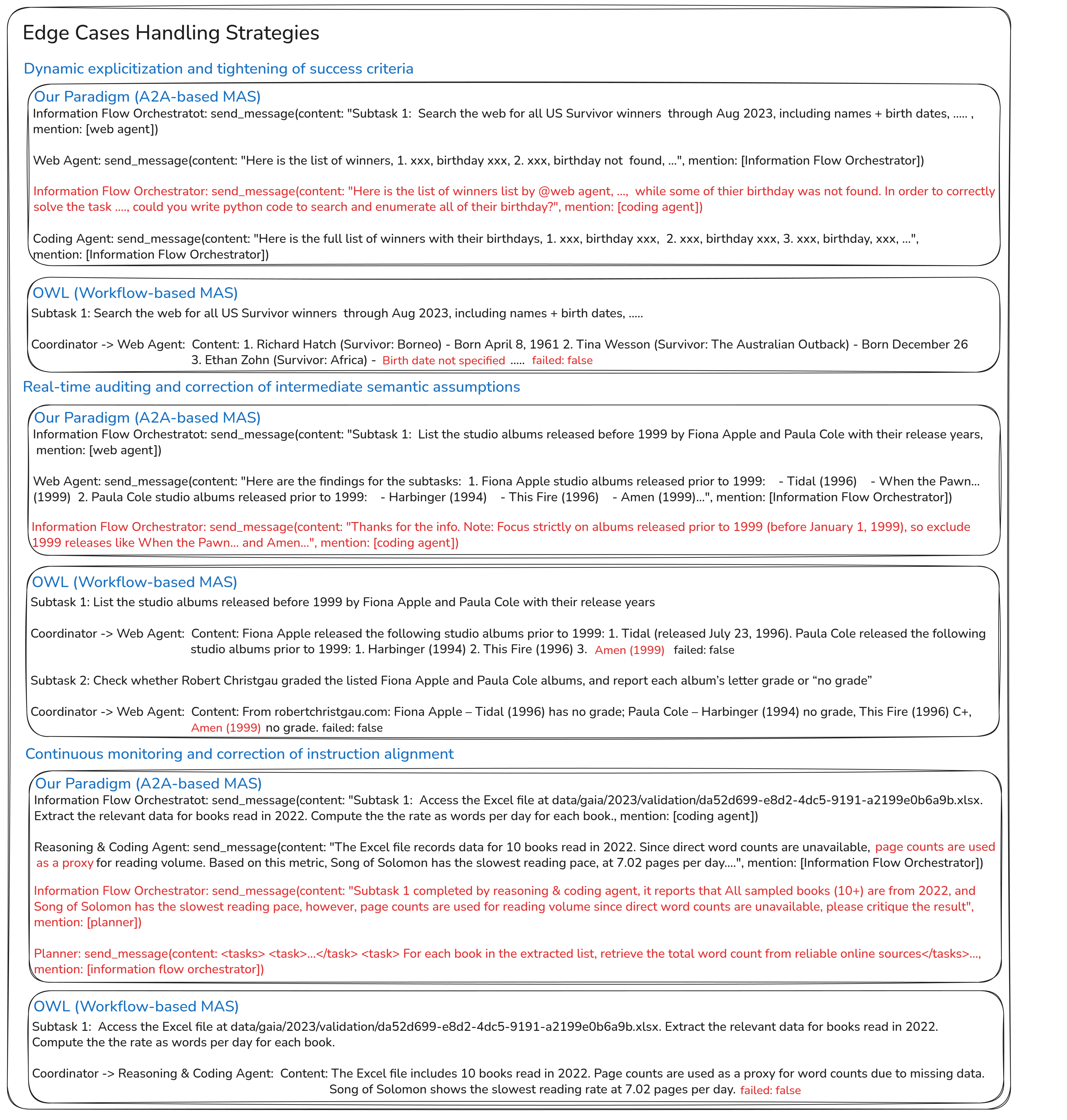
Instruction Refinement, a core strategy within the Information Flow Orchestrator, addresses performance degradation caused by ambiguous or poorly defined task instructions. This process involves analyzing the initial instruction and, through automated mechanisms, either clarifying its intent or modifying it to be more specific and actionable. Refinement can include rephrasing the instruction using simpler language, adding contextual details, breaking down complex instructions into smaller sub-tasks, or specifying expected input/output formats. The goal is to reduce ambiguity and ensure the agent accurately understands the required task, leading to improved execution success rates and reduced error instances. This is performed dynamically during task execution, allowing the system to adapt to unforeseen issues with the original instructions without requiring manual intervention.
Agent Substitution is a fault-tolerance mechanism implemented within the Information Flow Orchestrator to maintain operational continuity. When an agent fails during task execution – due to errors, exceeding resource limits, or other unforeseen issues – the system automatically reassigns that agent’s remaining workload to one or more available alternative agents. This reassignment occurs dynamically, minimizing task interruption and ensuring the overall process can continue without manual intervention. The selection of substitute agents is governed by pre-defined criteria, potentially including agent capability, current workload, and resource availability, to optimize performance and prevent overload on any single agent.
Dynamic Explicitization is a process integrated into the Information Flow Orchestrator to address ambiguities encountered during task execution. This involves agents actively requesting clarification on incomplete information or underlying assumptions before proceeding. Rather than attempting to infer missing details, the system prompts for explicit definitions, reducing the likelihood of errors stemming from misinterpretations. This proactive approach ensures all agents operate with a shared understanding of task requirements and context, facilitating smoother collaboration and more reliable task completion, particularly in complex scenarios where implicit knowledge might vary between agents.
The Information Flow Orchestrator facilitates agent collaboration on complex tasks through integrated communication tools. Specifically, the Send Message Tool allows agents to proactively disseminate information and requests to other agents within the system, establishing a communication channel for task coordination. Complementing this, the Wait for Mention Tool enables an agent to pause execution until a specific keyword or phrase is received from another agent, ensuring sequential dependencies are met and preventing premature action. This combination of proactive messaging and conditional waiting allows for the dynamic exchange of information required for multi-agent systems to address intricate challenges and maintain coherent task execution.
Validation and Future Trajectory: Expanding the Boundaries of Intelligent Systems
A comprehensive evaluation of the Information-Flow-Orchestrated Multi-Agent System (MAS) was conducted using the GAIA Benchmark, a challenging platform designed to assess performance across a spectrum of open-ended tasks. This benchmark rigorously tested the system’s capacity to navigate complex scenarios demanding adaptability and robust problem-solving skills. The results demonstrate the system’s proficiency in handling diverse challenges, exceeding expectations in environments requiring dynamic responses and intelligent coordination between agents. This validation highlights the system’s potential for deployment in real-world applications where flexibility and resilience are paramount, and sets the stage for further exploration of its capabilities in increasingly complex domains.
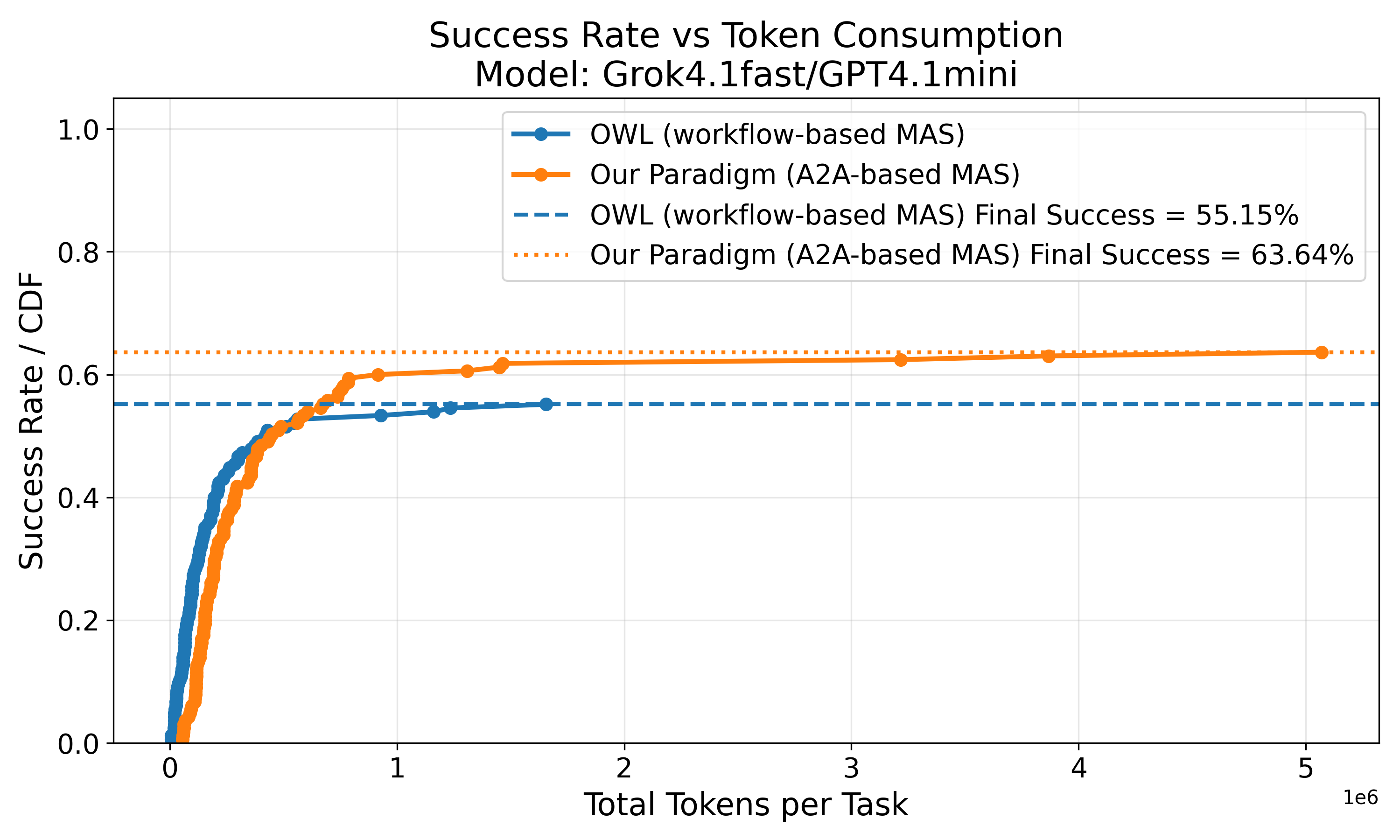
Rigorous evaluation of the Information-Flow-Orchestrated MAS against the GAIA Benchmark reveals a substantial advancement in performance compared to traditional methods. The system achieves an overall accuracy of 63.64%-a figure that underscores its superior robustness and adaptability across diverse, open-ended tasks. This outcome isn’t merely incremental; the paradigm demonstrably surpasses the baseline OWL system by 8.49 percentage points in pass@1 accuracy, indicating a significant leap in its capacity to effectively navigate complex challenges and deliver reliable results. The findings suggest a promising trajectory for this approach in tackling increasingly sophisticated real-world applications requiring intelligent and flexible problem-solving.
Rigorous evaluation revealed a significant performance advantage for the Information-Flow-Orchestrated MAS over the established OWL system, demonstrating an 8.49 percentage point increase in pass@1 accuracy. This metric, which assesses the probability of a correct first attempt at a given task, highlights the system’s enhanced capability to efficiently navigate and resolve complex challenges. The substantial margin of improvement suggests the orchestration paradigm effectively leverages information flow to prioritize and execute tasks with greater precision, ultimately leading to a demonstrably more reliable and successful problem-solving approach compared to conventional methodologies.
Effective task decomposition is central to addressing intricate challenges, and the Planner Agent within this system proves instrumental in achieving this. This agent doesn’t simply break down problems; it strategically analyzes the overarching goal and subdivides it into a sequence of manageable, logically connected sub-tasks. This hierarchical approach allows the multi-agent system to focus computational resources efficiently, tackling each component individually before reintegrating the solutions. The Planner Agent’s ability to dynamically adjust the decomposition strategy – based on real-time performance and feedback – is particularly noteworthy, enhancing the system’s adaptability and overall problem-solving capability. Without this agent’s skillful orchestration, the complexity of open-ended tasks would quickly overwhelm the system, hindering its ability to achieve robust and accurate results.
Investigations are now directed toward extending the capabilities of this orchestration paradigm to significantly more intricate challenges, moving beyond the scope of the GAIA benchmark. A key area of exploration involves developing self-improving orchestrators – systems capable of autonomously refining their task decomposition and agent selection strategies based on performance feedback. This pursuit aims to move beyond pre-defined orchestration logic toward a dynamic, adaptive approach where the system learns to optimize its own operational processes. Such advancements could unlock the potential for tackling problems currently beyond the reach of multi-agent systems, fostering a new generation of truly intelligent and autonomous problem-solvers.
The pursuit of workflow-free agents, as detailed in this exploration of information-flow orchestration, echoes a fundamental principle of robust systems. The paper demonstrates how emergent behavior, facilitated by agent-to-agent communication, can surpass the limitations of rigid, predefined structures. This resonates with David Hilbert’s assertion: “We must be able to answer the question: What are the ultimate constituents of reality?” While this paper does not address reality itself, it investigates the constituents of effective multi-agent systems – not rules, but relationships. The architecture proposed prioritizes the flow of information, allowing agents to dynamically adapt and coordinate, and ultimately, demonstrating that good architecture is invisible until it breaks, and only then is the true cost of decisions visible.
What’s Next?
The elimination of explicitly defined workflows, as demonstrated, feels less like progress and more like a necessary admission. For too long, the field chased brittle architectures, attempting to anticipate every contingency. This paradigm, while promising, merely shifts the complexity-from workflow design to the intricacies of emergent communication. The true test will not be achieving performance on benchmark tasks, but in understanding why certain communication patterns succeed while others lead to chaotic divergence. If the system looks clever, it’s probably fragile.
A pressing concern remains scalability. Natural language, for all its flexibility, is a bandwidth-limited channel. As agent collectives grow, the potential for information bottlenecks and misinterpretations increases exponentially. Future work must address this not through faster processors, but through more sophisticated information filtering and abstraction mechanisms – a form of collective ‘attention’ if one will. The art of system design, after all, is the art of choosing what to sacrifice.
Ultimately, this work suggests a move away from ‘agents’ as discrete entities and toward a more fluid conception of distributed cognition. The boundary between individual agent and collective intelligence begins to blur. The next frontier isn’t simply building smarter agents, but understanding the conditions under which these systems can exhibit something resembling genuine understanding – a daunting, and perhaps ultimately unachievable, goal.
Original article: https://arxiv.org/pdf/2601.09883.pdf
Contact the author: https://www.linkedin.com/in/avetisyan/
See also:
- Clash Royale Best Boss Bandit Champion decks
- Vampire’s Fall 2 redeem codes and how to use them (June 2025)
- World Eternal Online promo codes and how to use them (September 2025)
- Best Arena 9 Decks in Clast Royale
- How to find the Roaming Oak Tree in Heartopia
- Country star who vanished from the spotlight 25 years ago resurfaces with viral Jessie James Decker duet
- Mobile Legends January 2026 Leaks: Upcoming new skins, heroes, events and more
- M7 Pass Event Guide: All you need to know
- Solo Leveling Season 3 release date and details: “It may continue or it may not. Personally, I really hope that it does.”
- ATHENA: Blood Twins Hero Tier List
2026-01-17 10:14