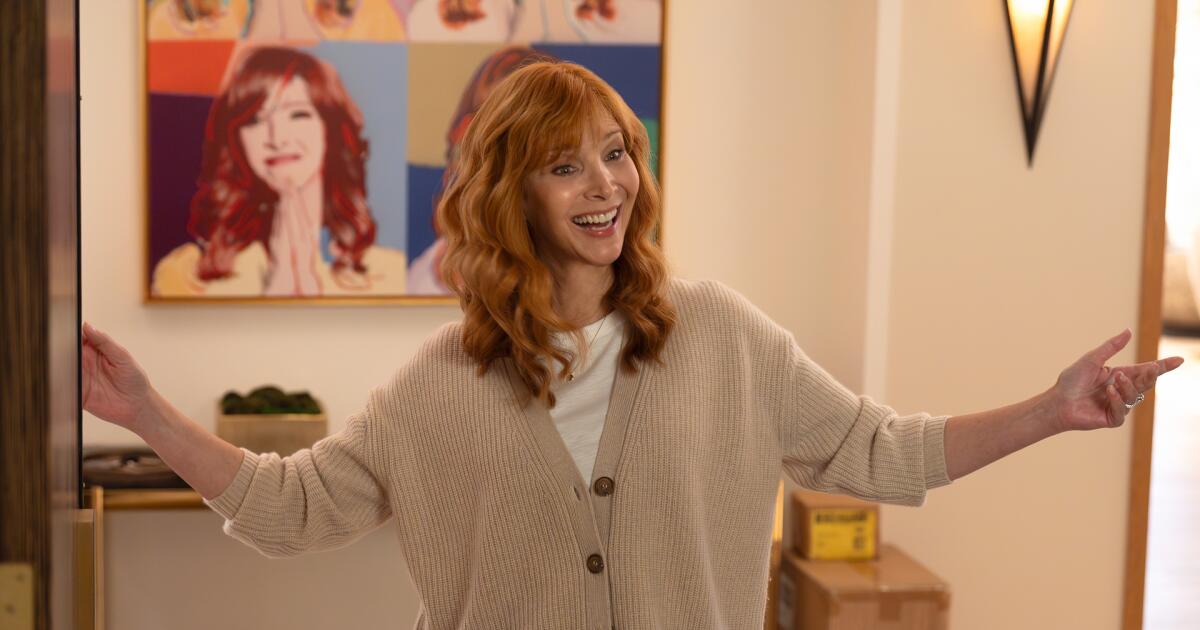
Similar to the legendary city of Brigadoon, Lisa Kudrow’s show “The Comeback” is back on television after a long absence. However, unlike the timeless Brigadoon, the characters have aged, and they’re now facing a world that’s changed and doesn’t quite appreciate them as much, leaving them feeling less confident as they try to find their way.
Lisa Kudrow, the co-creator and writer of the series alongside Michael Patrick King, began her career during a time when network television was still dominant. She starred in a popular and critically acclaimed show that attracted viewers of all ages. In some ways, that early success was hard to top, as the television landscape rapidly changed. “The Comeback” first aired in 2005, shortly after “Friends” ended, and its first season explored the growing popularity of reality TV. The show’s second season, in 2014, satirized the darker, more sophisticated dramas being produced for streaming services.
This final season is particularly relevant and thought-provoking, exploring how artificial intelligence is changing television and the entertainment industry – and suggesting a potentially troubling future. It’s not just entertainment; the show carries a strong moral and political message, and feels incredibly urgent. While acknowledging that AI could create content that’s ‘good enough,’ this human-made show, ‘The Comeback,’ ultimately champions the value of human creativity – it’s almost a declaration of its importance.
Lisa Kudrow returns as Valerie Cherish, a 60-year-old actress constantly reminded of her age. While still working, her career has stalled. Her TV series, “Mrs. Hatt,” only aired on Epix and hasn’t gained any attention. She’s taking whatever work she can get – low-budget films and a brief appearance on “The Traitors” – and desperately trying to stay relevant. She fumbles with a podcast called “Cherish the Time,” hires a social media manager named Patience who doesn’t seem to help, and posts sponsored content online hoping to land future brand deals.
Despite some recent changes, Valerie and her husband, Mark, are doing okay. They’ve moved from Brentwood to a condo in Sierra Towers with a great view of the Sunset Strip, hoping for a fresh start. Mark lost his finance job – apparently due to a poorly-timed joke – but he received a generous severance package. Now, he spends his days playing pickleball. He briefly explored a reality show opportunity called “Finance Dudes,” but it didn’t pan out. He’s starting to feel a bit lost and unsure about the future.
Valerie is surprised but interested when her manager, Billy, presents her with an offer for a new TV series on a different network. The catch? The script is written by artificial intelligence – a fact Billy isn’t supposed to reveal. The network executive, Brandon, smoothly explains it complies with writers’ union rules, but insists it must be kept quiet, setting the stage for plenty of comedic moments built around deception. He tells Valerie that the AI choosing her is proof of its incredible abilities.
The network has also produced a very standard, multi-camera sitcom called “How’s That?.” Valerie plays Beth, who runs a quaint bed and breakfast in New England with her attractive nephew, Bo – a setup playfully referred to as “Beth and Bo, B&B.” According to a network executive, audiences are looking for something lighthearted after so many complex, dark dramas on streaming services. The actors don’t realize the show is actually written by a struggling married couple, Josh (John Early) and Mary (Abbi Jacobson). Josh considers himself an expert on female perspectives and carefully guards the jokes he writes, while Mary is indifferent. Their writing assistant, Marco (Tony Macht), is simply focused on financial security. Unbeknownst to everyone on set, the show is partially written by AI, which is presented as a remote employee named “Al.”
As the show revisits familiar faces, Valerie unexpectedly runs into Jane (Laura Silverman), a filmmaker she used to work with, now working at Trader Joe’s. Jane had grown frustrated with the struggle of trying to get people interested in her films. When Valerie reveals her new show is created using AI – and asks Jane to keep it a secret – it reignites Jane’s passion for filmmaking. Lance Barber will return as Paulie G., Valerie’s longtime rival. Sadly, Robert Michael Morris, who played Valerie’s friend and hairdresser Mickey, passed away in 2017, and Jack O’Brien now plays Tommy, filling a similar role in the show.
Okay, so Valerie isn’t a huge star, but she’s definitely talented – she actually won an Emmy for this really intense drama, “Seeing Red,” which is a big part of season two. I loved how she stood up to the costume guy, Benito Skinner, when he tried to stick her in a caftan – she knows what looks good and respects her job. She’s not demanding or anything, just proud of what she does and happy to be in the union. Honestly, she’s super likable, especially because she’s fiercely loyal, even when it backfires. Being the first actor in an AI-driven comedy is…well, Mark puts it perfectly: it’s like being the first person to try something really risky and potentially awful. You instantly root for her, and when things take a seriously dark turn in the final act, she totally steps up and becomes the hero of the story.
Despite dealing with a serious topic, this season takes a much lighter and more comedic approach. Unlike previous seasons – which felt like raw, amateur footage or a found-footage film – this one is filmed like a typical TV show. This allows viewers to see private moments and conversations as if they weren’t being recorded, and the characters don’t have to act aware of a camera crew. Surprisingly, by not trying to appear realistic, the show actually feels more genuine.
Director James Burrows, playing a version of himself, points out that while AI can generate jokes quickly, they’re never as good as those crafted by human writers working hard to create something truly original. He believes that genuine surprises come from a team of writers pushing themselves to improve. Just like the character Valerie couldn’t be created by an algorithm, actress Lisa Kudrow is uniquely herself – not a variation of any other character, even an older or quirkier one. There’s simply no data for AI to learn from that could replicate her specific talent and presence; she’s one of a kind.
Always strive for the best possible outcome, rather than simply accepting something that’s just okay. Ultimately, it’s up to you to make that decision.
Read More
- The Division Resurgence Best Weapon Guide: Tier List, Gear Breakdown, and Farming Guide
- Kagurabachi Chapter 118 Release Date, Time & Where to Read Manga
- Last Furry: Survival redeem codes and how to use them (April 2026)
- Clash of Clans Sound of Clash Event for April 2026: Details, How to Progress, Rewards and more
- Gold Rate Forecast
- Guild of Monster Girls redeem codes and how to use them (April 2026)
- ‘Project Hail Mary’s Soundtrack: Every Song & When It Plays
- Top 5 Best New Mobile Games to play in April 2026
- All Mobile Games (Android and iOS) releasing in April 2026
- eFootball 2026 Master League leaks: A detailed look at the new mode, and why it feels disappointing
2026-03-22 13:31