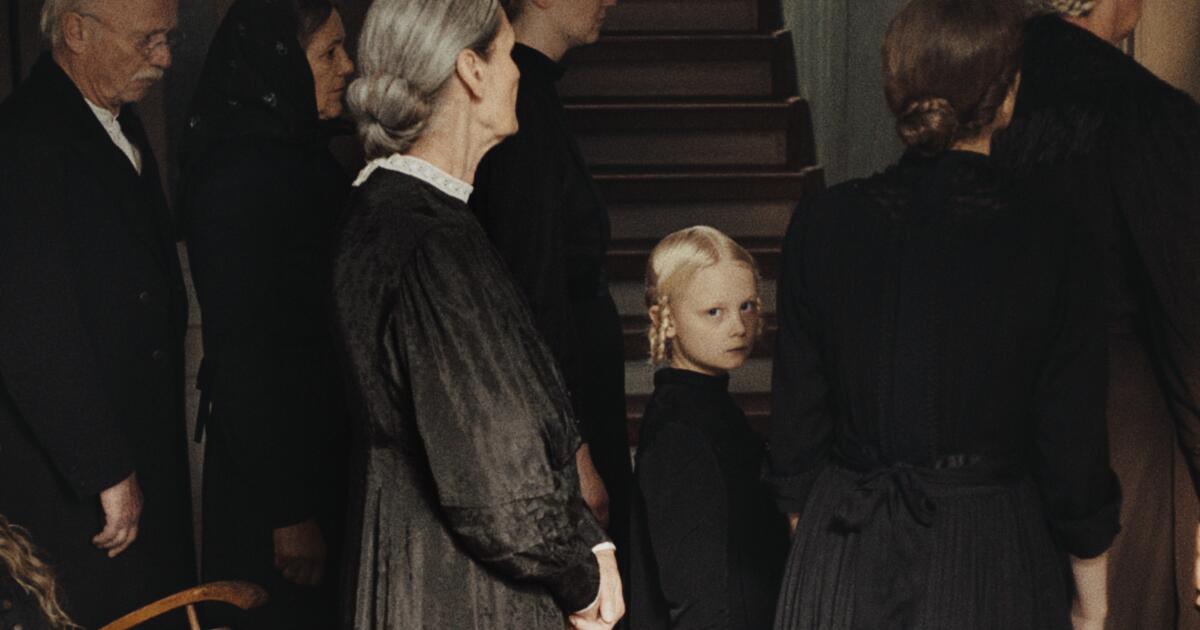
Mascha Schilinski’s impressive second film, “Sound of Falling,” feels haunted by the past. It’s a beautifully atmospheric story that follows four young women living in the same house across a span of about 110 years, offering a glimpse into their lives and the echoes they leave behind.
Unlike many films that romanticize connections between people across time, “Sound of Falling” is raw and realistic. It moves effortlessly between the early 1900s and the present day, portraying humanity as a vulnerable species constantly battling hidden struggles that repeat through each generation. The film emphasizes the fleeting nature of life, showing how so many characters – and their aspirations – have faded into the past, much like we all will eventually.
I was completely captivated by “Sound of Falling,” the film that won the Jury Prize at Cannes last year. It introduces you to four incredible young women across generations, all connected to the same family farm in northern Germany. There’s Alma, a child living around 1910, then Erika in the 1940s, a flirty teen named Angelika in the 80s, and Lenka, a shy girl in the present day. What’s so striking is that the director doesn’t make it easy; she doesn’t tell you when you are, leaving you to piece things together. It actually begins with Erika, and a surprisingly intimate scene where she quietly watches over her ailing uncle, Fritz. It’s a bold opening! We eventually learn the story behind his injury, but the film unfolds at its own pace, and I loved that. It’s a truly epic story, slowly revealed.
“Sound of Falling” subtly and cleverly examines how sexism and the suppression of women have resonated throughout history. The mistreatment of servants in the past mirrors the unsettling experiences of Angelika in the 1980s, who is disturbed and fascinated by her uncle’s unwanted attention. However, the film doesn’t force these connections; events unfold because they realistically reflect the difficult, ordinary lives of women in those times. It’s only when we see these stories together that the full impact and meaning become clear.
Movies
I’m really excited about what I’ve seen from Cannes so far! Ari Aster’s ‘Eddington’, starring Joaquin Phoenix and Pedro Pascal, is definitely getting a lot of buzz, and I was pleasantly surprised by Harris Dickinson’s directing debut – especially since I loved him in ‘Babygirl’. It’s great to see fresh talent making waves on the Croisette.
Similar to recent films like “Aftersun” and “Nickel Boys,” “Sound of Falling” feels like a carefully reconstructed memory. While all three films beautifully capture the way memory is flawed and incomplete, “Sound of Falling” emphasizes the feeling that the past is truly lost – something we can sense but never fully grasp. The film portrays scenes from Alma and Erika’s rural lives as if they were old exhibits in a museum, and even more recent moments feel like faded photographs. Characters often narrate in the past tense, making even present-day scenes feel like distant recollections. The cinematography, with its ghostly quality and occasional point-of-view shots, creates the feeling of wandering through forgotten spaces. When characters briefly make eye contact with the camera, it’s unsettling, powerfully connecting their past with our present.
Viewers will slowly piece together the family ties between the women in “Sound of Falling,” but the details are best left for them to uncover as the story unfolds. Family relationships are a key theme in Schilinski’s work – the director and her wife recently had a child. However, her films so far suggest these bonds aren’t always positive. Her first film, “Dark Blue Girl,” focused on a girl trying to prevent her parents from reconciling. In “Sound of Falling,” she explores darker themes like incest and suicidal thoughts, alongside a powerful urge to escape. Although the four young women never interact, they all share a sense of hopelessness. The confusion of young Alma, observing the secrets of adults, mirrors the insecurity of Lenka a century later as she connects with a girl who seems unusually mature. The film subtly asks: what if Alma and Lenka could have a conversation? What would they tell each other?
This film centers around questions that are difficult to grasp, inviting the audience to interpret its meaning. Recurring images and ideas – like buzzing flies, photography, and Anna von Hausswolff’s song “Stranger” – weave throughout the movie. While the song’s lyrics don’t directly relate to the film’s themes of beauty and pain, they add to its mysterious quality. The film doesn’t offer easy answers, but the lyrics – “There is something moving against me… changing my path, changing my soul” – offer a helpful way to understand its captivating and haunting atmosphere. Ultimately, watching this film is a transformative experience.
Read More
- Invincible Season 4 Episode 4 Release Date, Time, Where to Watch
- Physics Proved by AI: A New Era for Automated Reasoning
- How Martin Clunes has been supported by TV power player wife Philippa Braithwaite and their anti-nepo baby daughter after escaping a ‘rotten marriage’
- CookieRun: OvenSmash coupon codes and how to use them (March 2026)
- Goddess of Victory: NIKKE 2×2 LOVE Mini Game: How to Play, Rewards, and other details
- Total Football free codes and how to redeem them (March 2026)
- American Idol vet Caleb Flynn in solitary confinement after being charged for allegedly murdering wife
- Nicole Kidman and Jamie Lee Curtis elevate new crime drama Scarpetta, which is streaming now
- “Wild, brilliant, emotional”: 10 best dynasty drama series to watch on BBC, ITV, Netflix and more
- Roco Kingdom: World China beta turns chaotic for unexpected semi-nudity as players run around undressed
2026-01-23 23:01