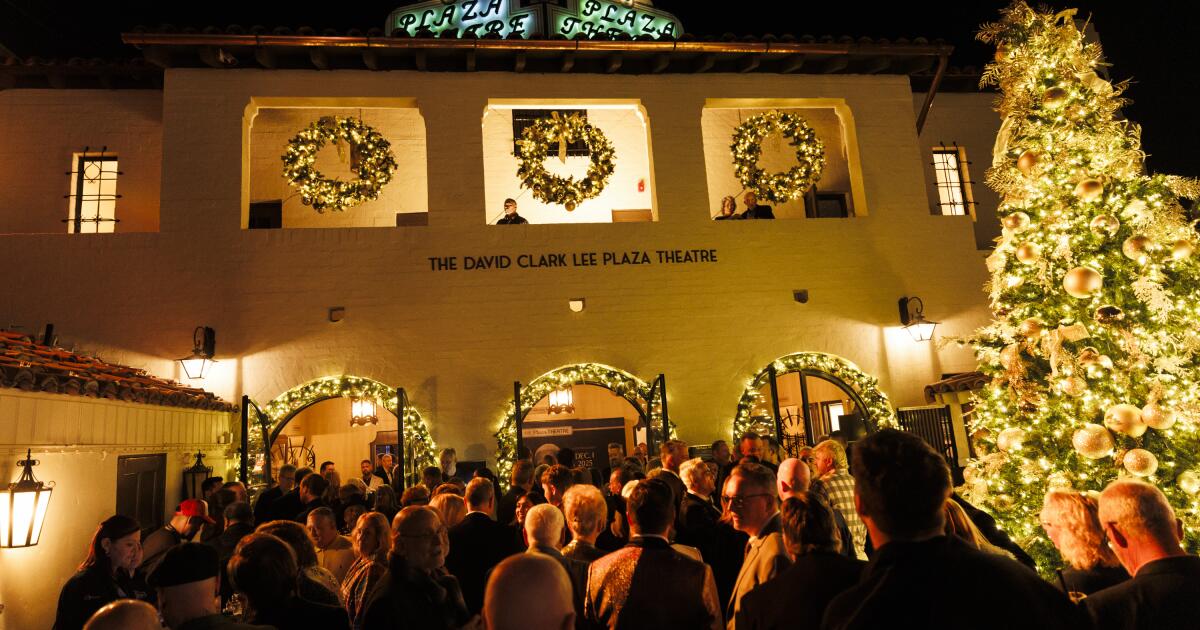
Hollywood loves a good comeback story, and Palm Springs has one for the books.
The Plaza Theatre in the desert town had a glamorous opening night in 1936 with a showing of George Cukor’s film “Camille,” featuring a radiant Greta Garbo. Bright spotlights lit up the night, a red carpet welcomed guests to the 800-seat theater, built in the Spanish Colonial Revival style, and cameras flashed as stars like Frank Capra, Robert Taylor, Barbara Stanwyck, Tyrone Power, and Shirley Temple arrived.
The glamorous event solidified Palm Springs’ growing reputation as a vacation spot for Hollywood’s elite. Over the next 90 years, the town blossomed into a world-renowned resort, growing to a population of around 45,000. This number nearly doubles with the influx of seasonal visitors, particularly during the pleasant winter months.
The Plaza Theatre, however, fell on hard times.

For decades, this venue was the heart of the city’s nightlife, but it closed its doors in 2014. It remained empty and deteriorated until 2019, when people began working to restore it. After a $34 million renovation, it finally reopened on December 1st with a spectacular concert by Cynthia Erivo, accompanied by the Palm Springs Pops Orchestra. The reopening was a glamorous event, complete with bright lights, a red carpet, and flashing cameras. This beloved, historic landmark had been beautifully restored to its former glory.

“We didn’t just renovate the theater; we restored it to its original glory,” explained J.R. Roberts, president of the Palm Springs Plaza Theatre Foundation, the group that led the project. “It’s exactly as it appeared in 1936, right down to the colors, details, and lighting.”
The theater has been completely transformed, with only the LED screen behind the stage and the seats remaining unchanged. The seats themselves have been updated from white leather to comfortable red. The previous design, featuring burnt orange paint and bright neon lights, is gone. This earlier style was characteristic of the theater when it hosted the popular vaudeville show, the Fabulous Palm Springs Follies, which ran for 23 seasons before the venue closed in 2014.
Recent improvements to the Plaza aren’t immediately visible, but major upgrades have been made behind the scenes. The heating, cooling, and electrical systems are completely new, and the lighting and sound have been modernized.
The Plaza theater was designed to feel completely immersive – a style popularized in the 1920s by architect John Eberson. These theaters created dreamlike atmospheres by using architectural details that resembled beautiful outdoor scenes. At The Plaza, the walls are decorated to look like a charming Spanish village, with lights that shift from pink to purple to mimic a sunset. Above, the domed ceiling is filled with tiny lights that twinkle like stars in the night sky.
1

2

3

The Plaza Theatre sparkled as it opened its doors. Inside, the theater’s Spanish Colonial Revival design created a unique and inviting atmosphere. Guests gathered to celebrate the grand opening.
Jason Currie, an architect with Architectural Resources Group, explained that much of the building’s original structure had been hidden over time – covered with drywall, damaged, or altered with new materials. His firm was hired by the foundation to carefully restore the building, and they used the original blueprints to guide a complete renovation.
Currie explained that the original decorative concrete proscenium, which featured stencil painting, was hidden behind a plaster wall and partially painted black. The original tile roof had also been replaced. The team removed all of these later additions to restore the proscenium to its original condition.
Historian Jim Cook, author of the new book “Desert Dream to Silver Screen: The Story of the Historic Palm Springs Plaza Theatre” (co-written with Catherine Graham), notes that the theater was remarkably beautiful and one-of-a-kind when it was first built.
Julia Carnell, whose family owned a major cash register company in Dayton, Ohio, funded the project as part of the La Plaza shopping center.
I was reading about this fascinating woman, and apparently, even during the Great Depression, she was incredibly wealthy. She was a regular at the Desert Inn – a place run by this amazing woman named Nellie Coffman – and would always stay right across the street from wherever she was. It’s just a little detail, but it really paints a picture, you know?
Coffman didn’t simply manage the famous resort; she envisioned it at a time when Palm Springs was just a small, developing town on the route to Los Angeles.
After a ceremony with Palm Springs Mayor Ron deHarte, Cook explained that the town was founded by incredibly strong and determined women – a remarkable feat given the difficult desert landscape. She emphasized that these women were central to the growth and identity of the entire town.

Carnell commissioned architect Harry Williams to create La Plaza, a modern complex featuring a movie theater and a pioneering shopping center designed with cars in mind. The center included a two-story parking garage offering car service, seasonal rental cottages, and housing for working women located above the shops.
Julia was a strong advocate for women’s rights and believed they deserved a voice, especially during a time when they were often overlooked, as Cook explained. She actively supported the suffragist movement to ensure women had a place in society.
Over time, the Plaza evolved. It started as a local movie theater and transformed into a community arts center, hosting a variety of live shows like vaudeville and even a famous performance by Louis Armstrong. In the early 1940s, it became a popular spot for radio broadcasts, starting with Jack Benny, who pioneered nationwide broadcasts from the Plaza Theatre in Palm Springs with his Sunday night show. Later, near the end of World War II, Frank Sinatra briefly moved his weekly radio program to the Plaza.
Back in the 1970s, the Plaza theater was rented to a company that divided it into two smaller cinemas with a temporary wall. They also removed the original, beautifully tiled ticket booth outside, a decision many people regretted. This demolition, as Cook points out, was a key event that led to the current efforts to preserve historic buildings in Palm Springs.
With the recent completion of the Plaza’s restoration, the foundation hired John Bolton, an expert from Oak View Group—a live event hospitality company—to manage the venue. Bolton’s first step was to invite many of the area’s leading arts and event organizations to use the space, including the Palm Springs Symphony, the Palm Springs Gay Men’s Chorus, Modernism Week, the Palm Springs International Film Festival, the Palm Springs International Jazz Festival, and a new classical music series called Classical Coachella.

Bolton explained that this approach helps ensure the theater’s long-term success, as touring shows naturally fluctuate in popularity. He’s aiming to establish lasting yearly events, like a Christmas Eve sing-along at the Plaza, and also contribute to the revitalization of the downtown area.
The newly renovated Plaza Theatre is predicted to be a key part of bringing the city’s downtown area back to life, bringing visitors to local hotels, restaurants, and stores.
Bolton has scheduled over 100 performances, drawing over 10,000 attendees from every state in the U.S. City Council member Jeffrey Bernstein estimates the venue will host around 135,000 visitors annually, who are projected to spend over $40 million. The city anticipates this will create at least $21 million a year in economic benefits, specifically supporting local small businesses through sales and hotel taxes.
After Cynthia Erivo’s opening night concert finished, over 800 excited fans flooded out onto the streets, looking for somewhere to grab a late drink and some food.
Read More
- Clash Royale Best Boss Bandit Champion decks
- Brawl Stars December 2025 Brawl Talk: Two New Brawlers, Buffie, Vault, New Skins, Game Modes, and more
- Best Hero Card Decks in Clash Royale
- Clash Royale December 2025: Events, Challenges, Tournaments, and Rewards
- Call of Duty Mobile: DMZ Recon Guide: Overview, How to Play, Progression, and more
- Best Arena 9 Decks in Clast Royale
- Clash Royale Witch Evolution best decks guide
- All Boss Weaknesses in Elden Ring Nightreign
- Brawl Stars December 2025 Brawl Talk: Two New Brawlers, Buffie, Vault, New Skins, Game Modes, and more
- Deneme Bonusu Veren Siteler – En Gvenilir Bahis Siteleri 2025.4338
2025-12-09 14:04