Author: Denis Avetisyan
New research reveals that combining human intuition with artificial intelligence significantly enhances collective problem-solving and accelerates creative discovery.
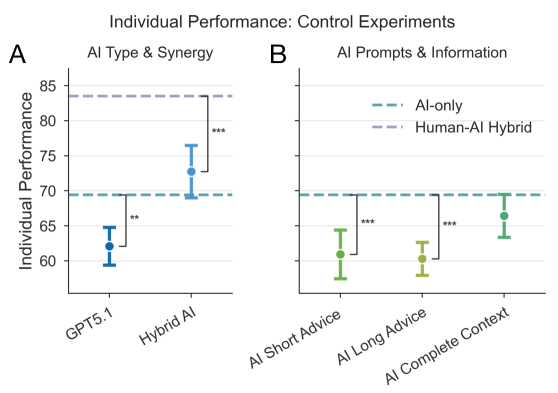
Hybrid human-AI groups outperform both human and AI-only teams in creative search tasks by effectively balancing exploration and exploitation strategies and maintaining solution diversity.
While artificial intelligence increasingly augments creative processes, the extent to which it enhances-or constrains-collective problem-solving remains an open question. This research, ‘Human-AI Synergy Supports Collective Creative Search’, investigates how hybrid human-AI groups perform in a word-guessing task designed to balance open-ended exploration with objective evaluation. Results demonstrate that these hybrid groups consistently outperform both human-only and AI-only teams, achieving superior performance while maintaining a diverse range of solutions through complementary strategies. Does this suggest a fundamental shift in how we approach collective intelligence, leveraging the unique strengths of both human intuition and artificial computation?
The Limits of Individual Cognition
Historically, problem-solving strategies have prioritized the capabilities of single individuals, often overlooking the significant advantages offered by collective intelligence. This emphasis on individual performance neglects the potential for synergistic effects when multiple agents – be they humans or artificial intelligence – collaborate. The power of a group lies in its ability to explore a wider range of solutions, correct individual errors through diverse perspectives, and leverage specialized knowledge. Research increasingly demonstrates that groups can consistently outperform the most skilled individuals on complex tasks, not simply through averaging contributions, but by dynamically combining insights and fostering novel approaches that would remain inaccessible to a lone thinker. This highlights a critical shift in understanding – that intelligence isn’t solely an individual attribute, but an emergent property of interconnected systems.
Semantic reasoning, the process of deriving meaning from information, frequently exposes the inherent limitations of individual problem-solving capabilities. Human cognition, while powerful, operates within boundaries of existing knowledge and biases, creating a restricted search space for potential solutions. This manifests as a trade-off between exploration – investigating novel, potentially fruitful avenues – and exploitation – refining known, reliable strategies. Individuals often struggle to balance these effectively; an overemphasis on exploitation can lead to suboptimal outcomes by missing innovative solutions, while excessive exploration can be inefficient and time-consuming. Studies reveal that complex semantic tasks demand a breadth of knowledge and diverse perspectives that often exceed the capacity of a single mind, suggesting that optimal reasoning frequently arises not from individual brilliance, but from the collective synthesis of varied cognitive approaches.
The synergistic potential between human cognition and artificial intelligence offers a pathway toward exceeding the limitations of either entity in isolation. Research increasingly demonstrates that problem-solving benefits not merely from the computational power of AI, nor simply from human intuition and experience, but from the interaction between the two. Effective collaboration requires interfaces and methodologies that leverage the strengths of each – AI’s capacity for rapid data analysis and exhaustive search, coupled with the human ability for abstract thought, creative hypothesis generation, and nuanced judgment. This interplay isn’t simply about AI assisting humans, but about a dynamic exchange where each learns from the other, leading to more robust solutions and fostering genuinely novel approaches to complex challenges. Consequently, investigations into these human-AI partnerships are essential for designing systems capable of tackling problems currently beyond the reach of either humans or machines alone.
Designing for Synergy: The Architecture of Hybrid Teams
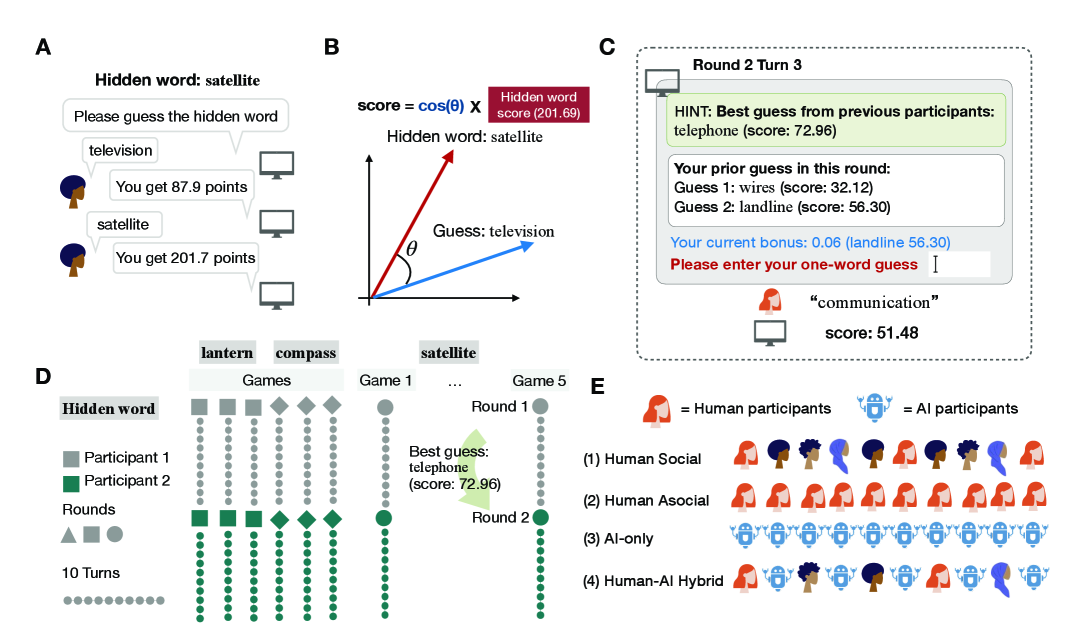
Experimental setups were constructed utilizing the word-association game ‘Semantle’ to mediate interactions between human subjects and two large language models: Gemini 2.5 and GPT 5.1. ‘Semantle’ requires players to iteratively refine guesses of a target word based on semantic similarity scores provided as feedback, making it suitable for evaluating collaborative reasoning. Each experimental condition involved human participants and AI agents taking turns proposing guesses and receiving similarity scores, allowing for the observation of information exchange and strategy development within the hybrid groups. The game’s structure provided a quantifiable metric – the number of guesses to reach the target word – for assessing group performance and the contributions of both human and AI components.
Hybrid Human-AI Groups were organized using a Linear Chain Network architecture, wherein information passed sequentially from one member to the next. This network structure facilitated a specific interaction pattern: a stimulus was initially presented to the first group member (either human or AI), who then produced an output serving as input for the subsequent member in the chain. This process continued until the final member generated an ultimate response. The linear arrangement was implemented to observe how information transforms and evolves as it propagates through the combined human and artificial intelligence system, enabling analysis of collaborative reasoning steps and potential bottlenecks in information transfer.
The PsyNet framework is a purpose-built platform designed to facilitate large-scale, online behavioral experiments focusing on group dynamics. It provides infrastructure for participant recruitment, experimental control, and automated data collection, supporting studies with hundreds of simultaneous human-AI team interactions. Key features include a centralized experiment management system, real-time monitoring of participant activity, and automated data pipelines for cleaning, processing, and analysis. This framework ensures data robustness through built-in quality control measures, such as attention checks and data validation procedures, enabling statistically powerful investigations into collaborative problem-solving and information exchange within hybrid human-AI groups.
Emergent Intelligence: Evidence of Collective Gains
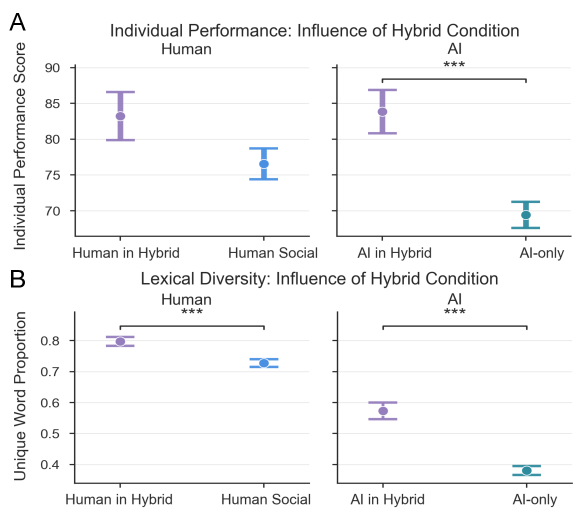
Analysis of collaborative problem-solving demonstrated that hybrid human-AI groups achieved a peak performance score of 83.52. This represents a statistically significant improvement over both individual human performance and AI-only performance (p < .001). The observed performance metric assesses the quality and efficiency of solutions generated, indicating that the combination of human and artificial intelligence resulted in superior outcomes compared to either approach functioning in isolation. These findings suggest a synergistic effect wherein human intuition and AI processing capabilities complement each other to enhance overall problem-solving efficacy.
Analysis of lexical data from hybrid human-AI groups demonstrated a statistically significant increase in collective diversity of word choices compared to individual performance. This diversity, measured by the Shannon Diversity Index, suggests a broader exploration of the semantic space during problem-solving. Specifically, the groups utilized a wider range of terms, indicating that the combined cognitive resources facilitated the consideration of more varied concepts and perspectives than either humans or AI operating independently. This expanded lexical range is not merely quantitative; it correlates with improved performance metrics, suggesting that semantic diversity is a contributing factor to the observed gains in collective intelligence.
Analysis of hybrid human-AI group dynamics revealed instances of second-order effects, where the actions of one agent – either human or AI – demonstrably altered the behavior of other agents within the group. This influence wasn’t limited to direct responses; observed patterns indicated adaptation of reasoning strategies based on prior interactions. Specifically, agents adjusted their approach to problem-solving following exposure to the methods employed by others, resulting in complex, emergent behaviors not predictable from individual agent capabilities. These reciprocal influences contributed to the group’s overall performance and suggest a form of collective adaptation beyond simple task completion.
![A positive correlation between collective performance and diversity, as indicated by linear regression and [latex]Pearson’s[/latex] correlation coefficients, demonstrates that higher diversity among hidden words correlates with improved collective performance.](https://arxiv.org/html/2602.10001v1/x4.png)
Beyond Performance: Quantifying the Leap in Creative Potential
Research utilizing the Divergent Association Task-a standardized measure of creative thinking-revealed a notable advantage for hybrid teams composed of both humans and artificial intelligence. These groups consistently generated a significantly greater number of unique and insightful solutions compared to individuals working independently. The task required participants to identify connections between seemingly unrelated concepts, and the study demonstrated that the combination of human intuitive leaps and AI’s capacity for broad data analysis fostered a synergistic effect. This suggests that AI doesn’t simply replicate human creativity, but rather augments it, enabling a collective intelligence that surpasses the capabilities of either entity in isolation.
Rigorous statistical control was essential to validate the observed creative gains in hybrid human-AI groups. Researchers employed a False Discovery Rate (FDR) correction to account for the multiple comparisons inherent in evaluating numerous potential solutions. This approach moves beyond simply identifying statistically significant results; it actively addresses the probability of incorrectly claiming a discovery when examining a large dataset – a common pitfall in creativity research. By controlling for spurious correlations, the FDR analysis bolsters confidence that the observed improvements in creative output weren’t due to chance, but rather reflect a genuine synergistic effect between human and artificial intelligence. This meticulous approach ensures the robustness and reliability of the findings, solidifying the claim that combining human intuition with AI’s computational strengths unlocks novel creative potential.
Research indicates a substantial creative advantage when humans and artificial intelligence collaborate, exceeding the capabilities of either entity in isolation. Statistical analysis reveals hybrid human-AI groups demonstrated a performance improvement of [latex]d = 0.23[/latex], alongside a statistically significant increase in the diversity of generated solutions ([latex]p < .001[/latex]). This suggests that the synergistic combination of human intuition – adept at abstract thought and contextual understanding – with AI’s computational power and capacity for vast data processing, unlocks emergent creative potential. The findings highlight that creativity isn’t simply about generating numerous ideas, but about exploring a broader, more varied solution space, a feat best accomplished through collaborative intelligence.
![Participants exhibiting higher diversity in their word choices, measured as [latex]1 - \text{mean pairwise cosine similarity}[/latex], also demonstrated significantly improved performance, as evidenced by higher maximal scores across rounds (p < 0.001 after Benjamini-Hochberg correction).](https://arxiv.org/html/2602.10001v1/x3.png)
Toward Collaborative Intelligence: Charting a Course for Future Research
Beyond the simplicity of a linear arrangement, future investigations should prioritize the exploration of diverse network topologies to significantly enhance collaborative intelligence. Researchers posit that structures like small-world networks, scale-free networks, or even more complex mesh configurations could dramatically improve information dissemination and collective problem-solving capabilities. The efficiency of information flow isn’t solely dependent on the number of connections, but crucially on how those connections are arranged; a well-structured network can minimize bottlenecks, reduce redundancy, and facilitate the rapid integration of diverse perspectives. Such advancements promise not only faster and more accurate outcomes, but also the potential to unlock emergent behaviors within hybrid human-AI groups, pushing the boundaries of what collaborative intelligence can achieve.
The potential for truly novel outcomes in ‘Hybrid Human-AI Groups’ hinges significantly on understanding how the unique strengths of each agent – be it human intuition or artificial processing power – contribute to the collective creative process. Future research must move beyond simply assessing whether a hybrid group outperforms either humans or AI alone, and instead focus on dissecting the specific roles different agents play, and how their diversity fuels innovation. Investigating the interplay between varying levels of expertise, cognitive styles, and even personality traits within these groups will be essential; a team comprised of solely high-performing individuals may, paradoxically, be less creative than one intentionally built with a broader spectrum of skills and perspectives. Ultimately, maximizing creative output requires not just combining human and artificial intelligence, but strategically orchestrating their individual contributions to leverage the benefits of cognitive diversity.
This research establishes a crucial stepping stone toward artificial intelligence systems designed not to replace human intellect, but to significantly enhance it. This framework envisions a future where AI functions as a collaborative partner, amplifying human cognitive abilities in tackling complex challenges and driving innovation. By focusing on synergistic interaction, these systems promise to move beyond automation, enabling humans and AI to jointly generate solutions previously unattainable by either alone. This paradigm shift holds particular promise for fields requiring creativity, critical thinking, and nuanced judgment, potentially revolutionizing problem-solving across diverse disciplines and ushering in a new era of collaborative intelligence.
The study illuminates a compelling interplay between human intuition and artificial intelligence, revealing that collaborative groups surpass the capabilities of either entity in isolation. This echoes Donald Knuth’s sentiment: “Premature optimization is the root of all evil.” The research doesn’t champion speed at the expense of thoroughness; instead, it demonstrates that a balanced ‘exploration-exploitation’ strategy – facilitated by the hybrid human-AI approach – yields both efficiency and diversity in creative problem-solving. The value isn’t solely in the final solution, but in the process of reaching it, a testament to the power of considered design over hasty implementation. The findings suggest that true innovation arises not from maximizing individual performance, but from optimizing the synergistic potential within a collective.
What’s Next?
The demonstrated synergy, while statistically significant, merely establishes a baseline. The question isn’t simply that humans and AI can outperform either alone, but why this occurs with such predictable efficiency. The current work frames the interaction as complementary exploration and exploitation, a functional description. However, it avoids the thornier problem of characterizing the qualitative difference between a human-guided search and one solely determined by algorithmic optimization. Understanding this difference – the nature of ‘creative’ divergence – remains paramount.
Future iterations must move beyond task performance to interrogate the cognitive load imposed on human participants. Efficiency gains are meaningless if achieved at the cost of increased mental fatigue or a diminished sense of agency. The boundary between assistance and automation is porous; determining the optimal level of AI intervention-the point at which the system enables rather than dictates the search-is a critical, and presently unresolved, challenge.
Finally, the inherent limitations of the semantic space employed warrant consideration. The current model relies on pre-defined relationships between concepts. True creative leaps often necessitate the construction of novel semantic connections – an ability that remains largely absent in current large language models. Therefore, research should focus not solely on enhancing existing search capabilities, but on developing systems that can actively reshape the landscape of meaning itself.
Original article: https://arxiv.org/pdf/2602.10001.pdf
Contact the author: https://www.linkedin.com/in/avetisyan/
2026-02-11 18:00