Author: Denis Avetisyan
New observations with the Atacama Large Millimeter/submillimeter Array are reshaping our understanding of how planets and small bodies formed from the swirling disks of gas and dust around young stars.
This review details how ALMA observations of protoplanetary disks, asteroids, and comets are revealing insights into planet formation processes and the inheritance of volatile compounds in our Solar System and beyond.
Despite decades of study, the precise mechanisms driving planet formation and the delivery of volatiles to nascent planetary systems remain incompletely understood. This review, ‘Satellites and small bodies with ALMA: Insights into Solar System formation & evolution’, highlights recent advances enabled by the Atacama Large Millimeter/submillimeter Array (ALMA) in characterizing the composition and evolution of Solar System satellites, asteroids, and comets. ALMA observations of thermal emission and spectral lines are providing crucial constraints on volatile inheritance and the physical conditions within protoplanetary disks, offering new insights into the origins of our Solar System and others. How will continued high-resolution ALMA observations refine our understanding of planetesimal formation and the early evolution of planetary atmospheres?
The Whispers of Creation: From Dust to Worlds
The genesis of planets is inextricably linked to the fate of volatile molecules – compounds like water, methane, and ammonia – within the swirling expanse of protoplanetary disks. These disks, composed of gas and dust surrounding young stars, serve as the nurseries for planetary systems, yet pinpointing the origins of these crucial volatiles remains a central challenge. Researchers theorize these compounds may have formed in situ within the disk, been inherited directly from the molecular cloud from which the star formed, or even delivered by comets and asteroids. Determining the primary source-and how these volatiles were distributed across the disk-is critical, as their presence and abundance profoundly influence a planet’s atmospheric composition, potential for liquid water, and ultimately, its habitability. The distribution of volatiles isn’t uniform; temperature and density gradients within the disk dictate where these molecules condense into ice, affecting planet formation and composition at different distances from the star.
Protoplanetary disks, the stellar nurseries where planets are born, are far from static environments. Within these swirling structures of gas and dust, complex physical and chemical processes compete to determine the fate of planetary building blocks. While gravity draws particles together, turbulence, magnetic fields, and radiation pressure all exert opposing forces, creating a chaotic landscape where collisions can both build and destroy potential planets. Current research focuses on disentangling these competing mechanisms – including the roles of pebble accretion, streaming instabilities, and the formation of pressure traps – to understand how initially microscopic dust grains grow into planetesimals, and ultimately, fully formed planets. The precise interplay of these forces remains a subject of intense debate, with ongoing observations and simulations continually refining models of planet formation.
A planet’s potential to harbor life is deeply intertwined with the delivery and retention of volatile molecules like water and methane during its formative years. The abundance and distribution of these compounds, established within the protoplanetary disk, dictate atmospheric composition, the presence of liquid water, and ultimately, surface conditions. Early planetary history, therefore, wasn’t simply a period of accretion; it was a delicate balancing act where slight variations in volatile delivery could lead to drastically different outcomes – a frigid, barren world, or a potentially habitable one. Investigating the mechanisms that governed volatile transport and incorporation into planetesimals provides crucial insights into the conditions that allowed our own solar system to develop a life-supporting planet, and informs the search for habitable worlds beyond it.
Unveiling the Disk: ALMA’s Piercing Gaze
The Atacama Large Millimeter/submillimeter Array (ALMA) achieves high-resolution observations of protoplanetary disks by utilizing millimeter and submillimeter wavelengths. This wavelength range allows ALMA to penetrate the dense dust clouds that obscure visible light, revealing the structure and composition of these disks. ALMA’s array configuration provides an effective aperture significantly larger than single-dish telescopes, resulting in angular resolutions down to approximately 25 milliarcseconds at 850 μm. This capability enables the spatial separation of emission from different molecules – including carbon monoxide, water, and various organic compounds – providing detailed chemical maps of the regions where planets are forming and allowing for the identification of chemical fingerprints indicative of specific processes and materials.
ALMA utilizes the principle of thermal emission to characterize the composition and structure of protoplanetary disks. Objects within these disks, including gas and dust grains, emit radiation across the millimeter and submillimeter wavelengths due to their temperature. By observing the intensity and spectral characteristics of this thermal emission, ALMA can map the distribution of various molecules – such as water, carbon monoxide, and organic compounds – within the disk. The wavelengths observed are sensitive to the temperature and density of the emitting material, allowing astronomers to determine the spatial arrangement of these volatile molecules and infer the physical and chemical conditions present during planet formation. Different molecules emit at specific frequencies, creating a ‘fingerprint’ that enables their identification and quantification within the disk environment.
ALMA observations of Solar System bodies, including comets and asteroids, facilitate comparative planetology by enabling detailed compositional analysis and spatial mapping. By characterizing the volatile and refractory components of these objects, researchers can investigate the distribution of materials within the early Solar System and establish potential source regions for planetary building blocks. Specifically, ALMA data allows for the identification of organic molecules, water ice, and other key compounds, providing insights into the delivery mechanisms of these materials to the inner planets and the potential for prebiotic chemistry. This extends to tracing the origins of specific materials found on planets back to their parent bodies in the asteroid belt, Kuiper Belt, and potentially even beyond.
The Atacama Large Millimeter/submillimeter Array (ALMA) achieves a spatial resolution of approximately 20 milliarcseconds (mas), equivalent to 30 kilometers at the distances of Kuiper Belt Objects (KBOs) and asteroids. This resolution permits detailed mapping of surface features and compositional variations on these bodies. Specifically, ALMA observations can resolve thermal emission from surface materials, allowing for identification of volatile compounds like water ice, methanol, and more complex organics. By analyzing the spatial distribution of these compounds, researchers can infer surface processes, identify potential sources of material, and constrain the origins and evolution of KBOs and asteroids within the Solar System. The ability to map compositional differences at this scale provides crucial data for comparative planetology and understanding the building blocks of planetary systems.
![Analysis of isotopic ratios-[latex]^{15}N/^{14}N[/latex] in astronomical objects and [latex]^{34}S/^{32}S[/latex] within the Solar System, derived from ALMA observations of molecules like CH3C15N and 34SO2, reveals variations across comets, protoplanetary disks, and planets, providing insights into their origins and evolution.](https://arxiv.org/html/2602.06126v1/x2.png)
Echoes of the Past: Tracing Origins with Isotopic Signatures
Isotopic ratios serve as tracers of material origin due to the predictable, yet variable, processes that fractionate isotopes during chemical and physical reactions. Isotopes are atoms of the same element with differing numbers of neutrons, resulting in slightly different masses. These mass differences influence reaction rates, leading to preferential incorporation of certain isotopes into specific molecules or reservoirs. Consequently, variations in isotopic compositions – expressed as ratios like [latex] \frac{^{34}S}{^{32}S} [/latex] – reflect the conditions and processes experienced by the material, providing a unique ‘fingerprint’ that can be used to identify its source and track its evolution. The magnitude of isotopic differences is typically measured in parts per thousand (‰) relative to a standard, allowing for precise comparisons between samples.
Isotopic analysis of sulfur and nitrogen in Solar System bodies provides constraints on their origin and evolution. Variations in the ratios of stable isotopes – specifically [latex]^{32}S[/latex], [latex]^{33}S[/latex], [latex]^{34}S[/latex] for sulfur and [latex]^{14}N[/latex], [latex]^{15}N[/latex] for nitrogen – reflect differences in nuclear statistical equilibrium during their formation and subsequent processing. Comets generally exhibit elevated [latex]^{15}N[/latex]/[latex]^{14}N[/latex] ratios compared to planetary atmospheres, suggesting formation in colder, more distant regions. Asteroids display a wider range of isotopic compositions, indicative of diverse parent body sources and potentially complex mixing processes. Planetary atmospheres, particularly those of the gas giants, offer insights into the delivery of volatiles from outer Solar System sources, while analysis of nitrogen isotope ratios in Martian meteorites helps to constrain atmospheric escape processes and the planet’s overall evolutionary history.
Outbursts from young stars, specifically FU Orionis-type events, temporarily increase the luminosity of the star due to enhanced accretion from its surrounding protoplanetary disk. These outbursts expose previously hidden icy grains that were shielded within the disk. Analysis of these exposed grains, performed through spectroscopic observation, reveals the isotopic composition of volatiles – compounds like water, carbon monoxide, and methane – that were originally present in the disk’s outer regions. This data provides constraints on the origin of these volatiles, distinguishing between those formed locally within the disk and those delivered from interstellar space or from the molecular cloud core that birthed the star. Consequently, the study of outbursting stars offers a unique window into the mechanisms responsible for volatile delivery to forming planetary systems and helps to model the composition of nascent planets.
Analysis of Io’s volcanic plume composition reveals a sulfur-34 to sulfur-32 ([latex]^{34}S/{}^{32}S[/latex]) ratio of 347±86 ‰. This value is substantially elevated compared to the isotopic composition of sulfur found in other Solar System bodies, including Earth, Mars, comets, and most asteroids. The disparity suggests that Io’s sulfur originates from a source distinct from the bulk of Solar System material. Current hypotheses propose that this unique isotopic signature may be attributable to sulfur sourced from the outer Solar System, potentially from icy planetesimals that were incorporated into Io during its formation or via subsequent impact events.
The detection of isotopic ratios mirroring those found in Solar System comets and icy satellites within debris disks surrounding distant stars supports the hypothesis of a shared origin for volatile-rich materials. Specifically, analysis of debris disk composition reveals elevated ratios of isotopes like [latex]^{34}S/{ }^{32}S[/latex] and [latex]^{15}N/{ }^{14}N[/latex] that are uncommon within the inner Solar System but characteristic of outer Solar System bodies. This suggests that material initially formed in the outer regions of our Solar System, or a similar protoplanetary disk, was dynamically scattered and now populates both the Kuiper Belt/Oort Cloud and debris disks around other stars, indicating a widespread distribution of these materials beyond our local stellar neighborhood.
Worlds Apart, Stories Shared: Volatile Histories of Titan, Io, and Beyond
Titan, Saturn’s largest moon, possesses a dense, nitrogen-rich atmosphere remarkably different from other bodies in the solar system. Isotopic analysis of nitrogen reveals a 15N/14N ratio significantly higher than that found on Earth or in the solar nebula, indicating a source distinct from these common reservoirs. This unusual isotopic signature suggests that Titan’s nitrogen originated from icy planetesimals formed in the frigid outer reaches of the solar system, beyond the snow line where volatile elements like nitrogen could condense and become incorporated into these building blocks. These planetesimals, likely originating from the Kuiper Belt or even further afield, were subsequently delivered to the Saturnian system, contributing to the formation of Titan and imbuing its atmosphere with this unique isotopic fingerprint. The findings offer valuable insight into the delivery mechanisms of volatile elements during the late stages of planetary formation and suggest that Titan preserves a record of materials from the solar system’s outermost regions.
Io, Jupiter’s innermost Galilean moon, exhibits intense volcanic activity fueled by tidal heating resulting from its orbital resonance with Europa and Ganymede – a relationship known as the Laplace resonance. Analysis of sulfur isotopes within Io’s dramatic volcanic plumes reveals a surprisingly complex history of material sourcing and transport. These isotopes aren’t uniformly distributed, indicating that Io’s volcanic activity isn’t solely driven by its molten silicate interior, but also involves the recycling and upwelling of sulfur-rich materials from different depths and potentially even external sources. The isotopic variations suggest a dynamic interplay between Io’s mantle, crust, and possibly even captured material from Jupiter’s magnetosphere, creating a fascinating puzzle for planetary scientists attempting to understand the moon’s internal structure and volatile history.
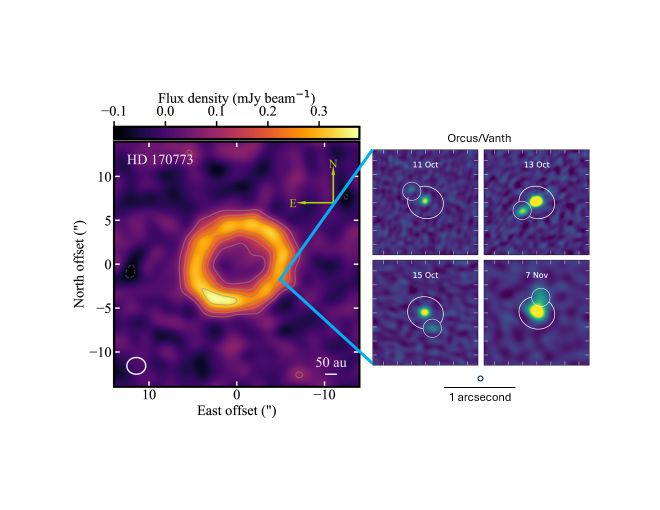
The dwarf planet Vanth-Orcus presents an anomaly in the study of binary systems; its satellite comprises a surprisingly large fraction of its total mass, with a mass ratio of 0.16 ± 0.02 – the highest known for any planet or dwarf planet in our solar system. This substantial proportion challenges conventional models of binary formation and suggests Vanth-Orcus may have undergone a unique evolutionary path. Current theories propose several possibilities, including a head-on collision with another Kuiper Belt Object or a complex gravitational interaction that allowed the satellite to accrete a significant amount of mass. Determining the precise mechanism responsible for this unusual mass ratio could offer valuable insights into the dynamics of the early solar system and the diverse processes that shaped the architecture of planetary systems.
The dwarf planet Eris and its moon Dysnomia present a compelling case for satellite reaccretion, a process where debris from a giant impact coalesces into a new moon. Current observations establish an upper limit on their mass ratio at 0.0085 – remarkably close to the predicted ratio for a satellite formed through this mechanism. This suggests that Dysnomia may not have formed in situ alongside Eris, but rather originated from a collision involving Eris, with the resulting debris reassembling into the smaller moon. This low mass ratio, coupled with dynamical modeling, supports the hypothesis that reaccretion played a significant role in the formation of this binary system, offering valuable insights into the collisional histories of objects in the distant Kuiper Belt and the evolution of binary systems throughout the solar system.
Kuiper Belt Objects (KBOs), persisting in the solar system’s frigid outskirts, are considered largely unchanged since the era of planet formation. These icy bodies, remnants of the protoplanetary disk, retain volatile substances – compounds like water, methane, and ammonia – in their original, primordial state. Consequently, analysis of KBO composition offers a unique window into the building blocks and environmental conditions present during the solar system’s infancy. By examining the abundance and isotopic ratios of these volatiles within KBOs, scientists can infer the temperatures, pressures, and chemical gradients that characterized the early solar nebula, providing crucial insights into how planets, including Earth, ultimately came to be. The continued study of these distant worlds promises to refine existing models of planet formation and reveal the processes that shaped our cosmic neighborhood.
The volatile histories of celestial bodies like Titan and Io, once largely speculative, are now being illuminated by a powerful synergy between isotopic analysis and observational astronomy. By meticulously examining the ratios of different isotopes – variations of an element with differing neutron counts – within atmospheres and volcanic plumes, scientists can trace the origins and evolution of key volatile compounds such as nitrogen and sulfur. This detailed isotopic ‘fingerprinting’ is then combined with data from telescopes and spacecraft, revealing patterns of material transport, planetary formation scenarios, and even potential evidence of past collisions. The combined approach not only refines existing models of the early solar system but also opens new avenues for understanding the distribution of volatile elements across diverse planetary environments, offering crucial insights into the conditions necessary for the emergence of life.
The study of protoplanetary disks, as detailed in this paper, reveals the intricate dance of matter coalescing into worlds – a process far removed from simple predictability. It generously shows its secrets to those willing to accept that not everything is explainable. As Igor Tamm once noted, “The most valuable things in life are those that cannot be explained.” This sentiment echoes the challenge presented by volatile inheritance within these disks; tracing the origins of water and organic molecules proves remarkably complex. Black holes are nature’s commentary on our hubris, and so too are these distant, swirling nurseries of planets, constantly reminding us of the limits of comprehension when facing the cosmos’ grandeur.
What Lies Beyond the Dust?
The observations detailed within – spectral lines, isotopic ratios, the faint thermal whispers from distant objects – offer a portrait, not a solution. Each precise measurement of volatile inheritance, each map of a protoplanetary disk, simply defines the boundary of what remains unknown. The data accumulate, yet the initial conditions, the true seed from which the Solar System arose, remain frustratingly obscured. Any attempt to reconstruct the past is, fundamentally, an extrapolation – a prediction subject to the inevitable distortions of gravitational influence and the simple passage of time.
Future work will undoubtedly refine the models, increase the precision of the measurements, and expand the sample size. However, the fundamental limitation remains: information is not conserved. Black holes do not argue; they consume. Similarly, the chaotic dynamics of planet formation and the subsequent collisional evolution of small bodies relentlessly erode the evidence needed to definitively constrain the early Solar System.
Perhaps the most fruitful path lies not in seeking ever-more-detailed observations of the present, but in embracing the inherent uncertainty. To acknowledge that any complete understanding of planet formation is an asymptotic goal, always receding with each new discovery. The value, then, is not in achieving certainty, but in meticulously charting the territory of the unknown, and accepting that some questions may forever remain beyond the event horizon.
Original article: https://arxiv.org/pdf/2602.06126.pdf
Contact the author: https://www.linkedin.com/in/avetisyan/
2026-02-10 08:28