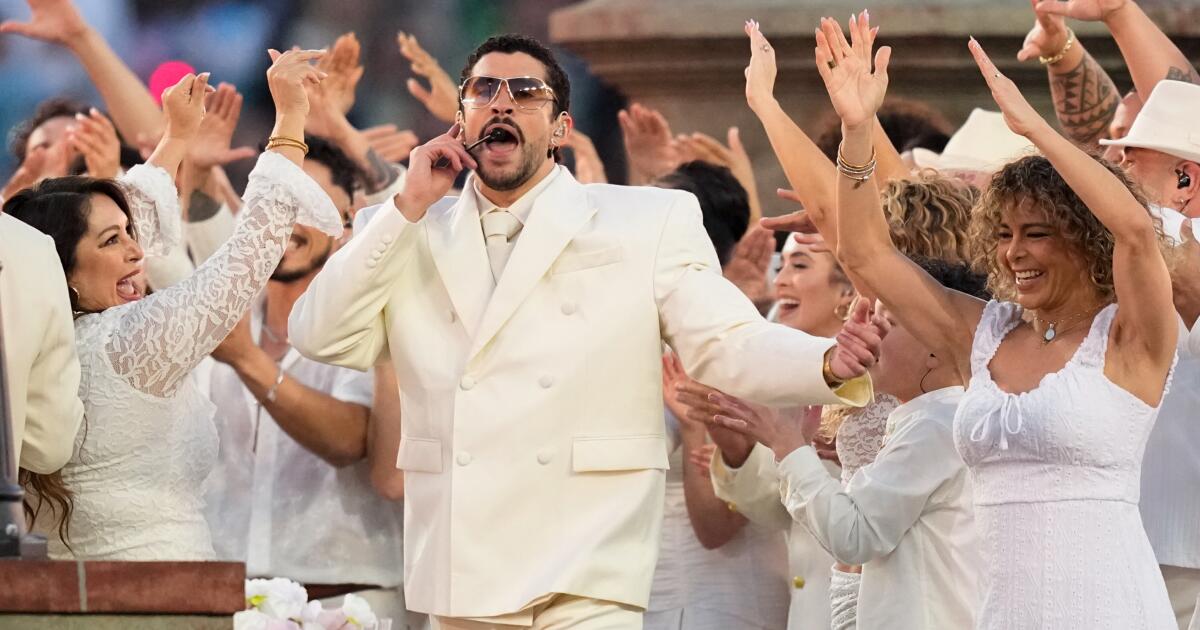
Thanks to Bad Bunny, it’s been a banner month for us Puerto Ricans.
Fresh off his historic Grammy win for Album of the Year – a first for a completely Spanish-language album – Bad Bunny delivered another groundbreaking performance at the Super Bowl halftime show on Sunday.
For Latinos in the U.S., achieving fair representation in Hollywood, politics, and music remains a challenge. Historically, Latin artists have been limited to stereotypical roles within the English-speaking American music scene. But Bad Bunny, representing Puerto Rico, broke through with his critically acclaimed 2025 album, “Debí Tirar Más Fotos.” He then used the Super Bowl – a stage typically reserved for displays of American pride – to highlight Puerto Rico and other nations throughout the Americas, offering a moment of celebration for communities often overlooked or criticized by U.S. conservatives.
Puerto Rico has a strong sports culture, especially in boxing and baseball. While American football isn’t usually popular there, everyone got excited when a team from Puerto Rico played in the Super Bowl. My parents watched from back home on the island, and my partner and I watched from our cold apartment in New York City, wishing we were in sunny Puerto Rico. But location didn’t matter – Puerto Ricans and Latinos everywhere were cheering together.

My Instagram feed was full of Puerto Ricans and other Latinos celebrating together, enjoying a much-needed moment of happiness during a difficult time when simply speaking Spanish or having brown skin can put you at risk of being targeted by ICE. I was lucky enough to see Bad Bunny perform in San Juan last August, and I knew his Super Bowl halftime show would be more than just a tribute to Puerto Rico. It felt like a powerful statement that no matter how much negativity is directed towards Latinos and immigrants, we will always be proud of who we are and where we come from.
Bad Bunny’s concert began with a powerful tribute to his roots. The stage at Levi’s Stadium was cleverly designed to look like a sugarcane field, likely referencing the first sugarcane refinery in his hometown of Vega Baja, Puerto Rico, which was built in 1873. The show opened with a guitarist dressed in traditional Puerto Rican jíbaro clothing – a straw hat and white linen shirt – who sang about the pride of being Latino, immediately connecting with audiences around the world.
As Bad Bunny began performing his 2022 hit song, “Titi Me Preguntó,” he led cameras through a temporary set designed to look like a sugar cane field, where dancers dressed as traditional Puerto Rican farmers, known as jíbaros, were performing. He was wearing a special all-white outfit, including a jersey with his mother’s last name, Ocasio, and the number 64—a nod to the number his uncle used to wear when he played football.
Bad Bunny’s concert featured scenes of everyday life in Puerto Rico, like a coconut stand, a shaved ice vendor, domino players, nail salons, and people from all walks of life – construction workers, jewelers, and more. These images highlighted that Puerto Rican music comes from the experiences of ordinary people, not just the wealthy.

Essay: Bad Bunny’s Super Bowl halftime show will be a history lesson for the ages
Historian Jorell A. Meléndez-Badillo believes Bad Bunny’s Super Bowl halftime performance could help address a lack of knowledge about Puerto Rico and its complex relationship with the United States.
The performance felt deeply connected to my Puerto Rican upbringing. Details like the dancers’ skirts, which echoed the traditional Taíno loincloths, and a set piece resembling Old San Juan’s lookout tower, instantly transported me home. Even the flickering lights reminded me of Puerto Rico’s sometimes unreliable power grid. During the mock wedding scene, I was particularly struck by a child falling asleep amidst the festivities – it was a scene I remembered all too well from my own childhood, longing for the party to end so I could finally go to bed.
As a huge fan, I always loved how he incorporated that amazing little house – the casita – into his shows, whether it was in Puerto Rico or on tour. And seeing it at the Super Bowl was incredible! It was packed with so many Latinx stars like Cardi B, Pedro Pascal, Jessica Alba, Karol G, Ronald Acuña Jr., and Young Miko. But what really got me was the New York City set they built around it – a real bodega, a barbershop, and even a spot modeled after Toñitas, that famous Caribbean club in Brooklyn. It felt so authentic and really celebrated our culture!
During his Super Bowl halftime show, Bad Bunny highlighted Toñitas, a beloved bar in New York City, both in his song “NUEVAYoL” and with a brief appearance by its owner, María Antonia “Toñita” Cay, who served him a drink. Toñitas has been a vital part of the Williamsburg neighborhood since the 1970s, representing a community’s fight against gentrification and providing a welcoming space for the Latine community as the area changes. For many Puerto Ricans living in New York, Bad Bunny’s tribute to Toñitas and to the diaspora felt especially meaningful, acknowledging those who maintain their Puerto Rican pride even when far from home.
This year’s Super Bowl performance was different from Bad Bunny’s first in 2020, when he appeared with Shakira and Jennifer Lopez. That show prominently featured Latinx artists, but this one had broader representation. Lady Gaga made a surprise appearance, performing a salsa version of her song “Die With a Smile” (originally with Bruno Mars) alongside the band Los Sobrinos. She also paid tribute to Puerto Rico by wearing a brooch featuring the Flor de Maga, the island’s national flower.

Although many fans might miss Bruno Mars, it makes sense why Bad Bunny invited Lady Gaga as his only non-Latinx performer. Bad Bunny has long admired Gaga, and both artists have consistently supported LGBTQ+ rights. Gaga clearly feels a strong connection with Bad Bunny, appreciating his dedication to fighting for equality and creating opportunities for those who are often overlooked, especially when facing opposition. After the Grammys, she praised Bad Bunny as an important voice speaking out for truth and justice.
Interestingly, the most impactful political moment of the halftime show didn’t come from Bad Bunny, but from fellow Puerto Rican star Ricky Martin.
I’ve been a fan of Ricky Martin for years, ever since his English hits like ‘Livin’ La Vida Loca’ and ‘She Bangs’ first came out. But seeing him perform Bad Bunny’s ‘Lo Que Le Pasó a Hawaii’ was something else. He wasn’t trying to be a rebel, but the song really hit home. He sang with so much feeling about the dangers facing Puerto Rico – how it could lose its culture, like Hawaii did when it became a state, with our beaches being taken over and our towns changing for the worse. It was a powerful moment, and it made me really think about protecting our heritage.
When Bad Bunny appeared carrying an older version of the Puerto Rican flag, it strongly boosted support for independence. This flag, a light blue shade, was originally designed to symbolize Puerto Rico’s freedom from Spain. However, after the island became a U.S. territory in 1898, the flag was banned until 1957.

As a film fan, I admit most Super Bowl viewers probably didn’t notice the light-blue flag, or fully grasp the meaning behind the emotional song about the struggles of being a colony. But for those of us from Puerto Rico watching, it was a powerful message: Puerto Rico is not for sale. It’s not just a place for outsiders to take advantage of, or a dumping ground, it’s a treasure we need to protect for future generations. And honestly, as a Puerto Rican, I don’t believe becoming a U.S. state is the way to do that.
As a U.S. territory, Puerto Rico’s residents can’t vote for president, yet they are still governed by the U.S. government. The island’s governor, Jenniffer González Colón, strongly supports President Trump and promotes conservative policies, including restrictions on gender-affirming care for young transgender people and a law defining personhood from the moment of conception. This creates frustration for many Puerto Ricans who feel unheard and stuck in a political system they didn’t choose.
As a lifelong movie and music fan, I was honestly a little disappointed to see the backlash when Bad Bunny was announced for the Super Bowl. It felt like some folks on Fox News and across social media were trying to decide who gets to be considered ‘American enough’ to perform, which struck me as pretty ridiculous. It completely overlooks the fact that the U.S. has had a presence in Puerto Rico for over a hundred years, and honestly, singing in Spanish doesn’t make Bad Bunny any less of a U.S. citizen. It felt like a really unnecessary debate.
As a huge music fan, I saw a lot of talk about the Super Bowl halftime show, and it was pretty clear who really won the ratings battle! While Turning Point USA put on their own show with Kid Rock and some other country artists, it only managed to get around 6.1 million viewers. That’s nothing compared to the massive 135 million people who watched Bad Bunny’s performance, at least according to the first numbers from NBC and CBS News. It just wasn’t close!

Commentary: The right’s answer to the Super Bowl halftime show is here. Bad Bunny has nothing to worry about
I heard Turning Point USA is trying to make a statement about Bad Bunny’s Super Bowl performance by putting on their own event at the same time. Honestly, it sounds like they’re hoping everyone will be… well, a little bored with what they offer instead. I’m definitely sticking with Bad Bunny, though!
Honestly, the most powerful moment of the entire show for me wasn’t a song, but when Bad Bunny just stopped and gave this incredible, heartfelt speech in Spanish. He was really speaking directly to the crowd, telling everyone to believe in themselves and understand their own value. It was unexpected, and it genuinely resonated – I think it moved a lot of people, myself included.
Speaking at Super Bowl 60, Benito Antonio Martínez Ocasio – known as Bad Bunny – encouraged everyone to believe in themselves. He shared, ‘I never stopped believing in myself, and you should too. You are more valuable than you think – truly believe that.’ He delivered this message in Spanish.
With the federal government increasingly detaining immigrants in facilities resembling detention camps – stripping them of their dignity after they’ve bravely sought a better life and worked hard to integrate – Bad Bunny’s Super Bowl performance felt like a powerful message of pride and resilience. The United States can’t continue to ignore the contributions and worth of Puerto Ricans and Latinos, and it’s time we demand to be recognized. We must embrace self-love and community, refusing to let hate and fear define us.
You know, Bad Bunny really hit the nail on the head during the Super Bowl halftime show. He said, and it truly resonated with me, that love is way more powerful than hate. It’s a simple message, but a really important one, especially right now.
2026-02-10 01:02