Author: Denis Avetisyan
New research reveals that even advanced AI-powered robots struggle to reliably perform simple physical tasks when faced with slight variations in their environment.
![Despite all BusyBox configurations being within the training data’s affordance distribution, the algorithms [latex]\pi_{0.5}\pi_{0.5}-canon[/latex] and GR00T-N1.6-canon demonstrated robust performance only with visually familiar canonical configurations, revealing a significant failure to generalize to even slightly altered, out-of-distribution visual arrangements of the same underlying affordances.](https://arxiv.org/html/2602.05441v1/figures/res_fully_s.jpeg)
A new physical benchmark, BusyBox, exposes the limitations of current vision-language-action models in generalizing affordances for robotic manipulation.
Despite advances in vision-language-action (VLA) models, robust generalization to novel environments remains a key challenge for robotic systems. This is addressed in ‘Benchmarking Affordance Generalization with BusyBox’, which introduces a new physical benchmark designed to systematically evaluate a robot’s ability to transfer learned affordances-like flipping switches or plugging in wires-across varying configurations. Empirical results demonstrate that even state-of-the-art open-weight VLAs struggle with this seemingly simple task of affordance generalization on the BusyBox platform. Will this benchmark spur the development of more adaptable and physically grounded robotic foundation models capable of truly versatile manipulation?
The Challenge of Generalization: A Fundamental Hurdle
Conventional robot learning methods frequently encounter difficulties when applying acquired skills to previously unseen environments or with novel objects, presenting a significant obstacle to widespread real-world implementation. These systems, often trained in highly controlled settings, struggle with even slight variations in lighting, surface textures, or object positioning-a phenomenon known as the reality gap. Consequently, a robot proficient at, for example, grasping a specific red block in a laboratory may fail entirely when presented with a blue block in a cluttered home environment. This lack of robust generalization necessitates either extensive retraining for each new scenario or the development of more adaptable learning algorithms capable of abstracting underlying principles of interaction rather than memorizing specific instances, highlighting a crucial area for continued research and innovation in robotics.
Current robotic learning assessments frequently prioritize performance on highly specific, isolated tasks, creating a skewed perception of progress towards genuinely versatile robots. These benchmarks often involve a limited set of objects, environments, and actions, failing to adequately test a robot’s ability to adapt to the unpredictable nature of real-world scenarios. Consequently, a robot might excel in a controlled laboratory setting, yet struggle with even slight variations in object shape, lighting conditions, or environmental clutter. This narrow focus hinders the development of robust and adaptable robotic systems, as it doesn’t truly measure the capacity for broader skill acquisition and transfer – a crucial requirement for deployment beyond carefully curated environments and a significant impediment to achieving true robotic autonomy.
The capacity for affordance generalization represents a significant hurdle in robot learning, as robots often struggle to apply previously learned interaction skills to novel objects. This isn’t simply about recognizing an object, but rather understanding how that object can be manipulated – can it be grasped, pushed, pulled, or used as support? Current approaches frequently rely on extensive training with specific instances, failing to equip robots with the ability to infer interaction possibilities from limited experience. A robot capable of affordance generalization wouldn’t need to ‘re-learn’ how to open every door; instead, it could leverage its understanding of grasping and rotational mechanics to successfully interact with a previously unseen door handle. Developing this capacity requires moving beyond purely visual recognition and incorporating principles of physics and embodied interaction, allowing robots to predict the outcomes of their actions and adapt to unexpected situations with unfamiliar objects.
![The BusyBox dataset of 1993 demonstrations, available at https://microsoft.github.io/BusyBox, is categorized by affordance, with tasks marked with [latex]*[/latex] requiring bimanual manipulation, though most benefit from close-range observation by both robot arm cameras.](https://arxiv.org/html/2602.05441v1/figures/task_category_pie_chart.png)
Introducing BusyBox: A Controlled Environment for Robust Evaluation
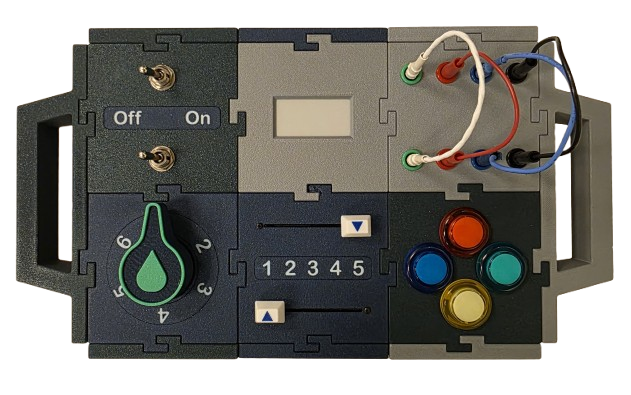
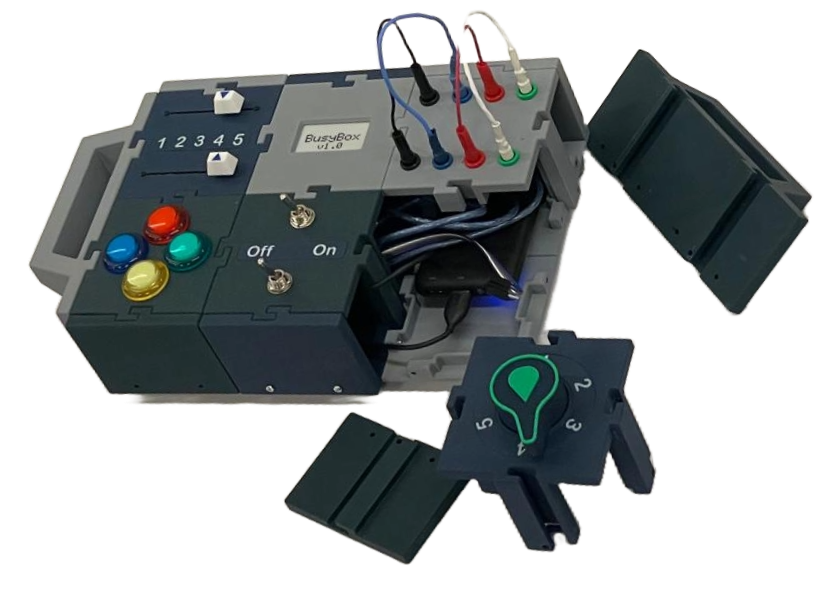
BusyBox is a 3D-printable benchmark platform developed to assess a robot’s capacity for generalization in manipulation tasks. The system utilizes a modular design, enabling researchers to construct numerous configurations from a standardized set of components. This allows for systematic evaluation of a robot’s performance across a range of object affordances and interaction types, moving beyond performance on a single, fixed task. By varying the arrangement and combination of modules, BusyBox presents a diverse and controllable test environment for assessing a robot’s ability to adapt to novel manipulation challenges and demonstrate robust performance beyond the training distribution.
BusyBox’s design incorporates a range of common mechanical components – specifically buttons, knobs, switches, and sliders – to enable systematic evaluation of affordance generalization in robotic manipulation. This modularity allows researchers to create numerous task variations by changing the arrangement and type of these components. By presenting a robot with familiar interactive elements in novel configurations, BusyBox assesses its capacity to transfer learned skills and apply them to previously unseen situations, effectively testing its understanding of object functionality beyond specific training examples. This controlled variation isolates the robot’s ability to generalize affordances rather than simply memorizing task sequences.
BusyBox’s configurable design enables a spectrum of testing scenarios, ranging from the Canonical BusyBox-where components are arranged in a standard, predictable layout-to the Fully-Shuffled BusyBox, which presents a randomized arrangement of all interactive elements. This progression allows researchers to systematically assess a robot’s ability to adapt to novel object placements and configurations. The variance between these configurations-and the intermediate arrangements achievable-provides a quantifiable metric for evaluating generalization performance, as successful manipulation requires identifying affordances irrespective of spatial arrangement. The ability to generate a large number of distinct, yet structurally similar, configurations creates a robust benchmark for evaluating a robot’s adaptability and resistance to overfitting on specific training scenarios.
A Dataset for Rigorous Validation of Vision-Language-Action Models
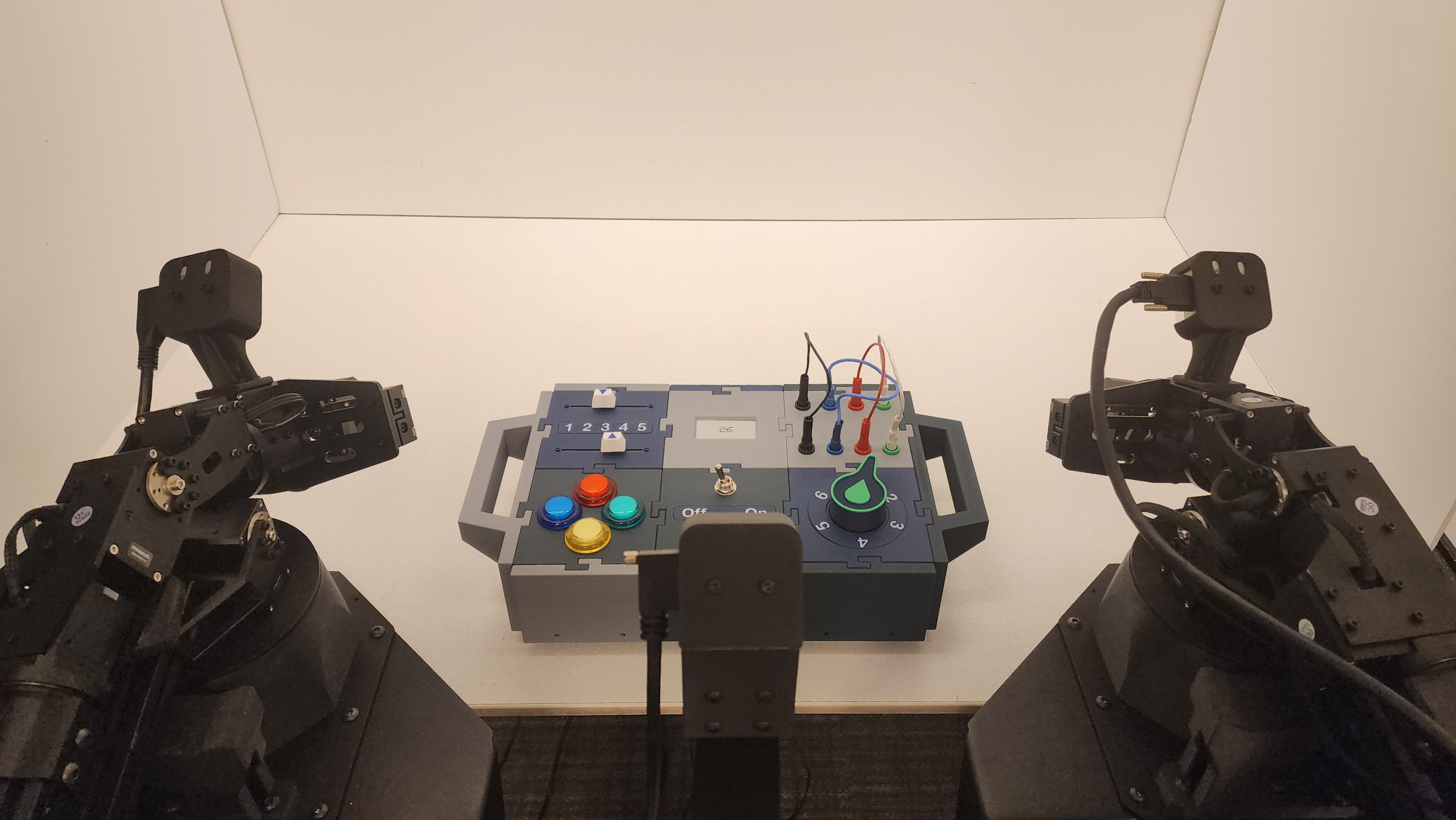
A dataset of nearly 2000 demonstration trajectories was compiled using the BusyBox environment and a teleoperation data collection method. Teleoperation involved a human operator remotely controlling the agent within the BusyBox simulation, and recording the resulting state transitions and actions. This approach yielded a substantial corpus of data representing successful task completion, which serves as the foundation for training and evaluating vision-language-action (VLA) models. The dataset captures a range of environmental variations and task configurations within BusyBox, providing a diverse training resource for improving agent generalization capabilities.
The collected dataset of nearly 2000 teleoperated trajectories in BusyBox serves as a critical resource for both the refinement and objective assessment of advanced Vision-Language-Action (VLA) models. Specifically, architectures such as π0.5 and GR00T-N1.6 are finetuned using this data to improve their ability to interpret visual input, natural language instructions, and subsequently execute appropriate actions within the simulated environment. Evaluation then leverages the dataset to quantify model performance, providing metrics on action accuracy and overall task completion rates. This process allows for comparative analysis between different VLA architectures and tracks iterative improvements as models are further developed and trained.
Despite utilizing sophisticated Vision-Language-Action (VLA) models, including π0.5 and GR00T-N1.6, performance on the standard BusyBox environment currently achieves a success rate of approximately 50-60%. This limited performance indicates significant difficulties in generalizing learned behaviors to unseen scenarios, even within a constrained simulated environment like BusyBox. The observed failure rate highlights the ongoing challenges in creating broadly applicable agents capable of robustly interpreting visual input, natural language instructions, and executing corresponding actions in complex, dynamic settings.
BusyBox in Context: A Complementary Approach to Robotic Benchmarking
BusyBox distinguishes itself within the robotics benchmarking ecosystem by concentrating on fundamental affordance generalization-the ability to apply learned skills to novel objects-and consequently presents a different challenge than more elaborate tests. Unlike benchmarks such as the Functional Manipulation Benchmark, FurnitureBench, and the NIST Task Boards, which prioritize complex, contact-rich manipulations or deformable object handling, BusyBox intentionally simplifies the interaction space. This focused approach allows researchers to isolate and efficiently evaluate the core capabilities of visual learning architectures, albeit within a constrained environment that doesn’t fully capture the breadth of real-world robotic challenges. The platform’s strength lies not in replicating the difficulty of these advanced benchmarks, but in offering a streamlined, controlled setting for rapid iteration and systematic analysis of foundational skills.
Robotics benchmarks such as the Functional Manipulation Benchmark, FurnitureBench, and NIST Task Boards distinguish themselves through a focus on intricate physical interactions and material properties. These evaluations routinely challenge robotic systems with tasks demanding precise contact handling – assembling structures, manipulating pliable objects like cloth or rope, and navigating scenarios involving significant friction or force exertion. By prioritizing these contact-rich and deformable object manipulations, these benchmarks deliver a more holistic assessment of a robot’s capabilities, extending beyond simple affordance generalization to encompass the complexities of real-world physical interaction and providing a rigorous test of dexterity, control, and perception.
BusyBox distinguishes itself not as a replacement for comprehensive robotic benchmarks, but as a valuable adjunct to them. The platform provides a uniquely controlled setting, enabling researchers to quickly design, test, and refine vision-language architectures (VLAs) without the complexities introduced by challenging contact dynamics or deformable objects. This streamlined environment facilitates systematic evaluation; subtle changes to a VLA can be isolated and their impact on performance rigorously assessed. Consequently, BusyBox accelerates the development cycle, allowing for rapid prototyping of new ideas before they are deployed on more demanding, real-world tasks, ultimately enriching the broader robotics evaluation landscape with focused and efficient testing capabilities.
The evaluation presented within the BusyBox benchmark highlights a critical gap between statistical performance and genuine understanding of physical interaction. Current vision-language-action models, despite achieving impressive results on datasets, falter when confronted with even minor variations in affordance execution – a testament to their reliance on correlation rather than causation. This echoes Henri Poincaré’s assertion: “Mathematics is the art of giving reasons.” The study demonstrates that simply ‘working on tests’ is insufficient; a truly robust system demands a provable understanding of the underlying physical principles governing actions, mirroring the mathematical discipline needed to ensure correctness. The benchmark reveals that these models lack this foundational rigor, demonstrating the need for algorithms grounded in a deeper, more mathematically sound understanding of affordances.
What’s Next?
The findings presented here, while perhaps unsurprising to those who value mathematical rigor over empirical demonstration, expose a fundamental fragility in current approaches to robotic intelligence. The seeming simplicity of affordance generalization – a task easily mastered by even rudimentary biological systems – belies the depth of the challenge when translated to silicon and code. That existing vision-language-action models falter on variations within the BusyBox benchmark suggests a reliance on spurious correlations rather than true understanding of physical principles. The pursuit of scaling parameters alone will not resolve this inherent weakness; elegance, and therefore robustness, demands a more principled foundation.
Future work must move beyond simply cataloging successes and failures on increasingly complex scenarios. A fruitful direction lies in formalizing affordances themselves, not as probabilistic associations, but as invariants within a dynamical system. The ability to prove that an action will achieve a desired outcome, independent of specific sensory input, represents a necessary – though admittedly ambitious – goal. Furthermore, a focus on modularity, as suggested by the platform itself, is not merely an engineering convenience, but a path toward compositional correctness.
Ultimately, the pursuit of robotic intelligence is not about replicating behavior, but about mirroring the underlying logical structure of the physical world. Until algorithms are judged not by what they do, but by why they do it, these systems will remain, at best, clever approximations of genuine understanding.
Original article: https://arxiv.org/pdf/2602.05441.pdf
Contact the author: https://www.linkedin.com/in/avetisyan/
2026-02-08 04:10