Author: Denis Avetisyan
A new study analyzing five decades of Swedish innovation reveals that direct collaborative ties are more crucial for success than network structure or shared expertise.
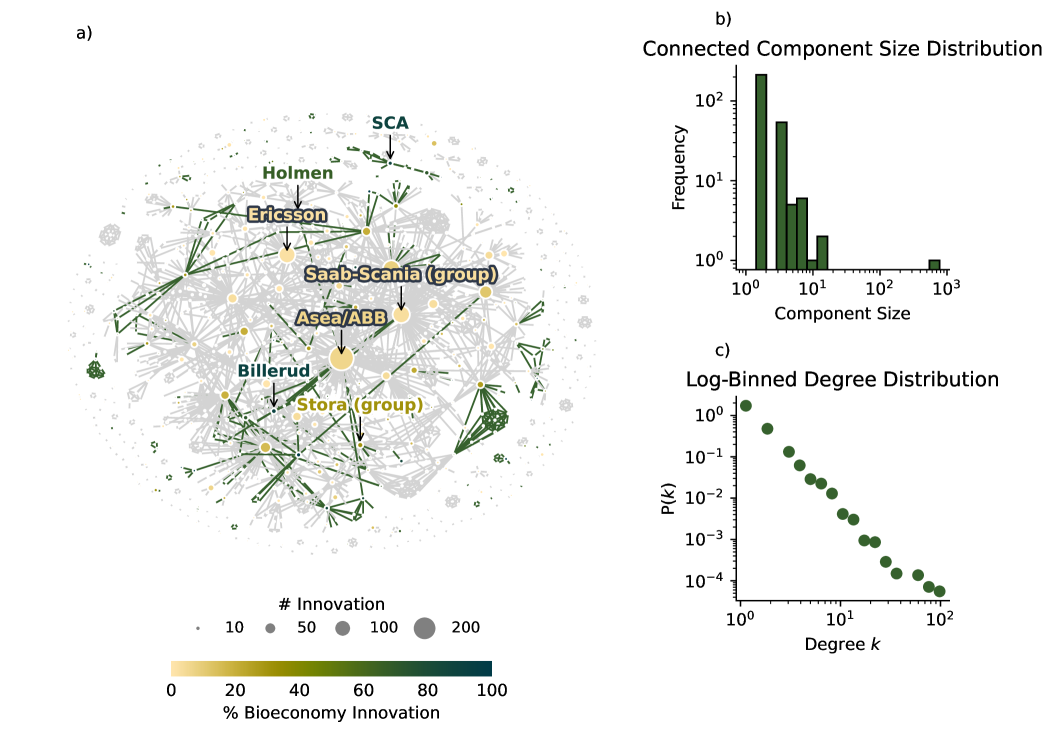
Research demonstrates that bioeconomy firms collaborate similarly to other industries, but produce less overall innovation, highlighting the importance of direct connections.
Despite widespread belief in the importance of tailored collaboration strategies, evidence linking specific network structures to innovation remains surprisingly limited. This study, ‘Collaboration for the Bioeconomy — Evidence from Innovation Output in Sweden, 1970-2021’, investigates the impact of collaborative networks on innovation using a longitudinal analysis of Swedish firms. Results demonstrate that while broader collaboration generally boosts innovation output, the composition of those ties-specifically, direct connections-proves more impactful than network brokerage or cognitive similarity, with no fundamental differences observed between bioeconomy and other innovating actors. Does this suggest that fostering widespread collaboration, rather than optimizing network configurations, offers the most effective path toward sustained innovation across all sectors?
Unveiling the Bioeconomy: Patterns of Innovation
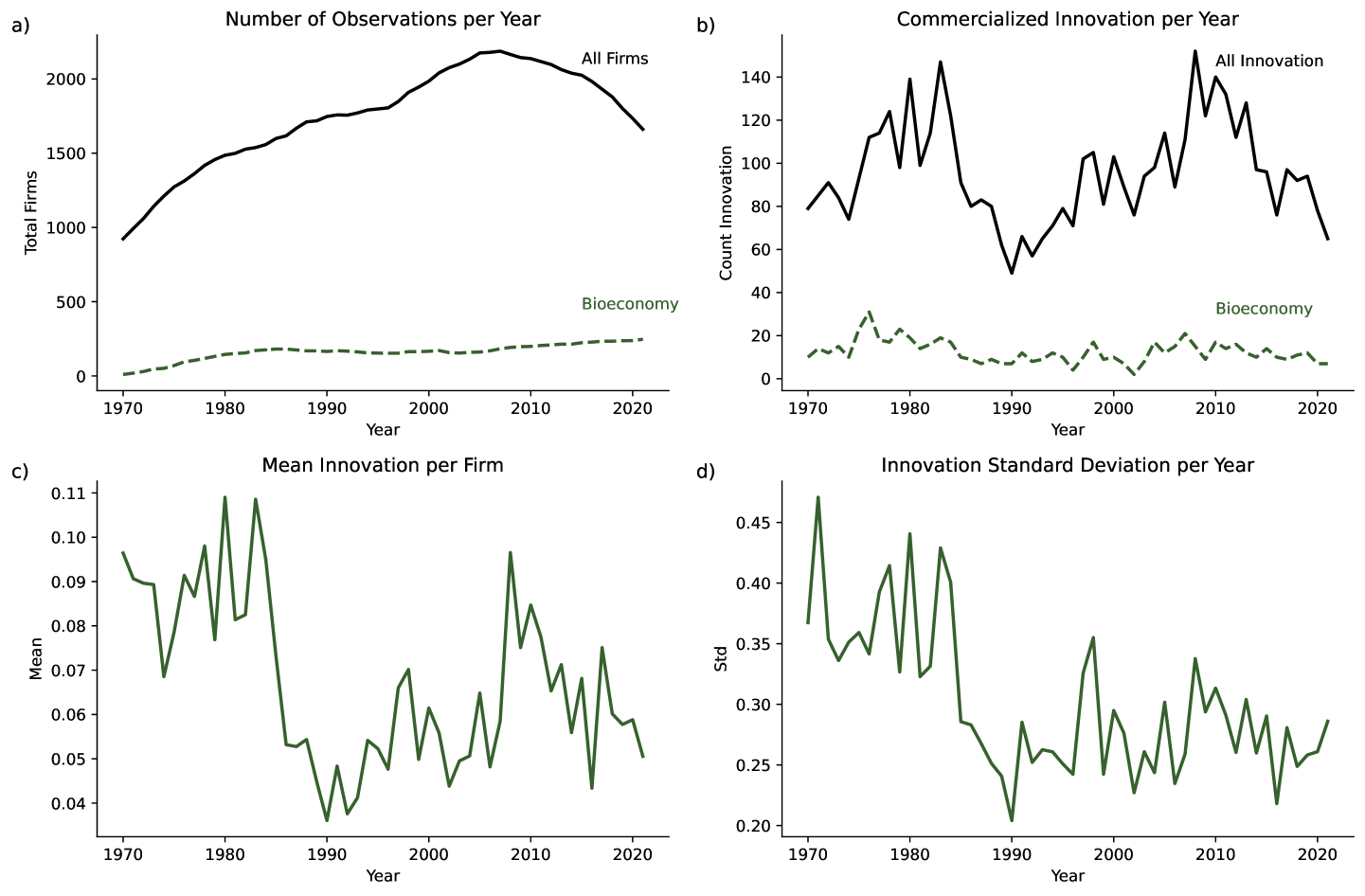
The world’s economic landscape is undergoing a significant transformation, increasingly driven by a ‘bioeconomy’ that prioritizes the use of renewable biological resources instead of fossil fuels. This shift isn’t merely conceptual; data reveals a concrete expansion, with innovations stemming from this sector demonstrably rising. Notably, the Forest-Based Bioeconomy – encompassing products and processes derived from trees and other forest resources – represents a substantial portion of this growth. Recent analyses indicate it contributes a significant 13.13% of total innovations tracked, accounting for 653 out of a total 4,972 innovations identified, highlighting the crucial role of sustainable forestry in the broader economic restructuring towards biologically-sourced materials and energy.
Assessing innovation within the burgeoning bioeconomy presents unique challenges that traditional metrics fail to capture. Relying solely on research and development (R&D) expenditure overlooks a significant portion of commercially viable advancements, particularly those arising from incremental improvements and applied research. This is because R&D spending doesn’t fully reflect the translation of scientific knowledge into marketable products or processes. Consequently, a shift towards more nuanced methodologies is essential; these should directly quantify outputs – such as new patents, novel products, and process improvements – rather than simply tracking financial investments. Robust evaluation requires approaches that capture the full innovation lifecycle, from initial discovery to successful commercialization, providing a more accurate representation of the bioeconomy’s dynamic growth and potential.
Tracking innovation within the burgeoning bioeconomy demands methods that move beyond simply measuring research and development spending. Literature-Based Innovation Output (LBIO) provides a compelling alternative, directly quantifying commercialized innovations by analyzing patterns within scientific publications. This approach identifies instances where academic research demonstrably translates into marketable products or processes – for example, a published method for biofuel production appearing in a patent application, or a novel biomaterial described in a research paper subsequently featured in a commercial product. By meticulously mapping these connections, LBIO offers a more immediate and verifiable measure of innovation than traditional indicators, allowing for a dynamic assessment of the bioeconomy’s progress and pinpointing areas where research investment is yielding tangible results. This method not only captures innovation occurring outside of large corporations – often missed by conventional metrics – but also provides a time-sensitive view of the innovation lifecycle, revealing how quickly research findings are being adopted and commercialized.
Networks of Collaboration: The Architecture of Innovation
Collaboration networks are fundamental to innovation processes, functioning through both direct relationships and indirect connections between organizations. A quantitative analysis of these networks reveals an average node degree of 2.41. This metric signifies that, on average, each firm within the studied network maintains 2.41 direct collaborative ties with other firms. These direct ties facilitate the immediate exchange of knowledge and resources, while indirect ties-connections through intermediary organizations-enable access to a broader range of information and expertise, contributing to increased innovative capacity. The degree of a node is a key indicator of a firm’s centrality and potential influence within the innovation ecosystem.
NetworkX is a Python package designed for the creation, manipulation, and study of the structure, dynamics, and functions of complex networks. It provides data structures for representing graphs, along with algorithms for analyzing network properties such as centrality, connectivity, and community structure. Utilizing NetworkX, researchers can construct network representations from datasets like the SWINNO Database, representing organizations as nodes and collaborative relationships as edges. The package supports various network formats for import and export, and offers functionalities for visualizing networks, allowing for the identification of key actors and patterns in information or resource flow. Its capabilities extend to simulating network evolution and performing statistical analysis on network data, facilitating a quantitative understanding of innovation ecosystems.
The SWINNO Database serves as the primary data source for analyzing innovation networks, providing detailed information on commercialized innovations from 2008 to 2022. This resource catalogues over 18,000 innovations and the collaborative relationships between the 3,388 unique firms involved in their development. Data points include information on the innovating firm, the location of innovation activity, the technological field, and the specific partners engaged in collaborative research and development. The database’s comprehensive nature allows for quantitative analysis of network topology, identification of key players, and assessment of the impact of collaboration on innovation outcomes. Data is sourced from patent records, financial databases, and firm-level reports, and is annually updated to ensure current accuracy.
Bridging Structural Gaps: The Role of Information Brokers
Collaboration networks often exhibit structural holes – gaps between otherwise unconnected groups of actors. Organizations positioned to bridge these gaps can function as information and control brokers. This brokerage role arises because information does not flow freely between disconnected groups, creating an opportunity for an intermediary to facilitate communication and exert influence. By connecting disparate clusters, these brokers gain access to diverse knowledge sources and can synthesize novel combinations, potentially leading to innovative outcomes. The existence of structural holes, therefore, presents a strategic advantage for organizations capable of establishing bridging ties and leveraging the resulting control over information flow within the network.
Two-Step Betweenness is a network metric used to identify organizations that function as information brokers by controlling access to non-redundant connections. Calculated as the sum, across all pairs of unconnected nodes in a network, of the proportion of shortest paths between those nodes that pass through a given actor, it quantifies the degree to which an organization lies on critical pathways for information transfer. A higher Two-Step Betweenness score indicates a greater capacity to connect disparate groups and, consequently, a stronger position for facilitating the flow of novel information. The metric differentiates brokerage roles beyond simple degree centrality, as it specifically assesses control over information that would not otherwise travel between those connected groups.
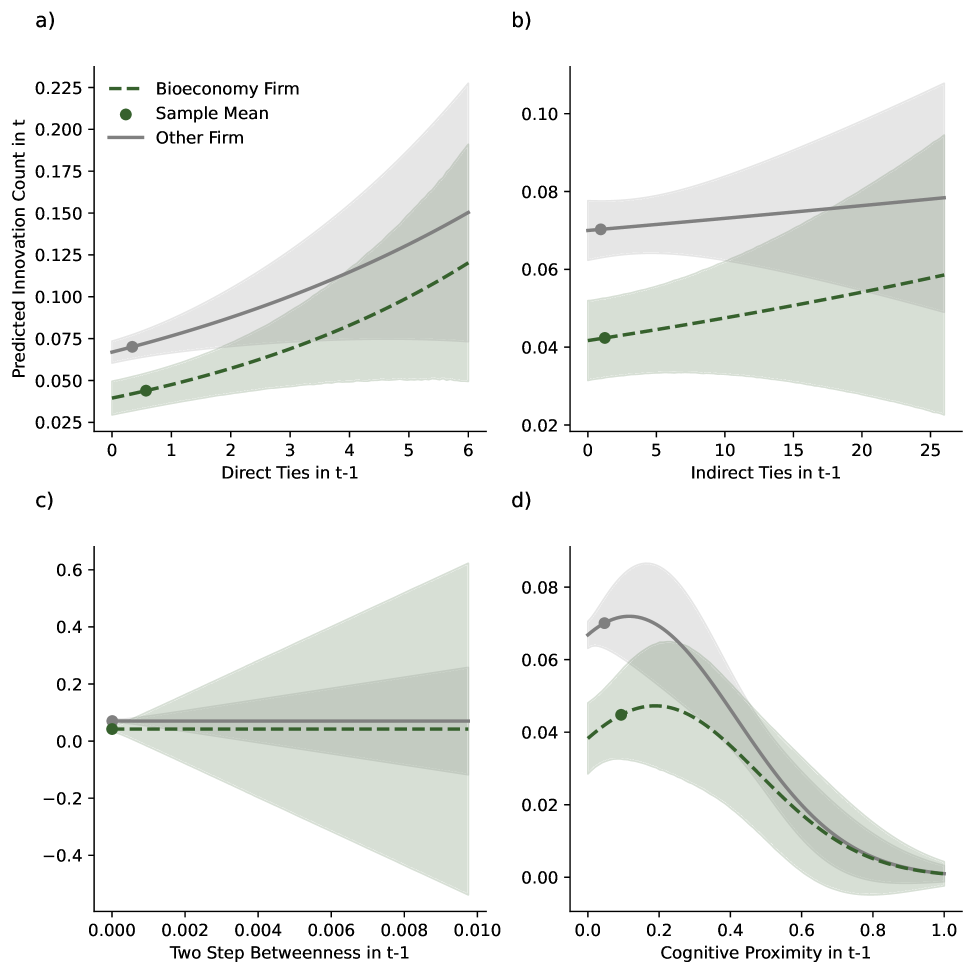
Statistical analysis conducted using Statsmodels reveals a positive correlation between a firm’s direct collaboration ties and its innovation output. Specifically, the model indicates that each additional direct collaborative relationship is associated with an increase of 0.010 in the firm’s predicted yearly innovation output, holding all other variables constant. This finding suggests that actively fostering and maintaining a network of direct collaborations can measurably contribute to a firm’s innovative capacity. The statistical significance and magnitude of this effect were determined through regression analysis, providing quantifiable evidence of the impact of network position on innovation performance.
The Nuances of Shared Knowledge: An Inverted-U Relationship
The success of collaborative innovation hinges significantly on cognitive proximity – the degree to which collaborating organizations share a common knowledge base. This shared understanding, encompassing similar expertise, experiences, and perspectives, acts as a crucial facilitator for effective knowledge transfer and combination. When organizations possess a substantial overlap in their cognitive frameworks, communication becomes streamlined, reducing the time and effort required to interpret information and coordinate activities. However, this isn’t a simple linear relationship; a complete lack of shared understanding can create insurmountable barriers to collaboration, while excessive similarity may stifle the introduction of novel ideas and perspectives. The level of cognitive proximity, therefore, represents a delicate balance that profoundly impacts the potential for generating truly innovative outcomes, making it a critical consideration for strategic alliances and research partnerships.
Research indicates that innovation doesn’t simply increase with shared knowledge; instead, an inverted-U relationship exists between cognitive proximity and innovative output. Initially, a moderate degree of overlap in knowledge bases between collaborating entities stimulates innovation, as it facilitates efficient communication and knowledge transfer. However, as cognitive proximity increases to encompass near-identical understandings, the potential for genuinely novel ideas diminishes, leading to incremental rather than breakthrough innovations. Conversely, extreme cognitive distance – where collaborators possess vastly different knowledge – also impedes innovation due to communication barriers and difficulties in integrating diverse perspectives. This suggests that a ‘sweet spot’ of moderate similarity, allowing for both efficient communication and the introduction of fresh ideas, is optimal for fostering impactful innovation.
Understanding the nuanced relationship between shared knowledge and innovation requires tools capable of revealing non-linear dynamics, and the Marginaleffects Python package provides precisely that capability. This package moves beyond simple linear correlations by allowing researchers and practitioners to visualize how the effect of cognitive proximity on innovation changes at different levels of similarity. By calculating and plotting marginal effects – the change in predicted innovation output for a unit change in cognitive proximity – Marginaleffects clearly demonstrates the Inverted-U relationship, pinpointing the optimal level of similarity for maximizing inventive outcomes. This detailed visualization is invaluable for policymakers aiming to foster collaborative environments and for innovation managers seeking to strategically assemble teams with the right balance of shared knowledge and diverse perspectives, ultimately enabling data-driven decisions regarding knowledge sharing and organizational partnerships.
Scaling Innovation Studies: Efficient Data Handling for Complex Networks
The burgeoning field of innovation studies increasingly relies on the analysis of expansive collaboration networks and associated datasets, demanding computational tools capable of managing and processing information at scale. Traditional data analysis methods often struggle with the volume, velocity, and variety characteristic of these networks, hindering the extraction of meaningful insights. Efficient data handling isn’t merely a technical necessity; it’s a fundamental prerequisite for uncovering patterns in co-authorship, patent citations, and funding allocations. Without streamlined processing, researchers risk being overwhelmed by data, losing the ability to identify key influencers, track the diffusion of knowledge, or assess the impact of collaborative efforts. Consequently, the development and implementation of optimized computational workflows are critical for accelerating discovery and fostering a deeper understanding of innovation ecosystems.
Polars represents a significant advancement in data manipulation, offering a performant alternative to traditional DataFrame libraries. Implemented in Rust, a systems programming language known for its speed and memory safety, Polars leverages modern hardware capabilities – including multi-core processing and SIMD instructions – to achieve remarkable processing speeds. Unlike Python-based solutions which often encounter performance bottlenecks due to the Global Interpreter Lock (GIL), Polars is designed for parallelism from the ground up, enabling it to efficiently handle large-scale datasets common in collaboration network and innovation studies. This speed isn’t achieved at the cost of functionality; Polars provides a comprehensive API for data filtering, aggregation, and transformation, making it a powerful tool for researchers seeking to extract meaningful insights from complex data with minimal computational overhead.
The confluence of sophisticated analytical methods and high-performance data processing is proving critical to understanding the complexities of innovation. Researchers are increasingly able to move beyond descriptive statistics, employing network analysis, machine learning, and computational modeling to dissect the relationships between collaborators, ideas, and ultimately, economic outcomes. This capability hinges on tools that can efficiently manage and manipulate massive datasets – previously a significant bottleneck. By streamlining data handling, these tools allow for more iterative exploration, the testing of complex hypotheses, and the identification of subtle patterns that drive progress. Consequently, a deeper understanding of innovation’s underlying mechanisms becomes possible, enabling evidence-based strategies for fostering sustainable economic growth and addressing global challenges.
The study’s findings regarding the primacy of direct ties in fostering innovation echo a sentiment articulated centuries ago by Galileo Galilei: “You can know a man who knows physics, but very few ever know physics itself.” This research demonstrates that simply being connected isn’t sufficient; the nature of those connections – direct engagement and knowledge transfer – is critical. While network structure and cognitive proximity receive considerable attention, the analysis reveals these factors are less impactful than establishing strong, immediate collaborative links. It underscores that understanding the mechanisms of knowledge exchange, rather than merely mapping the network, is paramount to driving innovation, even within specialized fields like the bioeconomy where overall output may differ.
Where Do We Go From Here?
The apparent simplicity of the findings-direct ties matter more than network topology, and the bioeconomy isn’t a special case-is, perhaps, the most unsettling result. It suggests a level of predictability in innovation that runs counter to much of the rhetoric surrounding disruptive technologies. The data indicate that simply having connections is more influential than how those connections are arranged, a realization that should prompt reconsideration of the resources devoted to elaborate network-building exercises. One could posit that the focus on network structure has been a solution searching for a problem.
Future work must address the stubborn issue of low overall innovation output within the bioeconomy sector. The present study identifies a difference in degree, not in kind, but the reason for this lower output remains elusive. Is it a function of regulatory hurdles, capital access, or a more fundamental disconnect between research agendas and market demands? Disentangling these factors requires a more granular examination of innovation processes within bioeconomy firms, moving beyond aggregated output metrics.
Finally, the temporal scope of this study-spanning five decades-highlights the inherent challenges of tracking innovation. The very definition of “innovation” shifts over time, and the metrics used to measure it are invariably imperfect. A truly comprehensive understanding will necessitate longitudinal studies that incorporate qualitative data, capturing the nuances of knowledge creation and diffusion. The pursuit of patterns, it seems, is a perpetually unfinished task.
Original article: https://arxiv.org/pdf/2602.05112.pdf
Contact the author: https://www.linkedin.com/in/avetisyan/
2026-02-07 12:52