Author: Denis Avetisyan
A new framework combines the power of artificial intelligence with agent-based modeling to create more accurate and scalable simulations of dynamic systems.
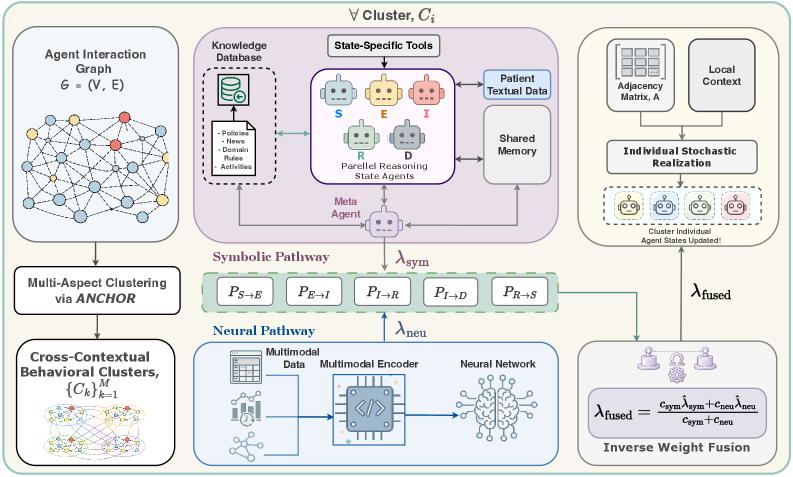
PhysicsAgentABM leverages neuro-symbolic AI and cluster analysis to shift inference from individual agents to adaptive groupings, improving uncertainty quantification and population dynamics modeling.
Scaling expressive agent-based modeling often presents a trade-off between individual-level fidelity and computational tractability. This limitation motivates PhysicsAgentABM: Physics-Guided Generative Agent-Based Modeling, a novel framework that decouples population-level inference from entity-level variability through neuro-symbolic fusion and adaptive clustering. By shifting computation to behaviorally coherent agent groups-specialized in state transitions and guided by large language models-PhysicsAgentABM achieves both improved calibration and significant reductions in computational cost. Could this paradigm shift unlock more accurate and scalable simulations of complex systems across diverse domains, from public health to financial markets?
Scaling is the Enemy: The Limits of Traditional Agent-Based Models
Agent-based models, while powerful tools for simulating complex systems, frequently encounter limitations when scaling to large populations. As the number of interacting agents increases, the computational demands grow exponentially, quickly creating bottlenecks that hinder analysis and model runtime. This isn’t merely a matter of processing power; the intricate web of interactions also obscures the identification of genuine emergent behaviors. The sheer volume of data generated can overwhelm attempts to discern meaningful patterns from random noise, making it difficult to validate model outputs or draw robust conclusions about the system being studied. Consequently, traditional ABMs often struggle to accurately represent systems where collective phenomena arise from the interactions of numerous, diverse entities, prompting researchers to explore alternative modeling approaches.
The limitations of traditional agent-based modeling often stem from an overemphasis on individual interactions, obscuring the profound impact of collective dynamics. While meticulously detailing how each agent behaves in isolation, these models frequently fail to adequately represent the spontaneous formation of clusters, groups, or networks within a population. These emergent groupings aren’t simply the sum of individual behaviors; instead, they exhibit unique properties and influence the overall system in ways that are impossible to predict by examining agents in isolation. The tendency of agents to self-organize into meaningful clusters – driven by factors like shared traits, proximity, or common goals – creates feedback loops and amplifies certain behaviors, fundamentally reshaping the dynamics of the system and demanding modeling approaches that prioritize these collective phenomena.
Beyond Brute Force: Neuro-Symbolic Fusion for Generative ABM
PhysicsAgentABM employs a hierarchical framework to enhance Generative Agent-Based Models (GABM) by combining the strengths of both symbolic reasoning and neural network capabilities. This integration moves beyond traditional GABMs which often rely solely on large language models. The framework utilizes neural networks to learn complex, data-driven relationships within the modeled environment, while symbolic reasoning provides a structured approach to incorporate pre-existing knowledge, rules, and constraints. This combined approach allows for a more efficient and robust simulation of agent behavior, as the symbolic component guides the neural network’s learning and inference processes, and vice versa.
The PhysicsAgentABM framework implements cluster-level inference as a key optimization strategy, moving beyond individual agent reasoning common in traditional Generative Agent-Based Models (GABMs). This hierarchical approach enables the model to process and make decisions based on aggregated groups of agents, rather than evaluating each agent independently. Benchmarking demonstrates a significant performance improvement, with the cluster-level inference architecture achieving up to a 7.5x speedup compared to flat Large Language Model (LLM)-based GABMs. This computational efficiency is critical for scaling simulations to larger agent populations and more complex scenarios.
The PhysicsAgentABM framework utilizes a dual-mechanism approach to enhance generative agent-based modeling. Neural networks within the architecture are employed to discern complex relationships and patterns directly from input data, enabling the model to adapt and generalize based on observed information. Complementing this, symbolic reasoning provides a means of incorporating pre-existing knowledge and defined constraints into the modeling process. This integration not only improves the accuracy and reliability of the generated simulations but also substantially reduces computational demands; specifically, token usage is decreased by a factor of 2.9x compared to models relying solely on large language models.
![Evaluating variants of the [latex]ANCHOR[/latex] model reveals that its full configuration achieves optimal performance across clustering separability, structural coherence, and behavioral motif coherence, while removing key components-motifs, contrastive alignment, or boundary optimization-results in systematically inferior performance.](https://arxiv.org/html/2602.06030v1/x9.png)
Embracing Uncertainty: Modeling State Transitions at Scale
PhysicsAgentABM incorporates Uncertainty Modeling to address the probabilistic nature of both agent actions and environmental influences within a simulation. This is achieved by assigning probability distributions to agent behaviors and environmental parameters, rather than relying on deterministic values. Consequently, repeated simulations with identical initial conditions will yield varied outcomes, reflecting the inherent randomness present in real-world complex systems. The framework supports various probability distributions – including normal, uniform, and custom distributions – to accurately represent the specific uncertainties associated with each modeled element. This approach allows for the quantification of risk and the exploration of potential scenarios, providing a more robust and realistic representation than deterministic agent-based models.
PhysicsAgentABM incorporates explicit modeling of State Transition and Transition Hazard to provide detailed analysis of agent behavioral changes. State Transition refers to the movement of an agent between defined states – for example, from ‘healthy’ to ‘infected’ in an epidemiological model – and is governed by probabilistic rules. Transition Hazard quantifies the probability or rate at which an agent will undergo a specific state transition, influenced by internal agent characteristics and external environmental factors. By explicitly defining both the transitions and their associated hazards, the framework allows for the investigation of how various factors impact the likelihood and timing of state changes within the modeled system, enabling a more granular understanding of agent dynamics and system-level outcomes.
PhysicsAgentABM leverages Graph Neural Networks (GNNs) to represent relationships between agents and facilitate information propagation, improving the capture of emergent behaviors within the modeled system. This approach offers a significant efficiency gain over flat Language Model (LLM)-based Agent-Based Models (GABMs), achieving a 6.7x reduction in required API calls. By encoding agent interactions as a graph structure, the GNN allows for localized computation and message passing, minimizing the need for repeated queries to a central language model for each agent’s decision-making process. This reduction in API calls translates directly to lower computational costs and improved scalability for large-scale simulations.
![A physics-based agent-based model ([latex]PhysicsAgentABM[/latex]) accurately captures Singapore’s COVID-19 recovery dynamics following the Circuit Breaker, exhibiting a tightly coupled decline in infections and accelerated recovery unlike neural network, large language model, or rule-based baselines which showed delayed or underestimated recovery rates (95% predictive intervals shaded).](https://arxiv.org/html/2602.06030v1/x10.png)
From Simulation to Insight: Applications and Implications
Epidemiological modeling benefits significantly from this framework’s ability to represent the nuanced interplay between individual actions and broader population trends. Accurate disease spread prediction isn’t simply a matter of tracking infection rates; it demands a detailed account of how people interact, their susceptibility, and the environmental conditions that influence transmission. This approach allows researchers to move beyond simplified assumptions and create simulations that realistically capture the heterogeneity of real-world populations and their surroundings. By simulating these complex interactions, the framework provides a more robust and reliable means of forecasting outbreaks, evaluating intervention strategies, and ultimately, mitigating the impact of infectious diseases – a crucial capability in an increasingly interconnected world.
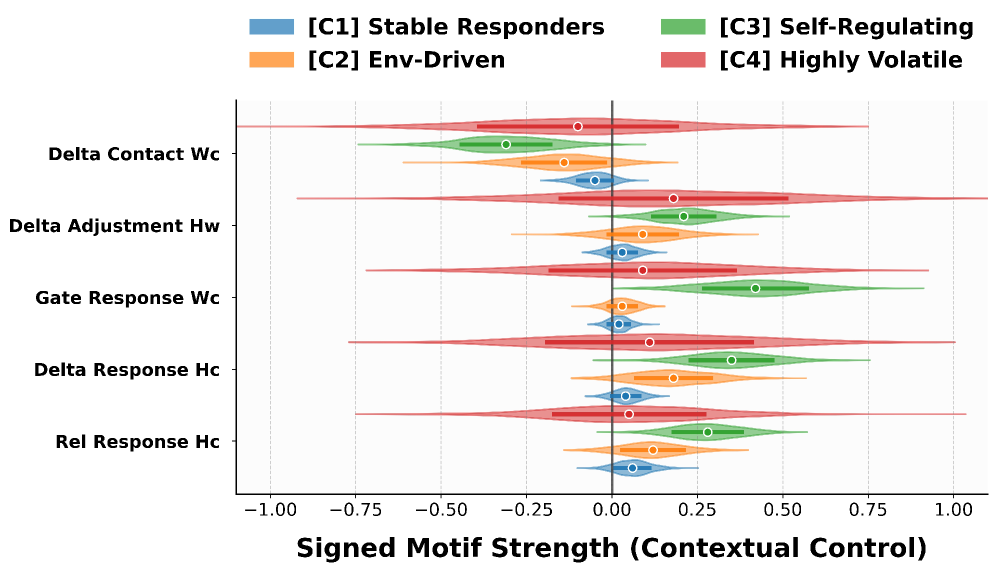
ANCHOR represents a novel approach to enhancing the fidelity of complex system simulations through a clustering mechanism driven by large language models. This system leverages ‘Contextual Abstraction’, a process where the LLM-agent intelligently identifies and prioritizes the most relevant features within a simulation, effectively filtering out inconsequential details. Rather than attempting to model every variable, ANCHOR focuses computational resources on the factors that demonstrably influence system behavior, streamlining simulations and improving their accuracy. This selective approach not only reduces computational burden but also mitigates the risk of noise and spurious correlations, allowing for more robust and reliable predictions of emergent phenomena within complex systems.
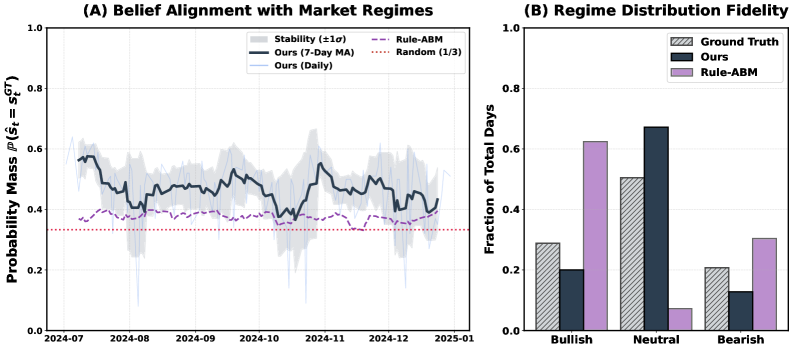
PhysicsAgentABM offers a significant advancement in the study of complex systems by effectively connecting the actions of individual agents to emergent, population-level behaviors. This innovative framework moves beyond traditional modeling approaches, providing a nuanced understanding of how microscopic interactions give rise to macroscopic phenomena. Rigorous evaluation, utilizing metrics such as Expectation Calibration Error (ECE) and Brier Scores, demonstrates the framework’s robust probabilistic reliability; consistently low scores indicate highly accurate predictions even in the face of inherent system uncertainty. Consequently, PhysicsAgentABM is not merely a simulation tool, but a powerful predictive engine capable of informing decision-making and offering actionable insights across a diverse range of disciplines, from social science and economics to ecology and epidemiology.
The pursuit of elegant simulation, as PhysicsAgentABM demonstrates, invariably encounters the messiness of production. This framework’s shift from individual agent inference to adaptive clusters is a pragmatic concession – a recognition that scalable modeling requires sacrificing some theoretical purity. It’s a beautiful attempt to tame chaos, yet one should anticipate the inevitable emergence of unexpected behaviors within those clusters. As Grace Hopper once observed, “It’s easier to ask forgiveness than it is to get permission.” This sentiment resonates; PhysicsAgentABM doesn’t solve complexity, it manages it, accepting that the bug tracker-the record of emergent, unforeseen consequences-will always be compiling. The framework doesn’t deploy-it lets go, and prepares for impact.
What’s Next?
The shift from individual agent inference to cluster analysis, as proposed by PhysicsAgentABM, feels less like a solution and more like a carefully managed demotion of complexity. It acknowledges a fundamental truth: detailed simulation eventually collapses under its own weight. The elegance of neuro-symbolic integration will, predictably, encounter the brutal reality of production data – messy, incomplete, and cheerfully inconsistent. Expect to spend considerable effort coaxing these clusters into behaving as intended, a task that will inevitably resemble herding cats with a statistical model.
Uncertainty quantification, while laudable, will become the dominant maintenance activity. The framework’s success hinges on defining meaningful cluster behavior. What constitutes “adaptive”? How do these emergent properties scale to genuinely complex systems? These are not theoretical hurdles; they are the practical limitations that will define the next generation of agent-based modeling. One anticipates a proliferation of bespoke metrics designed to mask the underlying chaos, a familiar pattern in the field.
Ultimately, PhysicsAgentABM is a promising step toward accepting that perfect simulation is an illusion. The real challenge isn’t building more detailed models; it’s building models that fail gracefully. This framework doesn’t solve population dynamics; it buys some time before the inevitable need to rebuild the entire thing. And that, in this field, is a victory.
Original article: https://arxiv.org/pdf/2602.06030.pdf
Contact the author: https://www.linkedin.com/in/avetisyan/
2026-02-06 18:30