Author: Denis Avetisyan
A new approach to artificial intelligence focuses on agents that autonomously adapt and refine their capabilities in response to changing environments.
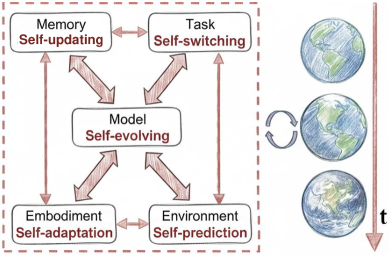
This review explores the emerging field of self-evolving embodied AI, detailing systems capable of continual learning and autonomous improvement of perception, memory, and physical embodiment.
Current embodied artificial intelligence systems struggle with real-world dynamism, relying on pre-programmed responses to static environments. This limitation motivates the exploration of a new paradigm, detailed in ‘Self-evolving Embodied AI’, which proposes agents capable of autonomous adaptation through continual self-improvement of memory, task prioritization, environmental prediction, physical embodiment, and internal models. This approach enables agents to learn and interact with complex environments in a human-like manner, potentially unlocking truly general artificial intelligence. Could this framework pave the way for robust, adaptable AI systems capable of thriving in unpredictable, open-world scenarios?
The Limitations of Pre-Programmed Intelligence
Conventional artificial intelligence systems frequently operate within the boundaries of their initial programming, exhibiting limited capacity when confronted with scenarios not explicitly accounted for during development. These systems, reliant on predefined configurations and algorithms, essentially extrapolate from existing data rather than genuinely understanding the underlying principles governing a situation; consequently, performance degrades rapidly when encountering genuinely novel inputs or unexpected conditions. This inflexibility stems from the fact that traditional AI excels at optimizing within known parameters, but lacks the capacity for flexible reasoning or creative problem-solving required to navigate truly unpredictable environments. The result is a dependence on continuous human intervention to recalibrate settings or provide additional training data, ultimately restricting the potential for true autonomy and hindering widespread applicability in dynamic, real-world contexts.
The efficacy of many artificial intelligence systems is unexpectedly limited by their dependence on meticulously crafted, human-defined parameters. These systems, while capable within their programmed boundaries, often falter when confronted with environments exhibiting even slight deviations from their training data or anticipated conditions. This reliance on pre-set configurations prevents genuine adaptability; the AI cannot independently refine its responses to unforeseen circumstances or learn from novel experiences in real-time. Consequently, achieving true autonomy – the ability to operate effectively and make decisions without constant human intervention – remains a significant challenge, as performance is inherently constrained by the foresight, and therefore the limitations, of its creators.
The rigid nature of traditionally programmed artificial intelligence presents a significant obstacle to solving complex, real-world challenges that demand ongoing adaptation. These systems, while proficient within their specifically defined parameters, falter when confronted with scenarios outside of their initial training or pre-set configurations. This limitation isn’t merely a matter of improving algorithms; it represents a fundamental bottleneck in achieving true autonomy and widespread applicability. Consider tasks like autonomous navigation in unpredictable urban environments, or personalized medicine requiring constant evaluation of evolving patient data-these necessitate a capacity for continuous learning that pre-programmed AI simply lacks. Without the ability to independently refine its understanding and responses based on new experiences, the system’s performance plateaus, ultimately hindering its effectiveness and requiring constant human intervention to maintain functionality.
Self-Evolving Embodied AI: A Paradigm Shift in Adaptation
Self-Evolving Embodied AI establishes a system wherein artificial agents possess the capacity to independently modify their internal representations of the world and, consequently, their behavioral patterns. This autonomous refinement is not limited to parameter adjustments within a fixed model; instead, the framework allows for alterations to the model’s architecture itself, encompassing both the selection of appropriate algorithms and the optimization strategies employed. The core principle involves continuous adaptation driven by the agent’s interactions with its environment, enabling it to improve performance and navigate novel situations without explicit reprogramming or external intervention. This contrasts with traditional AI systems which typically rely on pre-defined models and require manual updates to address changing conditions.
Model Self-Evolution (MSE) facilitates autonomous adaptation in AI agents by dynamically modifying both the neural network architecture and the optimization algorithms used during training. This process extends beyond traditional hyperparameter tuning; MSE allows for alterations to network depth, layer types, and connectivity, as well as the selection and modification of optimization methods like stochastic gradient descent variants or evolutionary strategies. The capability to adjust these components enables agents to respond to changing environments or task requirements without requiring manual intervention or pre-defined adaptation schedules, potentially leading to more robust and efficient learning in complex scenarios.
This research introduces a novel approach to continually adaptive intelligence by utilizing Large Language Models (LLMs) as a core architectural component. LLMs provide the foundational reasoning and learning capabilities necessary for self-evolving agents, enabling them to not only process information but also to dynamically adjust their internal models and behavioral strategies. This leverages the LLM’s pre-trained knowledge and generalization abilities to accelerate the adaptation process and improve performance in complex, changing environments, moving beyond traditional reactive or pre-programmed AI systems. The LLM serves as the central ‘brain’ for the agent, interpreting sensory input, formulating plans, and guiding the self-evolution mechanisms.
Mechanisms of Continuous Adaptation: The Foundations of Self-Evolution
Environment self-prediction utilizes world models to enable agents to forecast subsequent environmental states based on current observations and actions. These internal models, often learned through experience, allow the agent to simulate potential outcomes without direct interaction with the environment. This predictive capability facilitates proactive behavior; rather than reacting to stimuli, the agent can anticipate future needs or challenges and adjust its actions accordingly to optimize performance or avoid negative consequences. The accuracy of this prediction is directly correlated to the fidelity of the world model and the agent’s ability to accurately extrapolate from learned patterns, enabling more efficient and robust decision-making in dynamic environments.
Memory self-updating is a core mechanism enabling continual learning in autonomous agents. This process involves the non-uniform treatment of past experiences, prioritizing the retention of information critical for future performance while actively discarding redundant or detrimental data. Selective retention is achieved through mechanisms assessing the predictive value or novelty of experiences, often employing metrics like prediction error or information gain. Revision occurs via techniques such as replay buffer prioritization or experience re-weighting, modifying existing memories to improve generalization. Discarding involves pruning less relevant experiences to constrain memory usage and prevent negative transfer, ultimately optimizing the efficiency and effectiveness of the learning process.
Embodiment Self-Adaptation refers to an agent’s capacity to maintain performance despite alterations to its physical characteristics or operational capabilities. This mechanism involves continuous monitoring of internal states – such as actuator efficiency, sensor calibration, or structural integrity – and subsequent adjustments to control policies or kinematic configurations. By dynamically recalibrating its actions to account for degradation, damage, or environmental effects on its body, the agent exhibits increased robustness and resilience. This contrasts with traditional robotic control which assumes static embodiment and requires explicit re-programming for even minor physical changes, representing a shift towards continual adaptation and autonomous self-maintenance in complex environments.
Real-World Impact: The Potential of Self-Evolving Intelligence
The convergence of self-evolving artificial intelligence with robotics promises transformative advancements across multiple sectors, particularly in the realms of autonomous unmanned aerial vehicles (UAVs), self-driving cars, and service robotics. These technologies, currently limited by their reliance on pre-programmed responses and labeled datasets, stand to gain significantly from systems capable of continuous learning and adaptation in real-world scenarios. Instead of requiring explicit re-programming for novel situations, these robots will be able to refine their decision-making processes through interaction with the environment, improving performance and robustness over time. This paradigm shift will enable UAVs to navigate increasingly complex airspace, autonomous vehicles to handle unpredictable traffic conditions, and service robots to provide more effective and personalized assistance – all without constant human intervention or the need for extensive, manually curated training data.
The capacity for artificial intelligence to learn and adapt within complex, unstructured environments represents a significant leap toward genuine autonomy. Unlike traditionally programmed systems reliant on pre-defined rules, this self-evolving AI paradigm allows agents – be they drones navigating unpredictable weather or robots assisting in dynamic hospital settings – to refine their performance through experience. This isn’t simply about reacting to known stimuli, but about building internal models of the world and proactively adjusting strategies to overcome unforeseen challenges. Consequently, tasks previously requiring constant human oversight, such as navigating cluttered warehouses or providing in-home care, become viable for fully independent operation, promising increased efficiency, reduced costs, and expanded capabilities across numerous sectors.
The advent of continually adaptive intelligence promises a transformative shift across multiple critical sectors. Logistics and transportation stand to gain through self-optimizing delivery routes and predictive maintenance for autonomous vehicles, minimizing delays and maximizing efficiency. In healthcare, this technology could power robotic surgery assistants capable of learning from each procedure, enhancing precision and patient outcomes. Perhaps most crucially, disaster response will benefit from AI agents that can independently assess damage, locate survivors, and coordinate rescue efforts in rapidly changing and unpredictable environments – all without requiring constant human intervention. This isn’t simply about automation; it’s about creating systems capable of evolving their strategies and skills in real-time, offering a level of resilience and adaptability previously unattainable in artificially intelligent systems.
The pursuit of self-evolving embodied AI, as detailed in this work, demands a rigorous adherence to foundational principles. It mirrors a mathematical elegance where each adaptation is a logical deduction from the agent’s interaction with its environment. Tim Berners-Lee aptly stated, “The web is more a social creation than a technical one.” This echoes the core concept of continual learning; the AI’s ‘world model’ isn’t pre-defined but emerges through ongoing interaction-a social construct of data and experience. Redundancy in the agent’s architecture is an abstraction leak, hindering the purity of its evolutionary process. The agent’s ability to refine its perception, embodiment, and memory represents a search for the most concise and provable solution, a testament to elegant algorithmic design.
What’s Next?
The pursuit of self-evolving embodied AI, as outlined in this work, reveals not a destination, but an infinite regress. The capacity for autonomous adaptation, while conceptually elegant, merely shifts the burden of complexity. The fidelity of world models, the very foundation of this self-improvement, remains stubbornly tethered to the initial conditions – the ‘seed’ of human design. To claim true evolution necessitates a severing of this tether, a move toward agents capable of not just learning within a defined space, but of redefining that space itself.
A critical limitation lies in the evaluation of ‘improvement’. Current metrics, invariably human-defined, impose an external judgment upon a system ostensibly designed for autonomy. The question is not whether an agent performs a task ‘better’, but whether its internal representation of reality – however alien – is consistently refined through interaction. The emphasis must shift from performance benchmarks to the demonstrable consistency of its internal logic, a provable convergence toward an internally consistent worldview.
In the chaos of data, only mathematical discipline endures. The future of embodied AI does not reside in ever-more-complex algorithms, but in the rigorous formalization of agency itself. The challenge is not to build machines that mimic intelligence, but to create systems whose very existence is a testament to the power of logical necessity. Only then will the pursuit of self-evolution yield something more than a sophisticated echo of its creators.
Original article: https://arxiv.org/pdf/2602.04411.pdf
Contact the author: https://www.linkedin.com/in/avetisyan/
2026-02-05 10:15