Author: Denis Avetisyan
New research shows artificial intelligence can generate burger recipes that satisfy human palates while prioritizing sustainability and nutrition.
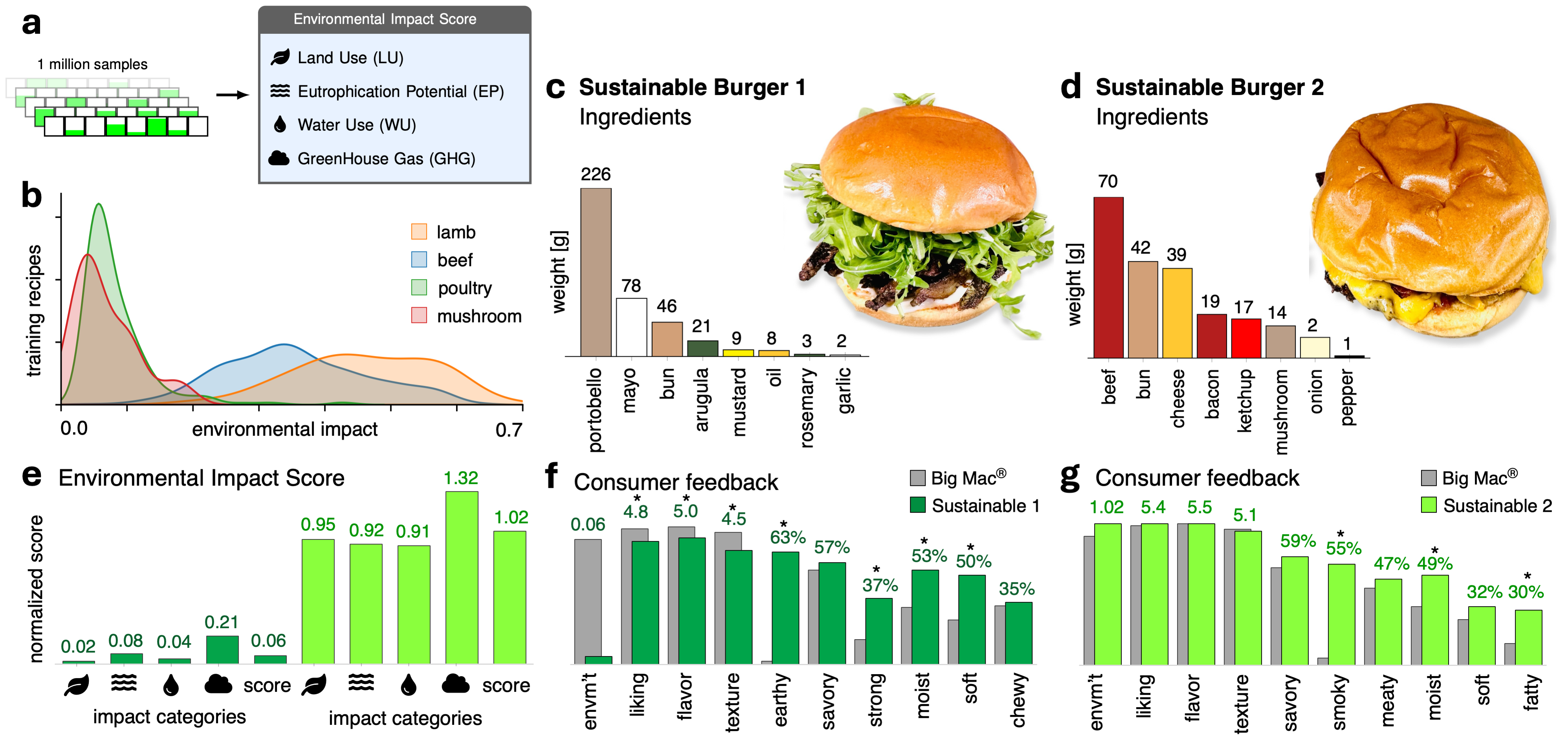
Generative AI models successfully optimize food formulations for taste, environmental impact, and dietary value.
Balancing palatability, nutrition, and environmental impact remains a fundamental challenge in food design. This is addressed in ‘Generative Artificial Intelligence creates delicious, sustainable, and nutritious burgers’, which demonstrates that generative AI can learn human taste preferences directly from recipe data to formulate novel foods. The research successfully generated burger recipes-optimized for deliciousness, sustainability, or nutrition-that achieved comparable or superior sensory scores to a classic Big Mac, significantly reduced environmental impact, and boosted nutritional value in blinded evaluations. Could this approach unlock a new era of principled food design, proactively addressing both human and planetary health?
The Inevitable Recipe: Beyond Inefficient Experimentation
Historically, crafting a new burger recipe has been a remarkably inefficient process, frequently demanding significant time and financial investment. The conventional methodology typically involves chefs or food scientists manually experimenting with a relatively small selection of ingredients, a limiting factor that stifles innovation and often fails to deliver truly optimal results. This painstaking trial-and-error approach not only extends development timelines but also incurs substantial costs associated with ingredient sourcing, preparation, and sensory evaluation. Consequently, the potential for discovering novel and superior burger combinations remains largely untapped, hindering the industry’s ability to respond effectively to evolving consumer preferences for both taste and health.
Conventional burger recipe creation frequently prioritizes taste above all else, often resulting in products high in saturated fats, sodium, and processed ingredients. This approach neglects the increasing consumer demand for foods that not only satisfy the palate but also contribute to overall health and minimize environmental impact. Current methods struggle to simultaneously optimize for these competing objectives; a truly balanced recipe requires careful consideration of nutritional profiles, sourcing of ingredients, land and water usage, and greenhouse gas emissions – factors traditionally treated as secondary to flavor and cost. Consequently, achieving a burger that is both delicious, genuinely nutritious, and ecologically responsible presents a significant challenge, necessitating innovative strategies that move beyond simple ingredient substitution and embrace a holistic, data-driven approach to recipe development.
Current burger innovation often plateaus due to the sheer complexity of ingredient interactions and the limitations of trial-and-error formulation. Researchers are now applying data science to systematically explore the immense possibilities within burger recipes, moving beyond conventional approaches. This involves computationally modeling flavor profiles, nutritional content, and environmental impacts-from sourcing to production-of countless ingredient combinations. Preliminary results demonstrate the potential to dramatically improve burger sustainability, achieving over a tenfold reduction in environmental footprint, while simultaneously maximizing nutritional value, with Healthy Eating Index scores approaching a 100% increase. This data-driven methodology promises not only tastier, healthier burgers, but also a pathway toward a more responsible and efficient food system.
![A generative AI successfully created nutritious and personalized burgers, optimizing for healthy eating indices [latex] (unsaturated and saturated fats, nutrients) [/latex], environmental impact, and consumer preference, as demonstrated by recipes exceeding the nutritional profile of a Big Mac® and receiving positive feedback.](https://arxiv.org/html/2602.03092v1/fig4b.png)
The Algorithmic Kitchen: A Generative Descent into Flavor
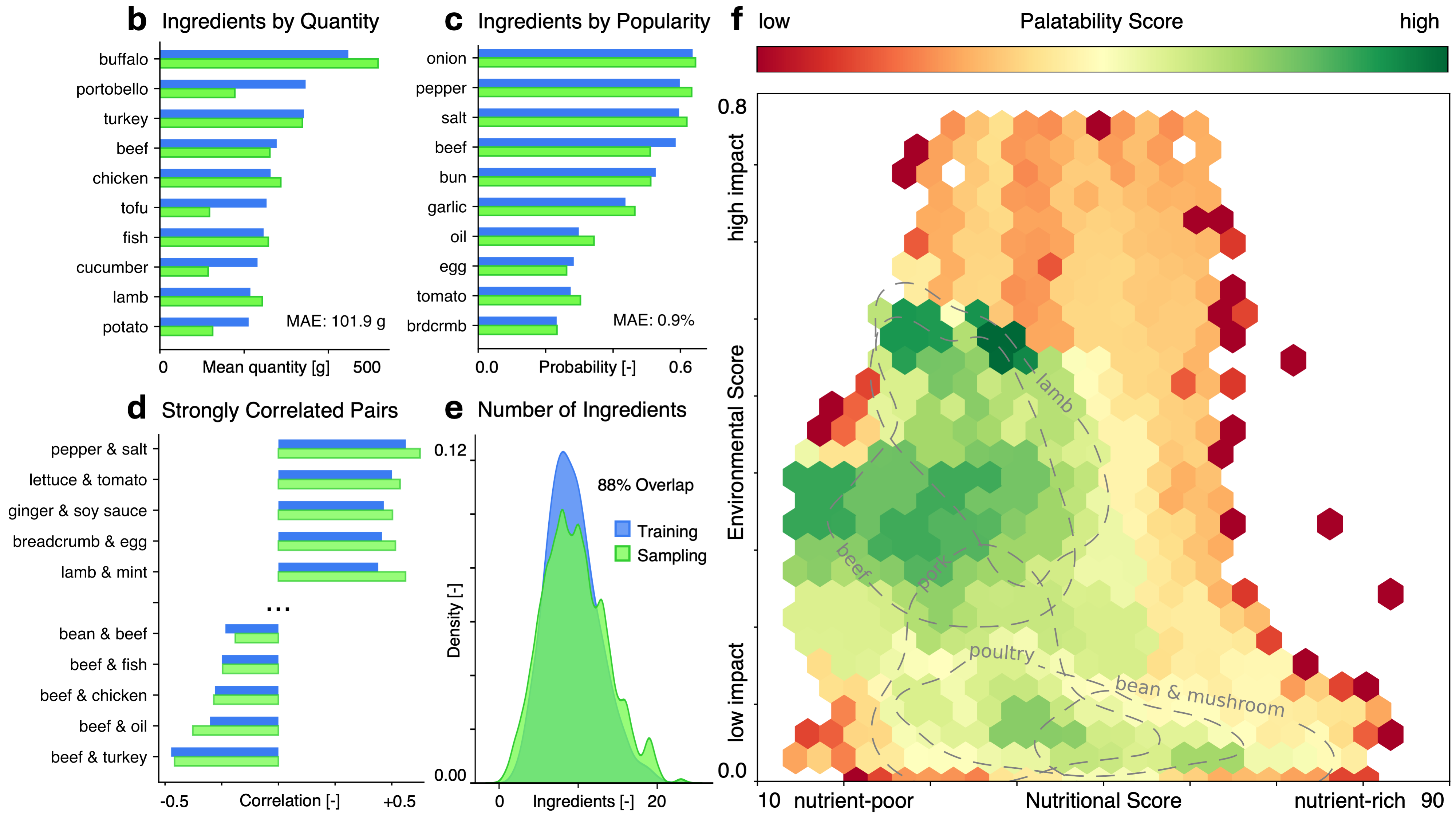
The recipe generation system utilizes Generative AI, specifically diffusion models, to synthesize novel burger recipes. These models operate by learning the underlying statistical relationships within a dataset of existing recipes. Rather than relying on predefined rules, the system identifies patterns in ingredient pairings and quantities, then generates new recipes that adhere to these learned regularities. The diffusion process begins with random noise and iteratively refines it into a coherent recipe, guided by the statistical distribution of the training data. This approach allows for the creation of diverse and potentially innovative burger combinations, while maintaining a level of realism derived from the established culinary norms present in the training set.
The recipe generation system utilizes two distinct generative models operating sequentially. A Multinomial Diffusion Model is first employed to select ingredients for a burger recipe. Following ingredient selection, a Score-Based Generative Model then predicts the quantity, in grams, of each selected ingredient. Combined, these models achieve an average absolute error of 101.9 g when predicting ingredient quantities across a test dataset, indicating the overall precision of the quantity estimation component after ingredient choices are made by the diffusion model.
The recipe generation process incorporates principles of Ingredient Co-occurrence to produce plausible and palatable burger combinations. This is achieved by statistically analyzing a large dataset of existing recipes to identify frequently paired ingredients; the AI prioritizes these pairings during new recipe creation. Quantitative evaluation demonstrates a high degree of accuracy in ingredient selection, with the model exhibiting a maximum absolute error of less than 1% when choosing which ingredients to include in a recipe, indicating a strong correlation between the AI’s selections and established culinary norms.
The Empirical Palate: From Algorithm to Appetite
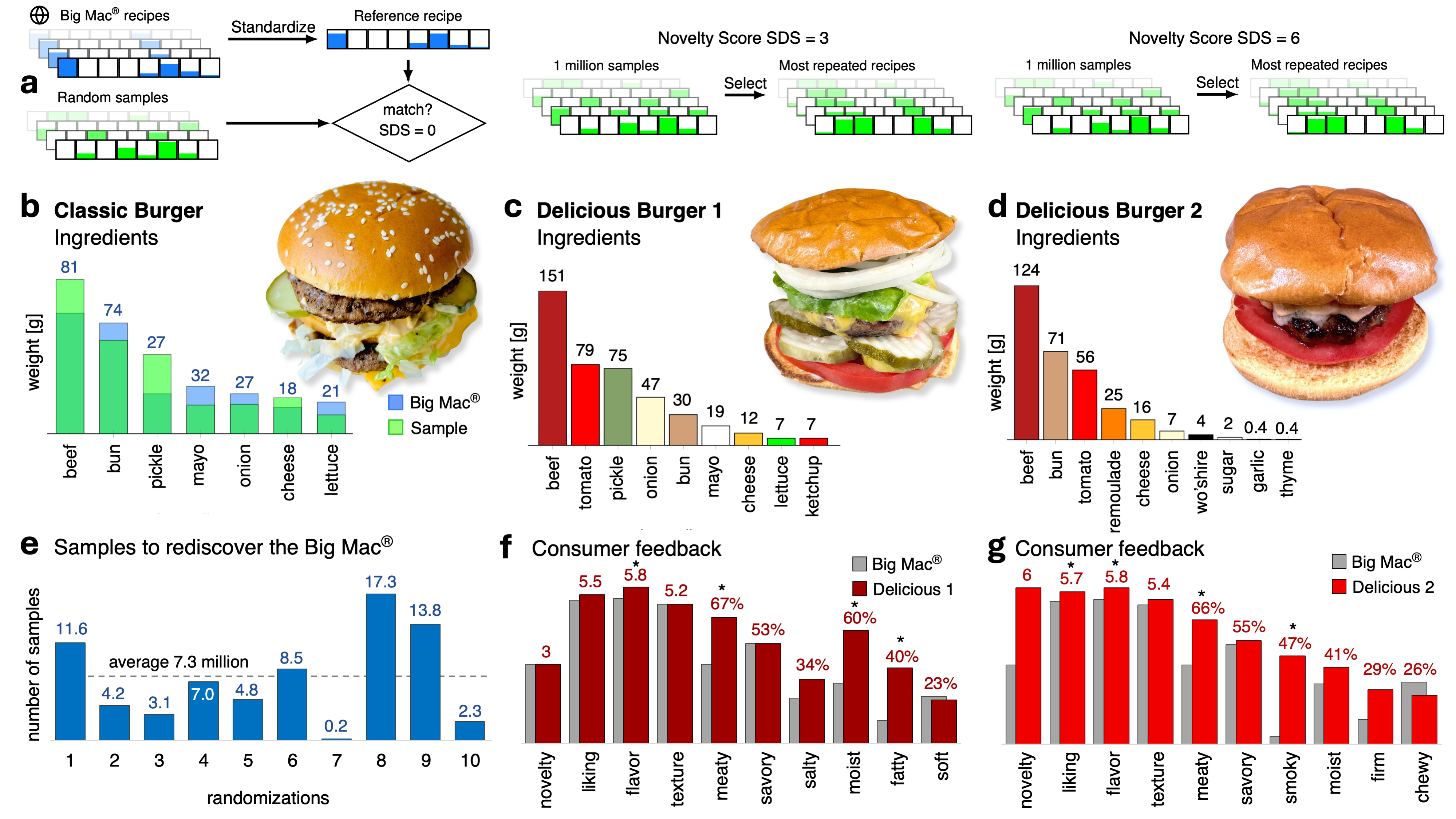
The generated recipes undergo quantitative evaluation via a Substantial Difference Score (SDS) which measures the dissimilarity between a generated recipe and known recipes, effectively balancing novelty and relevance. An SDS of 0 indicates complete replication of an existing recipe; demonstrating the system’s capability, the Big Mac® was successfully rediscovered within random sample generations, achieving the expected SDS of 0. This metric allows for the systematic assessment of recipe originality while ensuring generated outputs remain within the bounds of culinary plausibility and recognizable flavor profiles.
Sensory validation is a critical phase in recipe assessment, employing human taste testing panels to evaluate palatability and identify promising candidates for further development. These panels are composed of individuals representing the target demographic and are tasked with objectively scoring recipes based on attributes such as taste, texture, and overall appeal. Data collected from these evaluations provides crucial feedback on the subjective qualities of generated recipes, complementing algorithmic metrics and ensuring that novel formulations are not only computationally interesting but also genuinely enjoyable for consumers. Recipes exceeding pre-defined palatability thresholds are then prioritized for subsequent nutritional analysis and potential commercial viability assessments.
Nutritional quality of generated recipes is quantitatively assessed using the Healthy Eating Index (HEI), resulting in an average score of 63.12. This metric considers components of a healthy diet, providing a standardized evaluation of nutritional value. Comparative analysis demonstrates this score is nearly double that of the Big Mac® (HEI = 33.71), indicating the generated recipes, as a population, exhibit significantly improved nutritional profiles based on established dietary guidelines.
Beyond Consumption: A System of Sustainable Nourishment
A comprehensive Life Cycle Assessment forms the cornerstone of this system’s sustainability focus, meticulously quantifying the environmental impact of each burger recipe from ingredient sourcing to disposal. This detailed analysis considers factors like greenhouse gas emissions, land use, and water consumption, resulting in an impressively low Environmental Impact Score of 0.06. To provide context, this score is demonstrably more than one order of magnitude lower than that of a widely consumed fast-food item, the Big Mac®, which registers a score of 0.93. By utilizing this rigorous assessment, the system effectively minimizes the ecological footprint associated with each meal, promoting a significantly more responsible and sustainable approach to food production and consumption.
The pursuit of truly sustainable food systems demands a holistic approach, moving beyond simple production efficiency to encompass both human health and planetary wellbeing. This work demonstrates a commitment to that principle by actively minimizing the environmental impact of food choices while simultaneously maximizing nutritional benefit. Through careful recipe optimization, a synergistic relationship is established where reduced carbon footprints, water usage, and land degradation coincide with enhanced vitamin and mineral intake. This integrated strategy not only lessens the strain on Earth’s resources but also empowers individuals to make informed decisions that support both personal wellness and a more responsible, resilient food future – a future where dietary choices actively contribute to ecological balance.
The system’s architecture readily accommodates personalized nutrition, moving beyond generalized dietary recommendations to create burger recipes specifically tailored to an individual’s needs and preferences. Utilizing data on allergies, sensitivities, health goals, and even taste profiles, the platform can dynamically adjust ingredient selection and portion sizes. This level of customization isn’t simply about excluding ingredients; it actively optimizes the nutritional composition of the burger – increasing protein for athletes, reducing sodium for individuals with hypertension, or incorporating specific micronutrients based on identified deficiencies. By leveraging algorithmic precision, the platform envisions a future where fast food isn’t just convenient, but a proactively beneficial component of a personalized wellness strategy.
The pursuit of optimized burger recipes, as detailed in this research, isn’t about control-it’s about accepting the inherent complexity of taste and sustainability. The system doesn’t build a perfect burger; it cultivates a space where palatable, nutritious, and sustainable options emerge. This echoes a fundamental principle: stability is merely an illusion that caches well. Generative AI, in this instance, isn’t providing guarantees of perfect flavor or environmental impact-a guarantee is just a contract with probability-but rather navigating the probabilistic landscape of culinary possibilities. As Brian Kernighan observed, “Debugging is twice as hard as writing the code in the first place. Therefore, if you write the code as cleverly as possible, you are, by definition, not smart enough to debug it.” This applies to food formulation too; chasing absolute perfection often overlooks the robustness found in emergent, iterative design.
What’s Next?
The creation of a palatable, sustainable burger via generative artificial intelligence is less a solution and more a beautifully rendered postponement of inevitable complexity. The system, in essence, doesn’t solve food formulation; it externalizes the cost of preference – and limitation – into algorithmic space. Future iterations will undoubtedly refine the predictive models, chasing ever-narrower definitions of ‘deliciousness’ and ‘nutrition’. However, the true challenge lies not in optimizing existing parameters, but in acknowledging their inherent instability. Taste evolves. Resources shift. What constitutes ‘sustainable’ today will be measured against different metrics tomorrow.
The pursuit of algorithmic gastronomy reveals a fundamental truth: architecture is how one postpones chaos. This work illuminates the fault lines within the system it seeks to improve. The current models operate within a closed loop of known ingredients and defined preferences. The next phase will require grappling with the unpredictable – the emergent flavors, the novel proteins, the unforeseen consequences of large-scale adoption. There are no best practices – only survivors, and those who adapt quickest to the cascading failures of prediction.
Ultimately, this research isn’t about creating the perfect burger. It’s about building a more sensitive instrument for measuring the dynamic tension between desire and constraint. Order, after all, is just cache between two outages. The system will, inevitably, break down. The question is not if, but how – and what new, unanticipated flavors will emerge from the wreckage.
Original article: https://arxiv.org/pdf/2602.03092.pdf
Contact the author: https://www.linkedin.com/in/avetisyan/
2026-02-04 14:11