
There was a lot of excitement in the air just before Saturday’s fifth annual Beehive Block Party began, which was fitting considering the event’s name.
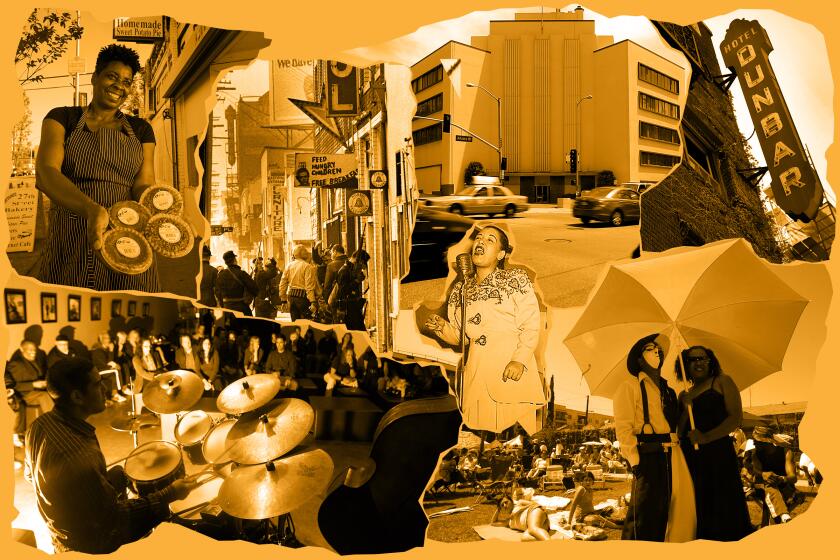
The Beehive’s large courtyard in South Los Angeles was bustling with activity as vendors set up stalls selling food, art, and used clothes. Many young people attended, sporting custom white T-shirts featuring the festival’s vintage-inspired artwork. Jack McGrail and Aiyana Da’Briel, the leaders of the SoLa Live Accelerator program that organized the event, were busy greeting attendees and managing details.
Entertainment & Arts
Located in South Los Angeles, The Beehive is a Black-owned community space that hosts popular events such as Black Market Flea and gatherings by Everyday People. It also supports local young people with access to technology and training.
I recently had the chance to speak with Audrey Ohwobete and Gladis Verenice Ramírez Veliz, two incredibly driven UCLA students – and the masterminds behind the fantastic event at SoLa Live. They were so enthusiastic, and it’s clear they poured months of hard work into curating the entire experience, all while working out of the SoLa Technology and Entrepreneurship Center. It was inspiring to hear about their dedication.
The design choices, even the colors – things like orange and blue meant to evoke a sunset feeling – were carefully considered. As a group of nineteen people, we combined our ideas to make this happen, and it felt incredibly fast. It was like everything came together in an instant; one moment you’re starting, and the next, it’s finished.”
The entire 2026 Beehive Block Party, from the performances by wst cmplx, Veritus Miller, and headliner Navy Blue, was organized by young people from South L.A. These talented individuals, aged 16 to 22, are part of the SoLa Live Accelerator program and are hoping to build careers in live entertainment.

This program is a collaboration between SoLa Foundation, a nonprofit connected to the affordable housing and investment firm SoLa Impact, and Live Nation, a major entertainment company. SoLa Foundation also offers other programs for young people, like a tech center and a scholarship opportunity.
Launched in 2022 as a short trial run, the live entertainment accelerator has evolved into a comprehensive six-month program. Each week features talks by industry experts from Live Nation, and it all leads up to a yearly community block party.
I learned from Sherri Francois, the head of SoLa Foundation, that this partnership started after a discussion she had with Live Nation’s CEO, Michael Rapino. They were talking about how few artists of color there are compared to the lack of diversity among leaders working in the music industry.
Francois explained that a donor learned about their program—which helps young people from disadvantaged communities, many of whom are Black or Latino—and remarked, ‘We’re not finding enough qualified candidates.’

Live Nation doesn’t release information about diversity within its workforce. However, a 2021 study from USC Annenberg showed that at live music and concert companies, only 12.5% of senior managers were people of color – despite these groups making up 40% of the U.S. population. Notably, less than 1% of those senior managers were Black. While the study has since broadened its focus, recent findings indicate that people of color now hold 16.7% of senior management roles at major music companies overall.
The SoLa Live Accelerator helps students explore various careers in live events. Each week, an industry expert shares insights into a different part of putting on a show – like booking performers, marketing the event, or managing the venue and tickets. Students then apply what they learn to plan their own festival.
The program doesn’t stop after completion for many participants. Live Nation offers ten competitive internship positions specifically to SoLa Live graduates, ensuring at least half of each group gets a paid chance to further their careers. Additionally, the five highest-achieving female participants receive extra guidance and support from women leaders at Live Nation.
Seeing how well things are going really shows me how much Live Nation believes in these artists. And honestly, it’s clear these performers are absolutely made for this – they’re really flourishing with the opportunity.
“That’s really the goal — to expose them, but then really train them to succeed in these roles,” McGrail added.
Getting a small opportunity can be incredibly important for talented young people like Ohwobete and Ramírez, who have big ideas but lack the resources to bring them to life.

Ramírez explained that when he was growing up, pursuing a career in music or entertainment wasn’t seen as a viable option. He believes that current artists are paving the way for future generations, offering opportunities that weren’t available to him.
She explained that breaking into this field is typically about who you know. “We don’t have any connections,” she said, expressing worry about not even being able to find an entry-level position. However, she also felt hopeful, adding, “This place offered us a real opportunity to pursue our dreams and passions.”
A career in live entertainment looks promising for young people with big goals. Experts at Goldman Sachs predict the industry will grow by 7.2% each year from 2024 to 2030. Recently, industry professionals told Bloomberg News that live entertainment jobs are very stable, even during economic downturns, and that many experienced workers are nearing retirement, creating opportunities for new talent.
SoLa Live graduates Aiyana Da’Briel and Kyland Talbott, both from the 2023 program, are already seeing the benefits of their participation. Da’Briel gained experience with Live Nation’s Venue Nation and Touring Immersion programs and then returned to SoLa to help lead the program alongside McGrail. Talbott also completed a Live Nation internship and is now working behind the scenes on the 2025 Grand National Tour featuring Kendrick Lamar and SZA.
Talbott explained that before starting the program, he’d never been involved in putting on shows or collaborating with artists live. However, he always enjoyed attending concerts as a fan.
Organizing our own event completely changed my perspective. Having worked both as a performer and behind the scenes, I much prefer working backstage to being on stage.

What sets this program apart, according to Ohwobete, is the strong sense of community among its participants. Talbott, who was Ohwobete’s RA and led the UCLA Hip-Hop Congress when she started at UCLA, introduced her to SoLa. Now, as director of the college club, Talbott wants to pay it forward and connect a new generation of students with the same opportunities.
She explained that this opportunity has a ripple effect, inspiring future generations. She plans to encourage her club members to prepare for similar chances by polishing their resumes and LinkedIn profiles, ensuring they’re ready when the time comes. It’s about passing on the benefit and ensuring others are prepared too.
Ramírez agreed, adding that the opportunity creates a larger chain reaction within a community.
As the oldest sister, my two younger siblings mean everything to me, and I want to set a good example for them. I share what I’m working on at SoLa, and it inspires them. It’s amazing to be able to encourage my family to explore careers beyond the typical manual labor jobs we often end up doing – it feels like I can inspire future generations and create a new legacy for our family name.
Ramírez saw herself as a key leader within the group, planning and directing video production while also ensuring all their social media posts matched the overall look and feel of the festival.
Once the party really got going – with music playing, guests enjoying colorful drinks in the courtyard, and the sun beginning to set – it was clear what the hosts had imagined.

2026-07-29 13:33