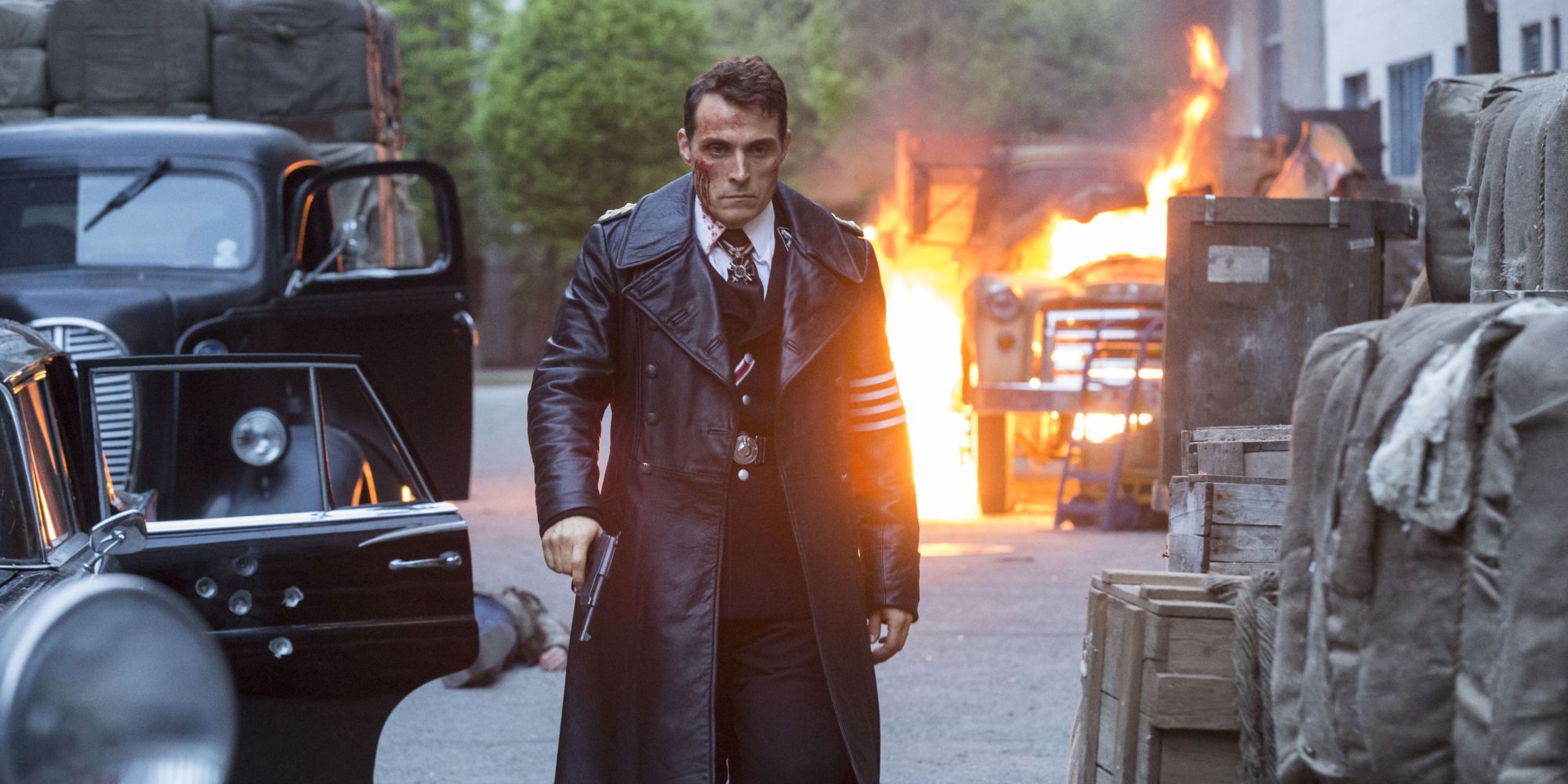
Philip K. Dick’s original work thoughtfully examines how history can be rewritten, focusing on everyday experiences during oppressive times and questioning what is truly real. The Amazon series expands on this foundation by developing characters more fully and adding a lot more action. This change turns the story into a gripping political thriller that taps into our current interest in dark future worlds.
Inspired by the dieselpunk aesthetic – a blend of retro style and advanced technology – The Man in the High Castle creates an unsettlingly modern world built on an alternate version of history. While some felt the show’s final episode was rushed, many agree it ultimately conveyed its central idea: the future is always uncertain.
The Man in the High Castle Defined Dieselpunk Sci-Fi
The famous science fiction author often imagined worlds ahead of their time, drawing inspiration from what might come. While the United States was entering a period of cultural change in the 1960s, the society depicted in his novel had already experienced over ten years of hardship and colonization.
Nazi Germany rapidly advanced technology to support its goals, achieving more in just 17 years than the United States has in over 80 years of being a leading global power.
The story featured a blend of technologies, both commonplace today – like video calls, high-speed trains, and even nuclear weapons – and those still considered futuristic, such as ‘Die Nebenwelt,’ a project enabling interdimensional travel. Interestingly, the narrative also drew heavily on the ancient Chinese text, the I Ching, using its principles to explain how some characters could achieve similar portal travel before Die Nebenwelt was even developed.
The show received praise for its disturbing yet strangely compelling portrayal of a world where fascism triumphed. However, its rich visuals and complex themes elevated it beyond a basic alternate history question – “what if?”. From the powerful machinery of Nazi Germany to the futuristic cities built across conquered North America and prosperous Germany, the series unintentionally incorporated many elements now associated with dieselpunk.
Although the term ‘dieselpunk’ wasn’t around in 1962 when the novel came out, its roots can be found in films like Fritz Lang’s groundbreaking Metropolis from 1927. A key part of this film’s look was Art Deco, a style of architecture that represented the luxury and wealth of the early 1900s.
As a movie buff, I always appreciate a bold vision – and the Chrysler Building in New York is a perfect example of that! When it was built back in 1930, people were both thrilled by how modern and forward-thinking it was, but also a little taken aback by its really unique, almost over-the-top style. It definitely wasn’t your typical building at the time.
People often call the dieselpunk style “decodence,” blending Art Deco with a sense of lavish excess, and that extravagance is clearly visible. The massive buildings in the occupied city of New York reflect the ruling power’s fixation on strength and lasting control.
A clear social hierarchy has developed, placing native Germans in a position of privilege and luxury while much of the world struggles. This is particularly noticeable in Berlin, where disillusioned and wealthy young people – the children of Nazi leaders – indulge in excess with money and drugs.
Dieselpunk dystopias are becoming increasingly popular, influencing how audiences see worlds that feel familiar yet strikingly different. They often showcase the grim realities of constant, machine-driven war and extreme industrialization, portraying the system itself as the source of control and suffering.
The show’s ending makes it clear that life goes on, regardless of who’s in charge. And for every good thing that happens, there’s always a potential problem waiting in the wings.
Philip K. Dick imagined a remarkably detailed world that later became recognized as a key influence on the dieselpunk genre. Amazon’s recent TV series vividly brought this dark and compelling vision to life, showcasing some truly memorable dieselpunk visuals.
The show’s look and feel perfectly embodies the dark atmosphere of the original story – something the book only hinted at. This bleakness isn’t confined to the screen; it feels disturbingly real, turning factual history into a chaotic and unsettling experience.
Philip K. Dick’s Story Takes on New Meaning in the 21st Century
Back in 1962, America seemed very stable after successfully navigating the Cuban Missile Crisis thanks to President Kennedy’s leadership. People generally had a lot of faith in their country, and imagining alternative outcomes felt like pure fantasy. However, the Vietnam War began to erode that trust, and since then, feelings of uncertainty and mistrust have only grown stronger over time.
Over six decades since it was first published, both Philip K. Dick’s novel and the Amazon series based on it now resonate in new ways. Originally a philosophical exploration of history, reality, and control, the story has become strikingly relevant to current issues like the spread of misinformation, the rise of authoritarianism, and the clear weaknesses appearing in democratic systems today.
The Man in the High Castle deeply examines how regular people cope with life under oppressive rule, whether they’re benefiting from it or suffering terribly. The show portrays characters simply trying to live their lives – working, raising families, and forming relationships – all while living under foreign occupation. What’s truly frightening isn’t the violence itself, but how easily people become accustomed to a tyrannical system, accepting it as just another part of everyday life.
This idea continues to resonate today as societies grapple with growing political extremism and a decline in trust for institutions. The story’s warning is especially timely, showing us how fascism takes hold when individuals make small compromises and the public remains passive. Ultimately, it demonstrates how even well-intentioned people can become accustomed to things that would have been considered deeply wrong by those who came before them.
This story powerfully shows how important it is to remember history accurately. Those in power often change historical narratives to control what people believe, and the children of the North American Reich represent this manipulation. The story highlights the danger of rewriting the past – a generation taught false stories might end up fighting for a version of truth that never actually existed. Though the story doesn’t show this manipulation fully taking hold, the warning is clear.
The series depicts a highly advanced nation, but both its glorification of Japan and its depiction of white supremacy are problematic. While both are offensive, the portrayal of white supremacy continues to be particularly contentious.
As a critic, I found the film’s depiction of suffering particularly harrowing. While it rightfully focuses on the devastation faced by Jewish communities – almost entirely wiped out within the narrative – it powerfully illustrates how people of color bore an equally immense burden. The story presents a chilling alternate history where a Nazi regime doesn’t stop at Europe, but brutally conquers and systematically dismantles Black and Indigenous America. What remains isn’t simply defeat, but a horrifyingly ‘purified’ nation built on genocide, forced removal, and the complete obliteration of cultures and identities. It’s a bleak and disturbing vision, to say the least.
People who were LGBTQ+, had disabilities, or didn’t fit the Nazi ideal of a ‘pure’ race faced severe persecution – ranging from being vilified to being murdered. Sadly, this horrific past doesn’t feel distant anymore.
The Man in the High Castle’s Ambiguous Ending Is a Testament to Hope
However, The Man in the High Castle also makes us question whether history was truly unavoidable. We often think of big events as if they were destined to happen, but the truth is, things could have easily turned out differently. The world we live in today is the result of many decisions, compromises, and alternative possibilities.
Democracy isn’t something we automatically have forever—it requires ongoing effort to keep it strong. Germany made significant social progress in the years between World War I and World War II, which makes its later descent into violent dictatorship even more striking, proving how easily public opinion can shift and how fragile even advanced societies can be.
The show’s ending is intentionally open-ended. While some viewers wanted a clear resolution, that ambiguity is actually central to the story – the struggle goes on, and the revolution isn’t over. However, because these events happen outside of what we see, there’s no certainty about whether things will ultimately succeed.
Everyone wants success, but it never lasts forever. When things go wrong, the important thing is to keep trying. Life is a constant journey of growth and change, an ongoing story with no true ending. The most we can do is persevere, just like Juliana Crain does even after facing setbacks.
2026-07-20 23:41