Summary
The EngineAI T800 is a powerful robot designed for full-contact combat. It features strong joints delivering 450 N·m of burst torque, combined with a visual feedback system that allows it to react and strike independently. Built with a durable aerospace-grade aluminum-magnesium alloy chassis and precise positioning technology, the T800 maintains control even during intense battles. EngineAI is now making the robot’s software and hardware available to 32 teams, effectively using its new URKL fighting league as a real-world testbed for developing advanced AI.
On July 16th, EngineAI unveiled its T800 humanoid robot at the Nanshan Cultural & Sports Center in Shenzhen, marking the start of the EngineAI URKL Global Humanoid Robot Free-Fighting League. The T800, standing at 1.73 meters tall and constructed with a durable aerospace-grade aluminum-magnesium alloy frame, isn’t just a prototype or exhibition piece. It’s designed for full-contact combat, and the URKL league is EngineAI’s platform to rigorously test its robots’ physical capabilities and artificial intelligence through real-world battles.
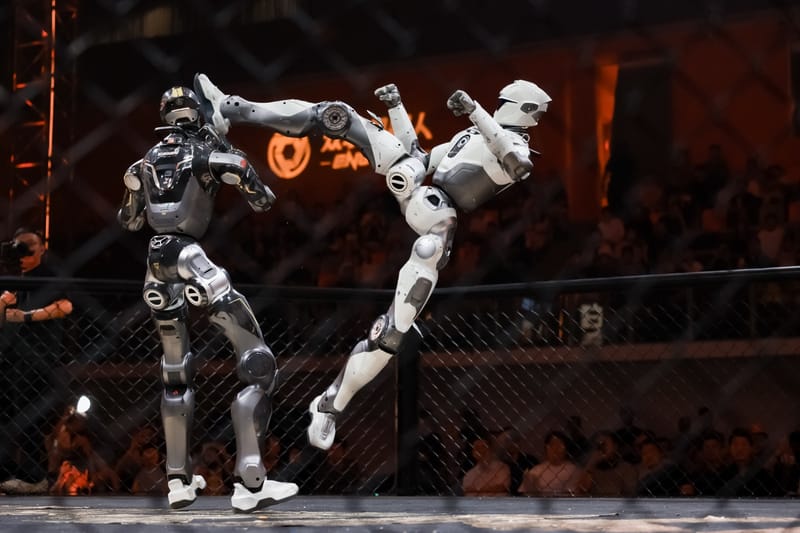
The T800 robot has powerful joints that can deliver a quick burst of 450 N·m of torque – enough force for moves like uppercuts and kicks, or to quickly get back up if knocked down. This power is crucial because realistic humanoid combat isn’t just about one strong hit; it’s about continuously moving, attacking, defending, and recovering while staying balanced. EngineAI explains the challenge is building a robot that can do all of this smoothly under pressure. The T800 uses a constant stream of visual information to understand what’s happening around it, make decisions, and then act on those decisions. It can track its opponent, anticipate their moves, and choose how to attack or defend independently. EngineAI’s goal is for the T800 to go beyond simply being capable of fighting, and instead truly understand how to fight.
Okay, so I’ve been checking out EngineAI’s T800 robot, and it’s seriously impressive. The frame is built from this super-strong aluminum-magnesium alloy – basically designed to take a beating over and over again. But it’s not just tough; the way it moves is incredibly precise thanks to some advanced positioning tech. It’s like they built layers into its system: first, that durable body, then a ‘cerebellar’ layer for fluid movement and balance, and finally a ‘cortical’ layer that handles thinking, making decisions, and adapting during fights. They’re aiming for something beyond just powerful hardware; they want an AI agent where the robot’s build, its movements, and how it learns all improve together in actual combat – not just in training simulations. It’s a whole package of ‘power and brain,’ as they put it.
The T800 robot isn’t a sealed unit; EngineAI has made its software and hardware fully accessible to all teams competing in the URKL league, allowing them to customize and improve it. This open design means advancements in AI algorithms aren’t limited by the robot’s physical capabilities, giving teams freedom to refine how the robot sees, thinks strategically, and moves with precision. It’s a move away from keeping robotics technology hidden, which has traditionally slowed down progress. Every match generates valuable data that can benefit the wider field of embodied AI. Furthermore, the league will release all of its core code as open source, so improvements made during competition become freely available for anyone in the industry to use and build upon.
The first night of the competition successfully showed how everything would work. Two teams from EngineAI battled each other in a practice match to demonstrate the rules and how judging would be done, immediately followed by the start of the main tournament with 32 teams. The most exciting fight of the night was between “Bullfighter,” wearing dark armor, and “White Eagle,” which Bullfighter won 3-2 after five intense rounds. Over 200 teams from around the world signed up to compete, and 32 made it through initial qualifying matches. These qualifying teams come from countries like China, the United States, Poland, and Singapore. The tournament will continue with four stages: Open Qualifiers (already completed), Round of 32, a Group Stage, and finally the Grand Finals. It uses a combination of group play where each team plays every other team twice, and a double-elimination bracket to determine the winners.
The EngineAI URKL competition is underway! Teams are currently competing in group stages, with more challenging elimination rounds and a Grand Finals event still to come. Anyone interested – including teams, researchers, and developers – can keep up with the league and learn how to join through EngineAI’s website and social media.
2026-07-20 11:26