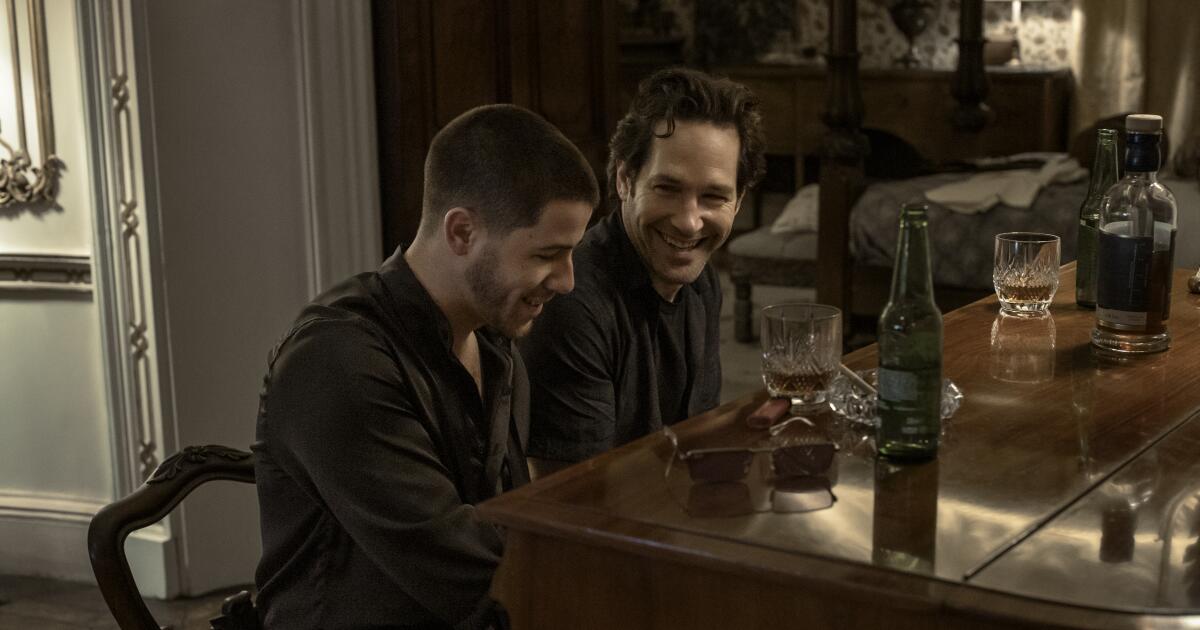
“Power Ballad” is a messy and sarcastic comedy about a wedding singer, played by Paul Rudd, and a famous pop star, Nick Jonas. They jokingly mess around with a song one night, and when it unexpectedly becomes a hit, they start fighting over who owns it.
I’ve always loved John Carney’s films – ever since “Once” back in 2007, he’s been all about the magic of people creating things together. He really gets how a raw idea can blossom into something beautiful, whether it’s the synth-pop of “Sing Street” or the quieter sounds of “Begin Again.” But lately, it feels like he’s been experimenting a bit. His most recent, “Flora and Son,” really resonated with me. It wasn’t about some huge transformation; it was about a mom picking up a guitar and realizing it’s okay to just mess around and enjoy making music without needing a grand outcome. I appreciated that honesty – we all deserve to noodle around a bit, you know?
“Power Ballad” feels more like a collection of initial concepts than a fully realized story. It begins strongly, with a clever scene showing how songs are written – arguably one of the best moments director Carney has created. The scene features Danny (Jonas, playfully referencing his past as a popular singer with the Jonas Brothers) explaining how to write a clean, radio-friendly hit to Rick, Paul Rudd’s character, the leader of a struggling cover band. Rick immediately tries to add his own lyrics, hilariously attempting to sneak in a risqué word (which he stretches into a comical “tit-i-taaaays!”). The casting is brilliant; Rudd’s surprisingly good singing matches his comedic timing perfectly.
Fifteen years ago, Rick Rudd was an aspiring rock star whose American grunge band toured Europe. During the tour, he met and fell in love with an Irish woman named Rachel (played by Marcella Plunkett), and they had a daughter, Aja, now a spirited teenager portrayed by Beth Fallon. Rick has since traded the rock star life for quiet anonymity in the Dublin suburbs, where he plays in a wedding band called Bride & Groove – a chance to relive his cool days, even if just by wearing tight jeans to gigs. While his bandmates are amusing, they aren’t very well-developed, and one character even feels the need to assert his own importance beyond being part of Rick’s story.

Movies
The 27 best movie theaters in Los Angeles
We’ve created a guide to 27 fantastic movie theaters in Los Angeles, including iconic spots like the TCL Chinese Theatre and the New Beverly, as well as popular chains like Alamo Drafthouse and the best AMC location in Burbank.
From the start, the movie feels like something writer-director John Carney and co-writer Peter McDonald wrote a long time ago and then forgot about. It’s odd that the main character, Rick, who supposedly left a serious band during the Obama years, sees himself as a contemporary of someone like Eddie Vedder. The character is meant to be in his late 30s, but he behaves much older, presenting himself as a relic of real rock and roll while performing mostly songs by Hall & Oates. It feels out of touch—wouldn’t a song like The Killers’ “Mr. Brightside,” a popular choice for weddings, fit better and get people excited?
At a party, Rick was asked to introduce Danny, a former boy-band member trying to launch a solo career. Rick had previously made fun of Danny, calling him a failure, but Danny’s performance was surprisingly captivating, even energizing Rick. Rick found himself mirroring Danny’s movements and enthusiastically clapping along. Their connection led to an all-night musical session where they shared marijuana, whiskey, and unfinished song ideas.
For a little while, the movie feels like a sweet, uncomplicated romantic comedy about two artists who are both unhappy with their lives. Danny is struggling with being in the public eye, while Rick is tired of being unknown. Danny really wants to perform at Madison Square Garden again, but Rick gave up on that dream a long time ago. Having seen a few movies, I expected the story to end with them both performing together at the Garden for a big crowd – a little cheesy, maybe, but ultimately feel-good.
This brief period of connection doesn’t last. Danny shockingly steals an unreleased song from Rick and turns it into a hit. This deeply hurts Rick, and disappoints fans who were hoping to see them collaborate further. Instead, Danny quickly becomes a superficial and unpleasant Hollywood figure, much like his manipulative manager, Mac Darling (Jack Reynor). Mac tries to appear current, but embarrassingly reveals he doesn’t understand internet culture, highlighting the writer’s lack of familiarity with modern trends.
Movies
John Carney, the Irish director of films like “Once” and “Begin Again,” helped bring movie musicals back to life by updating their classic romantic style for modern audiences.
Rick is falling apart, constantly tormented by the inescapable earworm of a song he can’t get rid of. This stolen track follows him everywhere – he hears it on the radio, in public places, and even when he’s performing, with people requesting it as their special song. The audience, and we, are subjected to frustratingly short clips of the tune, but the full lyrics aren’t revealed until the end, when it’s discovered that one of the writers awkwardly inserted the word “albatross” into the song.
Okay, so “Power Ballad” throws a ton of ideas at the wall, but doesn’t really do anything with them, which is a shame. I kept thinking it could’ve been about what makes a song a hit, or the difference between genuine talent and just having a stage presence. It hints at artists being afraid to share their best work, or performers feeling pressured to create what the label wants. There’s even a thread about how a song kind of stops belonging to the artist once fans get ahold of it. And it briefly touches on how both of the main characters seem to be writing songs to impress women—his fans for Danny, and his family for Rick—but the women involved aren’t even that impressed! It’s like it starts all these interesting conversations but then just…doesn’t go anywhere with them.
“What are you interested in?” Rick finally huffs to his daughter.
“Revenge,” she says.
Carney’s new film is a bleak and depressing experience. He highlights this darkness with stark contrasts, such as comparing the admiring female fans of Danny to the much more downtrodden women who approach Rick, even showing them with toilet paper clinging to their shoes.
“Power Ballad” tries to feel like a serious drama, but it’s actually a wildly over-the-top comedy. Paul Rudd plays his character’s embarrassment so intensely that he comes across as unhinged, sporting cuts and bruises that strangely never seem to get better. It’s distracting and emphasizes the film’s comedic nature.
The result is punishing — and tone deaf.
2026-05-28 22:31