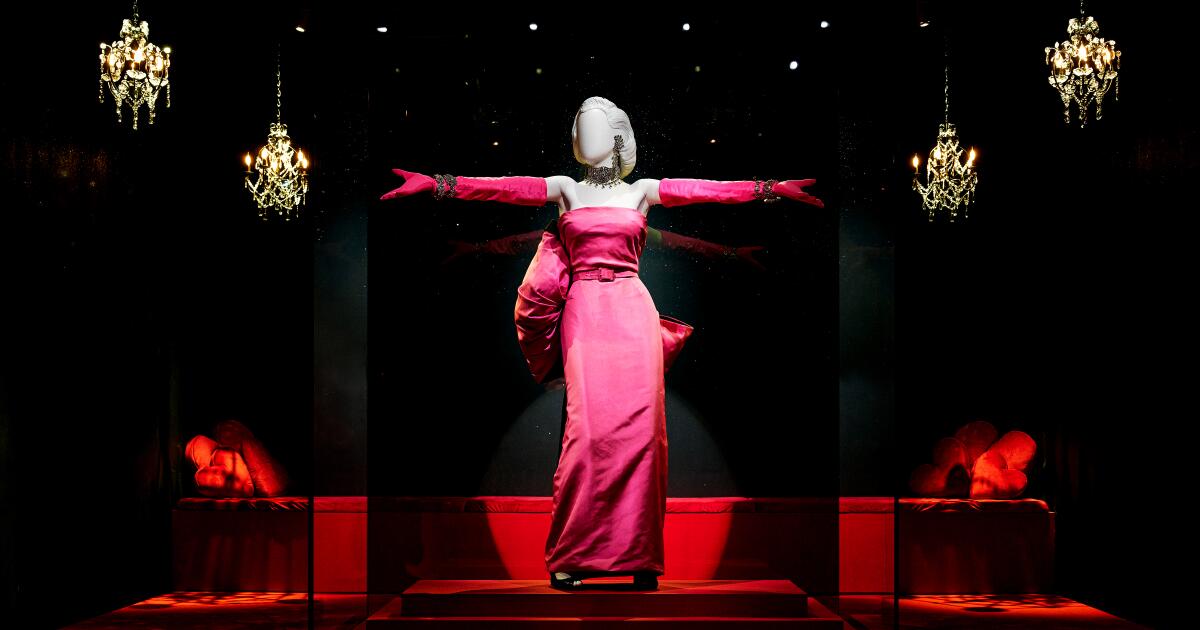
There she is, in that famous bright pink dress, arms outstretched in a gesture of both offering herself to the world and welcoming everything it has to offer—love, recognition, praise, and, as she famously sang while wearing it in “Gentlemen Prefer Blondes,” diamonds—a girl’s best friend.
It’s not Marilyn herself, but rather the iconic dress she wore – created by William Travilla and now on display in the new “Marilyn Monroe: Hollywood Icon” exhibit at the Academy Museum of Motion Pictures. The exhibit opens this Sunday and is one of several events celebrating the 100th anniversary of Marilyn Monroe’s birth.
Even decades after her death, Marilyn Monroe remains a captivating figure in Hollywood history. Though her career spanned just seventeen years, she left such a lasting impression that her image – and the many interpretations surrounding it – continues to resonate with us, like a brilliant, unforgettable afterglow.

Her death at the young age of 36, caused by an overdose, greatly solidified her place in history. It received widespread international media attention and sparked numerous conspiracy theories, many of which implicated prominent and influential figures, including members of the famous Kennedy family.
While tragedy and mystery certainly contributed, they don’t fully account for the enduring fascination with Marilyn Monroe. Countless books – including several published just this year – have been written about her, and numerous films have depicted her life. She’s also been a major source of inspiration for artists, from Andy Warhol’s famous silkscreen portrait created shortly after her death to the large-scale “Forever Marilyn” statue now permanently displayed in Palm Springs, despite some initial debate.

The Academy Museum’s exhibit highlights how Marilyn Monroe was a trailblazer. In the conservative 1950s, she openly embraced her sexuality and discussed topics like therapy and the challenges of being famous. She frequently challenged the studio system, was an early actress to launch her own production company, and insisted on having control over her photoshoots.
Despite a personal life marked by several marriages, struggles with substance abuse, and a reputation for being demanding to work with, she wasn’t afraid to challenge the media and playfully interact with reporters.

Two new novels capitalize on the 100th anniversary of Marilyn Monroe’s birth — one is brilliant, the other a dud
Two recently published novels delve into the heartbreaking story of Marilyn Monroe, but only one truly succeeds in portraying her as a person, rather than through the eyes of others.
Despite her impact, Marilyn Monroe isn’t generally remembered as a groundbreaking figure like a scientist or a women’s rights activist. Instead, she endures as an unforgettable icon of beauty, glamour, and captivating sensuality – a uniquely vibrant spirit whose existence felt tragically fragile in a world filled with jealousy and trivial concerns.
While creating the “Marilyn Monroe: Hollywood Icon” exhibit, associate curator Sophia Serrano interviewed numerous passionate fans – some of whom generously contributed items to the display – and they all shared a similar sentiment.

Despite her difficult life and untimely death, many view her as a symbol of strength and perseverance. Her life story is dramatic – she overcame a tough childhood to achieve success, only to face setbacks later on. People often saw her fighting for more complex and meaningful roles, but struggling to get the opportunities she deserved. Because of this, many connect with her story and find inspiration in it.
Marilyn Monroe wasn’t just a celebrity; she was a carefully crafted persona that captivated audiences and allowed people to project their dreams onto her. According to Serrano, this image wasn’t accidental – Monroe intentionally cultivated it through a combination of her natural charisma and a clear understanding of her own talents.

Inside Marilyn Monroe’s private library and the misogyny that erased it
Gail Crowther’s new book, ‘Marilyn and Her Books,’ delves into Marilyn Monroe’s collection of 400 books, revealing how people underestimated her intelligence due to sexism.
In 1952, as Marilyn Monroe’s career was taking off, a reporter discovered that the woman featured in nude calendars and posters was actually her. These photos, part of what’s now called the “Golden Dream” series, had been taken five years earlier. At the time, Monroe was filming “Gentlemen Prefer Blondes” for 20th Century Fox, and the studio head, Darryl Zanuck, insisted she deny any connection to the images.
Marilyn Monroe took a completely different approach, dismissing the controversy in an interview. She explained, “I was poor and needed the money… I don’t regret it; I didn’t do anything wrong.”

Marilyn Monroe’s lasting appeal comes from her captivating blend of seeming fragility – expressed through her expressions and voice – and underlying strength. This combination is the central idea behind the exhibit at the Academy Museum.
Because Marilyn Monroe lived such a full life, a complete exhibit could be enormous. This exhibit, held at the Academy Museum, concentrates on her film career. A large section features costumes from her movies – including the iconic white dress from “The Seven Year Itch” – because Monroe frequently collaborated on their design.
I was really struck by how much thought she put into everything, even her costumes! Apparently, she was Fox’s biggest star when Cinemascope came out, and they used her to promote it. But she was very particular about how things looked on film – she refused to wear A-line dresses because she felt the Cinemascope effect wasn’t flattering. It was amazing how she understood the technology and then used that knowledge to control exactly how she was presented. She really knew how to manage her image and make sure everything looked just right.

The famous pink dress Marilyn Monroe wore in “Gentlemen Prefer Blondes” almost didn’t happen. Originally, her character was supposed to wear sparkly hot pants, which are also part of the exhibit. However, after a controversy known as the Golden Dream “scandal,” studio head Darryl Zanuck insisted she wear a more modest outfit.
The exhibit also features personal belongings like the shoes Marilyn Monroe wore at her wedding to Joe DiMaggio. Visitors can also see a handwritten apology from gossip columnist Hedda Hopper, her scripts with notes, and even items from her beauty routine – including a mask she used to slim her face after being told she had a double chin. The exhibit clearly shows her complicated relationship with the media, using newspaper articles and old news footage.

One room showcases iconic scenes from her most well-known movies, and an entire wall is covered with numerous photographs. According to Serrano, she had an exceptional understanding of how to work with the camera – a sentiment shared by photographers and fellow actors who collaborated with her. Even Laurence Olivier, despite a difficult working relationship with her on the set of “The Prince and the Showgirl,” recognized this talent.
Stories about her being demanding on film sets are supported by frustrating telegrams exchanged between director Billy Wilder and her husband, playwright Arthur Miller. Wilder complained to Miller about her behavior, and Miller defended his wife in his replies.
The exhibit offers a complete look at Marilyn Monroe, featuring personal items from her home and even some of her everyday clothes – a stark contrast to the glamorous outfits she was famous for. According to Serrano, Monroe carefully cultivated her public image, revealing just enough to create a captivating illusion.

Marilyn Monroe continues to captivate people, and perhaps we know why. She confidently embraced her beauty and sensuality, something still remarkable today. Her connection with the camera was unique – when she was on screen, it was hard to look away. Even her famous walk, with its swaying hips, was surprisingly simple: she walked with one foot directly in front of the other, similar to a tightrope walker maintaining balance.
Marilyn Monroe often seemed to exist in a delicate balance, appearing both innocent and sophisticated, fragile yet strong – a hidden figure walking a tightrope between these contrasting qualities.
The desire for both connection and independence is a powerful force, inspiring both great art and profound struggles. No one embodied this tension more vividly than Marilyn Monroe. She was both a captivating creation and a complex individual, and the enigma surrounding her life continues to fascinate us decades later.
2026-05-28 13:32