
Actor Larry Brantley frequently tells fans that a common thing they say to him at pop culture conventions is, “You were the voice of my childhood.”
He explained it’s something he doesn’t take lightly, because even years later, a performance from early in his career can still deeply resonate with people, as he shared in a recent interview.
He became famous for voicing Wishbone, the main character in a creative PBS series that first aired in the fall of 1995.
Brantley played the funny role of a ridiculously cute Jack Russell terrier who thinks he’s the main character in famous stories like “Romeo and Juliet,” “Oliver Twist,” “Don Quixote,” and “Frankenstein.” He imagined himself as the hero in each of these classic tales.
“Wishbone” aimed to bring classic stories to life for kids in a way that was both respectful of the originals and inspiring – hoping to encourage them to read the books too. Many millennials remember the show fondly and say it actually worked!
Brantley says the messages he receives are genuinely meaningful, not just from excited fans. People often share how the show inspired a love of reading that has lasted their whole lives, and they’re now hoping to share that same passion with their own children.
Fans of the beloved show Wishbone can now explore the making of the series with the new documentary, What’s the Story, Wishbone?, directed by Joey Stewart. It reveals the amazing effort that went into bringing the show to life.
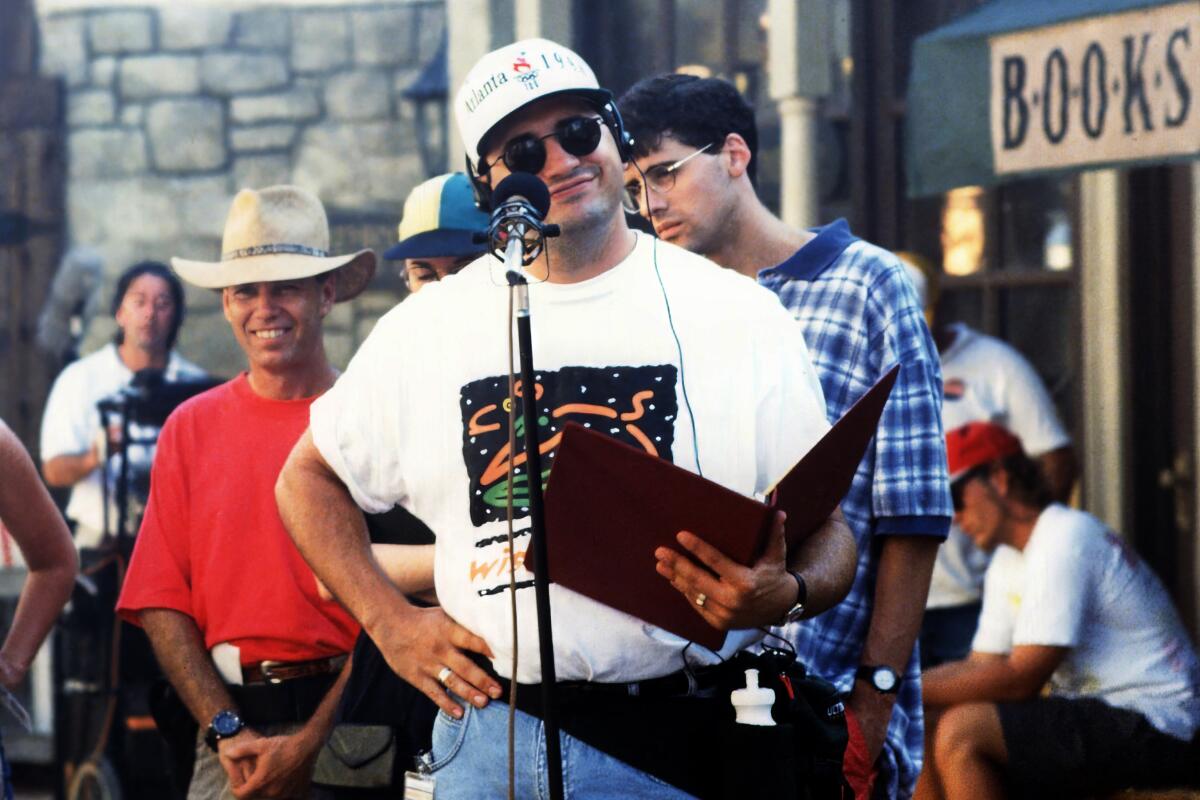
A photo shows Larry Brantley, who provided the voice for the character Wishbone, while filming the show in 1995. (Photo by Lynn Lockwood / Novel Tails)

The main character of the show, Wishbone, was actually a Jack Russell terrier named Soccer. (Lynn Lockwood / Novel Tails)
The movie will be shown on public TV stations starting Wednesday and running through June 9th. PBS SoCal will broadcast it on June 8th and 9th, and it will also be available online starting June 10th.
Even after working on shows like “Walker, Texas Ranger,” Stewart, a former first assistant director on “Wishbone,” still finds that people mostly want to discuss his work on that beloved series. For him, “Wishbone” has remained a constant throughout his career.
According to Stewart, just mentioning ‘Wishbone’ instantly sparks joy and nostalgia in people, reminding them of a cherished time they might have forgotten. He says this is usually followed by a flurry of questions about the show – what the dog was like on set, where it was filmed, and assumptions about its location. He’s experienced this reaction consistently throughout his 30-year career.
Around ten years ago, Stewart and Betty Buckley—who worked as a producer on the show “Wishbone”—started talking about how much they enjoyed working on it with the famous canine star. As Stewart remembers, they thought, “That was the best project we’ve ever been a part of. How can we recreate that experience?”
The team considered bringing the show back for a new audience, but when that proved too difficult, they decided to explore making a documentary about the show instead, as a way to revisit that special time in their careers.
Stewart says they decided to make a documentary because they’ve known the cast and crew for decades and remain close with them. They’re familiar with the story and fans have been requesting one for years, with many unanswered questions. That’s how the project began.

Stewart and Buckley presented their project to various studios and production companies, but they decided it was more important to stay in charge, even if it meant having fewer resources. As Stewart explains, ‘I wanted to ensure the story was told our way, by us.’
Due to budget constraints, the filmmakers only had two days to film all the interviews. According to Stewart, this meant they couldn’t include anyone who wasn’t available on those days, but they believe they still managed to cover all the important points. The documentary notably doesn’t feature any of the child actors from the original “Wishbone” cast, such as Jordan Wall, Christie Abbott, and Adam Springfield.
As a huge fan of “What’s the Story, Wishbone?”, I was fascinated to learn, through interviews and behind-the-scenes footage, how Rick Duffield and his team pulled off such a creative show. It’s incredible how they managed to recreate so many different time periods with really quick turnaround times, all while filming on a backlot in Allen, Texas! They actually made 40 episodes for PBS in just one year – that’s a seriously impressive feat.
Duffield explains that because they were developing the project internally, they could afford to take risks and potentially achieve something remarkable. Unlike teams working in places like Los Angeles or New York, they weren’t burdened by the same pressures and had the space to experiment and find solutions. They were given the autonomy to explore different approaches and weren’t limited by external constraints.
By 1998, the show had produced 50 episodes and a TV movie called “Wishbone’s Dog Days of the West.” Its high quality was recognized with a Peabody Award and four Daytime Emmy Awards.
Television
Soccer, a nine-year-old Jack Russell terrier, has become a popular online personality and is now the star of his very own movie!
Duffield believed strongly in high-quality children’s television, and for “Wishbone,” this meant filming everything on film to give it a cinematic feel. He wanted it to look like a real movie, not a typical studio production, even though each episode – including set and costume creation – had to be completed in just five days.
Duffield explains that movies transport viewers from a controlled studio setting to the real world, letting them experience life alongside characters and their friends, which creates a more immersive feeling. He adds that a different approach was immediately dismissed.
Growing up as an only child, Duffield has always had a special connection with dogs. When creating “Wishbone,” he considered making the show similar to classic dog stories like “Lassie” or “Benji.” He explains, “Dogs have a unique way of connecting with children, and I thought it would be fun to have a dog imagine himself as the main character in famous stories. For me, the dog was always the most important part of the show.”

While visiting Los Angeles, Rick Duffield and Larry Buckley were originally planning for just five episodes of Wishbone. They were shown several dogs who could potentially play the role, but they immediately fell in love with Soccer, a Jack Russell Terrier, when he performed his famous flip and made eye contact with Duffield. Soccer’s captivating gaze sealed the deal.
According to trainer Chris Duffield, the dog, known as Soccer, appeared to be experiencing emotions. He explains that anyone who worked with Soccer on the show would recognize this sensitivity, noting that the dog had a remarkable connection with people.
Brantley, the voice of Wishbone, readily admits he was the least experienced voice actor at the audition. He actually believes this inexperience was an advantage, preventing him from overcomplicating things. Instead of trying to sound like a dog, he focused on capturing the character’s personality.
Duffield explains that Larry brought a really energetic and playful quality to the character’s voice, which was exactly what they wanted to appeal to children.
While filming, Brantley stood on set with a microphone and screen to follow the camera’s view. Actors could hear his voice as Wishbone through a speaker, and he could hear their lines in return. This allowed them to truly act together in scenes. As Brantley explains, this setup raised everyone’s performance level because the actors weren’t just reading lines for a script supervisor – they were interacting with a fellow performer.
Brantley was also involved in translating “Wishbone” into different languages. He recalls receiving recordings from voice actors in languages like German, Norwegian, Finnish, and Korean, and noticing that some weren’t trying to sound like him. Instead, they were developing their own unique interpretations of the character, creating something new.
Brantley was surprised to learn that the voice actor who dubbed the show ‘Wishbone’ into Korean sounded just like him. He says the actor did an incredibly accurate impression!
Brantley explains that working with Soccer involved strict rules. No one was allowed to touch him while he was performing, as maintaining his focus was crucial. The usual lighthearted banter between takes was significantly reduced whenever Soccer was present on set.
To help publicize “Wishbone,” Brantley and Soccer – along with his trainers – traveled across the country. Brantley remembers people waiting in long lines just to see the cute dog, and that’s when he understood how popular the show had become.

Brantley described the audience’s reaction to the dog as incredible. He explained that traveling with the dog felt like being on tour with a fellow performer. He jokingly added that while the dog enjoyed first-class travel, he was stuck in coach, but wasn’t complaining.
Stewart gets upset whenever someone asks about Soccer, his beloved dog, who passed away in 2001 at the age of 13. He describes losing Soccer as being like losing a member of his family.
Parents liked how the show encouraged their children to read, but Duffield thinks teachers and librarians were its biggest fans. She explains, “They’re the ones working directly with kids every day, trying to get them to value great books, history, and culture – and that’s exactly what ‘Wishbone’ did. We really created the show for them.”
It’s tough to stream episodes of “Wishbone” right now. While you might find some lower-quality videos on YouTube, or used VHS tapes and DVDs for sale online, the show’s rights have changed owners several times. Currently, Mattel, the toy company, owns them.
Stewart enjoys sharing his collection of “Wishbone” episodes with friends and family who have children. He often gives them a flash drive loaded with as many episodes as he can find, even though the video quality isn’t great. He loves introducing a new generation to the show.
It’s unlikely a show like “Wishbone,” known for its high quality and fast-paced production, could be created today, or at least not in the same way it was originally made, given how crowded television is now.
Brantley admits the show was definitely a reflection of its era, but he happily shares that he would have loved to have continued working on it indefinitely. He says if they’d asked him to stay for another twenty years, he would have immediately agreed.
Christopher Nolan’s new film, “The Odyssey,” starring Matt Damon, will be released in theaters later this summer. However, many remember the story being brought to life earlier by the beloved TV show, Wishbone.
Brantley says he’s a fan of director Christopher Nolan and wants to see the film before forming an opinion. However, he playfully questions how anything could top the image of a Jack Russell terrier on a raft, suggesting it’s a wonderfully absurd and memorable scene.
2026-05-27 13:34