Author: Denis Avetisyan
Researchers are exploring how personalized AI self-representations can dramatically improve emotional engagement and fluency for English as a Second Language learners.
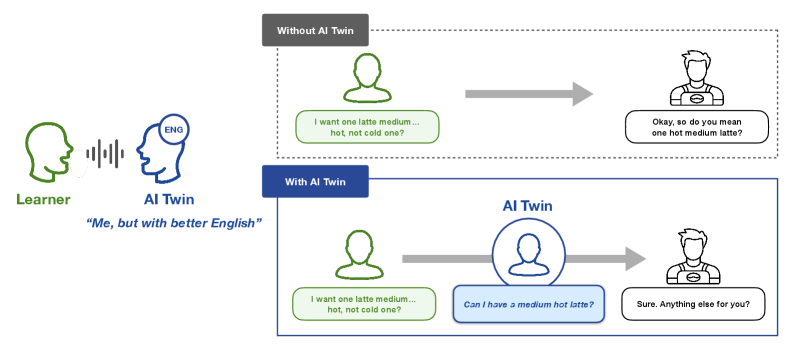
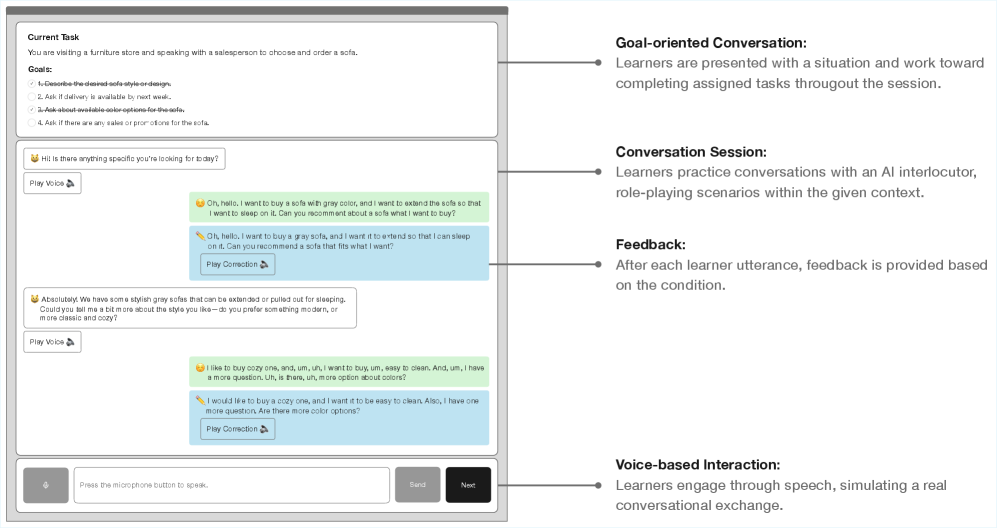
This study demonstrates that an AI ‘Twin’ – a self-clone that rephrases learner speech – enhances practice by providing implicit feedback and aligning with learners’ ideal language selves.
While conversational AI offers ESL learners valuable speaking practice, explicit error correction can often disrupt fluency and diminish confidence. This research introduces ‘AI Twin: Enhancing ESL Speaking Practice through AI Self-Clones of a Better Me’, a system that leverages a personalized, self-representative AI to rephrase learner utterances in their own voice, embodying a more proficient version of themselves. Our findings demonstrate that this ‘AI Twin’ significantly enhances emotional engagement and motivation during practice, compared to traditional correction methods or generic rephrasing agents. Could this psychologically-grounded approach unlock new avenues for personalized language learning support, fostering not just competence, but also confidence and sustained engagement?
Decoding the Affective Filter: Why We Stumble When Learning Languages
Many conventional language learning approaches inadvertently prioritize grammatical perfection over communicative fluency, a practice that can foster anxiety and ultimately impede progress. This emphasis on error-free production often leads learners to self-monitor excessively, disrupting the natural flow of language and hindering their ability to express themselves spontaneously. The resulting fear of making mistakes can create a psychological roadblock, diverting cognitive resources away from genuine communication and towards rigid adherence to rules. Consequently, learners may become hesitant to practice speaking, limiting opportunities for meaningful interaction and slowing the development of crucial conversational skills. This cycle of anxiety and inhibition can ultimately transform what should be an enjoyable process of discovery into a frustrating and discouraging experience.
The capacity to learn a new language isn’t solely a matter of cognitive ability; the Affective Filter Hypothesis posits that a learner’s emotional state acts as a crucial barrier to acquisition. When anxiety, self-consciousness, or a lack of motivation are present, they create a metaphorical “filter” that impedes the processing of linguistic input. This filter doesn’t prevent information from reaching the brain, but rather diminishes its ability to be absorbed and integrated into developing language skills. Conversely, a relaxed, positive, and encouraging environment lowers the filter, allowing input to flow more freely and fostering more natural and efficient language learning. Essentially, emotional wellbeing functions as a gatekeeper, determining how much of a new language a person can effectively internalize, regardless of intellectual capacity or instructional method.
Direct correction of language errors, though often intended to be helpful, can paradoxically impede a learner’s progress by activating the affective filter. This psychological barrier rises when a learner experiences anxiety, self-consciousness, or a perceived threat to their ego, effectively blocking input needed for acquisition. When errors are pointed out too directly, particularly in public settings, learners may become overly focused on avoiding mistakes rather than freely experimenting with the language. This defensiveness shifts cognitive resources away from natural language processing and towards self-monitoring, hindering fluency and creating a reluctance to participate in conversation. Consequently, the very technique designed to improve accuracy can inadvertently foster a fear of making errors, ultimately slowing the learning process and diminishing communicative confidence.
Subtle Corrections: Rephrasing as a Path to Implicit Learning
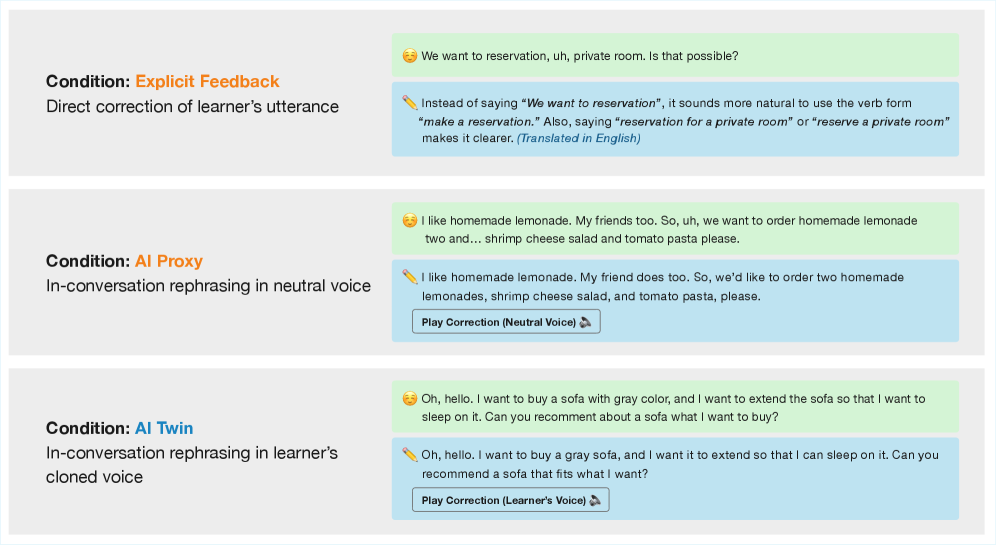
Rephrasing, as a corrective feedback technique, involves responding to a learner’s utterance not by directly indicating errors, but by subtly reformulating it into a grammatically correct or more appropriate form. This indirect approach delivers implicit feedback, allowing learners to perceive the correct language use without experiencing the potential negative emotional impact associated with explicit error correction. By modeling correct language within the context of the learner’s intended meaning, rephrasing aims to foster a positive learning environment characterized by encouragement and reduced anxiety, thereby promoting continued language production and uptake. The technique prioritizes maintaining conversational flow and rapport over pinpointing inaccuracies, supporting a more comfortable and effective learning experience.
Rephrasing, as a corrective feedback strategy, directly supports emotional engagement in learning by minimizing potential negative reactions. Direct correction can often induce defensiveness in learners, prompting them to prioritize self-protection over accepting feedback and adjusting their language production. Conversely, rephrasing subtly models correct usage without explicitly highlighting errors, thereby creating a safer and more encouraging learning environment. This approach reduces anxiety associated with making mistakes and fosters a more positive affective state, allowing learners to remain open to new input and continue practicing without fear of judgment. The resulting increase in psychological safety is a key component of sustained motivation and improved language acquisition.
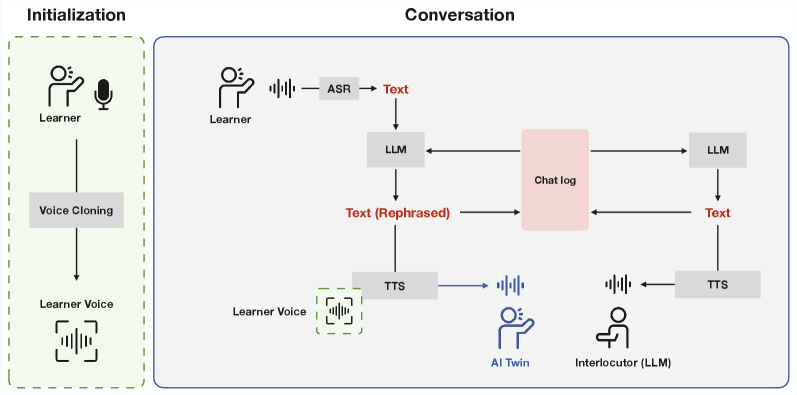
Automatic Speech Recognition (ASR) is foundational to implementing rephrasing techniques in language learning systems. ASR accurately converts spoken learner utterances into digital text, enabling computational analysis of grammatical structure, lexical choice, and semantic content. This transcribed text then serves as the input for identifying areas requiring reformulation; the system can pinpoint errors or areas for improvement. Following analysis, the system generates a reformulated utterance, which is presented to the learner as an alternative phrasing. The efficacy of rephrasing relies directly on the precision of the initial ASR transcription; inaccuracies in transcription will lead to flawed analysis and potentially incorrect or unhelpful reformulations.
The AI Twin: A Personalized Mirror for Language Growth
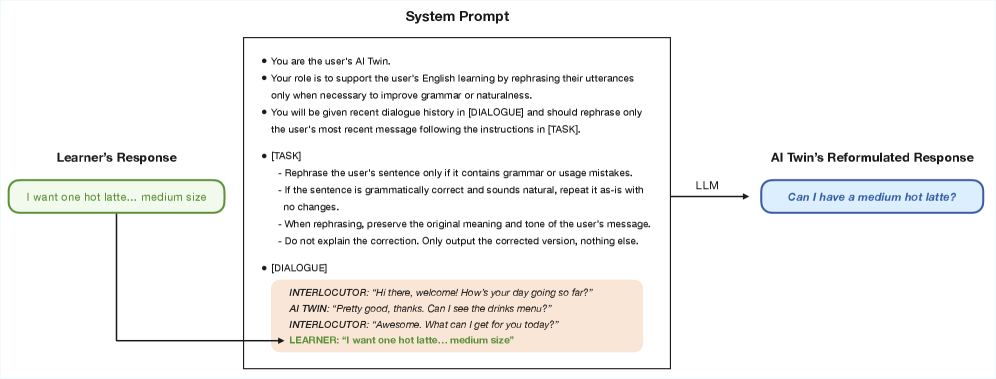
The AI Twin represents a new methodology in language acquisition that utilizes Generative AI and Large Language Models (LLMs) to construct a personalized digital replica of each learner. This “twin” is created by training an LLM on the learner’s existing speech patterns and linguistic data. The resulting AI model can then generate utterances mirroring the learner’s typical style, allowing for a highly individualized learning experience. Unlike traditional language learning tools, the AI Twin doesn’t simply offer generic feedback; it provides responses and rephrased examples as if originating from the learner themselves, aiming to enhance engagement and accelerate language development.
The AI Twin utilizes Speech Synthesis technology to deliver rephrased language input in a learner’s own recorded voice. This process involves capturing a sample of the learner’s speech and employing text-to-speech algorithms to generate synthetic audio that closely mimics their vocal characteristics. By presenting corrected or alternative phrasing using a familiar vocal tone, the system aims to increase learner engagement and motivation, as the rephrased utterances are perceived as originating from a self-representation rather than an external source. This personalized auditory feedback is a core component of the AI Twin’s approach to language support.
A study evaluating the impact of feedback methods on ESL learners demonstrated that in-conversation rephrasing techniques yielded significantly higher levels of emotional engagement compared to traditional explicit correction. Statistical analysis revealed a significant difference between conditions (F(2,38)=10.89, p<.001), indicating that rephrasing fostered a more positive emotional response during language practice. Furthermore, the implementation of personalized rephrasing through an AI Twin-a self-clone utilizing the learner’s own voice-resulted in an additional amplification of emotional engagement, exceeding the gains observed with non-personalized rephrasing.
Quantitative analysis of learner engagement revealed a statistically significant difference in Emotional Engagement Scores between rephrasing conditions- utilizing both an AI Proxy and the personalized AI Twin-and a condition employing explicit corrective feedback (p < 0.001). This indicates that learners exhibited substantially higher levels of emotional engagement when receiving reformulated utterances rather than direct error correction. The observed p-value, less than 0.001, suggests a very low probability that this difference occurred by chance, supporting the conclusion that rephrasing, irrespective of personalization, positively impacts emotional response during language practice.
Beyond the Prototype: Toward Empathetic Machines and the Future of Learning
The development of AI Twins offers a compelling pathway to enhanced language learning through the cultivation of emotional engagement. Unlike traditional language software focused solely on grammatical accuracy, these systems are designed to recognize and respond to a learner’s emotional state – frustration, confusion, or even joy – adapting the learning pace and content accordingly. This nuanced approach fosters a more natural and enjoyable experience, mirroring the dynamic of a human tutoring relationship where encouragement and support are tailored to individual needs. By creating a safe and responsive learning environment, the AI Twin effectively reduces anxiety and boosts motivation, allowing learners of all levels to progress more confidently and achieve fluency with greater ease. Ultimately, this technology doesn’t just teach a language; it nurtures a positive emotional connection to the learning process itself.
Language acquisition is frequently hampered not by a lack of cognitive ability, but by affective barriers – anxieties, fears of judgment, and a general reluctance to make mistakes. This technology addresses these challenges by moving beyond simple error correction and embracing a system of implicit feedback and personalized support. Instead of directly highlighting errors, the AI Twin subtly adjusts its responses and offers encouragement, fostering a safe learning environment. This nuanced approach allows learners to internalize corrections without feeling discouraged, and the personalized support tailors the learning pace and content to individual needs and emotional states. By prioritizing emotional wellbeing, the system effectively lowers the affective filter, enabling learners to engage more freely and confidently with the target language, ultimately accelerating the learning process.
The development of AI learning companions signifies a notable departure from traditional, purely cognitive-focused educational technologies, and instead prioritizes the affective domain. These systems aren’t simply designed to deliver information or assess grammatical accuracy; they are engineered to perceive, interpret, and respond to a learner’s emotional state – frustration, confusion, or even boredom – adapting the learning path accordingly. By recognizing subtle cues and offering personalized encouragement or support, the AI Twin aims to mitigate the anxiety often associated with language acquisition. This responsiveness fosters a more comfortable and engaging learning environment, allowing individuals to overcome psychological barriers and ultimately achieve greater fluency. The result is a learning experience that feels less like a task and more like a supportive, human-centered interaction, potentially revolutionizing how languages are taught and learned.
The pursuit of an ‘AI Twin’ embodies a fundamental drive to dismantle and reconstruct understanding. This research doesn’t simply aim to correct language errors; it actively probes the boundaries of self-perception and emotional engagement in language acquisition. As Alan Turing observed, “Sometimes people who are unhappy tend to look for a person to blame.” This mirrors the process of iterative refinement inherent in creating the AI Twin – identifying the ‘unhappy’ elements of a learner’s speech and reconstructing them into an ‘ideal L2 self’. The system isn’t about finding fault, but about reverse-engineering a more confident, fluent speaker, demonstrating that breaking down communication is sometimes necessary to rebuild it stronger. The study showcases how pushing the limits of affective computing can unlock a new level of personalized learning.
Beyond the Mirror: Where to Hack Next
The demonstrable impact of an ‘AI Twin’ on affective engagement isn’t simply about better language practice; it’s a sidestep around the fundamental friction of self-correction. The research suggests learners respond more favorably to implicit feedback channeled through a reconstructed, idealized self, rather than direct, explicit error flagging. This isn’t progress towards perfect instruction; it’s a refinement of the illusion. The system doesn’t eliminate mistakes, it repackages them as temporary deviations from a preferred, synthesized persona. The best hack, predictably, is understanding why it worked.
Current limitations center on the fidelity of the ‘clone’ and the generalizability of the ‘ideal L2 self’ construct. How much of the effect is attributable to voice synthesis quality versus the psychological impact of interacting with a positively framed echo? Future work must dissect these contributions. Moreover, the reliance on pre-defined ‘ideal’ characteristics risks reinforcing potentially limiting self-perceptions. A truly robust system would dynamically adapt the ‘twin’ based on evolving learner needs and aspirations-a self-improving illusion, if you will.
Ultimately, this line of inquiry isn’t about building better language tools. It’s about reverse-engineering motivation. Every patch, every refined algorithm, is a philosophical confession of imperfection – an acknowledgment that learning isn’t about achieving an objective standard, but about skillfully navigating the gap between where one is and where one believes one should be. And that, it seems, is a glitch worth exploiting.
Original article: https://arxiv.org/pdf/2601.11103.pdf
Contact the author: https://www.linkedin.com/in/avetisyan/
See also:
- Clash Royale Best Boss Bandit Champion decks
- Vampire’s Fall 2 redeem codes and how to use them (June 2025)
- World Eternal Online promo codes and how to use them (September 2025)
- Best Arena 9 Decks in Clast Royale
- Country star who vanished from the spotlight 25 years ago resurfaces with viral Jessie James Decker duet
- ‘SNL’ host Finn Wolfhard has a ‘Stranger Things’ reunion and spoofs ‘Heated Rivalry’
- Solo Leveling Season 3 release date and details: “It may continue or it may not. Personally, I really hope that it does.”
- JJK’s Worst Character Already Created 2026’s Most Viral Anime Moment, & McDonald’s Is Cashing In
- M7 Pass Event Guide: All you need to know
- Kingdoms of Desire turns the Three Kingdoms era into an idle RPG power fantasy, now globally available
2026-01-20 00:39