Author: Denis Avetisyan
A new study reveals that discrepancies between the descriptions and content of pull requests generated by AI coding agents significantly hinder code review and acceptance.
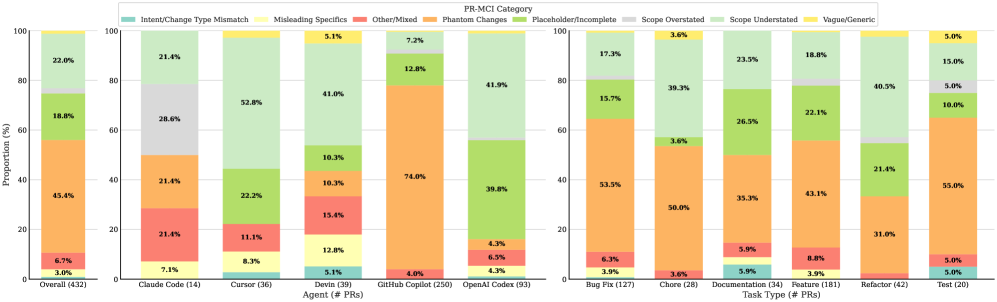
Analysis demonstrates that message-code inconsistency in agent-authored pull requests (PR-MCI) negatively impacts merge rates and review times, raising concerns about AI trustworthiness in software engineering.
While AI coding agents promise to accelerate software development, the reliability of their communication with human reviewers remains a critical concern. This is the central question addressed in ‘Analyzing Message-Code Inconsistency in AI Coding Agent-Authored Pull Requests’, a study quantifying discrepancies between AI-generated pull request descriptions and the implemented code changes. Our analysis of over 23,000 agentic pull requests reveals that such inconsistencies-which we term PR-MCI-significantly reduce acceptance rates and substantially increase merge times. Ultimately, can we build trust in AI-driven development workflows without verifying the fidelity of these crucial communicative messages?
The Illusion of Progress: AI Code and the Review Bottleneck
The software development landscape is undergoing a rapid transformation as Large Language Models (LLMs) become increasingly integrated into coding workflows. These powerful AI systems now routinely assist in generating code snippets, automating repetitive tasks, and even constructing entire functions with minimal human input. This capability dramatically accelerates development cycles, allowing engineers to focus on higher-level problem-solving and innovation rather than tedious implementation details. The integration isn’t limited to simple code completion; LLMs are now capable of producing functional code blocks from natural language prompts, effectively lowering the barrier to entry for both seasoned developers and those new to programming. This increased efficiency promises to reshape how software is conceived, built, and maintained, potentially leading to a surge in application development and a faster pace of technological advancement.
While artificial intelligence rapidly advances code generation, a critical bottleneck persists in the clarity and accuracy of accompanying pull request descriptions. Automatically generated summaries often fail to adequately reflect the nuances of implemented code changes, creating substantial friction during the code review process. This disconnect forces reviewers to expend considerable effort deciphering the intent behind modifications, rather than focusing on identifying potential bugs or architectural flaws. Consequently, the efficiency gains promised by AI-assisted development are diminished, and the risk of overlooking critical issues increases, highlighting a need for improved fidelity in automated PR summarization.
The efficiency gains promised by AI-driven code generation are currently hampered by a critical issue: a frequent misalignment between pull request descriptions and the implemented code changes. This disconnect isn’t merely cosmetic; it introduces significant friction into the code review process, forcing reviewers to expend additional effort clarifying the intent behind modifications. When a PR description fails to accurately reflect the code’s functionality, reviewers must actively reconstruct the purpose of the changes, increasing cognitive load and potentially overlooking subtle bugs or security vulnerabilities. Consequently, the time required for effective code review extends, diminishing the overall velocity of software development and negating some of the benefits of automated code generation.
A recent investigation into automatically generated pull requests – termed Agentic-PRs – uncovered a noteworthy fidelity issue, with 1.7% demonstrating high PR-MCI – or Pull Request-Mismatching Code Impact. This metric indicates a substantial disconnect between the textual description accompanying a code change and the actual modifications implemented within the code itself. While seemingly a small percentage, this finding highlights a critical gap in the ability of current AI-driven code generation tools to accurately and comprehensively convey the intent and consequences of their actions. Such mismatches introduce friction into the code review process, demanding increased effort from human reviewers to reconcile the description with the code and potentially increasing the risk of undetected errors or unintended consequences.
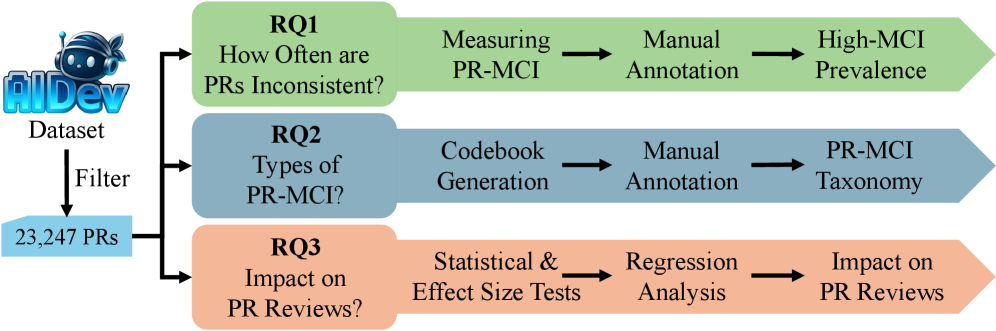
Defining the Disconnect: Introducing PR-MCI
PR-MCI, or Pull Request Message-Code Inconsistency, is defined as a metric used to determine the degree of correspondence between the textual description provided in a pull request and the actual code modifications introduced by that request. This measurement is not qualitative; rather, it is a quantifiable value derived from analyzing the stated intent of the PR description against a detailed examination of the committed code changes. The metric allows for systematic assessment of PR fidelity, enabling evaluation of whether the description accurately reflects the implemented functionality, bug fixes, or refactoring efforts. A higher PR-MCI value indicates a greater degree of misalignment between the message and the code, signaling potential issues with clarity or completeness.
The PR-MCI Taxonomy details specific types of inconsistencies between pull request descriptions and implemented code. ‘Scope Understated’ inconsistencies indicate the description does not fully reflect the extent of changes in the code. ‘Phantom Changes’ represent code modifications not mentioned in the PR description. Finally, ‘Placeholder/Incomplete’ descriptions are those containing temporary implementations or indicating unfinished work, despite corresponding code being present. This categorization allows for granular analysis of description fidelity and identification of common failure modes in AI-authored pull requests.
Analysis of pull request message-code inconsistencies revealed that “Phantom Changes” constitute the most prevalent category, representing 45.4% of all observed instances. This indicates that nearly half of all inconsistencies stem from pull request descriptions detailing changes not actually present in the committed code. These discrepancies suggest a misalignment between the intended modifications communicated in the PR message and the ultimately implemented code, potentially hindering code review efficiency and introducing ambiguity for developers.
The PR-MCI metric enables systematic evaluation of AI-authored pull requests by providing a quantifiable measurement of consistency between the PR description and the implemented code changes. This allows for objective assessment of AI performance in generating accurate and complete PR summaries. Repeated measurement of PR-MCI on AI-generated PRs facilitates iterative improvement of the AI model through targeted refinement of its description-generation capabilities. Specifically, tracking the frequency of different inconsistency types – such as ‘Scope Understated’ or ‘Phantom Changes’ – identified within the PR-MCI Taxonomy, allows developers to pinpoint specific areas where the AI struggles and focus training efforts accordingly, ultimately enhancing the quality and reliability of AI-assisted code contributions.
The Numbers Don’t Lie: Empirical Evidence from the AIDev Dataset
The empirical software engineering study leveraged the AIDev Dataset, a publicly available resource comprising pull requests sourced from a diverse range of software repositories on GitHub. This dataset includes detailed information on each pull request, encompassing code changes, author information, review history, and merge status. The AIDev Dataset was selected due to its scale – containing over 1.2 million pull requests as of the data release date – and its representation of multiple programming languages, project sizes, and contributor demographics. Data was programmatically extracted and processed to facilitate quantitative analysis of pull request characteristics and their correlation with acceptance and merge timelines. The dataset’s comprehensive nature allowed for statistically significant observations regarding the impact of AI-authored code on software development workflows.
The study centered on Agentic-PRs, defined as pull requests created by AI coding assistants including GitHub Copilot, Cursor, and OpenAI Codex. These PRs were specifically examined to determine their Pull Request Modification Cost Index (PR-MCI) scores. PR-MCI serves as a quantitative metric of the complexity and effort required to review and integrate the proposed changes within the codebase. Analysis of PR-MCI scores for Agentic-PRs enabled a comparison of the review burden and potential integration challenges posed by AI-authored code contributions relative to human-authored contributions.
Analysis of the AIDev Dataset revealed a statistically significant correlation between Pull Request Merge Compatibility Index (PR-MCI) and acceptance rates for AI-authored pull requests (Agentic-PRs). Specifically, Agentic-PRs categorized as having high PR-MCI demonstrated a 51.7% reduction in acceptance rates when compared to Agentic-PRs with low PR-MCI. This indicates that AI-generated code changes flagged as having greater compatibility issues, as measured by the PR-MCI, are substantially less likely to be approved and merged into the target repository. The PR-MCI metric, therefore, appears to be a strong predictor of successful integration for AI-authored contributions.
Analysis of the AIDev Dataset revealed that pull requests authored by AI agents and exhibiting high PR-MCI (Pull Request Modification Complexity Index) scores require 3.5 times longer to merge compared to those with low PR-MCI scores. This extended merge time indicates a substantial reduction in development velocity, suggesting that complex AI-authored contributions necessitate significantly more reviewer effort and integration time. The observed delay implies a potential bottleneck in workflows utilizing AI-assisted code generation, as the increased complexity directly impacts the speed at which changes can be incorporated into the codebase.
The Trust Problem: Implications for AI in Software Engineering
A significant challenge to widespread adoption of AI tools in software engineering centers on the prevalence of Pull Request-Merge Commit Inconsistency (PR-MCI), which signals a lack of transparency in how AI-generated code integrates with existing projects. High PR-MCI scores suggest developers may unknowingly accept code that doesn’t fully reflect the intended changes documented in the pull request, creating discrepancies and potentially introducing errors. This opacity erodes developer confidence, as it obscures the rationale behind code modifications and hinders effective code review. Without clear traceability between proposed changes and the final merged code, developers may become hesitant to rely on AI assistance, limiting the potential benefits of these technologies and fostering distrust in the collaborative development process.
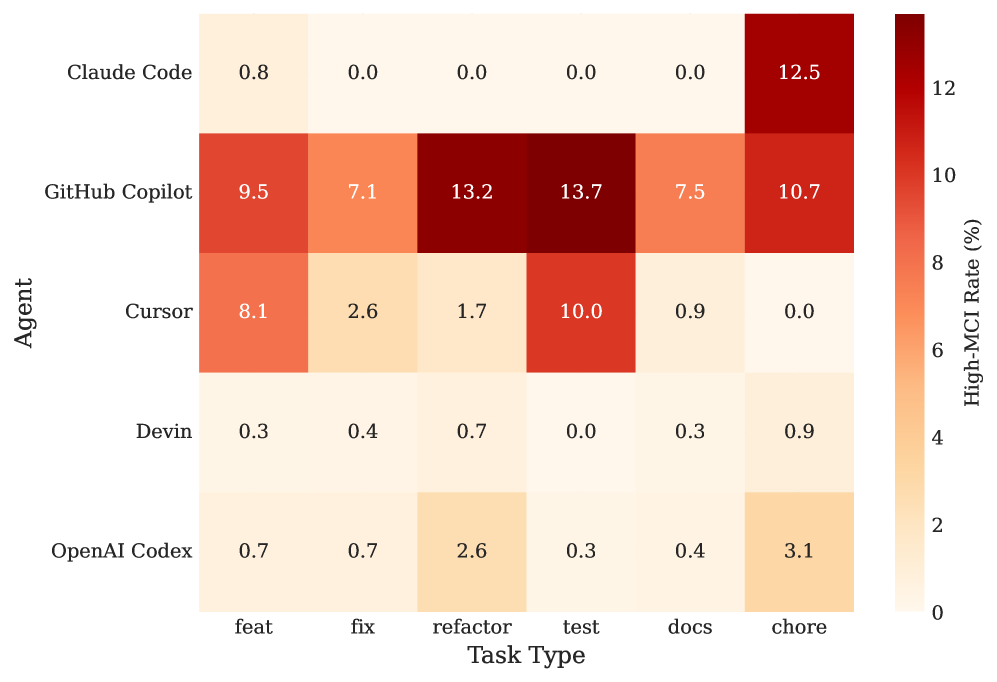
A comparative analysis reveals a significant disparity in the prevalence of Pull Request-Merge Conflict Introductions (PR-MCI) between two prominent AI pair programming tools. GitHub Copilot demonstrates a PR-MCI rate of 8.7%, indicating that nearly 9% of its code contributions lead to conflicts during integration with existing codebases. This figure is notably higher – approximately 20 times greater – than the 0.4% PR-MCI rate observed with Devin. The marked difference suggests that, while both tools offer assistance in software development, Copilot’s suggestions currently pose a substantially increased risk of creating integration challenges for developers, potentially hindering workflow efficiency and necessitating greater manual effort to resolve conflicts.
Analysis reveals a significant disparity in the prevalence of Pull Request-Merge Commit Inconsistency (PR-MCI) depending on the nature of the software engineering task. Specifically, PR-MCI occurs at a rate four times higher for ‘chore’ tasks – encompassing routine maintenance and operational adjustments – compared to ‘test’ tasks, which focus on verifying code functionality. This suggests that AI assistance, while potentially more reliable in generating code for well-defined testing scenarios, may introduce inconsistencies when applied to less rigorously defined or more automated operational tasks. The finding highlights a need for increased scrutiny and validation of AI-generated contributions to ‘chore’ tasks, ensuring that automated changes do not inadvertently compromise the integrity or maintainability of a software project.
Successfully integrating artificial intelligence into software engineering hinges on fostering a collaborative environment built on trust, and addressing prevalent issues like Pull Request Merge Conflict Introductions (PR-MCI) is paramount to achieving this. High rates of PR-MCI, where AI-generated code introduces conflicts during merging, directly undermine developer confidence and can lead to increased debugging time and project delays. Mitigating these conflicts isn’t simply a technical challenge; it’s a crucial step towards realizing the potential for AI to genuinely assist developers, rather than create additional burdens. A collaborative ecosystem, where developers readily accept and build upon AI contributions, demands a demonstrable commitment to code quality and seamless integration, ultimately unlocking the full benefits of AI-assisted development and fostering innovation.
The study of agentic pull requests reveals a predictable pattern. These large language models excel at generating code and accompanying descriptions, but consistently fail at ensuring those two align. The bug tracker will inevitably fill with discrepancies-a mismatch between promise and delivery. Grace Hopper observed, “It’s easier to ask forgiveness than it is to get permission.” This applies perfectly; the AI ‘ships’ first, creating technical debt in the form of PR-MCI, and then requests-or rather, requires-human reviewers to clean up the mess. The acceptance rates suffer, merge times balloon, and the illusion of effortless automation cracks. It isn’t innovation; it’s simply chaos with better PR.
The Road Ahead
The observation that an AI can describe a change to code without actually making that change should not, perhaps, be surprising. Anyone who has worked with developers-human ones-will recognize the pattern. Still, quantifying this ‘Message-Code Inconsistency’ is a useful exercise, mostly because it establishes a baseline for future disappointment. The current enthusiasm for agentic pull requests will undoubtedly lead to systems optimized for volume of changes, not correctness. It is a safe prediction that ‘scalability’ will be invoked frequently, conveniently ignoring the fact that a system’s ability to process many incorrect changes does not improve its fundamental flaws.
The real challenge isn’t better natural language processing; it’s building tools that reliably detect when the AI is, politely put, confabulating. Expect a proliferation of ‘PR-MCI detection’ frameworks, each promising 99% accuracy until they encounter the first edge case. Better one thoroughly tested unit test than a hundred confidently incorrect AI-generated ones.
The pursuit of ‘AI trustworthiness’ will continue, of course. But the field should acknowledge that perfect consistency is a theoretical ideal. The interesting question isn’t whether AI-authored PRs can be perfect, but how much inconsistency production teams are willing to tolerate before reverting to, well, actual engineers. It is a lesson history repeats, with slightly more elaborate tooling.
Original article: https://arxiv.org/pdf/2601.04886.pdf
Contact the author: https://www.linkedin.com/in/avetisyan/
See also:
- Clash Royale Best Boss Bandit Champion decks
- Vampire’s Fall 2 redeem codes and how to use them (June 2025)
- World Eternal Online promo codes and how to use them (September 2025)
- Mobile Legends January 2026 Leaks: Upcoming new skins, heroes, events and more
- How to find the Roaming Oak Tree in Heartopia
- Best Arena 9 Decks in Clast Royale
- ATHENA: Blood Twins Hero Tier List
- Clash Royale Furnace Evolution best decks guide
- Brawl Stars December 2025 Brawl Talk: Two New Brawlers, Buffie, Vault, New Skins, Game Modes, and more
- Clash Royale Season 79 “Fire and Ice” January 2026 Update and Balance Changes
2026-01-11 16:14