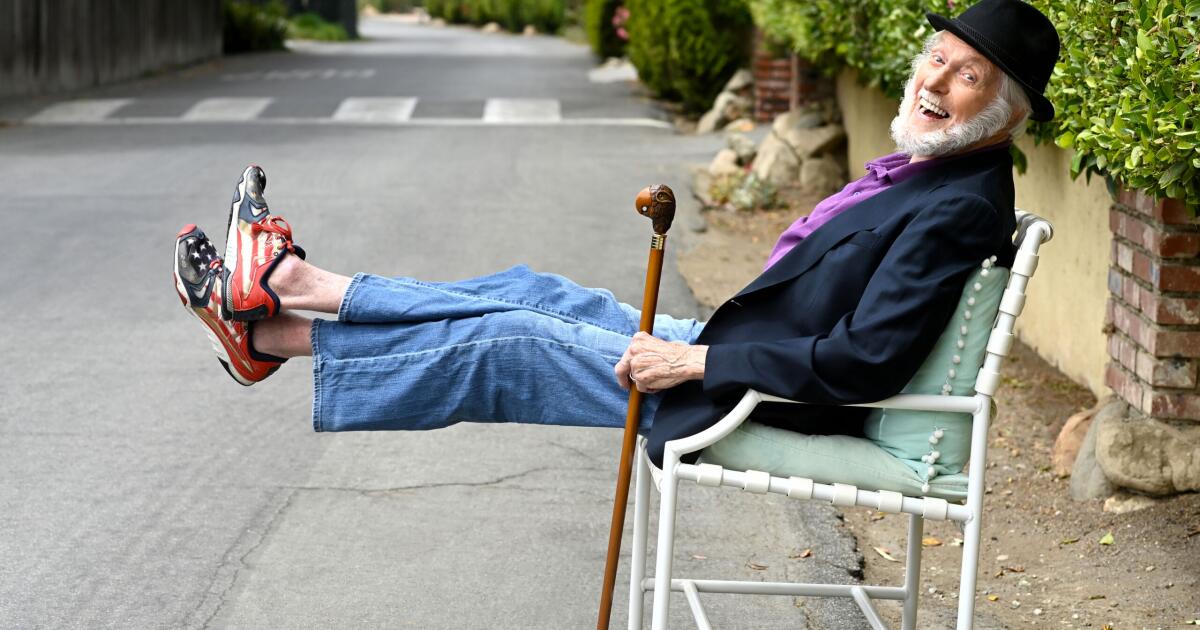
Dick Van Dyke is celebrating his 100th birthday this Saturday, and it feels like a truly momentous occasion – almost as if it wouldn’t feel right if he didn’t reach this milestone! I may be biased, but I hope younger generations still enjoy his classic shows like “The Dick Van Dyke Show” and “Mary Poppins.” Luckily, they’re still widely available and many parents are introducing them to their kids, so it seems likely they will continue to be loved for years to come.
While Dick Van Dyke isn’t working as much as he used to – a canceled event in June worried many fans – he’s still been seen in public over the past ten years. He often shares videos of himself dancing or exercising online, and he’s taken on a few acting roles. In 2023, he appeared as ‘The Gnome’ on ‘The Masked Singer’ and played a character with amnesia on ‘Days of Our Lives,’ a role that earned him another Emmy Award. He celebrated his 99th birthday by starring in a Coldplay music video filmed at his home, dancing to “All My Love” alongside Chris Martin, and the pair even appeared on “Jimmy Kimmel Live!” together. Last month, he released his latest book, “100 Rules for Living to 100: An Optimist’s Guide to a Happy Life,” following previous titles like “My Lucky Life In and Out of Show Business” (2011) and “Keep Moving: And Other Tips and Truths About Aging” (2015).
This Friday, PBS will air “Starring Dick Van Dyke,” a special as part of the “American Masters” series – a fitting title for such a beloved performer. (A separate film, “Dick Van Dyke 100th Celebration,” will be shown at Regent Theaters this Saturday and Sunday.) The documentary, directed by John Scheinfeld, celebrates the life and career of Van Dyke, a naturally joyful entertainer whose breakout role in “Bye Bye, Birdie” launched his success on Broadway, in film, and on television – and whose signature song is the optimistic “Put On a Happy Face.” While the film acknowledges Van Dyke’s past struggles with alcoholism – including a segment from a 1974 interview, noting he’s been sober since 1972 – it largely focuses on the positive. Difficult moments, like the end of his first marriage to Margie Willett (with whom he has four children), are handled delicately – described as “drifting apart” and shown through a digitally altered family photo. It’s worth noting that Dick Van Dyke wasn’t directly involved in making this film and didn’t provide any new interviews.
The film primarily showcases performance clips, but also includes heartwarming stories from Dick Van Dyke’s friends and admirers. People like Carol Burnett, who worked with him early in her career on “The Garry Moore Show” and later on “Van Dyke and Company” (where they hilariously improvised a slow-motion fight scene), share fond memories. Even Julie Andrews, his co-star in “Mary Poppins,” defends his often-criticized Cockney accent, saying he was simply so charming, funny, and captivating that it didn’t matter.

I just love Dick Van Dyke! Steve Martin says he’s unbelievably likable – a solid 10! Martin Short remembers writing ‘DVD’ in his scripts, which meant ‘do Dick Van Dyke’ – everyone wanted to work with him! Ted Danson, who acted with him on ‘Becker,’ says he played even serious roles with such grace and humanity. And Jim Carrey, who’s known for his physical comedy like Van Dyke, points out that famous stumble over the ottoman in the show’s opening wasn’t just a clumsy fall. Jim thinks it was a message – that you have to laugh at yourself and keep going, because life throws unexpected things at you, and we’re all a little ridiculous!
Conan O’Brien playfully compared him to the clay figure Gumby and even danced with him on his talk show. Larry Mathews, his TV son from “The Dick Van Dyke Show,” described him as relaxed and easygoing. The piece also features insights from Pat Boone, a contemporary of Van Dyke from the 1950s; Karen Dotrice, who played a child in “Mary Poppins”; NPR’s Eric Deggans, offering background information; and Victoria Rowell, a co-star from Van Dyke’s later series, “Diagnosis: Murder.” Interestingly, while “The Dick Van Dyke Show” is iconic, some may remember Van Dyke more for “Diagnosis: Murder,” which lasted three seasons longer.
The documentary also features interviews with the late Carl Reiner, creator of “The Dick Van Dyke Show,” who considered Van Dyke the most talented comedic actor ever. It also includes commentary from Mary Tyler Moore, his co-star. Their on-screen chemistry as Rob and Laurie Petrie was groundbreaking for 1961 and remains rare even today – they were a sitcom couple uniquely known for dancing and singing together. The show, which aired until 1966, was the ideal showcase for Van Dyke’s talents. It was a remarkably realistic comedy about work and family life, perfectly highlighting his physical comedy and expressive reactions, and the creators decided to end it while it was still fresh and successful.
As a movie, ‘Starring Dick Van Dyke’ struggles a bit with covering such a long life and career – spanning over eight decades. Like many documentaries, it feels a little messy, shaped by who was willing to be interviewed, the available footage (and its cost), and the filmmakers’ choices. It’s a shame there are no clips from his 1971 sitcom, ‘The New Dick Van Dyke Show’ – a show the filmmakers didn’t seem to value as much as I did. Surprisingly, the 2004 reunion special, ‘The Dick Van Dyke Show Revisited,’ isn’t mentioned either. I also wasn’t a fan of the documentary’s quirky visual style.
As a movie lover, I was really fascinated by all the little glimpses into his early life – like hearing a clip of him on local radio back in Danville, Illinois when he was just starting out. It was amazing to see footage of his early act, ‘The Merry Mutes,’ which is how he got his foot in the door performing in nightclubs in the late 40s. And it wasn’t all instant success! The documentary showed his attempts at being a morning news anchor (even working with Walter Cronkite!), a cartoon show host, and even a game show host. There’s a sweet moment of him performing ‘Put on a Happy Face’ with a fellow Broadway performer, Susan Watson, too. It really paints a picture of how he honed his skills before becoming a star.
The book understandably spends the most time on “The Dick Van Dyke Show” and “Mary Poppins,” including the sequel, “Mary Poppins Returns.” It’s wonderful to see production photos of Van Dyke, at age 93, dancing on a desk – reprising his role as the son of the character he originally played. These photos, and others, are a real treat for fans of both Moore and Andrews. Van Dyke playfully describes himself as “lazy” and “lucky,” emphasizing he wasn’t motivated by ambition, only the need to support his family, and doesn’t even consider himself a true actor. However, audiences clearly disagreed!
Beyond the 1968 film “Chitty Chitty Bang Bang,” which was similar to “Mary Poppins” and had its own unique charm, and the 1969 drama “The Comic” about a silent film star adjusting to talking pictures, Dick Van Dyke’s other theatrical films receive only brief mention and are represented by just a collection of movie posters. More focus is given to the 1974 TV movie “The Morning After,” where he played an alcoholic, around the time he publicly discussed his own struggles with alcohol.
The documentary occasionally feels like an advertisement, showcasing the charities Dick Van Dyke supports. However, two hours of his performances are undeniably enjoyable. The footage speaks for itself – moments like a man frantically searching for a tissue while trying not to sneeze, or the incredibly talented Van Dyke returning to magic, are funny even without any explanation.
This is also a story told through time, captured in a century of photos and films documenting every phase of his life. While his height and build have diminished with age, his familiar and expressive face remains instantly recognizable.
Read More
- Clash Royale Best Boss Bandit Champion decks
- Best Hero Card Decks in Clash Royale
- Clash Royale December 2025: Events, Challenges, Tournaments, and Rewards
- Clash Royale Witch Evolution best decks guide
- Best Arena 9 Decks in Clast Royale
- Clash of Clans Meltdown Mayhem December 2025 Event: Overview, Rewards, and more
- Cookie Run: Kingdom Beast Raid ‘Key to the Heart’ Guide and Tips
- Call of Duty Mobile: DMZ Recon Guide: Overview, How to Play, Progression, and more
- Clash of Clans Clan Rush December 2025 Event: Overview, How to Play, Rewards, and more
- Best Builds for Undertaker in Elden Ring Nightreign Forsaken Hollows
2025-12-12 14:32