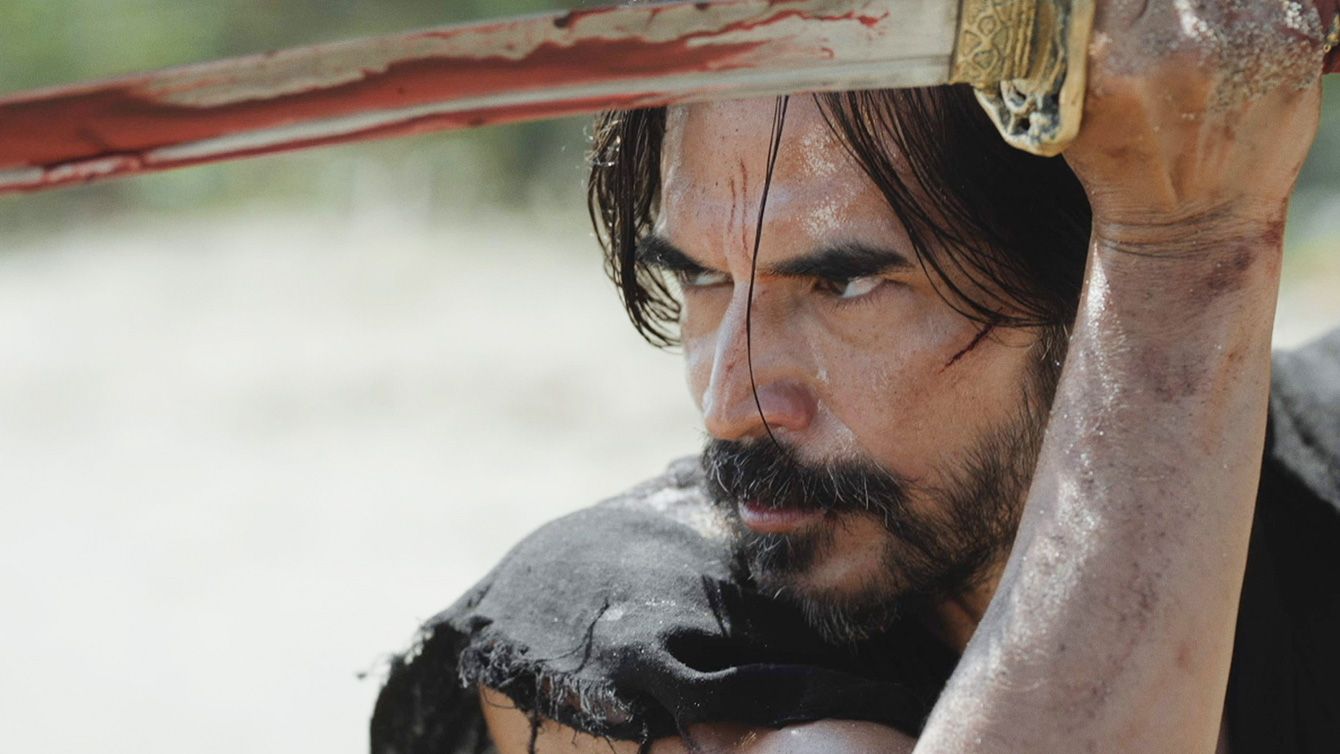
Traditional haiku poems often focus on common elements of nature – things like thunder, rain, and rocks – and explore their deeper meaning to reflect on human experiences. Josh C. Waller’s Lone Samurai uses poetic language, particularly through the character Riku’s narration, and visually resembles the simple, evocative style of classic Japanese poetry. The film portrays the full range of a swordsman’s life – from despair and violence to resilience and peace – all within the scope of a single day.
The story begins in the late 1200s, after a Japanese samurai force repelled Kublai Khan’s invasion. We meet Riku washed ashore on a lonely beach, gravely wounded with a wooden stake through his leg. The opening scenes immediately establish the film’s focus on physical hardship. Despite his severe injury, Riku pulls himself free and begins a journey across a desolate landscape of forests, valleys, and waterfalls. This land becomes a surreal and haunting reflection of his memories, blurring the line between dream and nightmare.
Lone Samurai is, Ironically, Best When Not Focused on the Action.
Riku journeys through a beautiful, yet lonely landscape, haunted by memories of his wife, Army (Sumire Ashina), and their children, who seem to be gone. While the portrayal of Army leans heavily into the overused trope of the sad, deceased wife common in action movies, the film generally stays focused. Surprisingly, even though the movie is advertised as a battle between samurai and cannibals, the most compelling parts happen before the action starts.
Riku attempts to perform a traditional samurai suicide, called seppuku, twice, but is stopped both times – first by seeing a mountain, and second by being hit with a rock. He’s been captured by a violent, cult-like group that practices cannibalism, and he needs to find a way out. Fortunately, he manages to escape without much trouble. As a skilled samurai facing a small, isolated group of cannibals, he has a clear advantage.
The fight choreography shares a similar energetic style with the film The Raid, creating some genuinely thrilling moments. However, the director doesn’t always capture the action effectively, with cuts that interrupt the flow and don’t showcase the martial artist’s skills fully. Plus, the main character is so dominant in fights that it diminishes the suspense.
However, the film’s biggest problem lies in the uncomfortable message it seems to send about society. Given Japan’s history as a colonial power in Indonesia, the scenes of a Japanese man killing many Indonesians feel problematic and insensitive. It’s reminiscent of a director who doesn’t understand the culture he’s filming, and this unfortunately overshadows much of the movie’s good qualities.
The movie would have likely been strongest as a survival story similar to Cast Away. It starts beautifully with a peaceful atmosphere, but unfortunately, it shifts into excessive violence, losing the impressive quality it initially established. Like Zatoichi or Lone Samurai, it works as a tale of a unique and fiercely loyal warrior, but the character of Riku could benefit from a more complex story in the future.
Read More
- Clash Royale Best Boss Bandit Champion decks
- Best Hero Card Decks in Clash Royale
- Clash Royale Witch Evolution best decks guide
- Ireland, Spain and more countries withdraw from Eurovision Song Contest 2026
- Clash Royale December 2025: Events, Challenges, Tournaments, and Rewards
- JoJo’s Bizarre Adventure: Ora Ora Overdrive unites iconic characters in a sim RPG, launching on mobile this fall
- ‘The Abandons’ tries to mine new ground, but treads old western territory instead
- How to get your Discord Checkpoint 2025
- Best Builds for Undertaker in Elden Ring Nightreign Forsaken Hollows
- HAIKYU!! FLY HIGH Character Tier List
2025-12-08 18:00