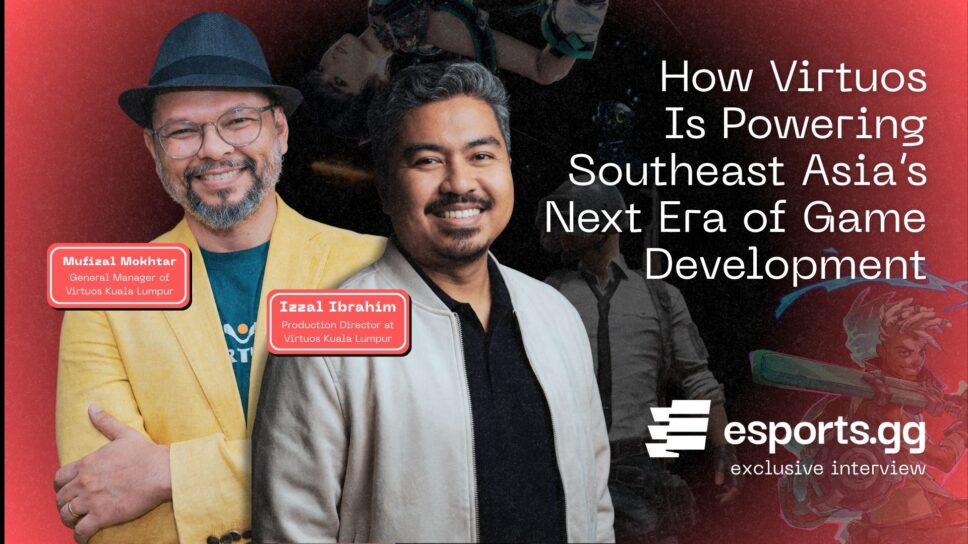
Virtuos highlights how working together on game development projects can help Southeast Asia become a leading hub for new ideas and creativity in the gaming world.
Southeast Asia is quickly becoming a major player in the global gaming world. Initially known mostly for its large number of players, the region is now a thriving hub for game development. Ambitious studios and diverse teams are emerging in Southeast Asia, and the preferences of its gamers are increasingly influencing gaming trends around the world.
Virtuos is one company that has benefited from this growing trend. They’re a game development studio that has contributed to many popular and well-known games, such as The Elder Scrolls IV: Remastered, PUBG, League of Legends, 2XKO, and Stellar Blade.
Mufizal Mokhtar, General Manager, and Izzal Ibrahim, Production Director at Virtuos Kuala Lumpur, recently spoke with Esports.gg about the rapid expansion of esports in Southeast Asia. They discussed how game development is changing, with more collaboration, and predicted that over the next ten years, Asia could become a leading creator of popular games enjoyed around the world, rather than just a support hub.
A region ready for global play
As a big fan of Virtuos, I’ve noticed how much they value the Southeast Asian region. It’s clear to me that they see the diverse languages and cultures here as a real strength – it makes SEA perfect for handling really complicated game development projects on a global scale.
Mufizal points out that this is a major benefit when creating complicated games, as clear communication is essential. He also noted that the Malaysian government is actively supporting these efforts, which helps improve the region’s overall infrastructure. As a result, Southeast Asia – particularly Malaysia – is evolving from simply a place to find workers to a hub for creative game development.
Over the last ten years, gaming has become much more accessible, sparking increased interest in game development. According to Mufizal, this interest fuels a positive cycle: a growing pool of talented developers leads to more job opportunities and attracts larger game projects to Southeast Asia.
Izzal notes a rising sense of local pride among players learning that popular, worldwide games were at least partially created right here. Virtuos KL, with its work on famous game franchises, is challenging the outdated idea that game development only takes place in the U.S., Japan, or Europe.
“And this passion,” he says, “is shown in the quality of work we deliver out of SEA.”
Co-development’s evolution from support to creative Partner
With increasingly ambitious game projects, development has become more complicated. Working with external studios is no longer just about getting extra assistance – it’s now a crucial part of how games are made.
Mufizal points out that creating today’s big-budget games involves a complex, multi-stage process, starting with initial ideas and continuing even after the game is released. Because of this, teamwork is essential. When done effectively, this approach allows creative directors to concentrate on what matters most: the overall concept, refining the gameplay, and making sure the game is enjoyable.
Izzal has also noticed a change in the region, with teams in Southeast Asia taking on more complex and creative roles in game development. They’re moving beyond simply creating game assets to actively co-developing entire games. He believes bringing in fresh perspectives is key to improving game ideas, and Virtuos’ extensive experience with over 1,500 games allows them to significantly boost their partners’ projects.
What makes Virtuos special isn’t just its size; it’s the company’s ability to bring together diverse cultures and viewpoints. With studios around the world, Virtuos fosters a unique exchange of ideas through internal groups, training programs, and opportunities for employees to work across locations.
This is important because game development teams that work together for a long time can fall into established patterns, according to Izzal. Virtuos brings fresh perspectives that help partners question their usual approaches and improve even the smallest parts of the game. This creative benefit comes from the people involved, not just the technology they use.
The “glocalised” collaboration approach of Virtuos
Virtuos excels at ‘glocalization’ – combining global resources with local expertise. For example, a client in Asia might collaborate with our team in Kuala Lumpur for daily communication and project management, while also tapping into the specialized visual effects skills of our artists in Los Angeles. Having local teams who understand cultural differences helps us communicate effectively and ensures everyone is on the same page creatively.
As a gamer who’s worked with teams all over the world, I’ve noticed something interesting. Western players usually appreciate really direct feedback – just tell it like it is! But with Asian teams, it’s different. They tend to prefer a more subtle, indirect approach to discussions. That’s where Virtuos comes in – they’re great at understanding those differences and helping everyone communicate effectively, basically bridging the gap between those styles.
According to Izzal, clear communication and solid teamwork are essential for a great game. This approach, rooted in the way the company operates, is a core principle for their producers.
Virtuos’ regional expansion isn’t about planting flags. It’s also guided by three criteria:
- Deep talent pools
- Specialized expertise
- Proximity to clients
Companies like CounterPunch and Pipeworks excel in areas like facial animation, collaborative game development, and ongoing live game support. At the same time, studios in Southeast Asia, such as Virtuos KL, are dedicated to developing local talent and expanding game development beyond mobile and smaller indie projects. Ultimately, the aim is to establish major, high-quality game development centers in regions that haven’t traditionally been known for them.
To help Southeast Asia thrive, developing skilled workers is crucial. That’s why Virtuos is making significant investments in talent development programs.
Virtuos KL collaborates with more than 10 schools by helping to design their courses and providing support like presentations, mentorship, and a comprehensive training program called the Virtuos Induction Program. Their Central Technology Group also ensures teams have the latest training and efficient work processes.
Izzal believes Malaysia and Southeast Asia have a great chance to grow in the areas of AA and AAA game development. He points out that larger projects will bring more attention, create more employment opportunities, and boost the region’s standing on the world stage.
Technology as an enabler, not a replacement
As generative AI becomes more popular, concerns are increasing about its impact on jobs and creative work. Many developers and gamers are worried that depending too much on AI could result in games that feel fake, predictable, or even completely lacking in originality and artistic quality.
It’s not just about AI replacing jobs in gaming; it’s also about preserving the emotional connection, cultural relevance, and unique feel that human creativity brings to games. The industry is now facing the challenge of adopting new AI technologies without losing the artistic qualities that make games special.
Generative AI and advancements in engine technology are changing how work gets done, and Virtuos is exploring these changes carefully. Mufizal explains that their main goal is to equip their teams with the following tools and resources:
- Streamline training
- Optimize project management
- Automate repetitive tasks
- Free developers for creative work
We’re still focused on the same core idea: collaborating to create games more effectively, and ultimately, making those games even better.
Virtuos helps Asian IP break out globally
As more games are created in Asia and gain popularity worldwide, Virtuos helps game studios grow beyond small, independent operations. They partner with mid-sized development teams, providing specialized skills and deep knowledge of game engines that these teams might lack internally. This allows the studios to concentrate on the creative aspects of game development instead of getting bogged down in technical challenges.
Izzal believes it won’t be long before one of these film studios becomes a huge international success.
Do leaders think Asia will be a major creator of new content and ideas? They both agree that this is already happening.
Malaysia is proving itself as a creator of successful games, with titles like No Straight Roads from Metronomik and OPNeon Games’ TCG Card Shop Simulator each selling over a million copies. As the country’s technical skills improve, we can expect even more innovative and ambitious games to emerge.
Virtuos believes it plays a crucial role in changing how games are made. They’re not simply creating games today, but are also helping to shape the future of game development across Asia.
Read More
- Clash Royale Best Boss Bandit Champion decks
- Clash Royale December 2025: Events, Challenges, Tournaments, and Rewards
- Best Hero Card Decks in Clash Royale
- Ireland, Spain and more countries withdraw from Eurovision Song Contest 2026
- Clash Royale Witch Evolution best decks guide
- JoJo’s Bizarre Adventure: Ora Ora Overdrive unites iconic characters in a sim RPG, launching on mobile this fall
- Mobile Legends December 2025 Leaks: Upcoming new skins, heroes, events and more
- ‘The Abandons’ tries to mine new ground, but treads old western territory instead
- Clash Royale Furnace Evolution best decks guide
- Mobile Legends November 2025 Leaks: Upcoming new heroes, skins, events and more
2025-12-05 20:43