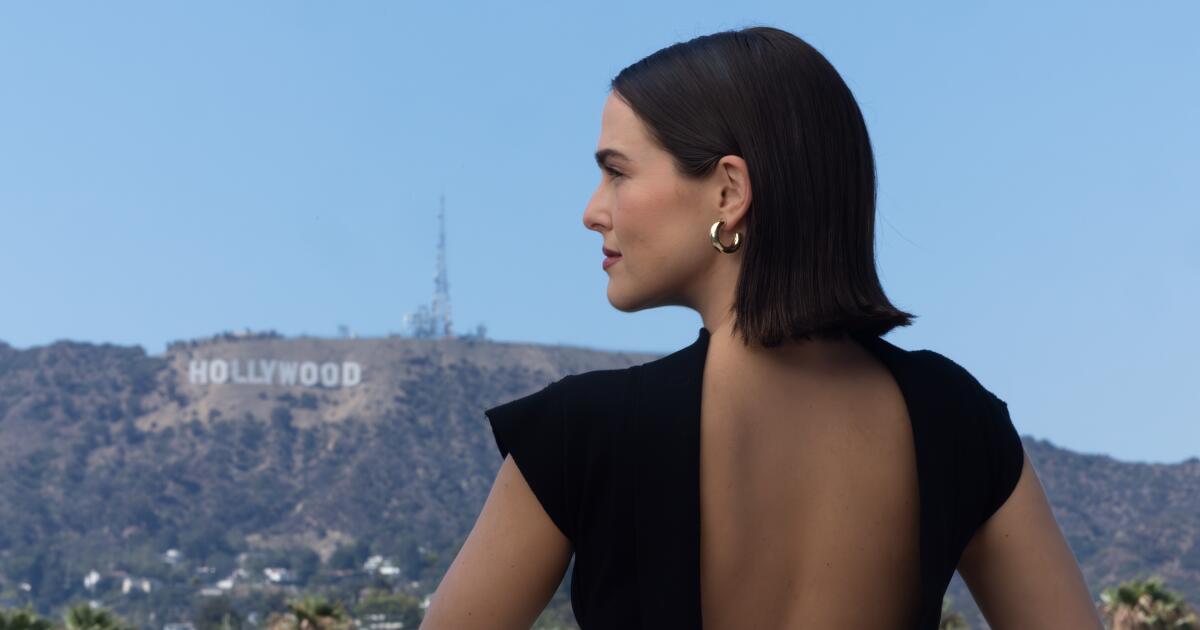
In creating a film that unveils the backstage story of one of cinema’s most groundbreaking and impactful movies, it might seem surprising for the entire narrative to revolve around a simple haircut. However, in the case of “Nouvelle Vague,” focusing on just such an element played a significant role as they delved into the making of Jean-Luc Godard’s revolutionary 1960 debut film, “Breathless.
As the film’s director, Richard Linklater, puts it, “All the roads led up to the haircut moment.”
Film director Richard Linklater, famed for movies like “Slacker,” “Before Sunrise,” and “Boyhood,” collaborated with actress Zoey Deutch for the first time in the 2016 baseball comedy “Everybody Wants Some!!”. It was during this project that he shared with her the concept of portraying Jean Seberg, an American actress who starred as the female lead in Godard’s Paris-based film about a hunted low-level criminal on the run. (“Nouvelle Vague,” which had its debut at Cannes earlier this year, will screen at both Toronto and New York festivals before hitting theaters on October 31 and Netflix on November 14.)

In the original movie, Seberg’s stylish, ultra-short blonde pixie cut set global fashion trends and embodied a carefree, youthful attitude. To recreate this iconic look, actress Margaret Qualley collaborated with colorist Tracey Cunningham and stylist Bridget Brager in Los Angeles. During a recent interview at Netflix’s Sunset Boulevard offices, overlooking the Hollywood sign, Qualley shared that she felt no apprehension about undergoing this transformation.
According to Deutch, aged 30, everyone around her seemed to find it particularly challenging. She noticed that both women and men would inquire about her well-being, expressing their disbelief and curiosity. Her situation became the centerpiece of conversations. It felt akin to an intriguing social experiment for her.
For Linklater, it was worth the wait.
In a video call from his home in Texas, Linklater reminisced about envisioning for several months that he was in Paris, introducing himself as “Jean Seberg”, only to have people recognize the brunette American. He went on to say, “I thought she was the ideal Seberg; trust me.” Then, the short-haired Zoey entered the room as Seberg, and everyone reacted with, “Oh, I see. That’s her.
German’s performances often exude a mischievous, lighthearted spirit, hinting at an understanding of the material, no matter if it’s a specific genre or setting. This aligns perfectly with the movie-obsessed environment of Godard and the collective of French New Wave filmmakers in “Nouvelle Vague.
Linklater refers to Zoey as an actress with a versatile portfolio, having successfully taken on diverse roles spanning from the teen drama ‘Before I Fall’, romantic comedies such as ‘Set It Up’, and even a legal thriller like ‘Juror #2’, demonstrating her ability to adapt across various genres.
When you watch her movies, Zoey shows a wide range of characters without fear, even playing tough or emotionally intense roles. This unwavering courage she displays is something I deeply respect.

As a devoted cinephile, I’ve been eagerly following Linklater’s work since his energetic coming-of-age comedy “Everybody Wants Some!!”. Over the years, we’ve kept in touch, and occasionally he’d drop a hint about an intriguing project-the Seberg film.
Fast forward a few years, and I couldn’t help but wonder if this captivating venture might actually materialize. Intrigued by the possibility, Deutch dove headfirst into the world of the French New Wave, immersing herself in their iconic films, and even learning fluent French to authentically capture the essence of the era.
She mentions that she likes to prepare for good fortune, as she’s currently in Los Angeles taking a brief pause from filming ‘Voicemails for Isabelle’, which is being shot in Vancouver.
In August 1960, there was an interview on television where Seberg provided a tour of her Paris apartment, switching between French and English. This interview served as a reference point for Deutsch. During the interview, Seberg attempted to conceal her native Midwestern accent by adopting a more mid-Atlantic tone, which was fashionable among performers at that time. Additionally, she spoke fluent French during this conversation.

Deutch mentioned that he felt relieved to have played her during a time when her French wasn’t flawless, as it made the encounter less daunting for him.
She comments, “I find her to be a profoundly enigmatic individual. Learning French for our film gave me a unique insight into her character, as well as the hairstyle. Working on an entire movie in a foreign language presented its own set of difficulties, but it was also incredibly rewarding because it allowed me to grasp her true nature.
Born in Marshalltown, Iowa, Jean Seberg rose to stardom after being chosen by director Otto Preminger for the lead role in his 1957 epic “Saint Joan.” During filming of the climactic burned-at-the-stake scene, she was injured and subsequently endured harsh criticism from the film’s reviews. Despite this, Preminger selected her again for his 1958 production “Bonjour Tristesse,” where she faced further psychological distress during production.
Jean Seberg, originally from Iowa, gained fame when Otto Preminger picked her to star in his movie “Saint Joan” (1957). She got hurt while filming the final burning-at-the-stake scene and felt terrible about the negative reviews. Despite this, Preminger chose her for another movie, “Bonjour Tristesse” (1958), where she faced more stress during filming.
Following the success of “Breathless” that catapulted Seberg into international stardom, her career experienced fluctuations. Her outspoken political views earned her scrutiny, resulting in FBI surveillance throughout her life. In 1979, tragically, her lifeless body was found in the backseat of her car in Paris, and her death was officially deemed a suicide.
Deutch explains, “Is her life afterward an intriguing mix of captivating, intense, and heart-wrenching events? Yes, it is. However, Rick wanted to focus on telling a story set at a particular point in time. We’re not revealing anything beyond that moment. At this stage, Godard isn’t renowned yet – he’s not the legend you might know later. You don’t know who he is or what he’s doing. He’s not who he will become.
In “Nouvelle Vague,” the relationship between Seberg and Godard (portrayed by Guillaume Marbeck) is central. Seberg frequently finds herself frustrated by Godard’s unorthodox concepts, not hesitating to voice her disapproval. However, Deutch skillfully captures Marbeck’s Godard character with his dry, Godardian mutterings, which range from affectionate to sharply sarcastic, providing a humorous touch to the film. Over time, they develop mutual respect for each other.
While working on the movie, Deutsch found that she was essentially portraying three roles: the real-life Seberg, the character of Patricia from “Breathless”, and the instances where Seberg briefly appears as she plays Patricia.
In “New Wave,” the scene reminiscent of “Breathless” where Jean-Paul Belmondo and Seberg take a playful walk along the Champs-Élysées was recreated. To accomplish this, Deutch had to meticulously mimic Seberg’s on-screen actions as Patricia, simultaneously delivering lines that were spoken by Seberg later, as the film recorded its dialogue post-production. Essentially, he played both characters concurrently.

Despite Seberg being thrust abruptly into the limelight with her initial films, Deutch, who was born in Los Angeles to “Back to the Future” actress Lea Thompson and film director Howard Deutch (“Pretty in Pink”), found a relatability in Seberg’s hardships.
According to Deutch, there’s a common, intuitive grasp shared by many who have been young actresses – you understand it. The experience of being a woman in Hollywood during youth is not exclusive to any specific time period; everyone involved encounters this reality.
Deutch notes, “However, I have a great deal of compassion and it hurts deeply when I think about her situation at 19, lacking a community to guide her through turbulent times. She’s an incredibly resilient, courageous, and intelligent woman. It’s only fair that we acknowledge our different upbringings and sympathize with anyone who finds themselves without a support system upon entering the world.

In the creation of “Nouvelle Vague,” they drew heavily from a wealth of resources about the filming of “Breathless.” This included numerous books, documentaries, and even the actual paperwork from the original set. Notably, the same camera that cinematographer Raoul Coutard used to film “Breathless” was the one featured onscreen in “Nouvelle Vague,” capturing the action there.
In the process of designing costumes for the movie, Pascaline Chavanne delved extensively into the history behind the clothes from the original production. However, some outfits were generously supplied by Chanel, among them a replica of a cappuccino-striped dress that Deutsch found so appealing she decided to wear it to the film’s Cannes photo call event.
In the movie, they needed to replicate the famous T-shirt that Jean Seberg wore during the Champs-Élysées scene, which bears the New York Herald Tribune’s logo. This image is now among the film’s most treasured moments.
According to Deutch, recalling the experience with a sincere tone, “There were spots where we could afford some flexibility and creative interpretation, but that particular shirt was not among them.” The emphasis was on achieving perfection in the ribbing design. They experimented extensively with various text styles and sizes to get it just right.
In a similar fashion, Deutsch borrowed snippets from “Breathless” and integrated them into “Nouvelle Vague,” such as casually entering sets or delivering lines with varying tones. This was reminiscent of Linklater’s approach during the filming of “Everybody Wants Some!!”, where he incorporated elements of the movie-making process to lend an air of spontaneity and unpredictability to the film itself.
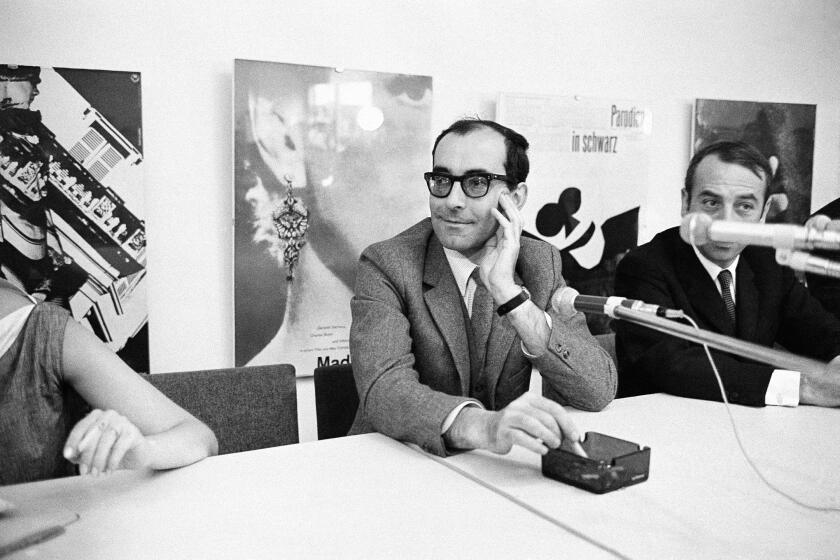
Appreciation: Jean-Luc Godard, a master of cinema who changed the medium forever
Throughout a six-decade long journey filled with masterpieces such as “Breathless,” “Week-end,” and “Goodbye to Language,” this exceptional, innovative artist consistently found a way to impress even the most discerning critics.
Deutch noted that he spent a great deal of time closely observing the film ‘Breathless’ and began questioning certain peculiar scenes that seemed out of place. He considers Godard and Linklater to be directors with a similar authentic spirit, stating that they both possess a presence that allows them to incorporate such elements in their work.
Linklater compares crafting the film to a spiritual gathering with the departed, since only two individuals depicted in it are reportedly still living. For him, reenacting iconic scenes like Seberg tracing her lips as Belmondo did holds great significance – it’s like summoning them spiritually.
In simpler terms, Linklater mentions that his most cherished moments occur when an actor delivers a stellar performance during filming, making them unique scenes. As a director, he has the privilege of being among the first to witness these exceptional acts, appreciating their talent and understanding the impact they will have on the movie. He eagerly anticipates editing and incorporating these remarkable scenes into the final production.
After they call ‘cut,’ reality swiftly moves back in and takes over, he notes. Magic may have occurred, but for now, let’s proceed. It’s as if ordinary life reclaims its hold on the magical moment – one might wonder what others present made of it.
According to Deutch, when making a movie, there’s often an unseen aspect that most viewers aren’t aware of. On-set events like arguments with your partner or the loss of a pet may leave an impact on the filmmakers, but these personal experiences usually go unnoticed by the audience. Viewers tend to appreciate the final product without knowing its behind-the-scenes history. However, those involved in the production feel, see, and remember the emotional undertones.
She’s expressing a mission statement that rivals any other. By blending the emotional resonance of “Breathless” with the tale of its origins, “Nouvelle Vague” discovers its unique heart and purpose: it embodies what happens when individuals with aspirations, skills, and creative spirit tap into their personal power.
Read More
- Mobile Legends: Bang Bang (MLBB) Sora Guide: Best Build, Emblem and Gameplay Tips
- Brawl Stars December 2025 Brawl Talk: Two New Brawlers, Buffie, Vault, New Skins, Game Modes, and more
- Clash Royale Best Boss Bandit Champion decks
- Best Hero Card Decks in Clash Royale
- Best Arena 9 Decks in Clast Royale
- Clash Royale December 2025: Events, Challenges, Tournaments, and Rewards
- Call of Duty Mobile: DMZ Recon Guide: Overview, How to Play, Progression, and more
- All Brawl Stars Brawliday Rewards For 2025
- Clash Royale Best Arena 14 Decks
- Clash Royale Witch Evolution best decks guide
2025-08-20 13:35