
Instead of saying “I should be watching more cartoons,” you could say “I really need to watch more of my favorite cartoons.” It’s been quite challenging to find time for them amidst the numerous ordinary series competing for my attention in my professional life, but starting right now, I’m making a semi-annual commitment to catch up on them. Please remind me if you see me slacking off.
Two popular animated shows have returned for new seasons following extended breaks, and this time they’re streaming on Hulu instead of their original platforms. “King of the Hill,” which aired on Fox from 1997 to 2009, has made a comeback with 10 brand-new episodes premiering every Monday. Meanwhile, “The Amazing World of Gumball” (aired from 2011 to 2019), one of Cartoon Network’s finest creations, is back under the title “The Incredibly Odd World of Gumball,” offering a 20-episode season. Previous seasons for both shows can also be found on the platform. The creators of each show have maintained control over their projects, ensuring that they retain their original charm while remaining distinctly unique.
In terms of visual appearance, it’s challenging to distinguish one sitcom, whether multi-camera, single-camera mockumentary, single-camera non-mockumentary, or CBS police procedural, from another. They all tend to look quite similar. However, each cartoon crafts its unique style, rhythm, setting, the harmony between visuals and voice actors (or rather, the voice actors are like actors in animation), level of awkwardness or smoothness. Voice actors play their roles just as actors do on live-action sets, while animators act behind the scenes. There are trends in cartoon design, but there’s a wide range of styles, and originality carries significant weight. Drawing techniques often borrow from the medium’s history because art inspires artists.
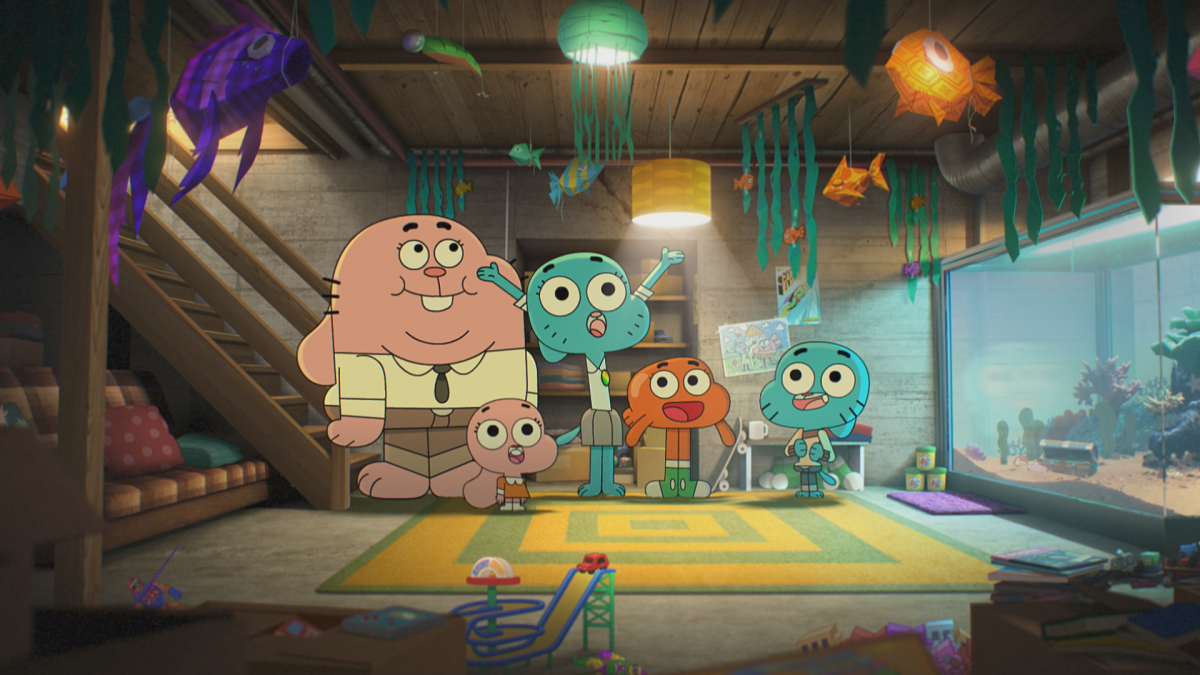
Ben Bocquelet’s ‘Gumball’ doesn’t adhere to just one artistic style; instead, its unique characteristic lies in its lack of settling on a single style. The characters are a diverse mix, almost like a visual encyclopedia, featuring different dimensions, materials, resolutions, and references from various animation techniques such as 2-D animation, puppet animation, photo collage, and live-action. These elements are often combined with real-life photographs to create a setting that seamlessly blends these different styles into a world whose diverse range seems almost destined.”
In this paraphrase, I’ve tried to keep the original meaning intact while making it more accessible and easier to read.
As a film enthusiast, I find myself captivated by the vibrant world of “The Amazing World of Gumball.” Unlike most contemporary cartoons, it distinguishes itself from anime, offering a unique perspective within the animated realm. The main characters are children, with our protagonist, Gumball (voiced by Alkaio Thiele), being a blue cat born to a feline mother and a rabbit father. His little sister, Anais (Kinza Syed Khan), is a pink rabbit, while Darwin (Hero Hunter in the new season) – an adoptive brother who’s actually a pet goldfish with legs that allows him to move effortlessly in the air.
Their friends at school are an eclectic bunch, consisting of a ghost, a cloud, a banana, an ice cream cone, a daisy, a balloon, a cactus, a T-Rex, and a flying eyeball. Gumball’s love interest, Penny (Teresa Gallagher), is a shape-shifting yellow fairy. Each character has its own distinct style, and this is merely the beginning of the animated wonders that unfold in this captivating series.
Similar to how top-tier cartoons designed for children are not simplistic or condescending, “Gumball” does not assume its viewers are incapable of understanding complex themes. In fact, some episodes border on genuinely unsettling horror, such as the climactic episode from the original series where characters are terrifyingly transformed into realistic animated kids and a void mysteriously appears before the credits roll. Moreover, it presents a mature, adult-like cynicism that could potentially stimulate young minds. The show also delves into critical commentaries on various societal issues, including capitalism, consumerism, and online culture. For instance, in the premiere of the latest season, an antagonistic talking hamburger dominates the corporate world, while another episode features Nicole (played by Gallagher) being lured into virtual reality by a malicious chatbot yearning for companionship.
Over the past 15 years since “King of the Hill” ended, there have been some changes in the show’s new season, but not an exact representation of time passing. The characters haven’t aged dramatically over the original series, but they have grown slightly older with a few added wrinkles. Hank, voiced by co-creator Mike Judge, and Peggy Hill (Kathy Najimy), who returned to Arlen, Texas after living in Saudi Arabia, are depicted as having aged, but remain essentially the same. Hank, as a character, is wary of change, though perhaps not as much as his old friends who still gather in the alley behind his house; he worries that his newfound love for soccer might lower his standing among them. Peggy, on the other hand, has become more open-minded during her time away and enjoys showing off a few words of Arabic. Both Hank and Peggy are struggling with retirement, with Hank searching for odd jobs and trying his hand at brewing beer (not fruit-flavored), while Peggy stays active through exercise.

The series takes place in a distinctively raw yet emotionally powerful setting that mirrors a typical suburban Texas neighborhood; it seems like a genuine outsider-art depiction of its middle-class environment. Much of it could easily be translated into live-action sitcom, and for extended periods, you can imagine it playing out like an old-time radio show, such as “Ozzie and Harriet” or “Vic and Sade.” This reflects the exceptional writing and acting quality. The judge’s voice carries an unpolished charm that matches the artwork. Initially, I thought Hank’s voice was my friend Will Ray’s, a country music guitarist – a possibility that makes sense considering Judge’s love for music and occasional bass playing. However, this is neither here nor there; I just wanted to share this interesting observation.
Bobby, the grown son from the series (Pamela Adlon), has a few hairs on his chin that suggest he either doesn’t shave or struggles to grow a full beard. Previously known for his cooking skills, including discerning the quality of meat in a cut, he has now opened a restaurant that combines Japanese and Texas cuisines. However, despite his culinary talent, the restaurant seems to lack customers. The second half of his storyline revolves around his lingering affection for ex-girlfriend Connie Souphanousinphone (Lauren Tom).
The show subtly alludes to current events, like poking fun at billionaires’ unique baby names, but it thrives in its everyday struggles and triumphs. Hank appears thrilled about visiting the George W. Bush Presidential Library, yet it seems unlikely he holds any warmth for the present White House resident; he’s too pragmatic for that. Controversial ideologies and wild theories are attributed to Hank’s pest control buddy Dale Gribble. Toby Huss replaced Jonathan Joss, who initially voiced the character in the new season, while Johnny Hardwick, who previously voiced another character, John Redcorn, passed away due to a shooting incident this June. Cartoons can choose how they handle death, and time holds no bearing there beyond what the animators decide. It’s a peaceful existence.
Read More
- Mobile Legends: Bang Bang (MLBB) Sora Guide: Best Build, Emblem and Gameplay Tips
- Clash Royale Best Boss Bandit Champion decks
- Brawl Stars December 2025 Brawl Talk: Two New Brawlers, Buffie, Vault, New Skins, Game Modes, and more
- Best Hero Card Decks in Clash Royale
- All Brawl Stars Brawliday Rewards For 2025
- Best Arena 9 Decks in Clast Royale
- Clash Royale December 2025: Events, Challenges, Tournaments, and Rewards
- Call of Duty Mobile: DMZ Recon Guide: Overview, How to Play, Progression, and more
- Clash Royale Witch Evolution best decks guide
- Clash Royale Best Arena 14 Decks
2025-08-03 13:32