Author: Denis Avetisyan
A new collaborative workspace, Reflexis, aims to enhance the rigor and transparency of qualitative analysis by embedding reflexivity and analytical provenance into the research process.
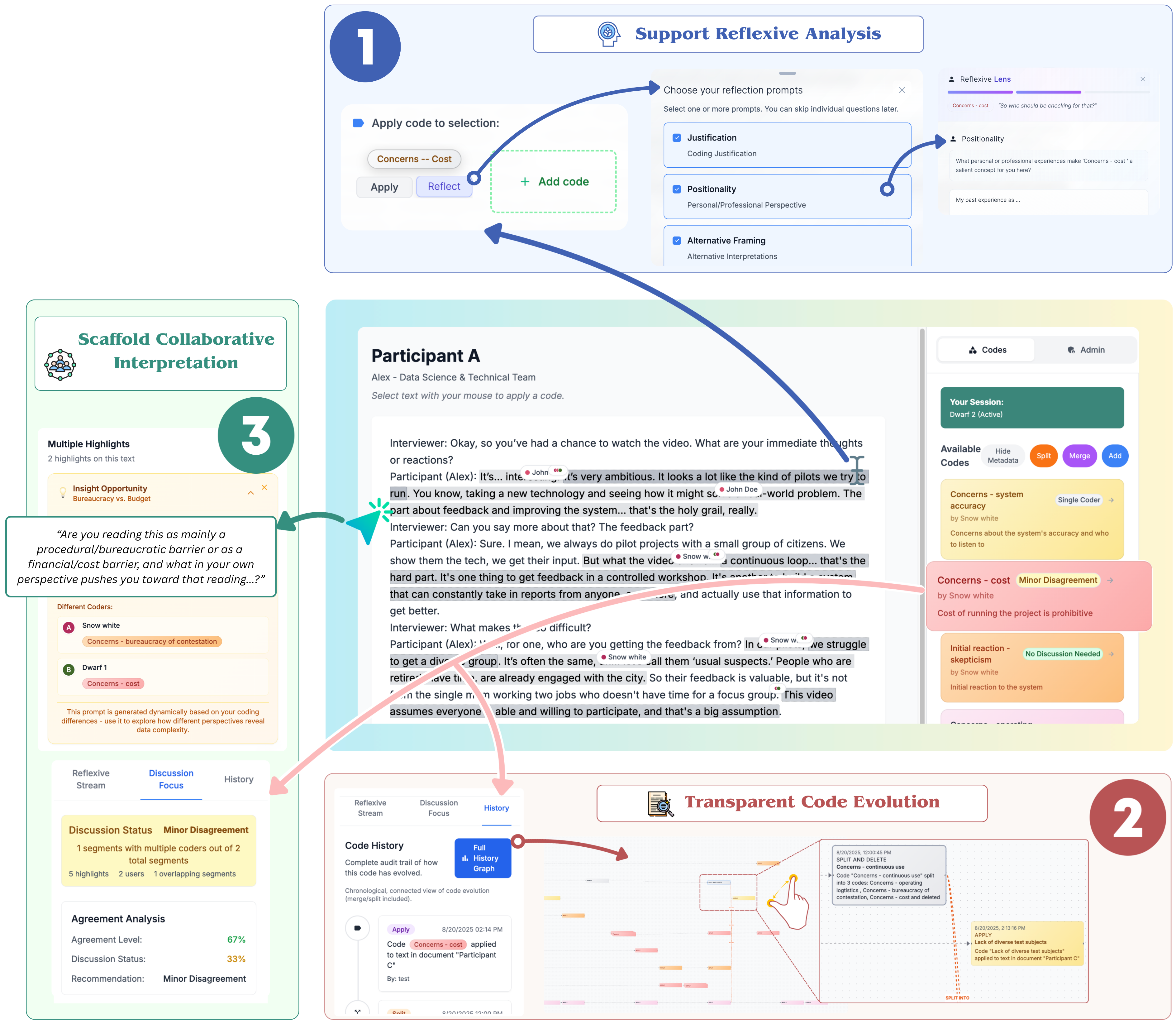
Reflexis supports reflexive thematic analysis through design for deliberation, fostering collaborative interpretation and explicitly surfacing researcher positionality.
While qualitative data analysis increasingly emphasizes rigorous reflexivity and collaborative interpretation, existing software often prioritizes efficiency over supporting these critical practices. This paper introduces ‘Reflexis: Supporting Reflexivity and Rigor in Collaborative Qualitative Analysis through Design for Deliberation’, a collaborative workspace designed to embed analytical provenance, encourage positionality awareness, and facilitate productive disagreement within the qualitative analysis workflow. Our evaluation with [latex]\mathcal{N}=12[/latex] paired analysts demonstrates that Reflexis fosters more granular reflection and reframes disputes as opportunities for deeper understanding. How might such deliberative design principles reshape the future of qualitative research and promote more transparent, robust insights?
The Challenge of Interpretation: Seeking Clarity in Qualitative Analysis
Qualitative research, while valuable for in-depth understanding, historically faces challenges in demonstrating the reasoning behind analytical decisions. The process of transforming raw data – interview transcripts, field notes, or documents – into meaningful insights often involves subjective judgments during coding and theme development. Without a documented rationale for these choices, concerns arise regarding potential researcher bias, where pre-existing assumptions or perspectives inadvertently shape the findings. This lack of transparency hinders the ability of others to critically evaluate the study’s validity, assess the trustworthiness of the interpretations, and ultimately, build upon the research with confidence. Consequently, establishing clear audit trails of interpretive choices is increasingly recognized as crucial for enhancing the rigor and credibility of qualitative analysis.
The process of transforming raw qualitative data into meaningful insights relies heavily on coding and theme development, yet these stages are inherently subjective and can inadvertently mask the analytic path. Researchers, while striving for objectivity, inevitably bring their own perspectives and preconceptions to the interpretation of textual or visual materials. This subjectivity, if not carefully addressed, can obscure how specific codes were derived, why certain themes emerged, and what alternative interpretations were considered – essentially creating a ‘black box’ effect. Consequently, rigorous evaluation by peers becomes difficult, and collaborative scrutiny – vital for ensuring the trustworthiness of findings – is hampered. Without a transparent record of this analytic journey, assessing the validity and reliability of the research becomes a significant challenge, limiting its potential impact and broader applicability.
The strength of qualitative research hinges on the trustworthiness of its interpretations, yet establishing that trustworthiness proves challenging without a documented analytic process. A lack of transparency regarding how codes were developed, how themes emerged, and how initial understandings shifted makes it difficult to evaluate the validity of the findings. This opacity hinders independent assessment, limiting the ability of other researchers to verify conclusions or build upon the work. Consequently, studies lacking a clear interpretive trail often struggle to gain widespread acceptance or exert significant influence, potentially diminishing the impact of valuable insights derived from rich, contextual data.
Reflexive Thematic Analysis: Embracing Interpretation as Construction
Reflexive Thematic Analysis (RTA) departs from traditional qualitative research approaches by explicitly recognizing that meaning is not inherent within the data itself, but is actively constructed through the researcher’s interpretive lens. This contrasts with perspectives aiming for an objective ‘truth’ or uncovering pre-existing themes; RTA instead posits that the researcher’s background, experiences, and theoretical framework inevitably shape the analytic process and the resulting themes identified. Consequently, RTA prioritizes transparency regarding the researcher’s positionality and acknowledges that multiple valid interpretations can emerge from the same dataset, each reflecting a particular analytic stance. The focus shifts from discovering a single ‘correct’ reading to understanding how meaning is created through the interaction between the data and the analyst.
Reflexive Thematic Analysis requires researchers to engage in ongoing self-reflection throughout the analytical process. This involves explicitly identifying and documenting the pre-understandings, theoretical perspectives, and personal biases that inevitably shape the interpretation of data. Analysts are prompted to articulate their epistemological stance – how they believe knowledge is constructed – and their ontological assumptions – their beliefs about the nature of reality as it pertains to the research topic. Detailed reflexive accounts often include a ‘research diary’ or similar documentation, detailing evolving interpretations and acknowledging how the researcher’s own background and experiences influence coding decisions and thematic development. This continuous articulation of subjective influences is not viewed as a flaw, but rather as a crucial component of ensuring analytical rigor and transparency.
Reflexive Thematic Analysis (RTA) prioritizes researcher subjectivity to improve analytical rigor through increased transparency and critical self-awareness. This approach moves beyond attempts at achieving value-free analysis by requiring researchers to explicitly detail their own preconceptions, theoretical orientations, and the influence of their personal experiences on the interpretive process. By openly acknowledging these subjective elements, RTA enables a clearer audit trail of analytical decisions, allowing for critical evaluation of the research and promoting a more nuanced understanding of the data. This focus on transparency extends to articulating the researcher’s positionality and how it shapes the construction of themes, ultimately fostering more critically informed and defensible analytical conclusions.
Reflexis: A Workspace Designed for Collaborative Reflexivity
Reflexis is a software environment engineered to integrate the principles of reflexivity, the documentation of analytic processes, and shared interpretation directly into qualitative data analysis. Unlike traditional qualitative data analysis software, Reflexis is not solely focused on coding; it actively supports the systematic recording of an analyst’s evolving understanding of the data. This is achieved by building features that allow for the capture of reasoning behind coding decisions, the tracking of changes to codes over time, and the facilitation of discussion among research team members throughout the analytic process. The intent is to move beyond a simple record of what was coded to a detailed account of how and why interpretations developed.
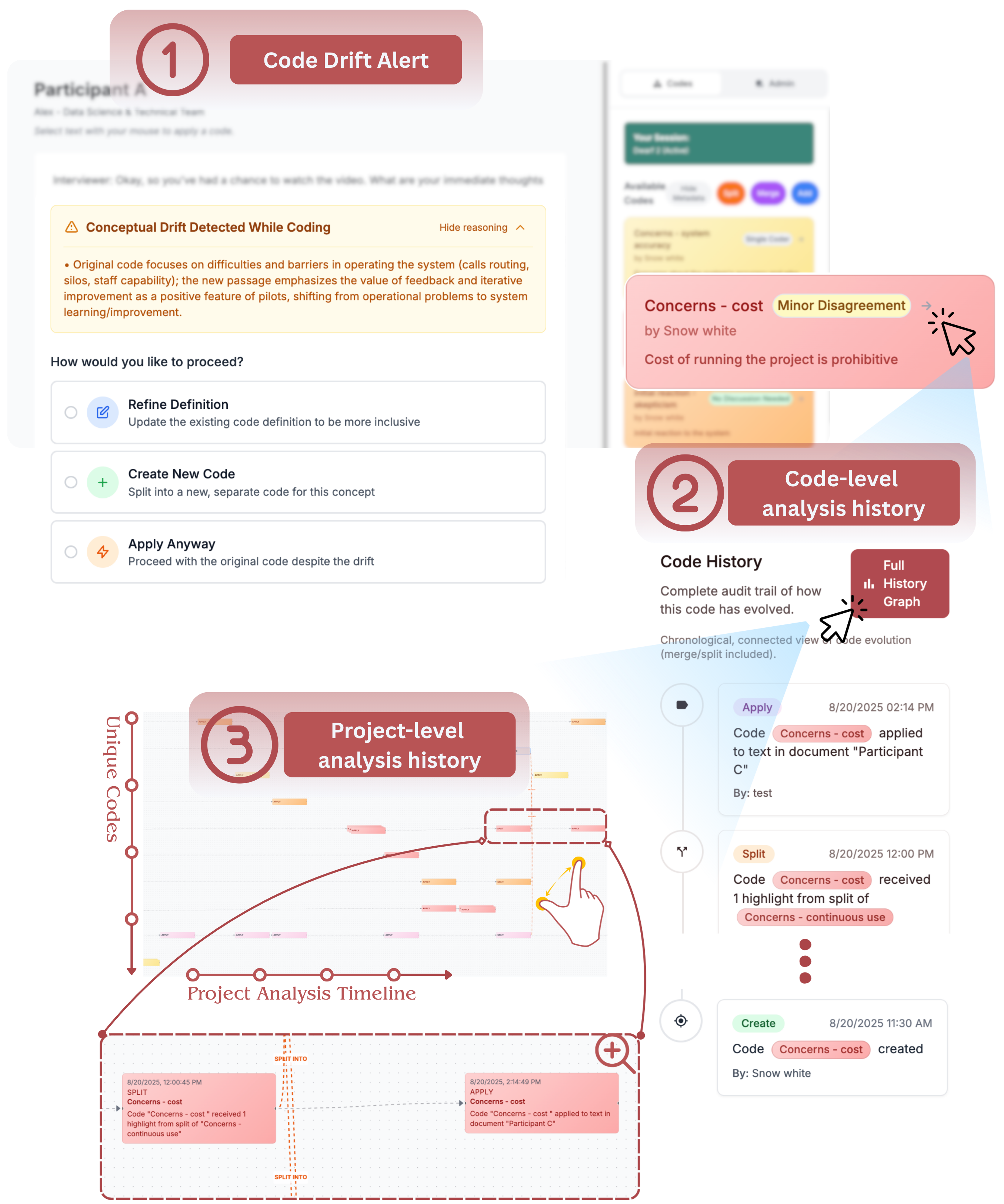
Analytical Provenance within Reflexis functions by automatically logging all modifications made to codes and interpretations throughout the qualitative data analysis process. This includes details such as the user initiating the change, the timestamp of the modification, and a specific record of what was altered – whether a code was created, redefined, applied, or removed. This detailed history allows researchers to reconstruct the analytic pathway, understand the rationale behind coding decisions, and identify potential biases or shifts in interpretation over time. The system stores this information as metadata directly linked to the data and codes, creating a verifiable and transparent audit trail of the entire analysis.
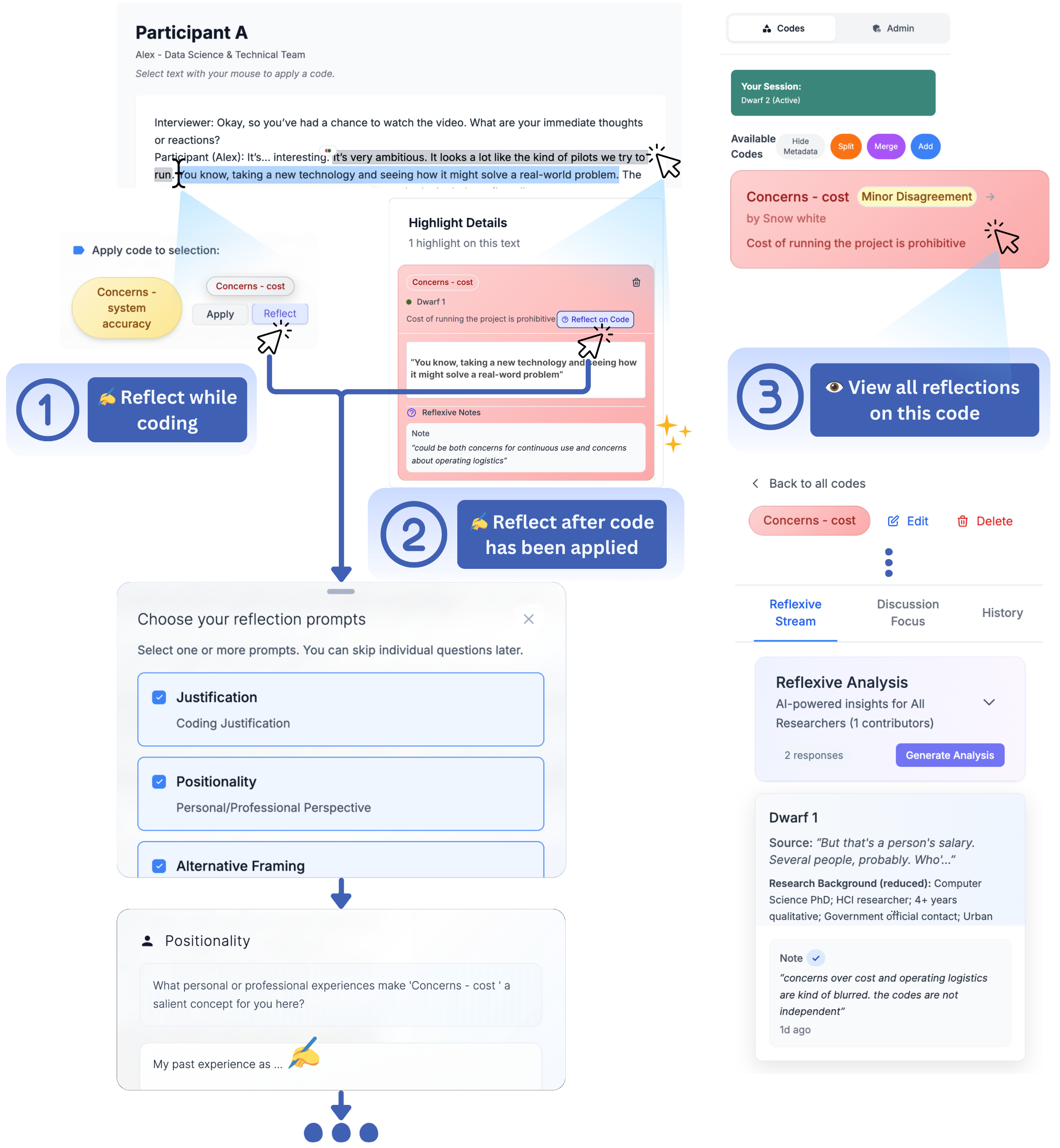
‘In-situ Reflexivity’ within Reflexis operates by integrating prompts for analyst self-reflection directly into the qualitative data coding process. These prompts appear contextually during coding, requesting analysts to document their reasoning, biases, or assumptions related to specific codes or interpretations. This functionality differs from traditional reflexive practices – typically conducted as separate journaling or memo-writing – by embedding the process within the immediate analytic workflow. The system captures these reflexive statements alongside the coded data, creating a linked record of both the analysis and the analyst’s thought process at that specific stage. This facilitates continuous self-assessment and allows for later review of how interpretations evolved, contributing to a more transparent and auditable analytic trail.
Reflexis incorporates features specifically designed to support collaborative interpretation during qualitative data analysis. These features enable researchers to engage in structured discussions directly within the platform, documenting diverse perspectives and facilitating a shared understanding of the data. User study participants reported that this functionality had the potential to improve both analytical workflow efficiency and methodological rigor when compared to conventional qualitative data analysis tools, suggesting a positive impact on team-based research projects and the transparency of interpretive processes.
Enhancing Validity Through Design for Deliberation
Reflexis fundamentally centers on the principle that robust qualitative analysis isn’t simply what is found, but how those findings are reached. The system actively supports informed decision-making throughout the analytic process by making reasoning visible and encouraging continuous evaluation of choices. Rather than treating analysis as a linear path to objective truth, Reflexis acknowledges the inherent subjectivity and interpretive work involved, prompting researchers to explicitly consider alternative coding schemes, acknowledge the influence of pre-existing assumptions, and justify analytic moves. This emphasis on ‘Design for Deliberation’ moves beyond mere documentation of choices; it fosters a dynamic environment where analytic strategies are rigorously tested, debated, and refined, ultimately strengthening the credibility and trustworthiness of the research.
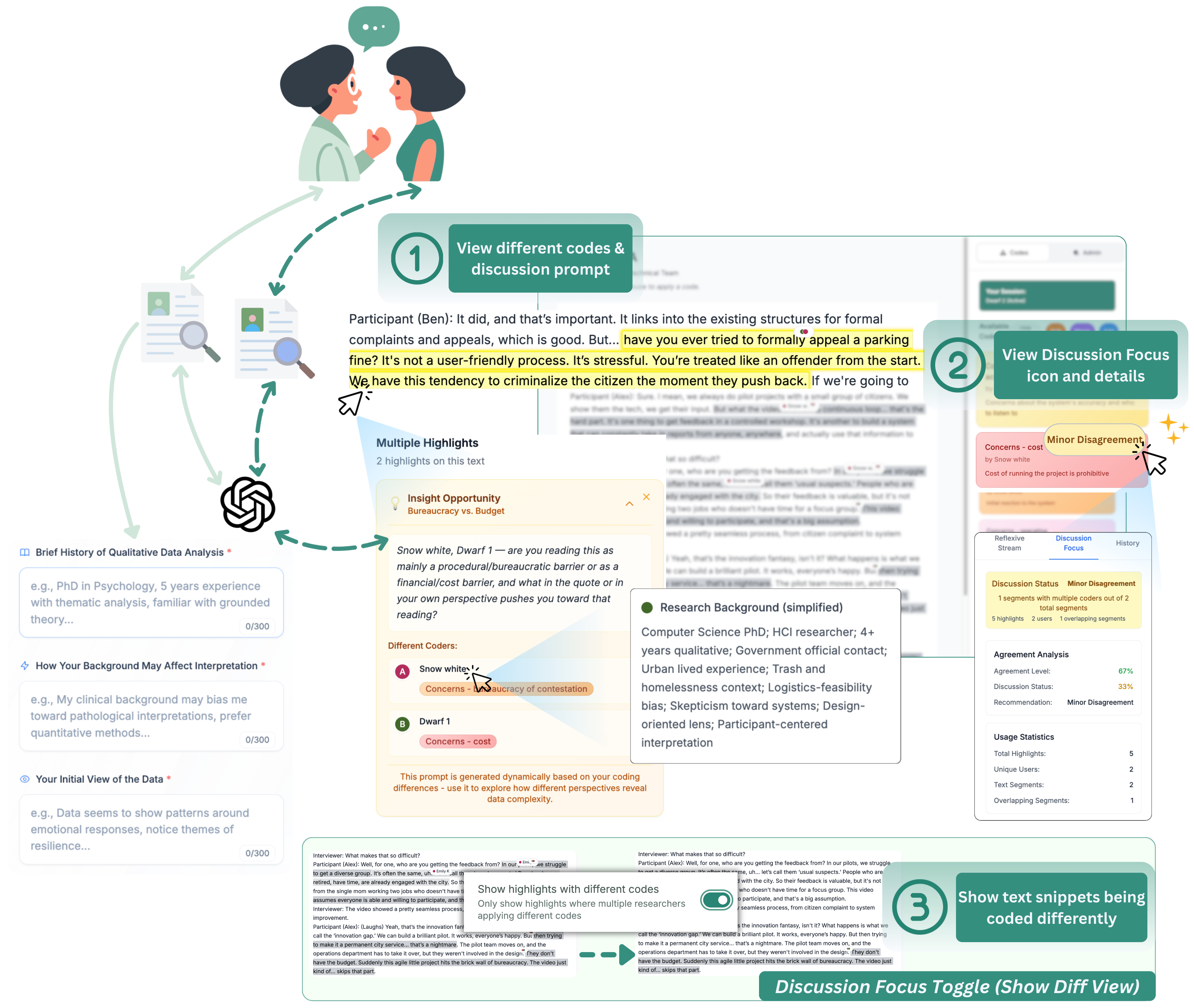
Reflexis incorporates features designed to proactively encourage critical evaluation of the analytical process. The ‘Discussion Focus’ tool centers team conversations around specific coding decisions, prompting researchers to articulate the rationale behind their interpretations and address potential ambiguities. Simultaneously, the ‘Code Drift Alert’ feature monitors coding consistency across the dataset, flagging instances where interpretations diverge and requiring clarification. This dual approach-focused discussion coupled with automated consistency checks-not only minimizes subjective bias but also fosters a more rigorous and transparent analytical workflow, ultimately strengthening the validity and reliability of qualitative findings by ensuring interpretations remain grounded in the data and consistently applied throughout the research process.
Reflexis actively fosters positionality-aware collaboration, prompting researchers to move beyond simply identifying potential biases and instead, explicitly address how their individual perspectives might shape data interpretation. The system encourages team members to articulate their own backgrounds, assumptions, and potential influences on the analytic process, creating a space for open discussion and critical self-reflection. This isn’t merely about acknowledging subjectivity; it’s about making those subjective influences transparent and systematically considering alternative interpretations arising from differing viewpoints. By integrating this practice into the collaborative workflow, Reflexis aims to mitigate the risk of unchallenged assumptions and enhance the trustworthiness of qualitative findings through a more nuanced and rigorous examination of the data.
A robust system for qualitative analysis demonstrably bolsters the validity and reliability of research outcomes. During a recent study, participants actively engaged with features designed to promote rigorous self-reflection, such as the ‘Reflexive Lens’ and ‘Code History Timeline’. These tools facilitated a deeper understanding of the analytic process and encouraged researchers to explicitly address potential biases. Notably, participants reported that features supporting principled disagreement and awareness of individual positionality were instrumental in fostering more focused and productive discussions, ultimately leading to more trustworthy and impactful qualitative findings.
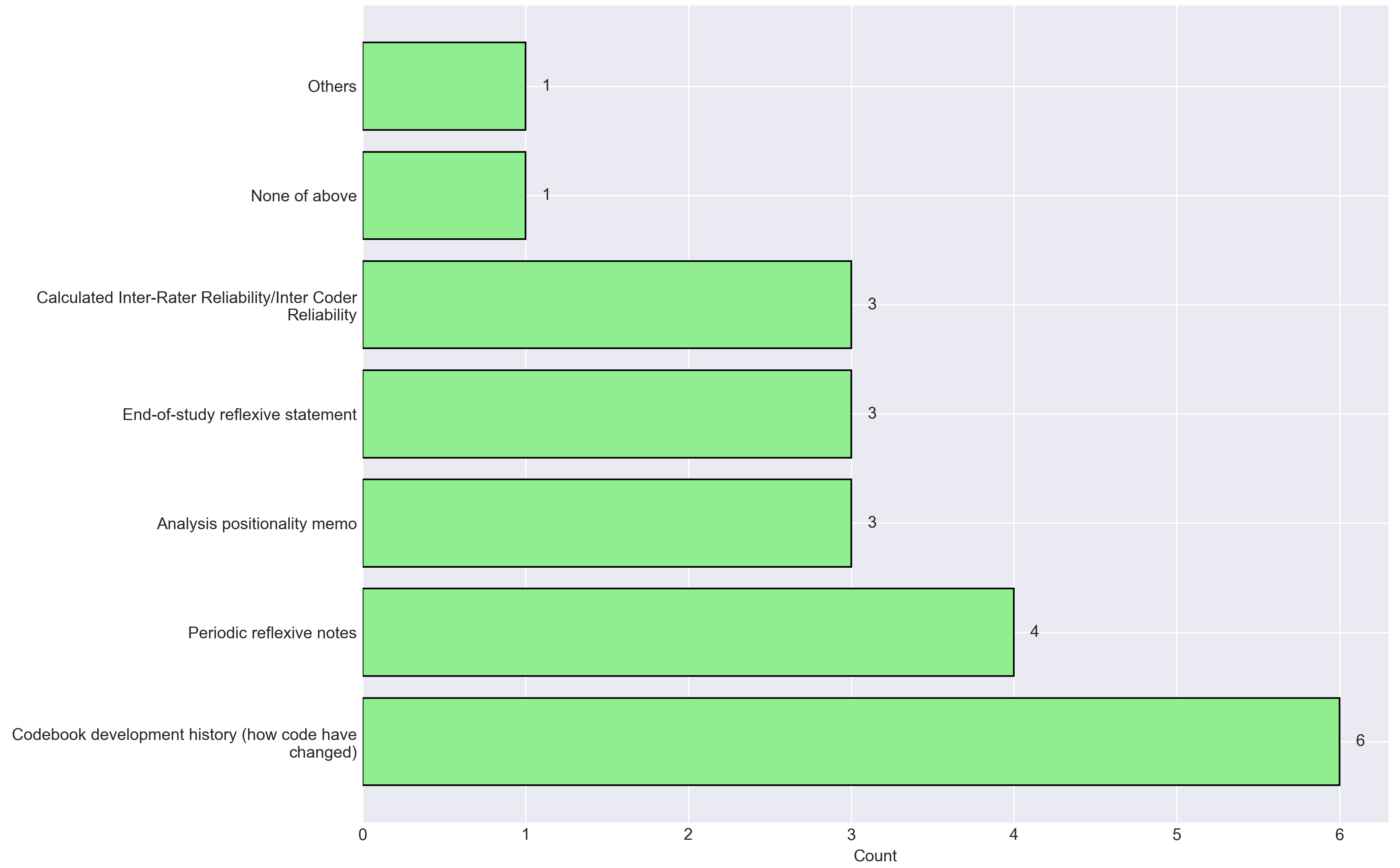
The design of Reflexis prioritizes a deliberate reduction of complexity within qualitative analysis. It isn’t about adding layers of functionality, but stripping away obstacles to clear interpretation and rigorous examination of researcher positionality. This echoes G.H. Hardy’s sentiment: “A mathematician, like a painter, is a maker of patterns of a particular kind.” Reflexis functions as a sculpting tool, revealing the essential patterns within data through deliberate design choices. By focusing on analytical provenance and collaborative interpretation-key aspects of the workspace-the system highlights what remains after superfluous elements are removed, fostering a more transparent and robust research process. The workspace doesn’t aim to do the analysis, but to facilitate a clearer view of the analyst’s journey.
What’s Next?
The pursuit of rigor in qualitative analysis often resembles an attempt to capture smoke. Tools can refine the process, but the fundamental challenge – the inescapable influence of the observer – remains. Reflexis offers a framework for acknowledging, rather than eliminating, this influence, but this is merely a beginning. Future work must address the question of sufficient reflexivity. At what point does detailed documentation of positionality yield diminishing returns, becoming performance rather than insight? The line between transparency and self-indulgence is surprisingly thin.
Furthermore, the integration of AI-assisted analysis demands careful consideration. The temptation to outsource interpretation to algorithms is strong, yet true deliberation requires a sustained engagement with the nuances of the data. The value of such tools lies not in automating insight, but in amplifying the capacity for thoughtful consideration. The challenge is to design systems that slow down analysis, prompting researchers to question assumptions rather than confirm biases.
Ultimately, the goal is not to produce ‘objective’ qualitative findings – an illusion, at best – but to cultivate a more honest account of the research process. The next iteration of this work should explore methods for evaluating the impact of deliberative design on the quality – and humility – of qualitative interpretation. Perhaps then, a little less smoke will remain.
Original article: https://arxiv.org/pdf/2601.15445.pdf
Contact the author: https://www.linkedin.com/in/avetisyan/
2026-01-25 13:29